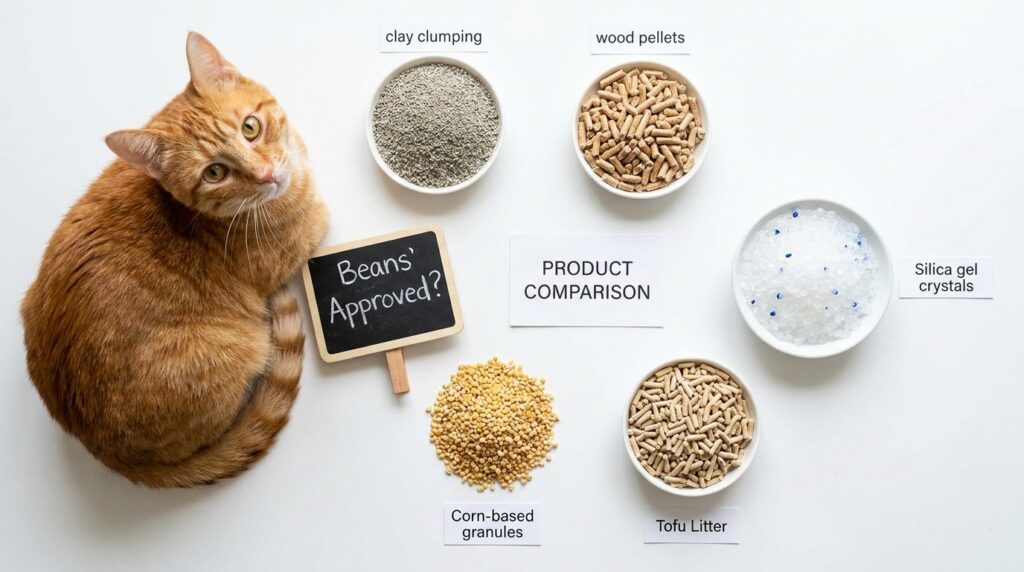
By Emma Hartley | Last updated August 18, 2026 | Reviewed by IndoorCatWell Editorial Team
This post contains affiliate links. We may earn a commission at no extra cost to you if you purchase through these links. Read our full Affiliate Disclosure.
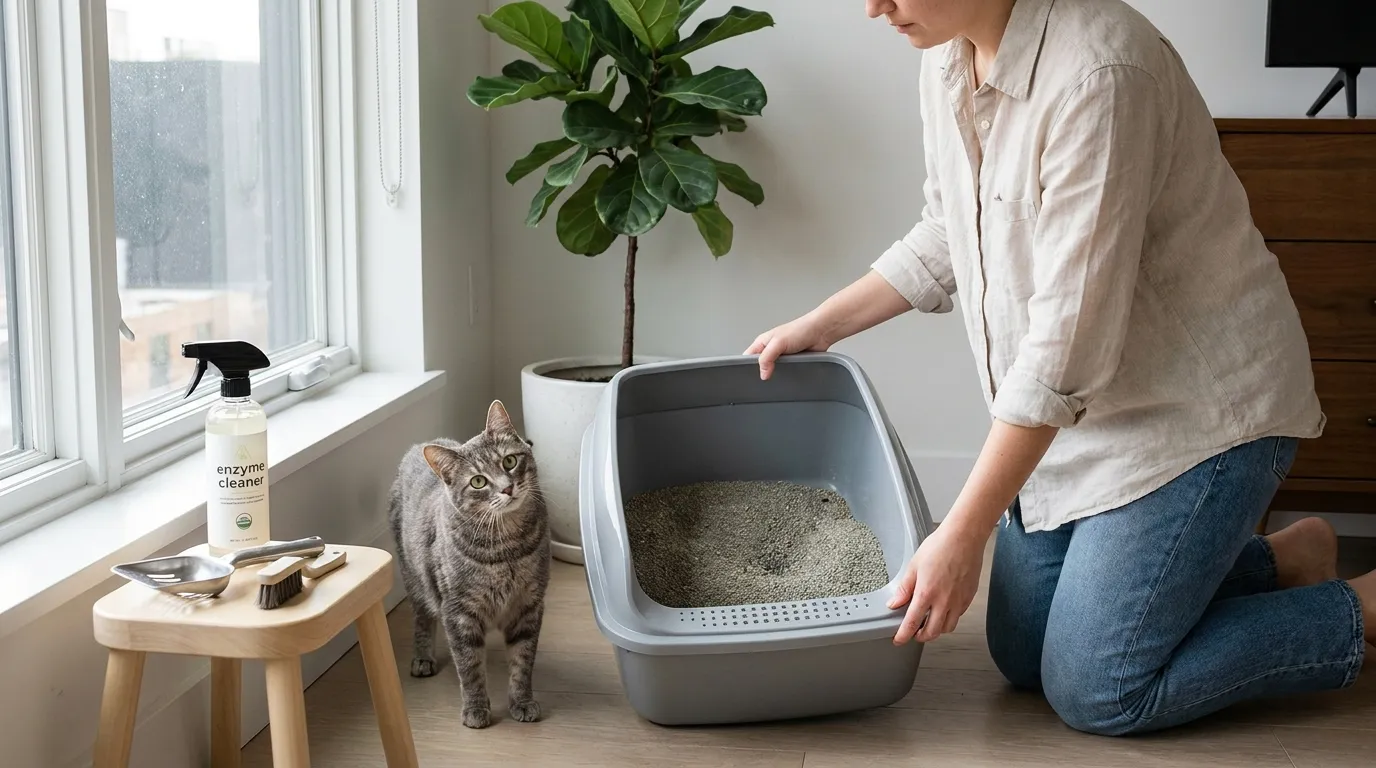
⚡ Quick Answer: Best Cat Litter for Odor Control
For most households, a good unscented clumping litter is the strongest overall choice for odor control because urine and feces can be removed rather than left sitting in the box. Crystal litter is a strong alternative for owners who prioritize lightweight handling and long-lasting moisture absorption. Multi-cat households should prioritize strong odor-sealing/clumping performance and a litter that can handle heavier waste loads.
- Best Overall: Dr. Elsey’s Ultra (Unscented, firm clumping, low dust)
- Best for Multi-Cat Homes: Arm & Hammer Clump & Seal (Odor-sealing technology, hard clumps)
- Best Crystal Litter: Fresh Step Crystals (Long-lasting silica absorption, lightweight)
- Best Low-Dust Option: Tidy Cats Free & Clean (Activated charcoal, unscented)
- Best Natural Option: ökocat Natural Wood (Reclaimed wood fiber, biodegradable)
- Best Budget Option: Scoop Away Unscented (Economical daily clumping clay)
- Best for Texture-Sensitive Cats: Dr. Elsey’s Sensitive (Fine-grain gentle texture, low dust)
🎯 Who Should Use This Guide?
This guide is for cat owners dealing with litter-box odor, ammonia smell, frequent scooping, tracking, or litter that stops controlling odor after a few days. It covers both clumping and crystal litter because the best option depends on how many cats you have, how often you scoop, your cat’s texture preference, and how much maintenance you want to do.
📌 Table of Contents
- How We Evaluated These Litters
- Full Comparison Table
- Odor-Control Decision Tool
- How to Choose Cat Litter for Odor Control
- 7 Best Cat Litters for Odor Control (Detailed Reviews)
- Clumping vs. Crystal: Which Controls Odor Better?
- Best Crystal Cat Litter for Odor Control
- Best Cat Litter for Multi-Cat Homes
- Is Unscented Cat Litter Better for Odor Control?
- Best Low-Dust Cat Litter
- Best Litter by Situation
- Why Does Cat Litter Smell? (7 Root Causes)
- How to Stop Cat Litter Smell (Practical Hierarchy)
- How Often Should You Change Cat Litter?
- How to Reduce Litter Tracking
- When Litter-Box Odor Could Mean a Health Problem
- Frequently Asked Questions
- Why Trust IndoorCatWell? & How We Keep This Guide Updated
How We Evaluated These Litters
We compared each litter by odor-control approach, clumping or absorption performance, dust, tracking, multi-cat suitability, maintenance requirements, and value. Product specifications and odor-control claims were checked against manufacturer information, while recommendations are based on the features that matter most for controlling litter-box odor in everyday homes. Where we have first-hand experience, we identify it clearly rather than presenting manufacturer claims as our own test results.
| Evaluation Factor | Evaluation Weight |
|---|---|
| Odor Control Mechanism & Longevity | 30% |
| Clumping Hardness / Moisture Absorption | 20% |
| Multi-Cat Performance & Capacity | 15% |
| Dust Level on Pouring & Digging | 10% |
| Tracking & Granule Scatter | 10% |
| Ease of Daily Maintenance | 10% |
| Cost & Overall Value | 5% |
Comparison Table: Best Cat Litters for Odor Control
| Product | Type | Odor Control | Multi-Cat | Dust | Tracking | Clumping | Best For |
|---|---|---|---|---|---|---|---|
| Dr. Elsey’s Ultra | Clay | Excellent | Excellent | Low | Low–Moderate | Excellent | Overall Odor Control |
| Arm & Hammer Clump & Seal | Clay | Excellent | Excellent | Low* | Moderate | Excellent | Multi-Cat Homes |
| Fresh Step Crystals | Silica Gel | Excellent | Good* | Low | Low | Non-clumping | Long-Lasting Freshness |
| Tidy Cats Free & Clean | Clay | Excellent | Excellent | Low | Low–Moderate | Excellent | Unscented / Low Dust |
| ökocat Natural Wood | Wood | Good | Good | Low | Moderate | Good | Natural Plant Material |
| Scoop Away Unscented | Clay | Good | Good | Moderate | Moderate | Good | Budget Pick |
| Dr. Elsey’s Sensitive | Clay | Good–Excellent | Good | Low | Moderate | Excellent | Texture-Sensitive Cats |
🧭 Odor-Control Decision Tool
Follow this quick step-by-step logic to identify the ideal litter type for your home:
➡️ YES: Prioritize hard-clumping multi-cat clay (Arm & Hammer Clump & Seal or Dr. Elsey’s Ultra).
➡️ NO: Proceed to Step 2.
➡️ YES: Consider silica gel crystal litter (Fresh Step Crystals).
➡️ NO: Proceed to Step 3.
➡️ YES: Choose fine-grain gentle clumping clay (Dr. Elsey’s Sensitive).
➡️ NO: Proceed to Step 4.
➡️ YES: Choose Tidy Cats Free & Clean or Dr. Elsey’s Ultra.
How to Choose Cat Litter for Odor Control
Choose clumping clay if:
- You want easy, complete removal of urine clumps every day.
- You live in a multi-cat household with higher daily urine volume.
- You maintain a disciplined daily scooping routine.
- Cost-per-pound and upfront affordability are top priorities.
Choose crystal (silica gel) if:
- You want a lightweight litter that is easy to carry and pour.
- You prefer longer intervals between full box replacements for a single cat.
- Your cat readily accepts the firm, granule texture underfoot.
- You want near-zero airborne dust during box maintenance.
Choose natural / wood litter if:
- Renewable, plant-based, or biodegradable materials are a core priority.
- You want natural timber scents rather than synthetic masking perfumes.
- You are comfortable with slightly softer clumps compared to dense sodium bentonite.
7 Best Cat Litters for Odor Control (Detailed Reviews)
1. Dr. Elsey’s Ultra — Best Overall

Why We Picked It
Dr. Elsey’s Ultra uses natural bentonite clay, hard clumping action, and an unscented formula. The manufacturer describes it as 99% dust-free, low-tracking, and suitable for multi-cat households. Its main advantage for odor control is the combination of firm clumps and frequent waste removal, rather than relying on perfume to mask odor.
Why we like it: Strong clumping makes it easier to remove urine-soaked litter completely, preventing wet clay from sticking to box corners and degrading into ammonia over time.
Main drawback: It is a conventional heavy clay litter, so it is not the right choice if your priority is lightweight handling or biodegradable disposal.
Odor-Control Mechanism
Dense sodium bentonite particles quickly encapsulate liquid on contact, forming compact solid clumps that prevent urine from seeping down to the plastic floor of the box. Daily scooping eliminates the odor source completely.
- Completely fragrance-free (hypoallergenic for sensitive feline noses)
- Consistently hard clumping that doesn’t crumble upon scooping
- Low airborne dust during pouring
- Suitable for single and multi-cat setups
- Heavy 40-lb bags require physical effort to lift
- Conventional clay (non-biodegradable)
- Some granule tracking around high-traffic boxes
Best for: Owners who prioritize strong clumping and odor control over lightweight handling.
Skip it if: You specifically want a biodegradable or crystal litter.
2. Arm & Hammer Clump & Seal — Best for Multi-Cat Homes

Why We Picked It
Arm & Hammer Clump & Seal is particularly relevant for multi-cat homes because its formula is designed around odor sealing and hard clumping. The manufacturer says its Clump & Seal technology forms hard urine clumps and uses odor-control ingredients including baking soda.
For a multi-cat household, the main advantage is straightforward: faster removal of urine and feces means fewer odor sources remaining in the box. The tradeoff is that some formulas are scented, so check the exact version before buying if your cat prefers unscented litter.
Odor-Control Mechanism
Micro-granules form an airtight seal around waste on contact while integrated sodium bicarbonate (baking soda) neutralizes acidic urine compounds chemically at the point of contact.
- Exceptional ammonia suppression in high-frequency multi-cat boxes
- Rapid, rock-hard clumping prevents clump breakdown during scooping
- Smooth, sand-like texture cats generally accept readily
- Certain product lines feature strong added fragrances (look for “Unscented”)
- Finer particle size tracks slightly more than coarse clay
Best for: Multi-cat households needing maximum ammonia containment and fast-forming clumps.
Skip it if: Your household requires strictly zero fragrances and you accidentally pick up the scented box.
3. Fresh Step Crystals — Best Crystal Litter
Why We Picked It
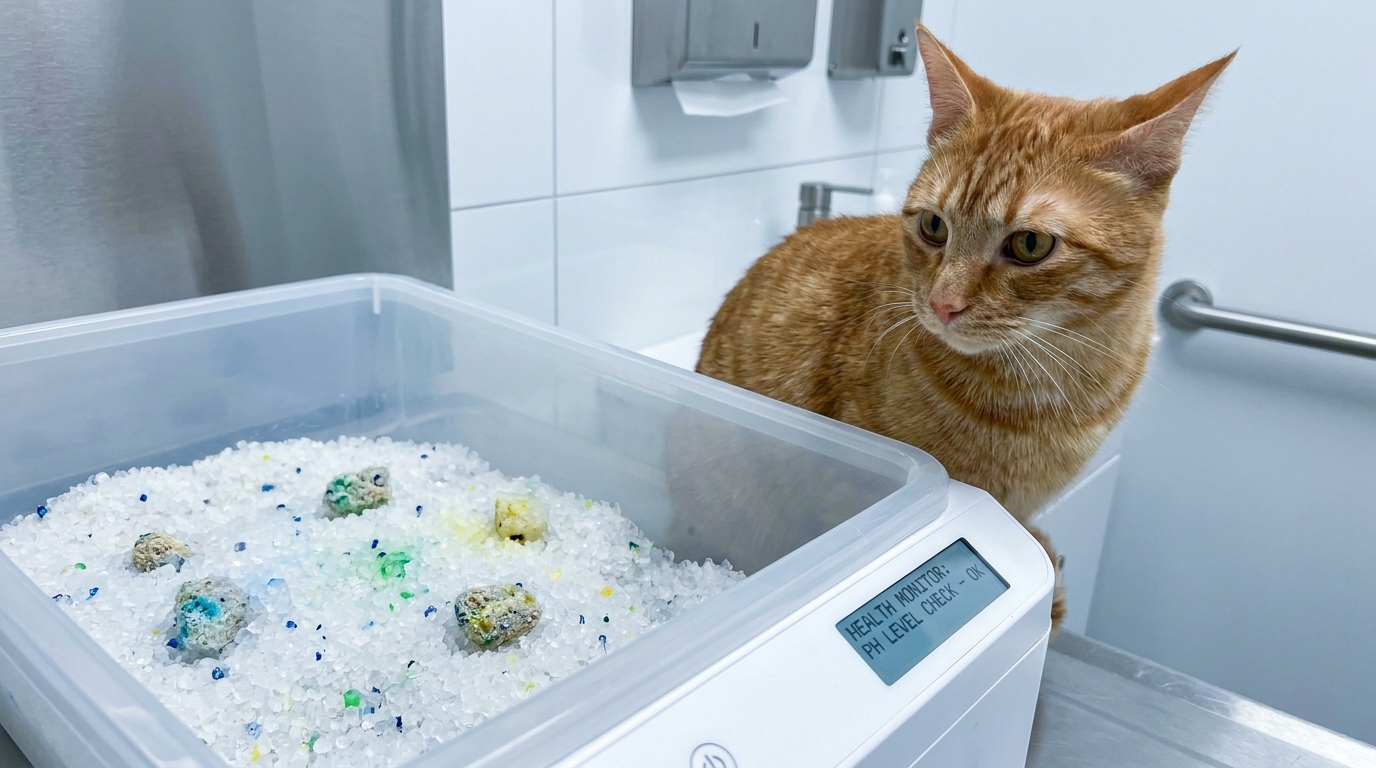
Current Fresh Step product information specifically describes its crystal litter as lightweight, low-dust, and designed for long-lasting odor control. Its Clean Care Crystal product advertises 30-day odor control per cat and provides usage guidance to scoop solid waste and stir crystals daily.
Unlike clumping clay, crystal litter does not form removable urine balls. Instead, urine is absorbed throughout the silica pores while moisture gradually evaporates, leaving odor compounds trapped. It represents a significantly lighter alternative to heavy clay bags.
Odor-Control Mechanism
Porous silica gel beads absorb liquid rapidly. Moisture evaporates while odor-causing molecules remain locked within the porous crystalline matrix. Solid feces are scooped out daily.
- Ultra-lightweight (roughly one-third the weight of clay)
- Virtually dust-free pouring and maintenance
- Long duration between full box replacements for single-cat homes
- Minimal tracking due to larger crystal particle size
- Higher monthly cost per pound than standard clay
- Requires daily stirring to prevent urine pooling at the bottom
- Some cats dislike the firm, crunchy texture under sensitive paws
Best for: Single-cat owners seeking lightweight litter and long replacement intervals.
Skip it if: Your cat rejects hard crystal textures or you have multiple cats without additional boxes.
4. Tidy Cats Free & Clean — Best Low-Dust Option
Why We Picked It
Purina markets Tidy Cats Free & Clean as 99.9% dust-free, unscented, and free of added fragrances and dyes. The formula incorporates activated charcoal for odor absorption and carries a 10-day odor-control guarantee when used as directed.
Activated charcoal is a recognized, porous carbon medium that physically adsorbs volatile organic compounds and ammonia odors rather than attempting to overpower them with artificial floral scents.
Odor-Control Mechanism
Activated carbon granules embedded throughout the clay trap sulfur and ammonia gas molecules, while bentonite clay forms tight clumps around liquid waste for daily removal.
- Activated charcoal provides genuine odor adsorption
- Zero artificial fragrances or color dyes
- Consistently low dust output during pouring
- Tight, scoopable clumping
- Standard clay weight
- Charcoal specks can leave minor dark dust marks on white box plastics over time
Best for: Cats and owners sensitive to perfume, dyes, and airborne litter dust.
Skip it if: You want a natural wood or flushable alternative.
5. ökocat Natural Wood Clumping — Best Natural Option
Why We Picked It
Made from precision-cut reclaimed wood and timber fiber, ökocat provides a plant-based alternative to mined sodium bentonite clay. The manufacturer states that the naturally porous structure of wood fibers suppresses enzymes that create ammonia odor without chemical additives.
It offers significant weight savings over traditional clay bags and is completely biodegradable. Clumps form reasonably well, though they are somewhat softer than clay and benefit from gentle scooping technique.
Odor-Control Mechanism
Capillary wood fibers absorb liquid on contact and bind ammonia compounds naturally, while releasing a subtle, clean natural pine and timber scent.
- 100% biodegradable and renewable reclaimed wood materials
- Significantly lighter than clay bags of equivalent volume
- Natural timber aroma without synthetic fragrances
- Low airborne dust
- Clumps are softer than rock-hard bentonite clay
- Wood particles are lightweight and can track if not paired with a mat
Best for: Environmentally conscious owners wanting a biodegradable plant-based clumping litter.
Skip it if: You demand rock-hard clumps that never break apart under heavy scooper pressure.
6. Scoop Away Unscented — Best Budget Option
Why We Picked It
For cat owners managing multiple litter boxes on a strict budget, Scoop Away Unscented delivers reliable clumping performance at a lower price point per pound. It contains no added perfumes and forms functional clumps when maintained with daily scooping.
While dust levels and tracking are moderate compared to premium low-dust options, it provides dependable odor containment when paired with appropriate litter depth.
Odor-Control Mechanism
Standard sodium bentonite clay clumps around liquid waste, allowing prompt daily removal to keep the remaining litter volume clean.
- Economical price point for high-volume use
- Dependable clumping for daily removal
- Unscented formula avoids chemical perfume smells
- Moderate dust output when pouring from the box
- Clumps may crumble slightly if scooped before fully dry
Best for: Budget-conscious owners who maintain a consistent daily scooping habit.
Skip it if: You require ultra-low dust for cats with diagnosed respiratory sensitivities.
7. Dr. Elsey’s Sensitive — Best for Texture-Sensitive Cats
Why We Picked It
Dr. Elsey’s Sensitive (formerly Precious Cat Touch of Outdoors/Sensitive) features a fine-grain, softer clay particle profile designed for cats with paw sensitivity, senior cats with arthritis, or felines that reject coarse, jagged litter textures.
It maintains strong unscented clumping performance and low dust levels without sacrificing odor containment, ensuring gentle tactile comfort for the cat while preventing box avoidance.
Odor-Control Mechanism
Fine-mesh sodium bentonite particles create a rapid barrier around moisture, forming tight surface clumps that keep odor locked inside the substrate.
- Ultra-fine, soft texture gentle on sensitive paws
- Unscented formula encourages consistent box use
- Firm clumping and low airborne dust
- Finer particles track more easily and benefit from a textured mat
- Slightly more expensive than standard clay formulas
Best for: Cats that hesitate or avoid the litter box due to coarse litter textures.
Skip it if: You want a heavy, large-granule litter that minimizes tracking without mats.
Why Trust IndoorCatWell?
IndoorCatWell focuses on practical indoor-cat care, including litter boxes, nutrition, enrichment, and everyday wellness. Our product comparisons are designed around the factors that matter to indoor-cat households: odor control, maintenance, tracking, dust, comfort, and value.
When we personally test a product, we identify the test conditions and show our own photographs. When information comes from a manufacturer, we label it as manufacturer-provided information rather than presenting it as our own testing.
How We Keep This Guide Updated
We review this guide when products change formulas, new litter products become widely available, or reliable product information changes. Product claims are checked against current manufacturer information where possible. Prices and availability can change, so we recommend checking the retailer before purchasing.
🐾 Explore More Litter Care & Health Resources
Discover more tested litter box solutions and indoor cat care guides: