If you’re in a hurry
Beans was drinking from his water bowl twice a day. After I switched him to a ceramic fountain he drinks five or six times daily and walks straight to it every time — no hesitation, no sniffing around first, just straight to it.
The fountain that did that: the Pioneer Pet Raindrop Ceramic. Dark marble finish. Completely silent. Three weeks in and I’d buy it again without thinking twice.
That’s the short version. Below is the full 14-day breakdown — including the one I’d tell you to avoid entirely.
Quick picks at a glance:
- Best overall: Pioneer Pet Raindrop Ceramic (~$85)
- Best for two cats: PetSafe Drinkwell Pagoda (~$90)
- Best budget ceramic: iPettie Tritone (~$68)
- Best if hygiene is your priority: Hepper Stainless Steel (~$30)
- Skip entirely: Catit Flower Fountain (plastic)
Comparison table
| Fountain | Material | Capacity | Noise | Price | My verdict |
|---|---|---|---|---|---|
| Pioneer Pet Raindrop | Stainless steel | 60oz | Silent | ~$85 | Best overall |
| PetSafe Drinkwell Pagoda | Ceramic | 70oz | Near silent | ~$90 | Best for 2 cats |
| iPettie Tritone | Ceramic | 71oz | Near silent | ~$68 | Best budget pick |
| Hepper Steel | Stainless steel | 67oz | Slight hum | ~$30 | Best single cat |
| Catit Flower | Plastic | 100oz | Faint hum | ~$30 | Don’t bother |
Why I even started doing this
Beans was drinking less than I wanted him to. Not worryingly little — he wasn’t dehydrated — but young male cats are statistically more prone to urinary blockages than almost any other cat group, and chronic low water intake is the main driver. I wasn’t waiting for a vet visit to confirm something I could prevent.
I’d read enough on the Cornell Feline Health Center website to know that moving water encourages cats to drink. Not because fountains are magic — because cats evolved reading still water as potentially unsafe. A moving stream reads as fresh. That’s not a marketing claim, it’s just how their instincts work.
So I bought a fountain. It worked. Then I bought five more to find out which ones actually hold up.
The one I kept: Pioneer Pet Raindrop
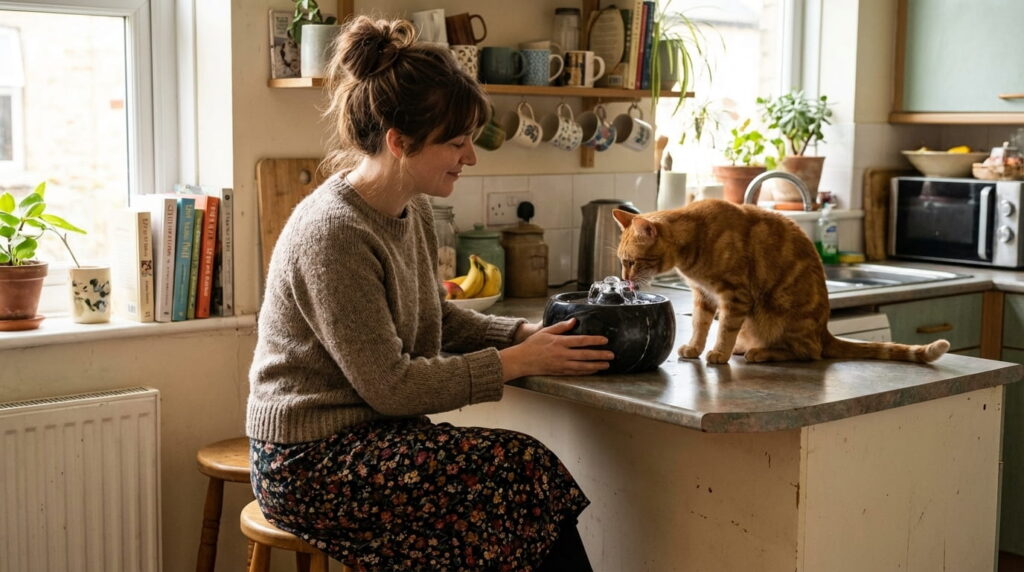
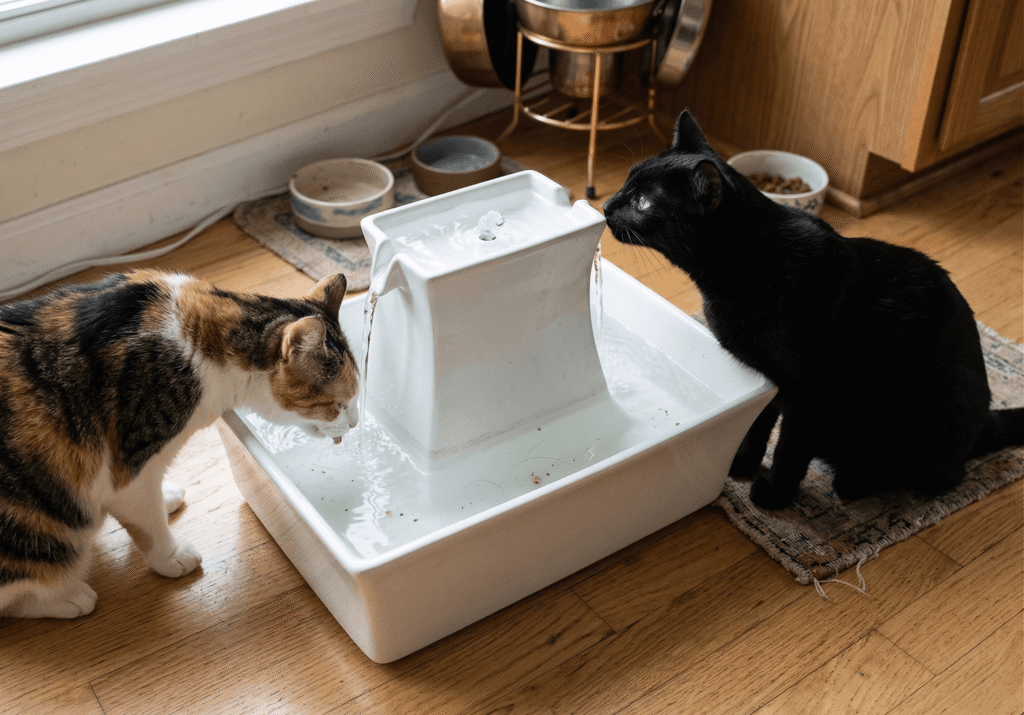
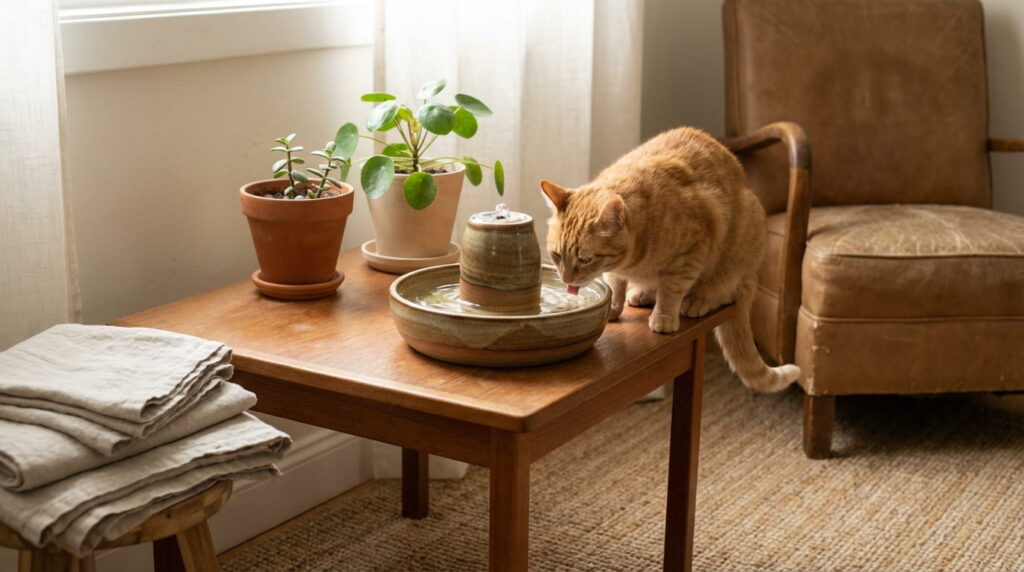
This is the Pioneer Pet Raindrop fountain sitting on my kitchen counter right now. Medium size. Two drinking positions — a top stream and a wider lower bowl. The pump runs so quietly that for the first two days I kept checking it was actually on.
Here’s what I tracked with Beans over 14 days:
Day 1: Approached within three hours of setup. Sniffed the rim. Drank from the lower bowl. Days 2-3: Four visits daily. Started alternating between the top stream and the bottom. Days 4-14: Settled at five to six visits. Walks straight to it now — confident, no circling.
Three weeks in and the pattern hasn’t changed.
What works: The ceramic stays noticeably cool. Cats prefer cooler water and I think this matters more than people give it credit for. The dark marble finish looks like it belongs in a kitchen rather than a pet shop. And that pump — genuinely silent. I’ve had plastic fountains that hummed loud enough to hear from across the room. This one makes no sound I can detect.
What doesn’t: The lower bowl is on the shallow side. If you have a flat-faced breed — Persian, British Shorthair, anything with a compressed face — reach matters and this one might frustrate them. Cleaning takes full disassembly once a week, about ten minutes. It’s not difficult but it’s not fast either.
Best for: Single cats or pairs. Owners who want something that doesn’t look like a pet product on the kitchen counter. Cats sensitive to pump noise.
Avoid if: You have three or more cats — the 60oz fills up fast with multiple drinkers and you’ll be topping it up daily. Or if your cat has a flat face.
PetSafe Drinkwell Pagoda Ceramic
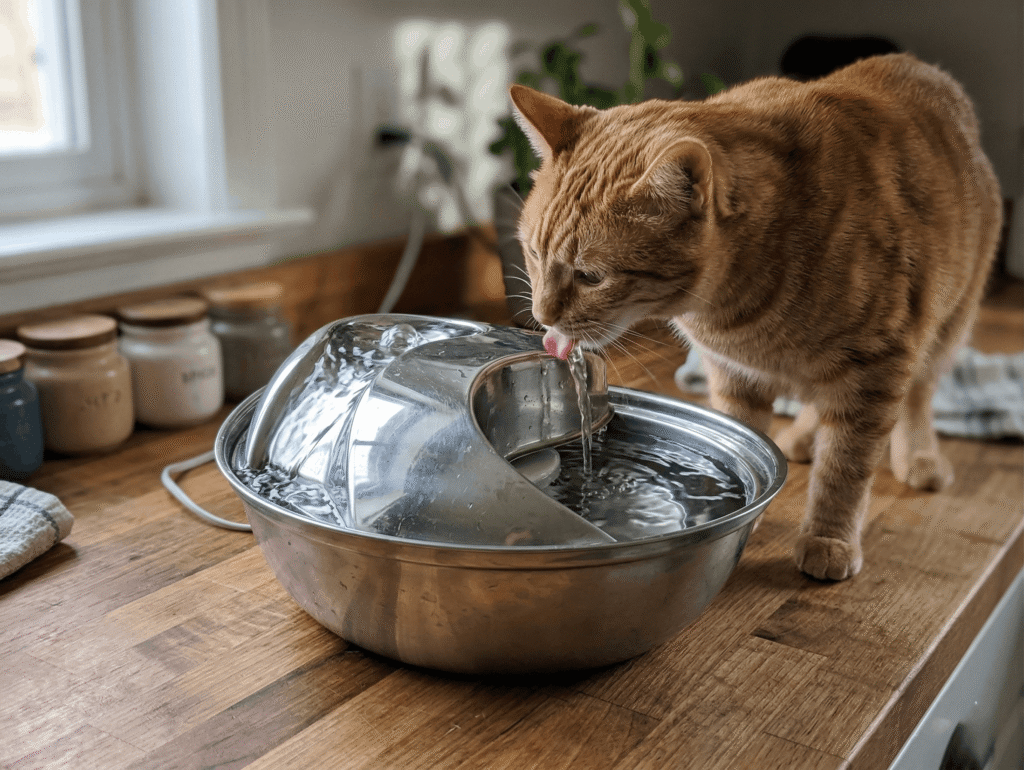
The PetSafe Drinkwell Pagoda is probably the most recognised ceramic fountain on the market. 70oz capacity, two streams, upper basin and lower bowl, and a dual-filter system that genuinely outperforms the Raindrop’s single filter after about day 7 — the water stays visibly cleaner for longer.
The lower basin is cramped. That’s the main thing. Smaller cats manage fine. A larger breed — Maine Coon, Ragdoll — would probably find it awkward. There are also eight interior corners to scrub during cleaning, which adds time compared to the Raindrop’s simpler shape.
I’d choose this over the Raindrop if I had two cats. The capacity makes more sense at that scale, and the dual filter justifies the extra cleaning time.
Best for: Two-cat households. Owners who want longer between filter replacements.
Avoid if: You have a large breed cat. Or you hate cleaning corners — and there are a lot of them.
iPettie Tritone Ceramic
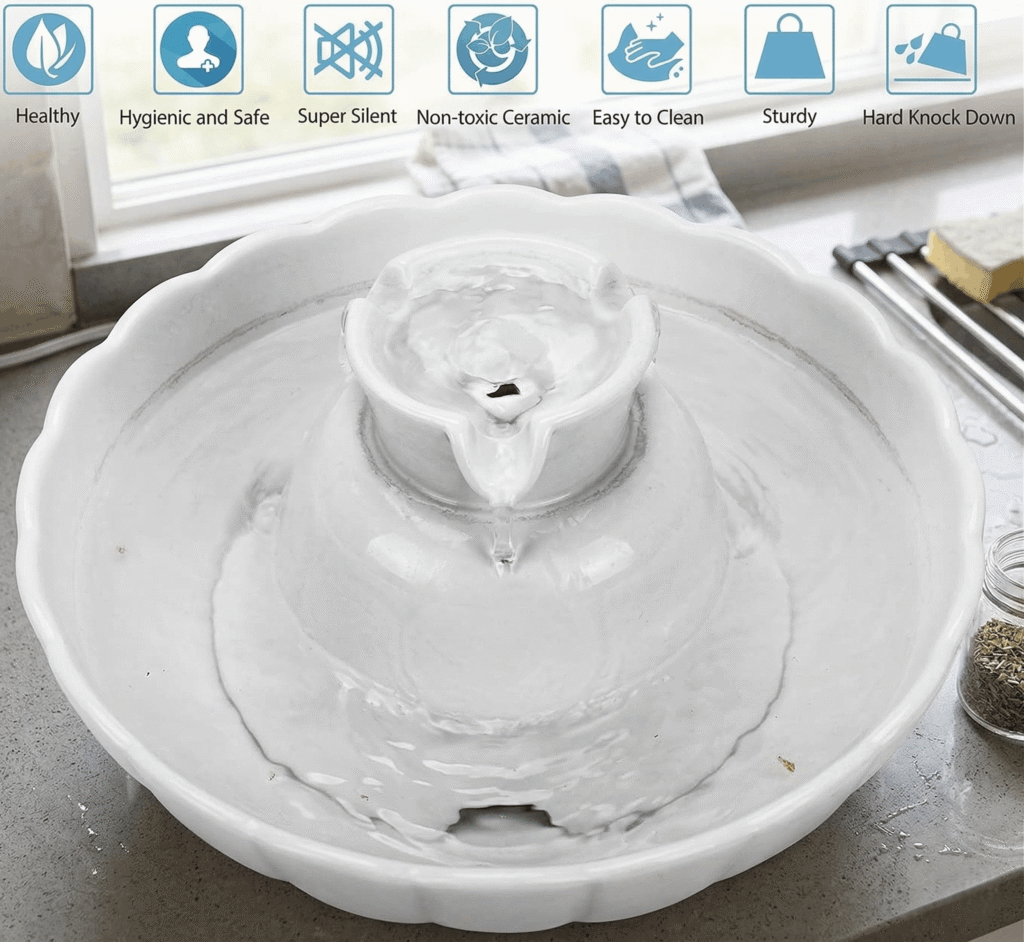
The iPettie Tritone is white ceramic, 71oz capacity, dishwasher safe. This is the one I’d recommend if budget is the main factor and you’re not willing to compromise on material.
The pump is quiet. The filtration is decent. The dishwasher compatibility makes weekly cleaning faster than either of the previous two — pull it apart, run it through, done in an hour.
The problem is the white finish. It shows limescale and water marks within days in a hard water area. It’s not a hygiene issue — it’s a visual one — but if you live somewhere with hard tap water you’ll be wiping it down every couple of days just to keep it looking clean.
Best for: Budget-conscious buyers who want ceramic without overpaying. Single cats.
Avoid if: You live in a hard water area and care how it looks on the counter.
Hepper Stainless Steel Fountain
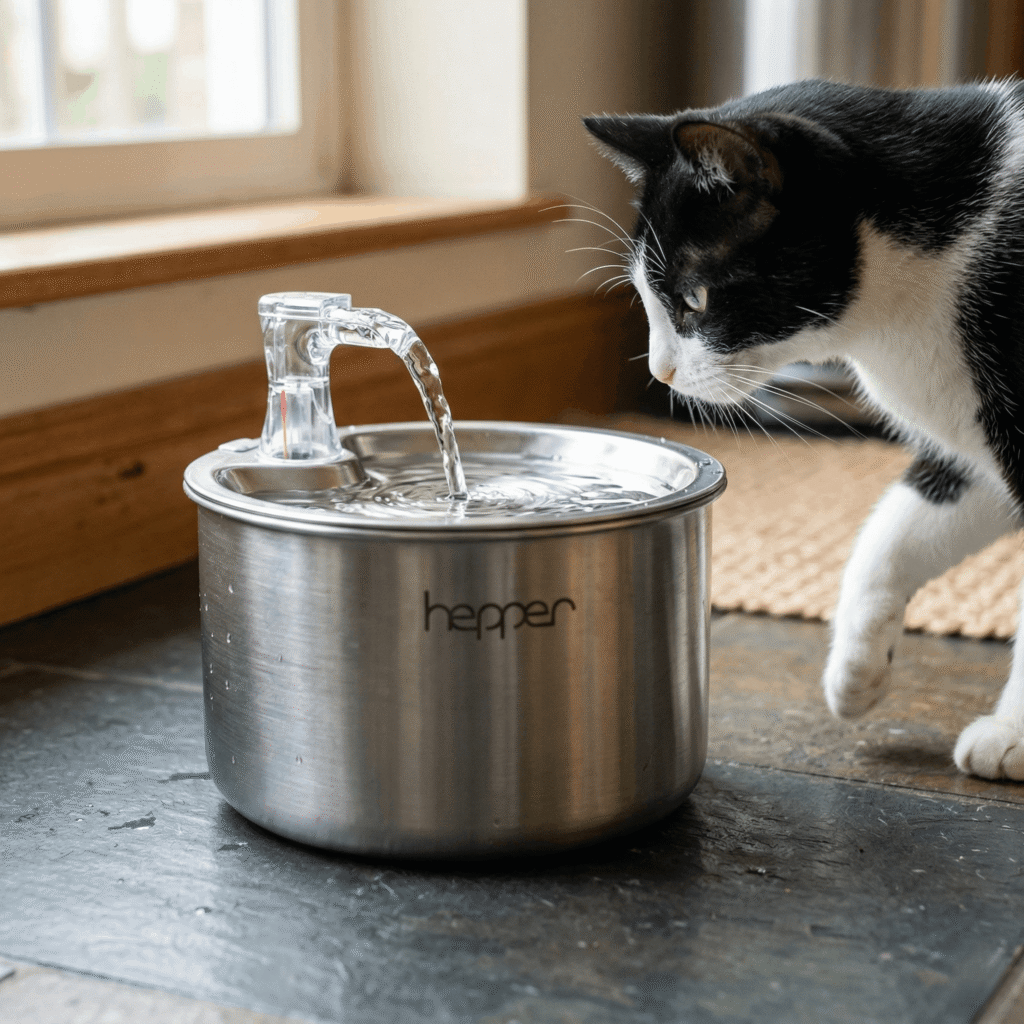
I included hepper stainless steel fountain because vets consistently recommend stainless steel as the most hygienic drinking surface available. It resists bacteria better than ceramic. It doesn’t absorb anything. And if your cat has had chin acne from a plastic fountain — which is more common than people realise — stainless is the correct fix, not just a different plastic.
The tradeoff is noise. Water hitting stainless steel is louder than water hitting ceramic. It’s not loud — a slight hum rather than a rumble — but if you have a skittish cat who took weeks to accept their current bowl, that extra sound might slow things down.
It also costs more than comparable ceramic models. Whether that’s worth it depends on your cat’s history. For a cat with no known sensitivities, ceramic is fine. For a cat recovering from chin acne or one with a history of urinary issues, I’d spend the extra and go stainless.
Best for: Cats with chin acne history. Multi-cat households where hygiene between deep cleans matters most.
Avoid if: You have a noise-sensitive cat. Or you prefer the warmer look of ceramic in your home.
Catit Flower Fountain — why I’d skip it
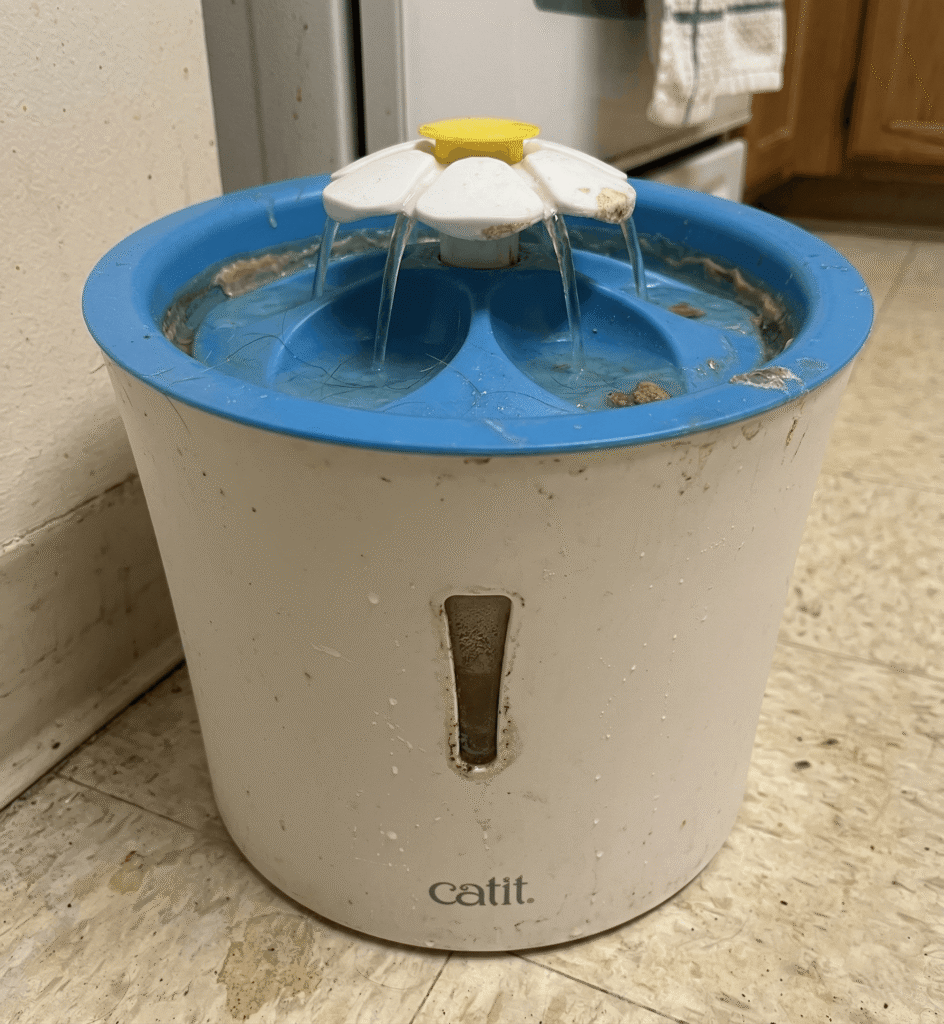
The Catit flower fountain is inexpensive, has a 100oz capacity, and sells well. I understand why people buy it.
Plastic develops biofilm faster than ceramic or stainless steel. You can clean it on schedule and it comes back. The filter sits directly under the waterfall attachment, exposed to every piece of debris and cat hair that falls in — it gets dirty fast. And plastic is a known irritant linked to feline chin acne. It’s not guaranteed to cause it, but ceramic eliminates the risk entirely for about £15 more.
I returned it after five days.
Best for: Nobody I’d recommend it to.
Avoid if: You care about your cat’s chin health, or you’ve had slime problems with plastic bowls before. Spend the extra money.
What 14 days of tracking actually taught me
Material matters more than any other spec. Ceramic keeps water cooler, develops less biofilm between cleans, and cats respond better to it than plastic. That’s not a guess — I watched Beans ignore a plastic fountain I tried early on and walk straight to the ceramic one.
Noise is the second factor. A pump Beans could hear slowed his adoption noticeably in early tests. The silence of the Raindrop was part of why he accepted it within hours rather than days.
Placement is something most fountain reviews don’t mention. According to Cornell Feline Health Center guidance on feline hydration, water should be placed away from the food bowl — cats instinctively separate eating and drinking in the wild. Moving Beans’ fountain two metres from his food increased his visit frequency on day 3. I didn’t change anything else that day.
One thing I want to be clear about: a fountain helps with hydration. It helped Beans measurably. But if your cat is showing signs of urinary distress, weight loss, or has stopped drinking almost entirely, that’s a vet call — not a product problem.
How I tested these
I tracked Beans’ fountain visits over 14 days — morning, midday, and evening counts. Water level was measured at the same time each day using a marked container. I noted how he approached each fountain, how long he drank, and any avoidance behaviour.
For the Pagoda, Tritone, and Hepper — which I tested separately before settling on the Raindrop — I cross-referenced consistent patterns from verified purchase reviews on Petco and Chewy, specifically the two and three-star reviews. I explain the full methodology on the How I Test Products page.
Frequently asked questions
How often should I clean a ceramic cat fountain?
Full disassembly and clean once a week. Wipe the ceramic surface every 2-3 days. Replace the carbon filter every 2-4 weeks — more often if you live in a hard water area.
Will my cat actually drink more?
Most do. Beans went from roughly two bowl visits a day to five or six fountain visits. It’s not guaranteed — some cats take weeks to accept a fountain, a few never do — but the pattern across cat behaviour research is consistent enough that it’s worth trying.
Is ceramic safer than stainless steel?
Both are significantly safer than plastic. Stainless is marginally more hygienic and easier to sterilise. Ceramic stays cooler and cats often prefer it. Either is a reasonable choice. Plastic isn’t.
How long does a ceramic fountain last?
The ceramic bowl itself can last years — assuming you don’t drop it. The pump is what fails. Expect 1-3 years depending on how consistently you clean the mineral buildup off it. A neglected pump dies faster. Clean it properly and it’ll outlast most plastic alternatives.