By Emma Hartley | Last updated August 2026 | Reviewed by IndoorCatWell Editorial Team
Cats communicate almost entirely through subtle sequences of tail, ear, eye, and body posture rather than isolated signals. Reading the whole cat prevents bites, deepens trust, and eliminates confusion.
Beans has never said a word to me and somehow tells me exactly what he wants, every single day. Cats don’t have a huge vocal range for the subtle stuff — that’s all body language. The problem is most owners are reading the wrong signals, or reading the right ones backwards.
I spent three months actually paying attention instead of guessing, cross-checking what I saw against feline behavior research, and writing down what actually held up. Here’s the real version, not the “cats are mysterious” version.
Tail Position Tells You the Most
The tail is the fastest-reading part of a cat. It moves before the face does.
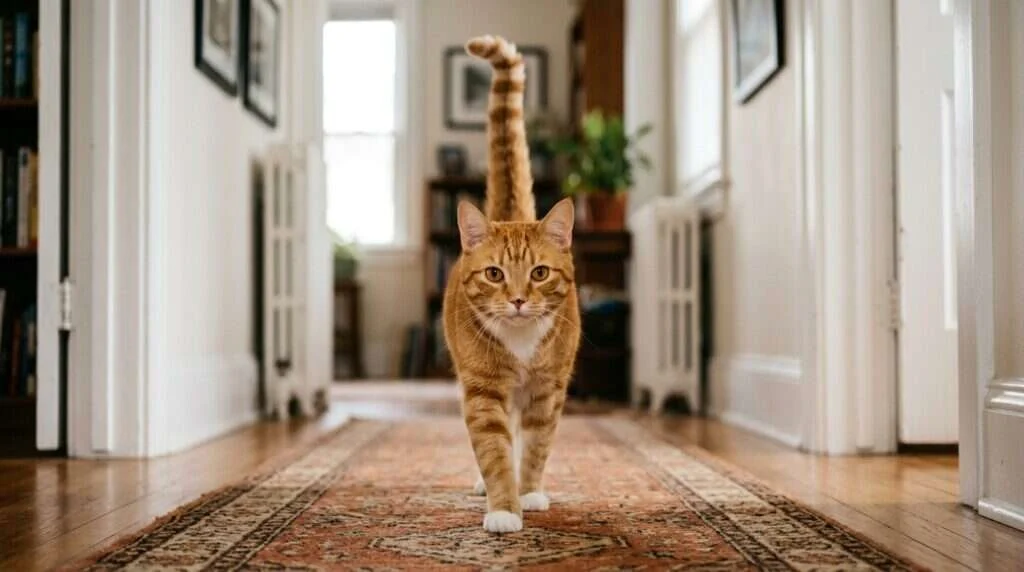
- Straight up, maybe with a curl at the tip — this is a greeting. It’s the closest thing cats have to a smile. Beans does this every time I walk in the door, tail up like a question mark, and it means “oh good, you’re here.”
- Low and tucked — fear or submission. Something in the environment has him on edge.
- Thumping or lashing side to side — overstimulation or irritation building. This is the one people miss most. A cat mid-pet with a tail starting to flick is telling you the pets are about to stop being welcome. Watch for it and you’ll dodge a lot of bites.
- Slow, gentle swaying while sitting — focus, usually predatory. He’s locked onto a bird outside or a toy and thinking about his next move.
Puffed up, especially with an arched back — this is the classic “Halloween-cat” pose, and it’s not aggression exactly. It’s a bluff. The cat is trying to look bigger because it’s scared, not because it wants a fight.

Ears Are the Second Signal
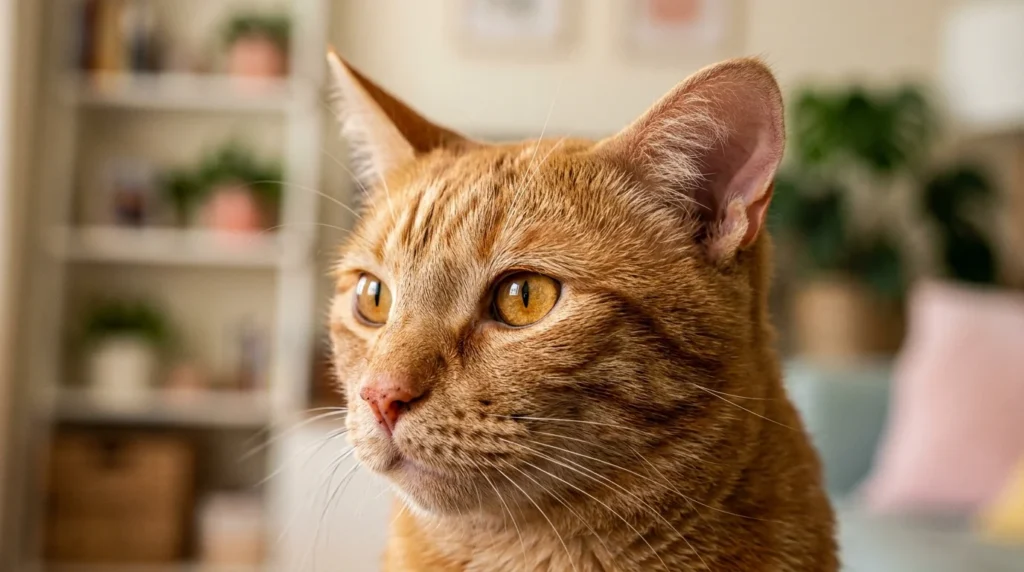
Forward and relaxed means content. Slightly out to the sides, sometimes called “airplane ears,” is uncertainty. Flat against the head is fear or anger, and at that point you should probably back off regardless of what the rest of the body is doing.
What surprised me: ears rotate independently up to 180 degrees. Beans can have one ear tracking a sound in the kitchen while the other stays locked on me. It’s not a mood signal in that case, just hearing doing its job.
Eyes: The Slow Blink Is Real
The slow blink thing isn’t a myth. A landmark 2020 study by the University of Sussex published in Scientific Reports proved that slow blinking acts as a genuine form of positive emotional communication between cats and humans. Half-closing the eyes and holding it, especially paired with a soft face, is a cat’s version of saying “I trust you, I’m not on alert.”
You can actually do it back — half-close your own eyes at your cat slowly, and many cats will return the gesture and approach more willingly. Dilated pupils are trickier: they signal arousal (excitement, fear, or low light). Context tells you whether blown pupils mean play mode or defensive fear.

The Whole-Body Postures
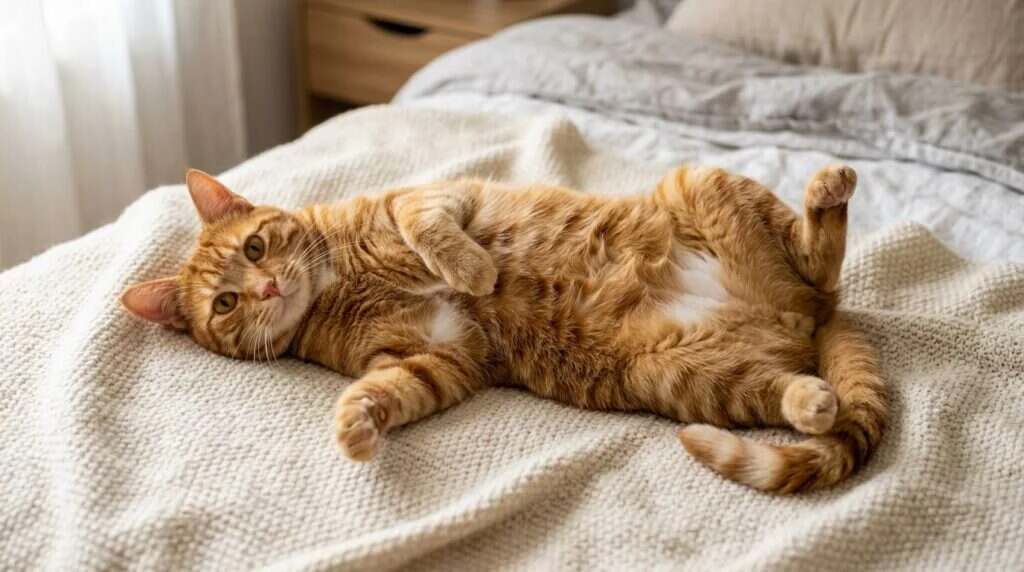
- Belly up, stretched out — this is not always an invitation. Sometimes it’s pure relaxation and trust. Sometimes it’s a defensive display — “I have four sets of claws and I’m not afraid to use them.” Read the rest of the body before reaching for a belly rub.
- The loaf — paws tucked under, body compact. Calm, content, not particularly alert. This is Beans’s default resting state on the windowsill.
- Kneading — a kitten nursing behavior that persists into adulthood during periods of profound contentment.
- The butt wiggle before a pounce — a mechanical motor pattern stabilizing hind paws before a strike.
- Freezing low to the ground — startled apprehension or predatory stalking depending on visual focus.
Vocal Signals That Pair With Body Language
Cats mostly meow at humans rather than each other. A short, high-pitched chirp is a greeting or casual request, while a long, drawn-out meow indicates urgency (food or an untidy litter box).
Purring is more nuanced: while usually signaling deep contentment, cats also purr to self-soothe when injured or frightened. Always cross-check purring against ear angle and muscle tension.
Putting It Together: Read the Whole Cat, Not One Signal
Never interpret a single body part in isolation. A twitching tail plus flattened ears and a crouch means give space immediately. A twitching tail plus forward ears and a wiggling butt means playtime is on. For more behavior insights, explore our guide on Why Cats Scratch Furniture and our comprehensive Indoor Cat Care Guide.
Frequently Asked Questions
Why does my cat show me their belly but bite when I touch it?
The belly-up pose is often trust, not an invitation to touch. Many cats expose their belly during relaxed stretching but still guard it reflexively — it’s their most vulnerable area. Watch the tail and ears before reaching for it; if either tenses up, skip the belly rub.
What does it mean when a cat's tail twitches while lying down?
A slow twitch during rest usually signals mild irritation or overstimulation building up, especially during petting. A fast, whip-like twitch paired with flattened ears is a stronger warning sign that a bite or swat may follow.
Why does my cat stare at me without blinking?
A hard, unblinking stare with a stiff body can be a challenge or heightened alertness. A soft stare that includes slow blinking is closer to affection. Context and the rest of the body matter more than the stare alone.
Do cats actually understand slow blinking from humans?
Research on cats and slow blinking (Humphrey et al., 2020, University of Sussex/Portsmouth) found cats are more likely to slow-blink back at humans who slow-blink at them first, and approach a stranger’s hand more readily afterward — suggesting it functions as a genuine trust signal both directions.
What does a puffed-up tail mean if my cat isn't hissing?
A puffed tail without hissing still signals fear or overarousal — the cat is trying to look larger as a defensive bluff. Absence of hissing doesn’t mean the cat is calm; check ear position and body posture for the full picture.
Why does my cat flick just the tip of their tail?
A tip-only flick, especially while sitting calmly, usually means mild interest or focus rather than irritation — it’s common while watching birds or waiting for food. It’s a much smaller signal than a full-tail lash.
Is purring always a sign my cat is happy?
No. Cats also purr when frightened, injured, or in pain, likely as a self-soothing mechanism. Check the surrounding body language — a purring cat with flattened ears and a tucked tail is stressed, not content.
🐾 Level Up Your Cat's Indoor Environment
Looking to keep your cat enriched, comfortable, and happy indoors? Browse our hands-on product reviews and evidence-based care guides.