64. Indoor Cat-Safe Plants: A Vet-Conscious Buying Checklist

This post may contain affiliate links. If you buy through them I may earn a commission, at no extra cost to you.
Most "cat safe plant" lists give you a handful of names and send you to the garden center. The problems start in the store: a tag that gives only a common name, a plant labeled "pet friendly" with no explanation, a mixed pot with one safe plant and one dangerous one, or a plant that has been sprayed with something you don't know about. This guide gives you a checklist to run before you buy, a short list of plants that the ASPCA lists as non-toxic, the traps to avoid, and what to do with plants you already have.

Short answer
Don't buy a plant until you've matched its scientific name to the ASPCA's database. Ignore "pet safe" labels unless you can verify them. Check the soil, fertilizer, and any treatment on the plant. Keep unidentified plants out of reach, and remember that even non-toxic plants can cause vomiting if a cat eats a lot.
In this guide:
- The checklist
- Names that mislead
- Plants the ASPCA lists as non-toxic to cats
- Pesticides and nursery treatments
- What to avoid at home even if the plant is safe
- Plants you already own
- A note on "vet-approved" claims
- Frequently asked questions
- What to do if you think your cat has worms
- Monitor or call: a quick guide
The checklist
Run this in the store, or at home before the plant comes in.
Find the scientific name on the tag. If there isn't one, take a photo of the plant and tag, and ask a staff member. If nobody can say, don't buy it.
Look it up in the ASPCA's toxic and non-toxic plants list, searching the scientific name and the common name. Check both, since common names overlap.

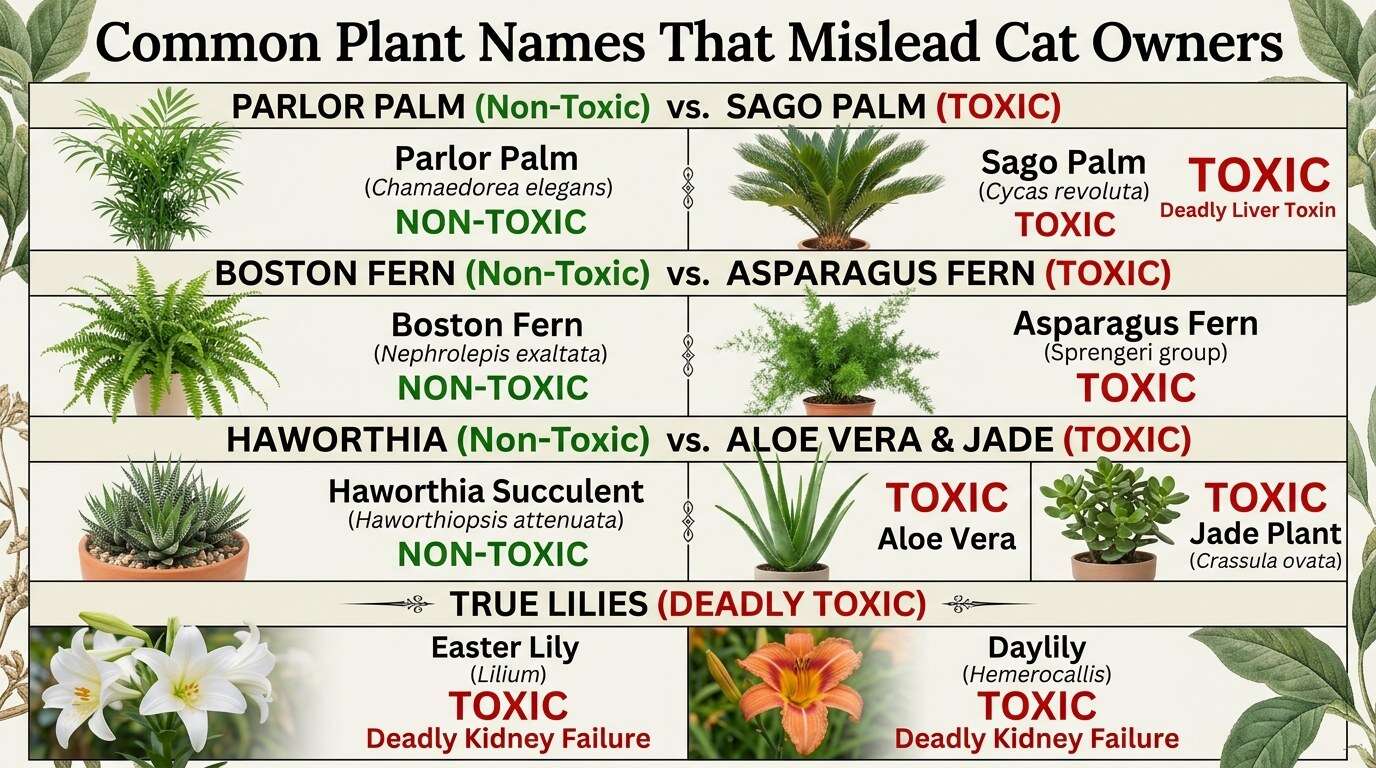
Check for look-alikes. See the table below.
Read the tag for treatments. Look for pesticides, systemic insecticides, or growth regulators. Ask the seller what has been applied.
Check the pot. Look for slow-release fertilizer pellets in the soil, decorative stones that a cat could swallow, and moss or mulch that might harbor mold.
Check for mixed pots. A "dish garden" or a "tropical mix" may contain several plants. Identify each.

Think about placement before you buy. Where will it sit, and can your cat reach it?
Ask about the return policy, in case you find the plant is unsuitable.
Save the tag and a photo in a note, so you can identify the plant later.
Names that mislead
A plant labeled "pet friendly" in a store may be accurate, or it may be a marketing line. Verify it.
Plants the ASPCA lists as non-toxic to cats
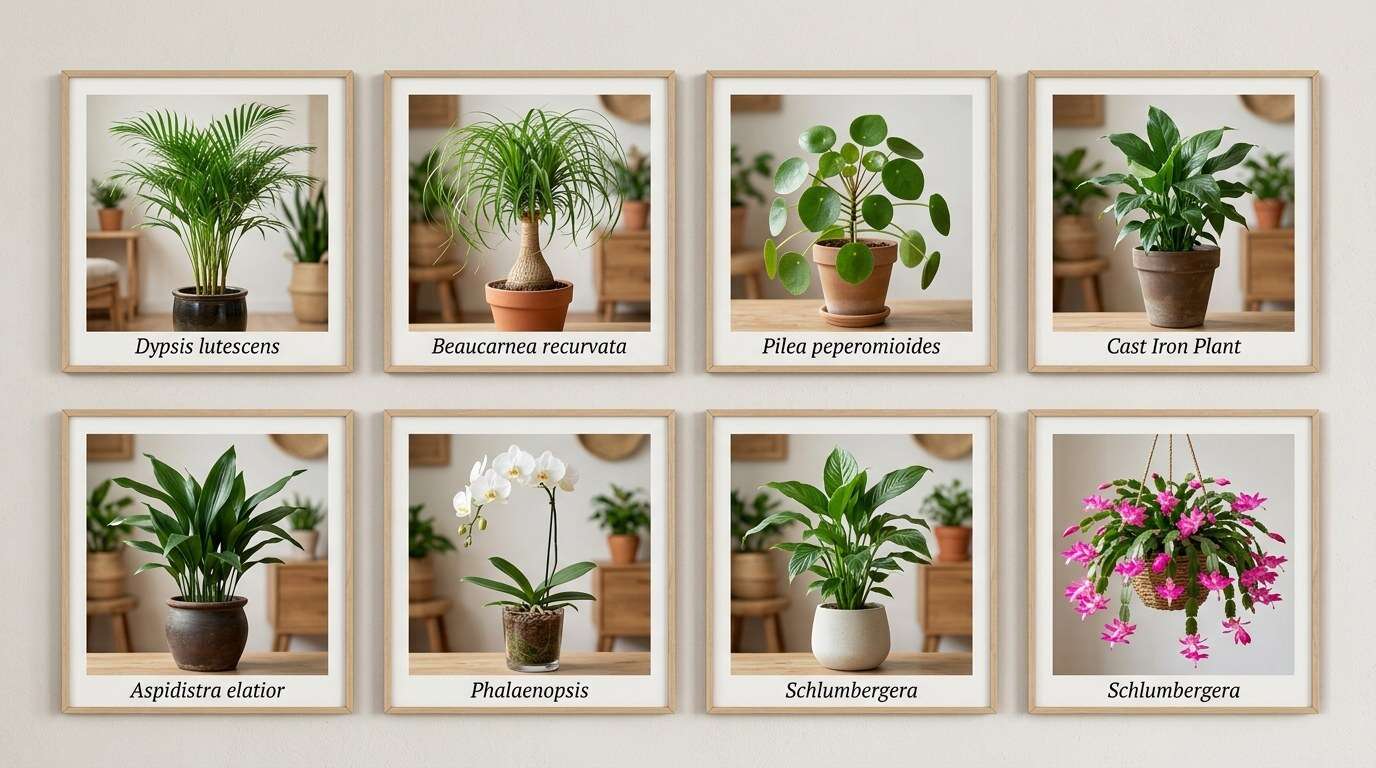
This is a short sample. Confirm each by its scientific name on the ASPCA site before you buy, because lists change and cultivars vary.
Non-toxic doesn't mean edible. A cat that eats a lot of any plant can vomit or have loose stools.
Pesticides and nursery treatments
Plants from nurseries and big-box stores may have been treated with pesticides, including systemic products that move through the plant, to keep them looking good during sale. Evidence of harm to cats from residue on an ordinary houseplant is limited, and I don't want to overstate it. But you can't know what was applied unless you ask, and a cat that chews leaves is eating whatever is on or in them.

Ask the seller what treatments the plant has had, and when.
Rinse the leaves and, if possible, repot the plant in fresh soil, since the original soil may hold fertilizer or treatments.
Keep it out of reach for a few weeks while you watch.
For plants a cat will chew, consider buying from a source that doesn't use systemic insecticides, or growing from seed or cuttings.
Don't use pesticide sprays, leaf shine products, or plant foods at home unless the label says they are safe around cats, and keep the cat out of the room until dry.
What to avoid at home even if the plant is safe
Slow-release fertilizer pellets and plant food
- Cocoa mulch, which contains theobromine
- Standing water in saucers
- Moldy soil
- Essential oil sprays on leaves
Cut flowers in a vase when lilies are present. Even the water is dangerous.
Plants you already own
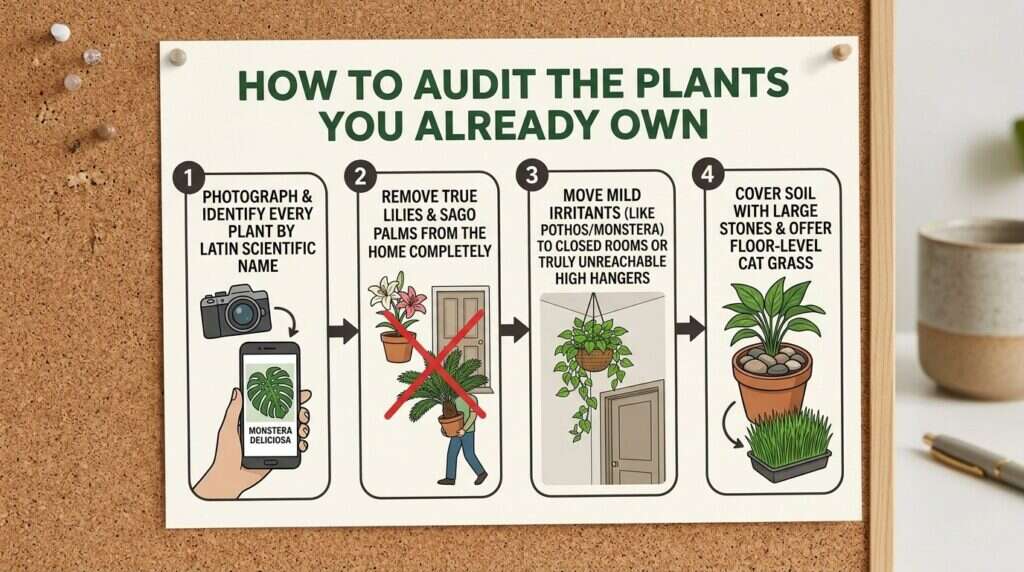
This is the part of the row 63 angle that matters most.
Identify every plant. Take photos and look up scientific names. Mark any you can't identify.
Remove or relocate the dangerous ones. True lilies and sago palms should leave a home with cats. Others, such as pothos or monstera, can go on high shelves, in hanging planters your cat can't reach, or in a room she can't enter.
Test the placement. Cats jump higher than you think. Watch her try.
Offer an alternative. A pot of cat grass gives her something to chew. See our cat grass guide.
Cover soil with large stones or a mesh to discourage digging.
Know the signs. Drooling, pawing at the mouth, vomiting, lethargy, or tremors after chewing a plant need a call to a vet or poison hotline. See our guide to plants poisonous to cats.
Keep the plant list handy in your phone, with scientific names, for an emergency call.
In the US, the ASPCA Animal Poison Control Center is (888) 426-4435 and Pet Poison Helpline is (855) 764-7661. Both may charge a fee, and both are US numbers.
A note on "vet-approved" claims
You may see lists labeled "vet approved." Check what that means. A veterinarian reading the ASPCA list isn't the same as a veterinary review of the page's advice. If your page says a vet reviewed it, a vet must have reviewed it, and the reviewer's name and date should be on the page.
When to talk to your vet
Immediately after any chewing of a lily, sago palm, or other high-risk plant
If your cat vomits repeatedly after eating plant material
If she chews plants compulsively, since this can signal boredom or a medical issue
Frequently Asked Questions
What indoor plants are safe for cats?
Several, including spider plant, Boston fern, parlor palm, and calathea, according to the ASPCA. Verify each by its scientific name.
Is a "pet safe" label reliable?
Not necessarily. Check the plant yourself.
Can my cat eat spider plants?
They're listed as non-toxic, but a lot of any plant can cause vomiting.
Are succulents safe?
It varies. Haworthia is listed as non-toxic, while jade and aloe are listed as toxic.
Should I worry about pesticides on a new plant?
It's sensible to ask what's been applied and to rinse or repot it.
Related reading
References
ASPCA, toxic and non-toxic plants list (aspca.org). Verify every plant in the table by scientific name on the day you publish.
Pet Poison Helpline, plant toxicity resources (petpoisonhelpline.com)
Cornell University College of Veterinary Medicine, poisonous plants resources
A veterinary toxicology source on systemic insecticides in ornamental plants, if you make any claim about them
65. Do all indoor cats need flea protection? (paste into article 19, do not publish a new page)
Your sheet already says this may be a section of the existing parasite prevention post. Articles 19, 25, 30, and 54 already cover how fleas get in, how to choose a treatment, apartments, and winter. A fifth flea page for "can indoor cats get fleas" would compete with 19. Add this section to article 19 instead. It addresses the one question the others handle only in passing: whether every indoor cat needs a preventive.
Do all indoor cats need flea protection?
Veterinary parasite guidelines, including those from the Companion Animal Parasite Council, recommend year-round flea prevention for most pets, because fleas can reach an indoor cat and one exposure can start an infestation that takes months to clear. That is a general recommendation, and your vet may adjust it for your cat's circumstances.
Lower risk is not zero. A cat can still pick up fleas from a visitor's clothing or from a mouse in the wall. Ask your vet to assess your cat, and ask whether a product that also covers other parasites, such as certain worms or heartworm, would save you using more than one.
If you decide with your vet not to use a preventive, set up a routine to catch fleas early: a weekly flea comb check over a white paper towel, a look at your cat's skin and coat, and a plan for what you'll do the day you find one. Never use a dog flea product on a cat.
Link this section to your treatment guide (article 25), your winter section (article 54), and your annual vet checklist.
66. Worms: signs and next steps (paste into article 20, do not publish a new page)
Your sheet says to merge this with the worm prevention article, and article 20 already covers routes, signs, and prevention. The missing piece is a practical "what do I do now" sequence for an owner who has seen something worrying. Add this section to article 20, and have a vet review it.
What to do if you think your cat has worms
Don't treat her on your own. Different worms need different medicines, and the wrong product or dose can fail to work or cause harm. Don't use a dog dewormer or an over-the-counter product without your vet's advice.
Note what you saw and when. For example, rice-like segments near the tail or on bedding, spaghetti-like worms in vomit or stool, scooting, a swollen belly in a kitten, weight loss, or diarrhea.
Take a photo, and if it's easy and safe, save a small sample in a sealed bag. Don't handle it with bare hands. Wash your hands afterward.
Collect a fresh stool sample if your vet asks for one. Use a clean bag or container, and take a piece from the freshest stool. Keep it cool and bring it in the same day if possible, or as your clinic directs.
Call your vet. Ask whether she needs to be seen and whether a fecal test is advised. Say if there are kittens, pregnant cats, children, or people with weakened immune systems in the home, since roundworm and hookworm can infect people.
Follow the treatment plan, and ask when to recheck. Many worms need more than one dose, and your vet may suggest a repeat fecal test.
Clean up. Scoop the litter box at least daily, wash your hands, wash bedding, and ask your vet about any environmental steps.
Review prevention. Ask what year-round product is right for her, and whether flea control is part of the plan, since fleas carry tapeworm.
Urgent signs: pale gums, weakness, repeated vomiting, a bloated, painful abdomen, trouble breathing, or a kitten who is lethargic or not eating. These need a same-day call.
A normal fecal test doesn't always rule out worms, since some parasites shed eggs intermittently. If your cat has signs and the first test is negative, ask your vet whether a repeat or a different test makes sense.
67. Sneezing: monitor or call the vet (paste into article 23, do not publish a new page)
Your sheet's keyword for this row is "my indoor cat keeps sneezing," which is exactly the keyword article 23 already targets. A second page would compete with the first. The title for 67 does add something article 23 doesn't have in a single glance: a short monitor-or-call triage. Add it near the top of article 23, right after the short answer.
Monitor or call: a quick guide
This isn't a diagnosis. It helps you decide how fast to act.
Write down when it started, how often it happens, the color of any discharge, her appetite, and any change at home. A short video of the sneezing helps your vet.
Do not give human cold or allergy medicines, decongestants, or pain relievers. Some are dangerous to cats, and acetaminophen (paracetamol) can be fatal.
Keep the rest of article 23 as it is. Your sheet's note, "one focused symptom page, not multiple sneeze variants," is the right instruction.