By Emma Hartley | Reviewed by IndoorCatWell Editorial Team | Last updated September 2026
This article provides practical, veterinary-supported cat care guidance. If you buy through our links, we may earn an affiliate commission at no extra cost to you. Read our full Affiliate Disclosure.
Unlike pack-oriented canines, domestic cats are territorial solitary hunters that view an unfamiliar feline as an existential threat to their resources. Introducing a new cat successfully requires a methodical, multi-week protocol: scent swapping before visual contact, visual contact before physical meetings, and pairing every step with positive mealtime rewards. Rushing the process is the single most common cause of lifelong territorial warfare.
⚡ The 5 Introduction Stages
- Basecamp Setup (Days 1–4): Complete isolation of the newcomer in a dedicated sanctuary room.
- Stage 1: Scent Swapping: Exchanging blankets, sleeping pads, and cheek pheromones.
- Stage 2: Territory Site Swapping: Allowing each cat to explore the other’s room without visual contact.
- Stage 3: Feeding Behind Closed Doors: Pairing the aroma of delicious food with the presence of the other cat.
- Stage 4 & 5: Controlled Visual & Supervised Contact: Baby gates and short, positive play sessions.
Phase 0: Setting Up Basecamp (Days 1 to 4)
Before bringing your new feline through the front door, prepare a dedicated basecamp room (such as a guest bedroom or home office) that your resident cat does not frequently use as a core sleeping spot. Equip it with food, water dishes placed 6 feet from the litter box, scratching posts, vertical perches, and hiding spots.
Keep the door firmly shut for the first 72 to 96 hours. Allow the newcomer to decompress from adoption stress while sniffing each other under the bottom door gap.
Stage 1: Scent Swapping (Building Olfactory Familiarity)
Olfaction is the primary language of feline territory. Before either cat sees the other, their scents must feel safe and neutral:
- Take a clean washcloth and gently rub the cheeks and chin of Cat A to collect soothing facial pheromones. Place this cloth near Cat B’s favorite resting spot with a high-value treat on top.
- Repeat in reverse with Cat B’s cloth presented to Cat A.
- Exchange sleeping blankets and bath towels daily.
- Success criteria: Both cats sniff the cloths with relaxed ears and eat treats off them without hissing, growling, or tail-flicking.
Stage 2: Site Swapping (Investigating Territory)
Once scent swapping is accepted calmly, let them explore each other’s physical territory without ever seeing each other:
- Confine your resident cat in an en-suite bathroom or secondary bedroom for 45 minutes.
- Open basecamp and let the new cat freely inspect the living room and hallways.
- Return the new cat to basecamp, and let your resident cat investigate the basecamp bedroom to sniff recent scent trails.
- Do this once or twice daily for 3 to 5 days.
Stage 3: Feeding on Opposite Sides of a Closed Door
Food is the ultimate emotional anchor. In this stage, you create a conditioned positive association: The scent and presence of that mystery cat means something delicious happens to me.
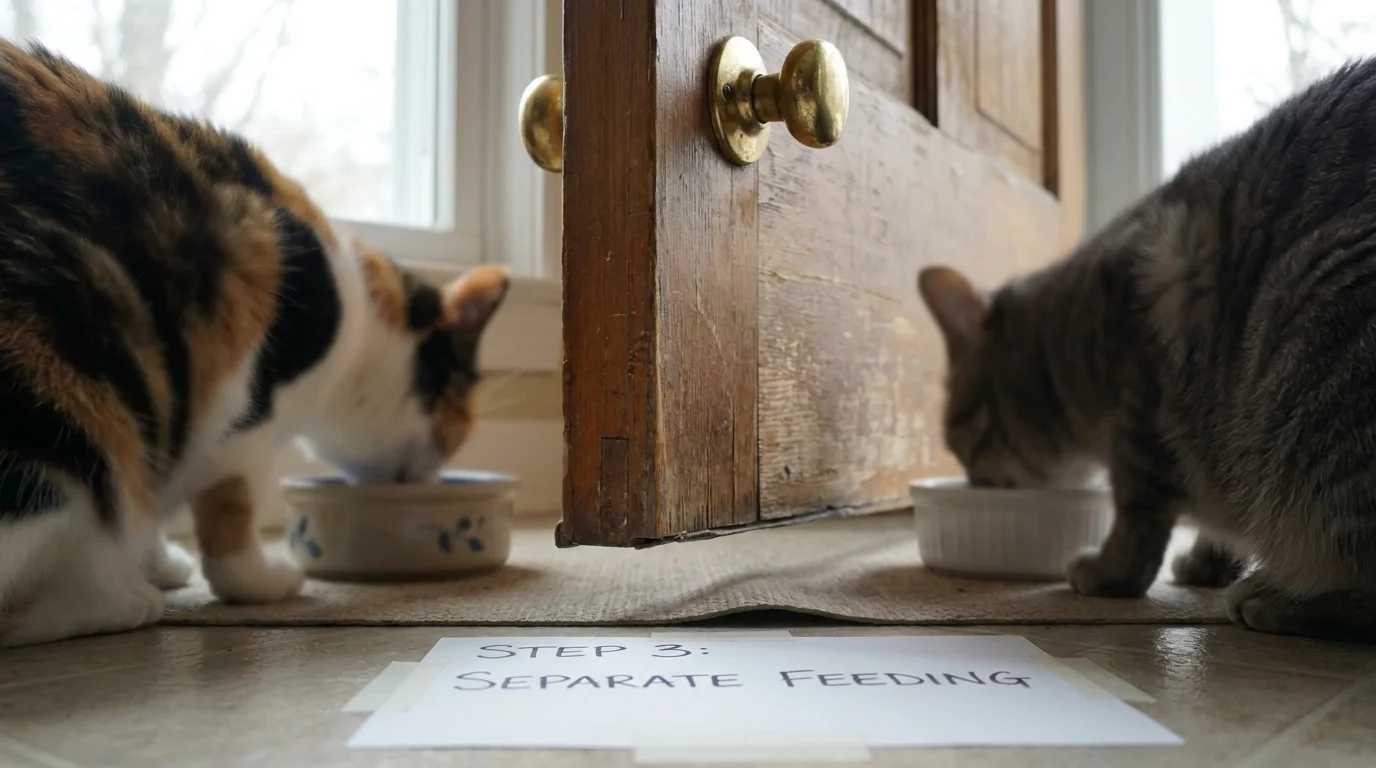
- Place food dishes 5 to 6 feet away from the closed basecamp door on both sides.
- Over several days, gradually inch the dishes closer by 6 inches per meal, provided neither cat hesitates or growls.
- Eventually, both cats will be eating happily just inches from opposite sides of the closed door crack.
Stage 4: Visual Contact Through a Barrier
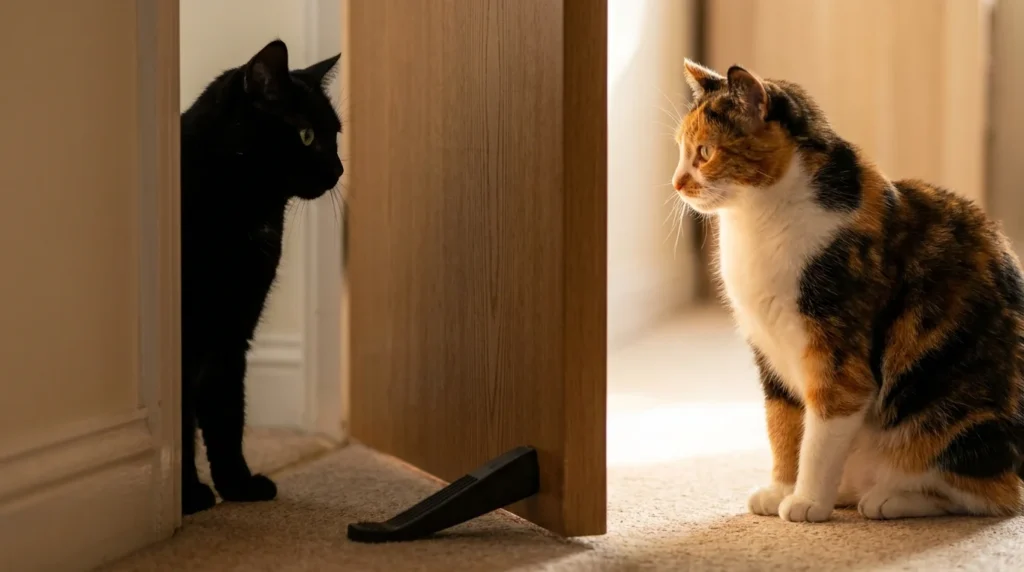
Now introduce sight without physical vulnerability. Install stacked baby gates or crack the door 2 inches secured tightly with an adjustable doorstop:
- Keep visual sessions short: 5 to 10 minutes during mealtime or feather wand play.
- Distribute squeeze lickable treats while both cats maintain eye contact.
- Red flags to halt: Flattened airplane ears, piloerection (puffed fur/tail), low growling, or unblinking hard stares. If these occur, close the door immediately and retreat to greater distance.
Stage 5: Supervised Physical Meetings
Only when both cats act bored or friendly through the visual barrier should you remove the gate. Follow these crucial ground rules:
- Never carry one cat toward the other: Forcing proximity triggers fight-or-flight panic. Let them choose their own pacing.
- Engage with two separate wand toys: Two human handlers playing with each cat at opposite ends of the room keeps their predatory focus redirected.
- Keep meetings short: End on a positive note after 10 to 15 minutes by separating them before any tension builds.
- Increase duration gradually: Repeat 2 to 3 times daily, extending duration over 1 to 2 weeks before leaving them alone unsupervised.
How to Handle Setbacks and Scuffles
Minor hisses or a brief warning swat are normal communication signals. However, if a screaming fight breaks out:
Safety Rule: Never reach your bare hands into a cat fight. You will suffer severe bite puncture wounds that easily lead to serious bacterial cellulitis. Instead, slide a piece of cardboard between them or toss a heavy bath towel over one cat to break eye contact, then herd them into separate rooms.
After any fight, reset completely. Give them 48 hours of complete separation with no visual contact, then resume two stages backward (at scent swapping or distant feeding). If a nervous rescue is struggling to bond, review our guide on how to get a scared cat to trust you.
Frequently Asked Questions
How long does introducing two cats usually take?
Most introductions require between 2 and 6 weeks. Outgoing, well-socialized cats may adjust in 10 to 14 days, whereas timid, senior, or single-cat rescues can take 2 to 3 months of patient staged integration.
Should I introduce a kitten to an adult resident cat the exact same way?
Yes. Although kittens produce lower territorial threat hormones, adult cats can still be overwhelmed or annoyed by boundless kitten energy. Go through all stages, but expect the timeline to move slightly faster.
What if my resident cat never becomes best friends with the new cat?
Polite coexistence—where cats ignore each other, share rooms peacefully, and avoid fighting—is a successful outcome. Not all cats need to groom each other or cuddle to live happy, stress-free lives together.