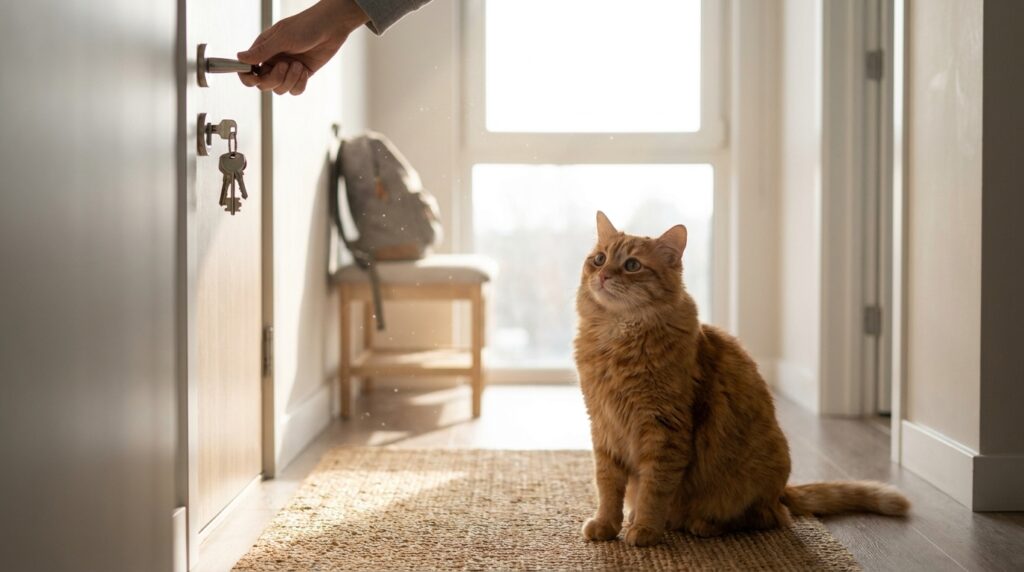
Every morning it’s the same thing. You grab your keys, your cat gives you that look, and you spend the commute wondering what she’s doing back home. If you’re trying to figure out how to keep indoor cat entertained while at work, the answer isn’t more toys — it’s building a system that actually gives her something to do while you’re gone.
This guide is not a list of 27 random toys to buy. It is a setup system — a before-you-leave routine and a home environment you configure once that keeps your cat occupied, mentally stimulated, and far less likely to be bored when you walk back through the door.
First: How Long Is Too Long to Leave a Cat Alone?
Before fixing the problem, it helps to understand the actual limits.
Most healthy adult cats can be left alone for around eight to twelve hours, provided they have access to fresh water, a clean litter box, and a safe, enriching environment. A standard workday — eight hours including commute — sits right at the edge of that window, which is why environment matters so much.
Age changes everything here:
| Cat Age | Safe Alone Time |
|---|---|
| Under 3 months | Up to 20 minutes |
| 3–6 months | Up to 4–6 hours |
| 6–12 months | Up to 6 hours |
| Adult (1–7 years) | 8–12 hours |
| Senior (8+ years) | 8 hours max; monitor closely |
Research from Oregon State University found that 64% of cats are securely attached to their owners, displaying similar attachment styles to dogs and even human infants. That stat tends to surprise people. Cats are not as indifferent to your absence as their daytime napping suggests.
A study published in PLOS One found that among cats showing separation-related issues, 67% displayed destructive behaviour, 63% excessive vocalization, and 60% urinated outside the litter box. Cats living without other animals in the household were significantly more likely to develop these problems.
So the stakes are real. A bored, under-stimulated solo indoor cat does not just nap through the day. She stresses, and that stress shows up in ways that are hard to reverse.
The Core Problem: Eight Hours of Stored Nothing
Many owners are out at work or school during the day, so the cat spends those hours in rest and relaxation, especially if she is the only pet in the household. The cat’s day then begins when the owner arrives home.
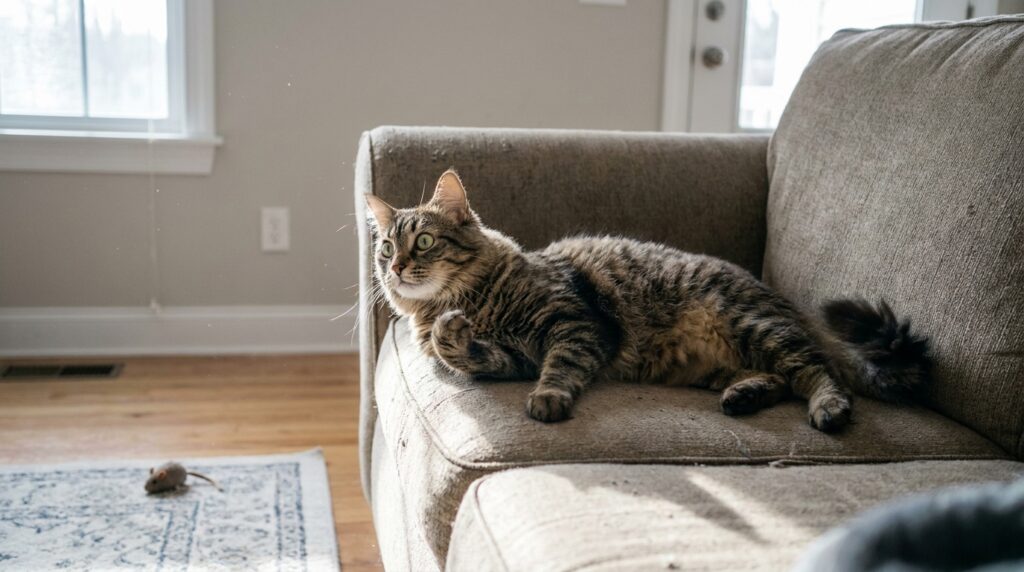
Here is what that actually means: your cat naps because there is nothing else to do. She stores energy. By the time you return, she has eight hours of unused drive sitting behind her eyes — and she will spend it either on you (great) or on your furniture (not great) or lying awake at 3am being loud (also not great).
The fix is not “leave out more toys.” It is structuring her environment so that the waking hours during the day have somewhere to go. That requires three things working together: a pre-departure routine, a stimulating home setup, and a consistent return routine.
Part 1: The Before-You-Leave Routine (Takes 10 Minutes)
This is the most underrated part. Most advice skips it. Most owners skip it too, because mornings are already rushed. That is a mistake.
Play Before You Go
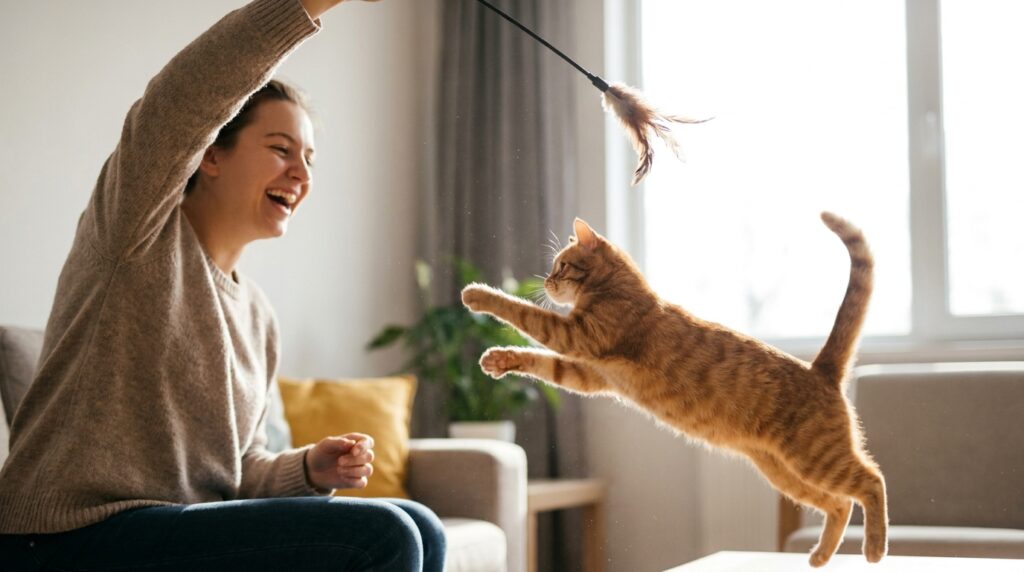
Spend some quality time playing with your cat right before you head out. Use a wand toy, laser pointer, or mouse toy to burn off excess energy. After a good play session, she’ll likely be more relaxed and less prone to boredom or destructive behaviour.
Five to ten minutes is enough. Use a wand toy, not a laser pointer, because lasers don’t give your cat a physical catch at the end — they leave the hunt sequence open. A proper wand session followed by a small treat or kibble toss completes the stalk-chase-catch-eat cycle and leaves your cat ready to groom and settle.
Feed After Play, Not Before
Feed the morning meal right after the play session. Cats naturally sleep after eating. If you feed her while you’re getting dressed and then play twenty minutes later, you’ve reversed the cycle she needs to settle. Play, then eat. In that order.
Scatter or Puzzle-Feed at Least One Meal
Instead of putting food in a bowl every time, use a puzzle feeder for at least one meal per day. Hide small portions of kibble in two or three locations around the flat so she has to work for part of her food. Hiding small treats or toys around the house encourages cats to search and discover them, tapping into their instinctual curiosity and providing a rewarding and interactive experience.
This is particularly good for solo cats because it gives them something problem-focused to do in the first hour after you leave, which is often the highest-anxiety window.
Cats with separation anxiety typically act out within the first twenty minutes or so after you’re gone. Getting her mind occupied immediately after departure reduces that peak significantly.
Part 2: Setting Up the Home Environment (Set It and Leave It)
These are the static elements of your system — things you configure once that work passively all day without you.
Window Access Is Non-Negotiable
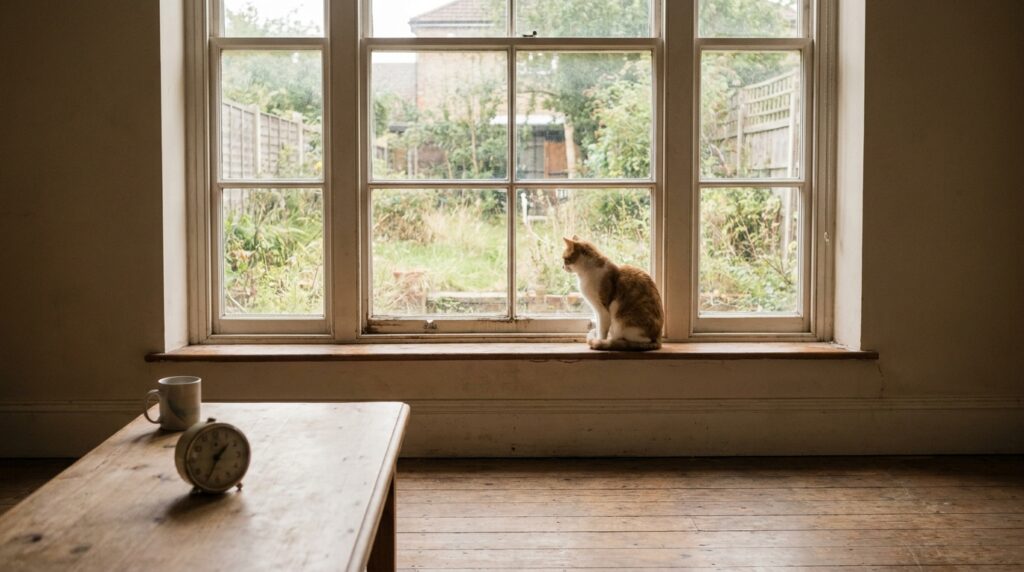
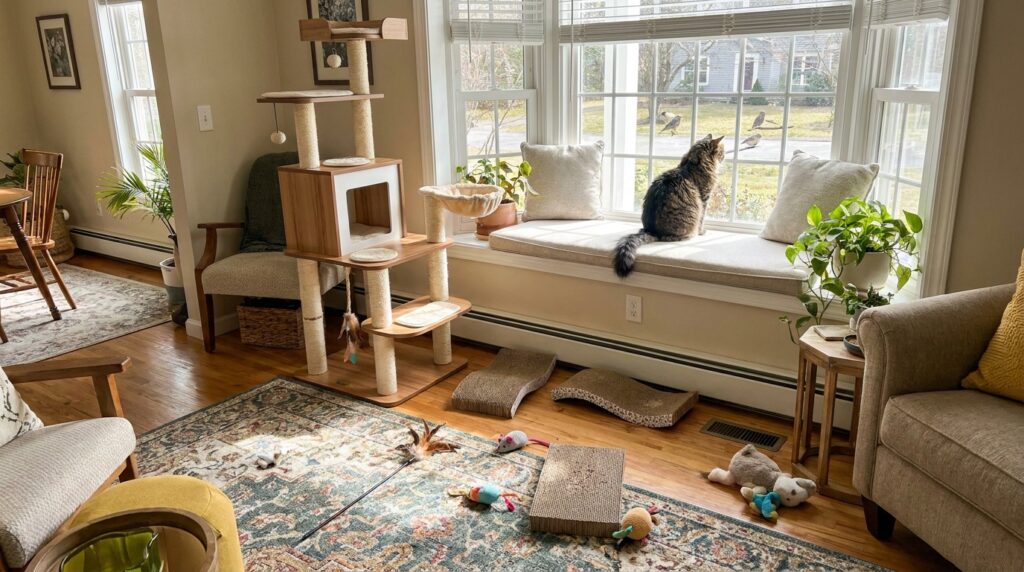
A window with a view is the closest thing to television your cat has. A cat perch that overlooks the yard will give her hours of free entertainment.
Take it further by hanging a bird feeder outside the window she can access. Birds, squirrels, and passing people give her moving targets to watch — which engages her prey-tracking instinct without any effort on your part. This is one of the highest-value, lowest-cost enrichment setups you can make.
If your windows only face a wall or a car park, consider a cat TV setup on a tablet or small screen. Hours-long videos made with feline viewers in mind, featuring birds, mice, squirrels, and other animals going about their day, are widely available and have shown genuine engagement from indoor cats.
Vertical Space: Height Is Enrichment
Cats feel safer and more confident when they can get up high. A tall cat tree near a window combines vertical access with visual stimulation. Installing wall-mounted shelves, cat trees, or climbing posts reduces stress and provides exercise.
If you already have a cat tree that your cat ignores, move it. Location matters more than size. A tree next to an active window is far more valuable than a premium tree in the corner of a spare room.
Rotate Toys — Don’t Leave Them All Out
Keeping your cat’s environment fresh by rotating toys and introducing new ones regularly maintains engagement. Scatter toys around your home or hide them in different spots.
A cat who sees the same five toys every day habituates to them within 48 hours. Pull two or three out each morning and put the others away. What was ignored last week suddenly becomes interesting again when it reappears after a few days’ absence. Sprinkle a small amount of catnip on a toy you’re reintroducing to trigger fresh engagement.
Leave Cardboard Out (Seriously)
An empty cardboard box costs nothing and gets used. Cats explore new textures, hide inside them, scratch them, and sit in them in that inexplicable way cats do. Swap the box every week or two. Add a paper bag with the handles removed. Neither of these requires a trip to a pet shop.
Puzzle Feeders and Slow Feeders
Food puzzles and toys are a great way to keep your cat engaged and entertained while you’re gone. There are a variety of puzzle and toy designs, and you can even make your own from common household items like boxes and toilet paper rolls. These puzzles let you put food and treats inside, and your cat will have to problem-solve to get their paws on the prize.
Start with a simple level-one puzzle (a few holes in a cardboard box) before buying commercial options. Some cats figure them out immediately. Others need a few days to engage. Either way, a puzzle feeder works because it converts eating from a thirty-second event into a fifteen-minute activity.
Part 3: Tech That Actually Helps (and What to Skip)
Automatic Feeders
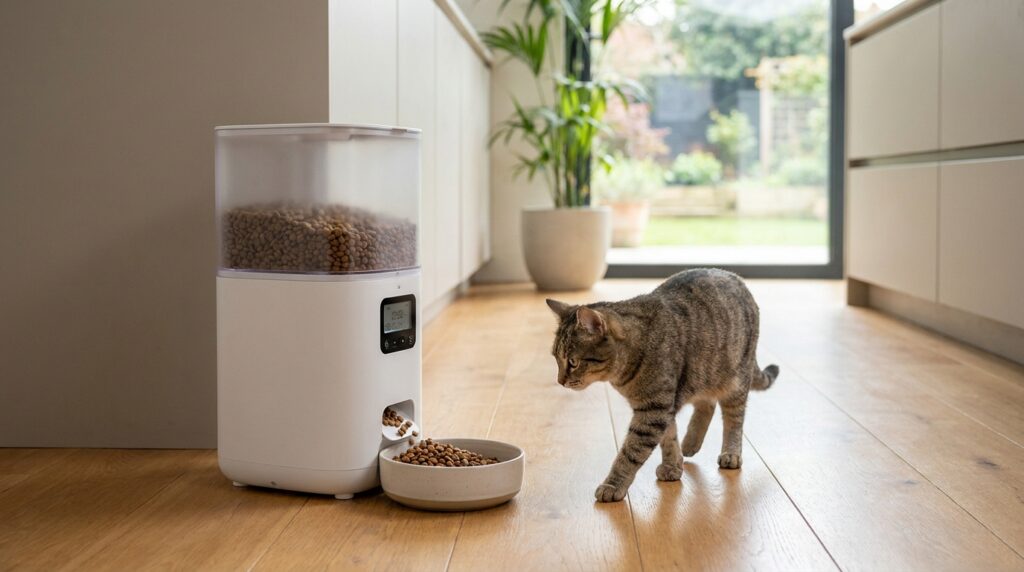
Scheduled automatic feeders let you split your cat’s daily food into three or four smaller portions throughout the day instead of two large meals. More feeding events means more moments of anticipation and activity. A cat who eats at 7am, 12pm, and 5pm is more alert and engaged across the day than one who eats at 7am and 6pm.
Look for a model with portion control and a timed release. Avoid gravity feeders (they fill the bowl whenever food drops, which is not the same as a schedule).
Interactive Cameras with Treat Dispensers
Interactive cameras let you do everything from dispensing treats for your kitty to playing with them using a laser pointer. These are great for owners who have to spend a great deal of time away, as they give a feeling of connection even if it’s a remote one.
If you work from home occasionally or have a flexible lunch break, a camera with a treat dispenser lets you trigger a small interaction mid-day. This is less about the treat and more about the routine — your cat starts to associate a particular time of day with something happening, which breaks up the monotony.
What to Skip
Automated laser pointers sound good in theory. In practice, many cats lose interest quickly because they never catch anything. The hunt cycle stays open. If you use one, always follow the laser session with a physical toy toss so your cat has something tangible to “catch.”
Part 4: The Highest-Impact Thing You Can Do — A Second Cat
If your cat is under five years old, solo, home all day, and you’ve tried everything else — seriously consider a second cat.
Cats are social animals: your cat may have extra energy or be waking you up for attention, which can be a form of social play. Two cats engage each other, play together, and meet each other’s social needs without relying on you being present. The daytime energy that currently gets banked and paid out at midnight gets spent appropriately.
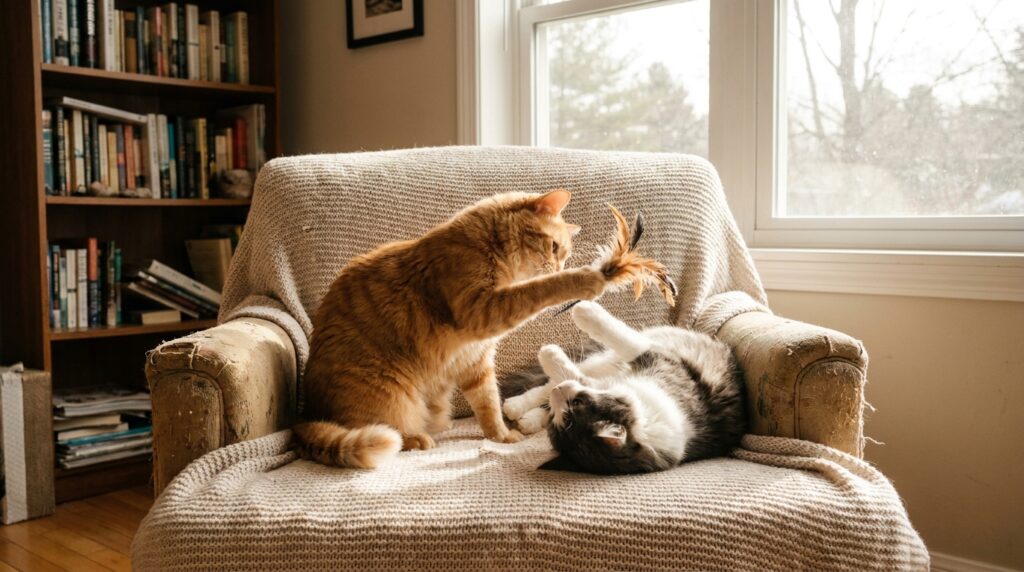
The introduction must be done properly. Keep cats separated by a closed door for at least a week. Swap bedding so they get used to each other’s scent before any face-to-face contact. Rush this and you can create territorial conflict that is much harder to fix than one bored cat.
If a second cat is genuinely not possible, a daily visit from a cat sitter or trusted friend mid-day is the next best option. Even a quick visit can make a huge difference.
Signs Your Cat’s Daytime Boredom Has Become a Problem
Boredom that’s ongoing tends to escalate. Here’s what to watch for when you get home:
Signs your cat might be struggling with being alone include: excessive vocalization — if your cat is meowing loudly and more often than normal, they might be having a hard time when you’re gone. Destructive activity, from scratching the sofa to damaging door frames, where your cat might be trying to de-stress by leaving calming scent signals. Litter box changes — if your cat is anxious when alone or thinks the litter box isn’t clean enough in your absence, they might start to eliminate outside the litter box. Changes in diet.
If you’re seeing two or more of these consistently, the environment isn’t working and you need to make changes — not wait for it to resolve.
Your Before-Work Setup Checklist
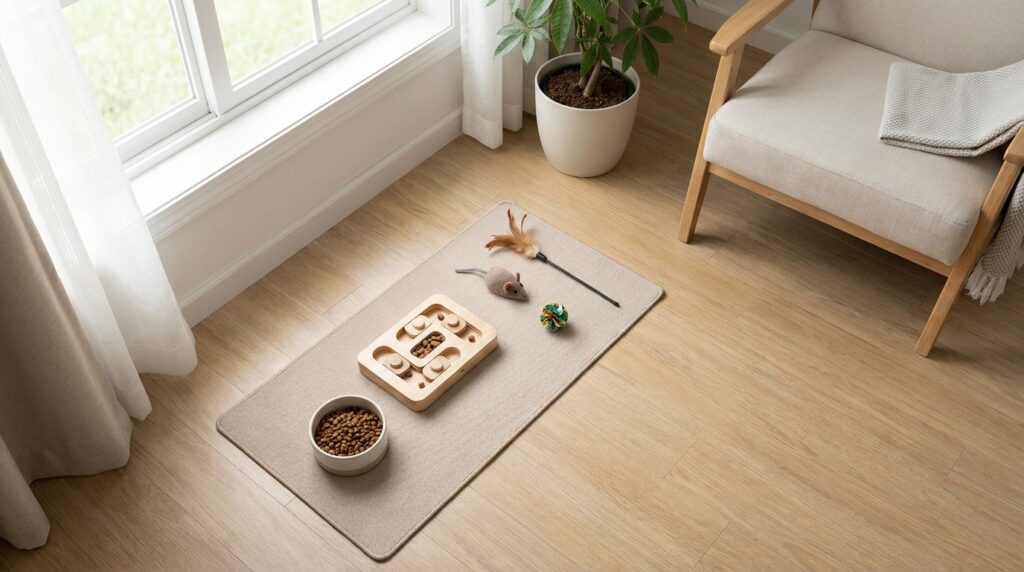
Use this every morning:
- Play session with wand toy (5–10 minutes)
- Feed main meal immediately after play
- Set out puzzle feeder with one portion of kibble
- Hide two or three treats around the flat
- Confirm window perch is accessible and clear
- Rotate toy selection (swap in two from storage, put two away)
- Fresh water available (two sources if possible)
- Clean litter box — not one that’s been sitting since yesterday
That’s your entire system. Ten minutes, done before you leave. The rest of the day, your cat has something to do.
FAQs
How do I keep my cat entertained while at work with no budget?
Rotate the toys you already have instead of leaving them all out. Add a cardboard box and a paper bag to whatever room she uses most. Scatter a portion of her kibble across the floor instead of putting it in a bowl. Move her favourite sleeping spot next to a window. All of this costs nothing.
Is it okay to leave a cat alone for 8 hours every day?
In general, healthy adult cats can typically be left alone for eight to twelve hours at a time. However, your cat can also become bored and lonely when left alone for too long, which can cause anxiety long term if they routinely spend several hours a day alone. Eight hours every day is manageable, but only if the environment is set up properly. An empty room with a food bowl and nothing else is not sufficient for a social, intelligent animal.
What toys are best for cats when the owner is away?
Self-play toys work best when they move unpredictably or dispense food — battery-powered mice, puzzle feeders, crinkle balls, and catnip toys that can be batted around freely. Wand toys require a human and should be saved for your interactive sessions. The key is rotating what you leave out so novelty stays high.
Should I leave music or TV on for my cat?
If your cat responds to certain styles of music, collect more of that style and set it up to play quietly while you are away. If in doubt, you can’t go wrong with classical — soft pieces, piano and string rather than trumpets and drums. Cat-specific audio playlists and calming pheromone diffusers like Feliway are also worth trying if your cat shows signs of anxiety.
How do I know if my cat needs more enrichment?
Destructive scratching, vocalising when you return home, overgrooming, or eliminating outside the litter box are the main signals. A cat who is well-enriched during the day generally settles calmly in the evening and doesn’t demand intense attention within the first five minutes of you walking in.
Conclusion
Keeping your indoor cat entertained while you’re at work is not about buying more stuff. It is about building a system — one that addresses her energy, her hunting drive, and her need for something to actually do during the hours you’re gone.
Play before you leave. Feed after play. Set up the environment so she has height, a view, rotating novelty, and food to work for. Come home, play again, and feed the evening meal. That loop — repeated consistently — changes everything.
Beans went from 3am chaos to sleeping through the night within two weeks of this routine. The evening play session was the one thing that made the biggest difference. If you start anywhere, start there.