
A cage is not a home. It can be a useful short-term tool for rest after surgery, for a cat that needs to be kept apart from others, or for a new arrival's first hours. Used well, it keeps a cat safe and calm. Used badly, it leaves a cat cramped, stressed, and sitting next to her own toilet. This guide explains how much space a cat needs, how to arrange litter, food, water, and bedding in a small area, how to keep her comfortable and occupied, and when a spare room is a better choice than a cage.
Short answer
Use a cage or large crate only for as long as it is needed, and make it as large as you can. Put the litter box at one end and food and water at the other, add a bed and a hiding place, keep it somewhere she can see and hear the household, and give her time out and attention whenever it's safe. If you can use a small room instead, do.
In this guide:

When a cage is reasonable
Recovery after surgery or injury, as your vet directs
Isolating a sick cat, if your vet advises
A short period when a new cat settles, or when introducing cats
Safe containment while contractors or guests are in the home
A cat that needs to be restricted for a short, defined period for medical reasons
When it is not
As a permanent home or for long daily periods
As punishment
To fix a litter or behavior problem without diagnosing it
When a room would work, since a bathroom or spare bedroom gives more space
For a cat who panics when confined. Ask your vet for another plan.
How much space does a cat need?
There isn't a single rule for home use, but welfare guidelines for temporary housing give a useful benchmark. The Association of Shelter Veterinarians' standards for shelter cats call for enclosures much larger than traditional small cages, with separate areas for resting, eating, and toileting. A figure of about 11 square feet (roughly 1 square meter) of floor space per cat is often cited as a minimum for shelter housing. Check the current guideline before quoting it. A standard small wire cage, often sold for pets, usually falls well short of this.
In practice:
- A large dog crate or a modular cat enclosure gives more room than a small cage.
- A playpen with a lid can be larger still.
- A small room, such as a bathroom or a spare room, is usually best.
The more space you give, the easier it is to keep the litter away from the bed and food.
Setting up the space
Location
Place it somewhere she can see and hear family activity, but away from loud noises, drafts, direct sun, and heaters. A quiet corner of a living area is often better than a closed garage or basement, where she'd be isolated. Keep it away from other pets who might upset her.
Layout
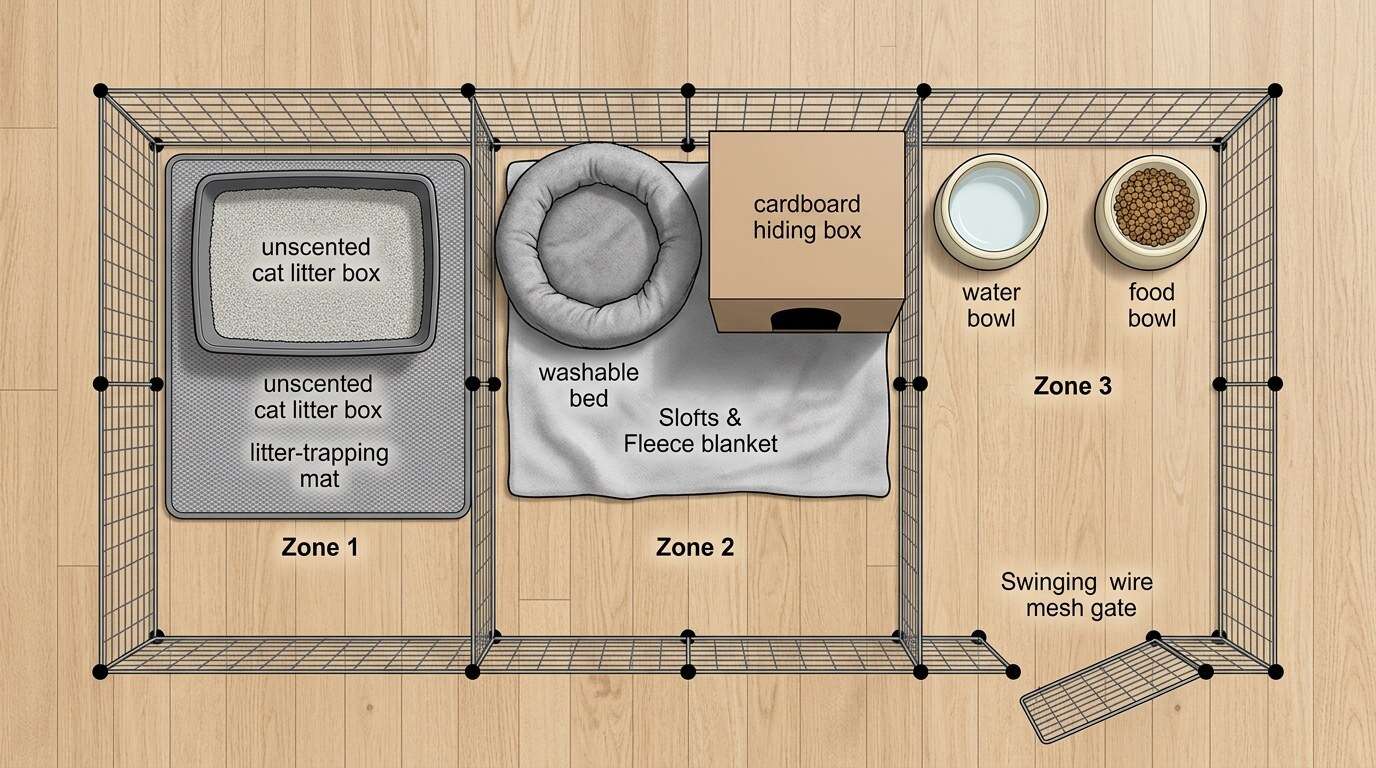
Litter box at one end. Choose a shallow box if she's recovering from surgery or has trouble stepping over a high edge. Keep it as far from the food as possible.
Food and water at the opposite end. Use heavy, stable bowls that won't tip. Cats often prefer water away from food, so if the space allows it, separate them.
A bed in the middle or a quiet corner. A soft, washable bed with a blanket that smells like home.
A hiding place. A box or a covered bed. Hiding helps cats cope with stress.
A shelf or low platform, if your vet permits climbing. If she has restrictions on jumping, skip it.
Litter
Use the type of litter she's used to.
Choose unscented litter, since strong smells can bother cats.
Scoop at least once a day, and more often if the space is small.
If she's recovering from surgery, ask your vet whether a soft, low-dust litter or paper-based litter is advised, because some types can stick to wounds.
Put a mat under the box to catch scatter.
Water and food
Offer fresh water and her regular food.
Change water daily and wash bowls.
Don't put the bowl next to the litter box.
If she's not eating, tell your vet.
Bedding and comfort
Soft, washable bedding
A cover over part of the enclosure for privacy, leaving ventilation
A comfortable temperature
No loose cords, strings, or small items she can chew
Enrichment
Confinement can be boring. Add:
- A scratching pad
- A toy she can bat, if safe
- A food puzzle, if her diet allows
- A window view, if possible
- Gentle interaction from you, if she wants it
- Keep toys simple and supervise anything with strings.
Daily routine
Check her several times a day.
Scoop the litter and clean up accidents.
Refresh water and food.
Spend time with her, even if it's just sitting nearby.
Give her time outside the cage if your vet allows and the room is safe.
Note her appetite, litter use, and behavior.
If she's confined for medical reasons, follow your vet's schedule for medication, wound care, and recheck visits.
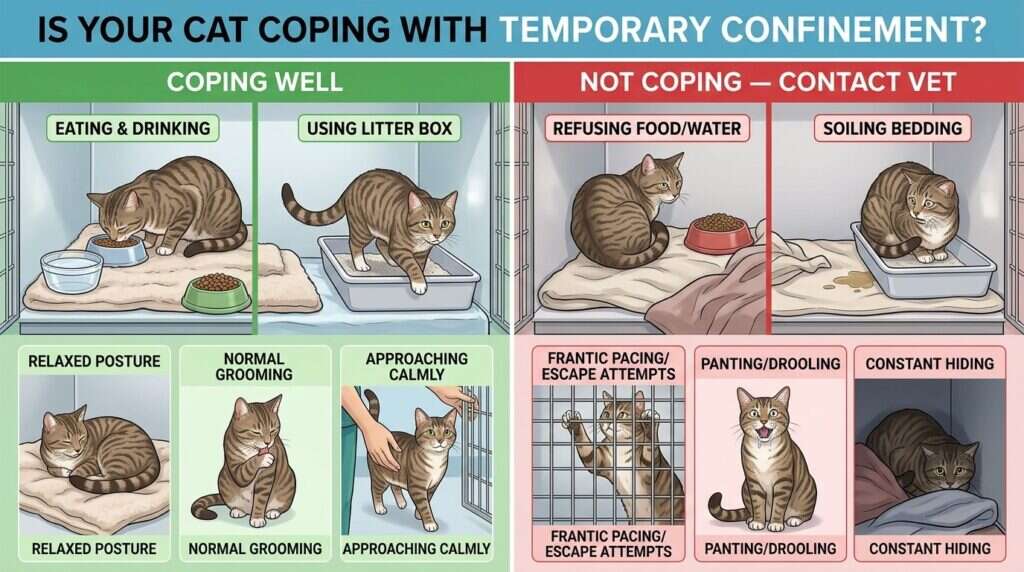
Signs she's coping or not
If she shows the signs on the right for more than a short time, try giving her more space, a hiding place, and quieter surroundings, and contact your vet.
Room-first alternative
A bathroom or a spare room is often better than a cage. Put the litter in one corner, food and water in another, and a bed and hiding places in a third. Remove hazards, such as cleaning products, small objects, and loose cords. Check windows and doors. For a new cat, a small room as a base lets her explore a controlled territory and adjust. Our first 30 days guide covers this in more detail.
Hygiene and safety
Wash your hands after handling her and cleaning.
Use mild, unscented cleaning products.
If she's sick, ask your vet about disinfecting and how to protect other pets.
Don't use essential oils or strongly scented sprays.
Check the enclosure for damage, sharp edges, and unstable parts.
Make sure the door latches securely.
Heat and cold
Cats in confined spaces can overheat or get chilly. Keep the temperature comfortable, avoid sun on the enclosure, and don't use heaters near it unless designed for pets. Provide cooler and warmer spots if possible.
Ending confinement
When the time is up, let her out gradually. Open the door and let her explore a small area first, then extend access. Keep the enclosure available as a retreat if she likes it. If she used it for introductions, follow a step-by-step plan.
When to talk to your vet
Before confining a cat for medical reasons, to ask about duration, space, and activity restrictions
If she isn't eating, drinking, or using the litter box
If she is highly distressed
If a wound looks worse, or her breathing changes
Frequently Asked Questions
Is it cruel to keep a cat in a cage?
Short-term, with adequate space and care, it can be appropriate. Long-term or cramped confinement is a welfare problem.
Can I put the litter box in the cage?
Yes. Keep it away from food and water.

How long can a cat stay in a cage?
Only as long as needed. For medical recovery, follow your vet's advice.
Should I cover the cage?
A light cover over part of it can help some cats feel secure. Keep ventilation.
What size cage is best?
As large as possible, with separate areas for toilet, food, and rest.
Should I leave the cat alone overnight?
Often yes, if she has what she needs, but follow your vet's advice if she's recovering.
Related reading
References
Association of Shelter Veterinarians, Guidelines for Standards of Care in Animal Shelters. Verify the current housing space recommendation before quoting 11 square feet.
International Cat Care, confinement and stress resources (icatcare.org)
Your vet's instructions for any medical confinement