
This post contains affiliate links. If you buy through them I may earn a commission, at no extra cost to you. I don't rank products here, because the right enclosure depends on your building and your cat.
A balcony or patio enclosure gives an indoor cat fresh air, sounds, and smells without exposing her to traffic, predators, or a fall. The risk is a poorly chosen one. Cats are strong, agile, and good at finding gaps, and a failed enclosure can mean an escape or a fall from height. This guide covers the main types, what to check on mesh, frame, and doors, the permission and building issues to sort out first, the heat and health considerations, and how to introduce your cat so she enjoys it.
Short answer
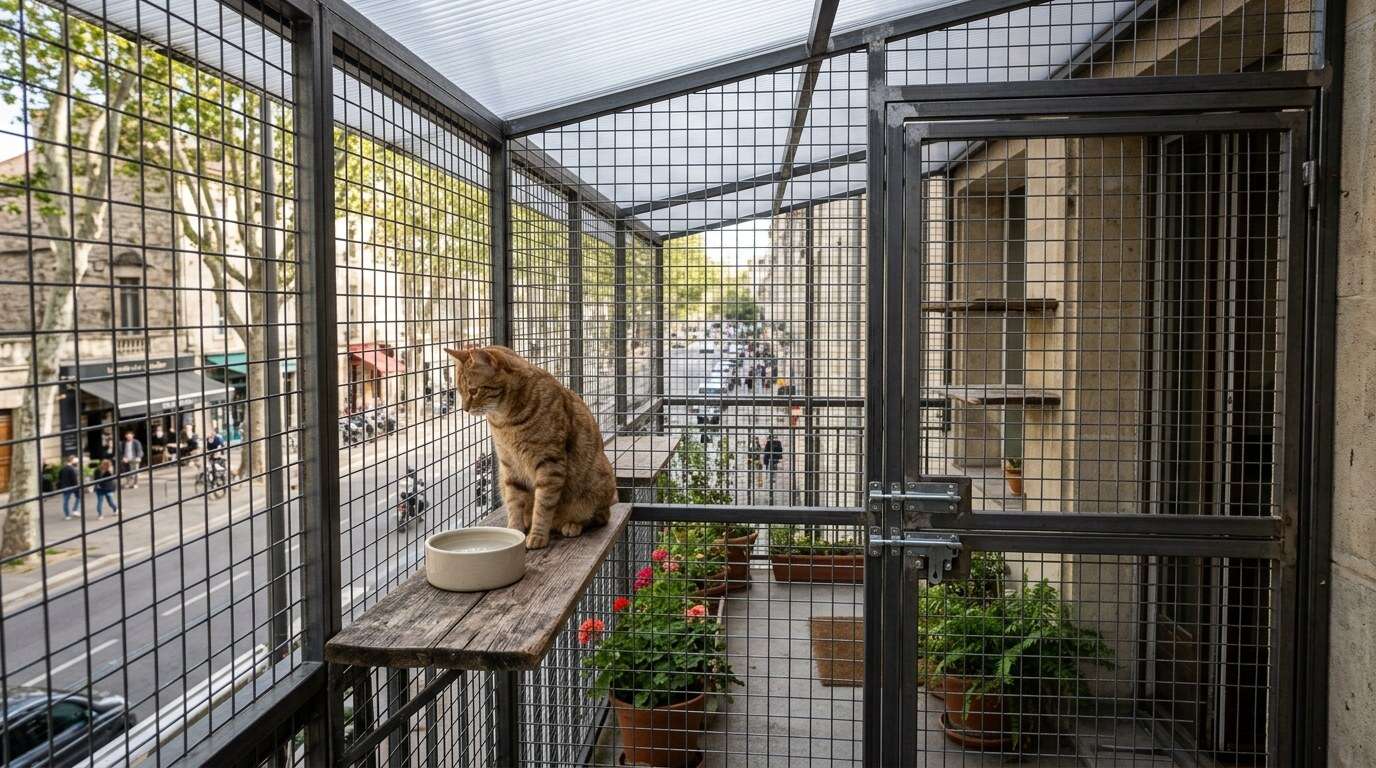
Choose an enclosure with a rigid, fully closed structure, mesh or netting that your cat can't squeeze through or chew, a secure double-latched door, and no gaps at the edges or base. Get your landlord's or building's permission in writing before you install anything. Supervise at first, provide shade and water, and speak to your vet about parasite and vaccination protection before outdoor air time.
In this guide:
- Check permission first
- Types of enclosures
- Safety features that matter
- Mesh and netting
- Frame and anchoring
- Doors and latches
- Wind and weather
- Falling objects
- Health and comfort considerations
- Heat and cold
- Parasites and disease
- Plants and hazards
- Surfaces
- Visitors and wildlife
- Falls and escapes
- How to measure and plan
- Introducing your cat
- Setting up the inside
- Frequently asked questions

Check permission first
Before you shop, find out what you're allowed to do.
Lease or HOA rules. Many buildings ban attachments to balcony railings, walls, or the facade. Some allow netting or freestanding enclosures.
Building codes and fire safety. Balconies can be designated fire egress routes, and blocking them may be prohibited. Ask your building manager.
Local rules. Some areas regulate structures on balconies or patios.
Weight limits. Balconies have load limits, and a freestanding enclosure with furniture adds weight. Check with the building.
Appearance rules. Some buildings regulate what can be visible from outside.
Get any approval in writing. If your landlord says no, window-mounted options or supervised harness time may be alternatives.
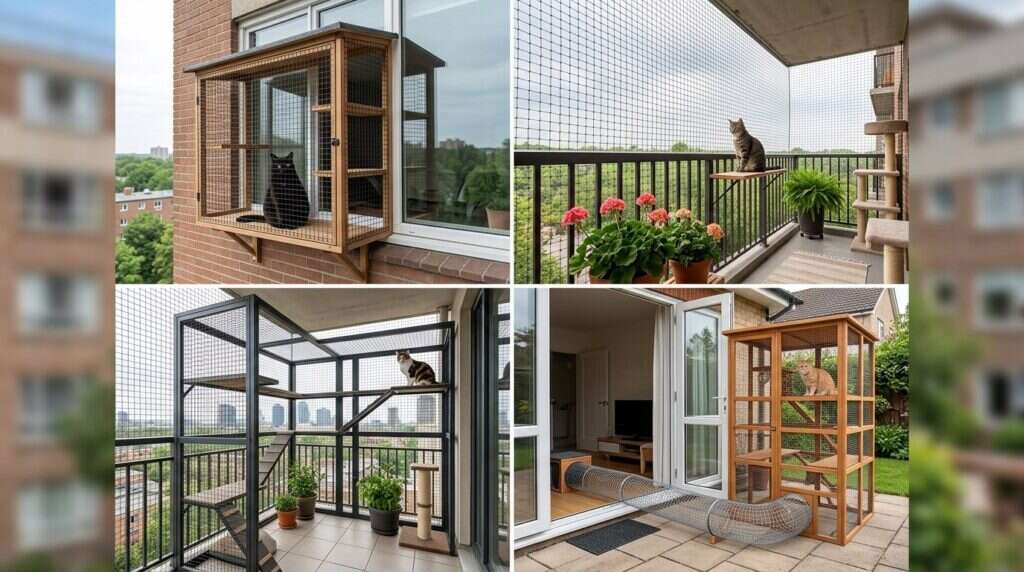
Types of enclosures
Safety features that matter
Mesh and netting
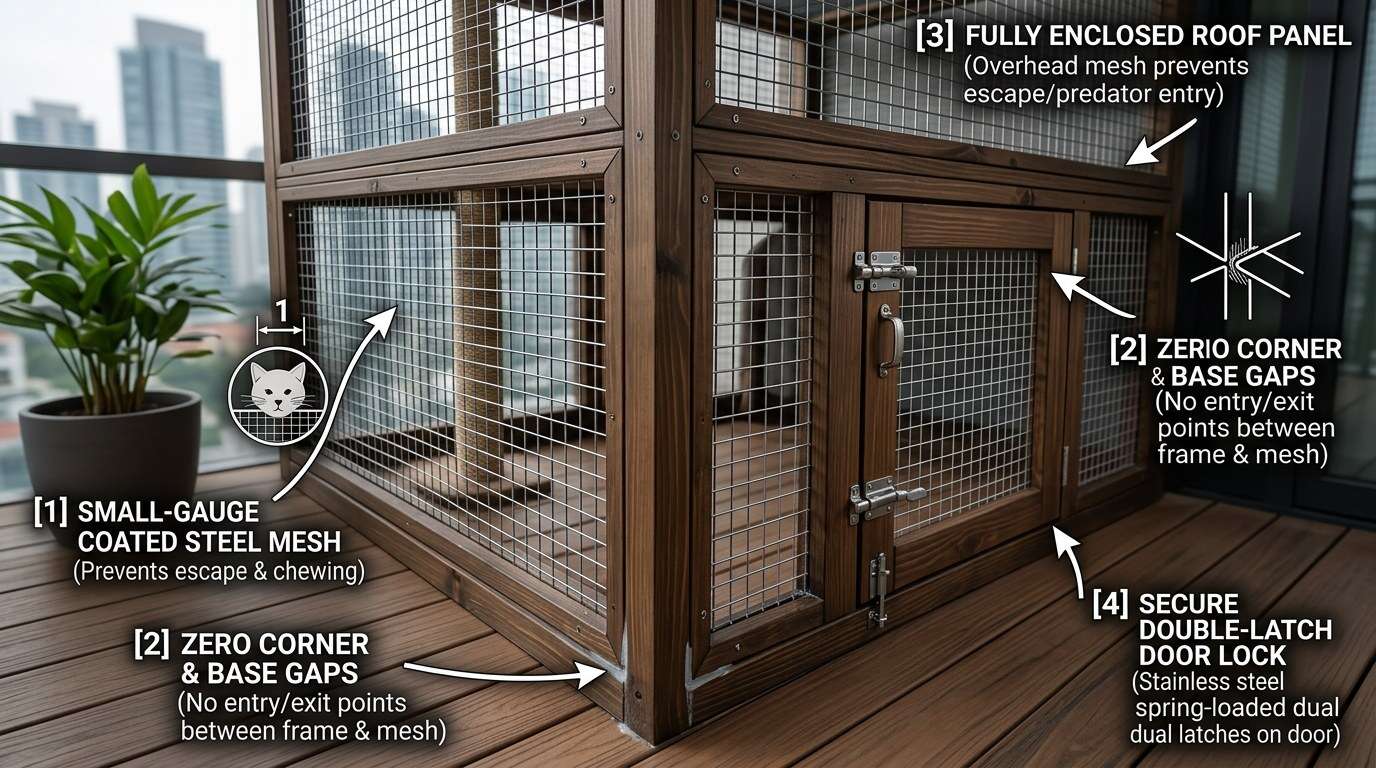
Gap size. The openings must be small enough that your cat can't push her head or body through. Manufacturers often state a maximum mesh size. Kittens and small cats need smaller openings than adults. If in doubt, choose smaller.
Material. Cats can chew through thin plastic netting, and sunlight can weaken it. Look for cat-specific, UV-resistant products, or steel or coated wire mesh. Check the strength rating.
Edges and joints. Gaps at corners, where mesh meets a wall or a railing, and at the base are the usual escape points. Check every join.
Roof. Cats climb. A fully covered top is safer than an open one.
Floor. On a patio, make sure your cat can't dig under or squeeze through gaps below the frame.
Frame and anchoring
The frame should be rigid and secured against wind, jumping, and climbing. Test it by pushing, shaking, and leaning on it. On a balcony, ask whether anchors will damage the structure, and whether a professional should install it.
Doors and latches
Cats learn latches. Use a door that closes firmly and has a secure latch, ideally a double latch or a lock. If the enclosure is attached to a room by a cat door, add a way to close it when you aren't home.
Wind and weather
Wind can loosen netting, tip lightweight frames, and blow objects in. Choose a design appropriate to your building's height and exposure. High-rise balconies are windier.
Falling objects
Make sure nothing can fall from the enclosure to people below. This includes toys, plants, and loose items.
Health and comfort considerations
Heat and cold
Balconies can be much hotter or colder than indoors. Direct sun can heat surfaces quickly, and a cat in an enclosed area can overheat. Provide shade, a cool resting spot, and fresh water. Don't leave your cat out in extreme heat or cold, and don't leave her unattended until you know how she responds. Signs of overheating include panting, drooling, restlessness, and lethargy, and require immediate attention.
Parasites and disease
Outdoor air time can increase exposure to mosquitoes, fleas, and ticks, and to other animals through the mesh. Talk to your vet about parasite prevention and whether any vaccines should be updated. Mosquitoes can carry heartworm to cats, and the American Heartworm Society recommends preventive medication for cats in areas where heartworm occurs.
Plants and hazards
Keep any plants in the enclosure cat-safe. Check them against the ASPCA's database, and avoid fertilizers and pesticides. Remove sharp objects, standing water that attracts insects, and anything the cat can chew and swallow.
Surfaces
Hot metal or rough concrete can hurt paws. Add a shaded rug or wooden platform where needed.
Visitors and wildlife
Birds, insects, and neighborhood cats can be exciting or frightening. Some cats become stressed or aggressive when they can see animals they can't reach. Watch her body language. If she seems stressed, add screening or reduce the time.
Falls and escapes
Falls from balconies and windows are a recognized cause of injury in cats, often called high-rise syndrome. A cat can jump at a bird without thinking. Don't rely on a balcony railing as a barrier, and don't allow free access to an unsecured balcony or open window. A properly built enclosure is a safer option than none.
Plan for the possibility of an escape.
Keep her microchip details up to date.
Put an ID tag on a breakaway collar if she tolerates one.
Take clear photos of her face and markings.
Keep a carrier handy.
Know the local shelter and lost-pet resources.
Our escape response guide explains what to do in the first hours.
How to measure and plan
Check permission in writing.
Measure the space. Note railing height and gaps, wall materials, anchoring points, and any obstacles.
Decide how she will enter. A door, a window, or a tunnel.
Choose the type that fits the building and her personality.
Plan shade, water, and a rest spot inside the enclosure.
Check for weaknesses after assembly. Press on every joint and gap.
Introduce her gradually (below).
Review regularly, since netting, joints, and latches can wear.
Introducing your cat
Let her investigate while the door is open, with you present.
Start with short supervised sessions of a few minutes.
Put familiar items inside, such as a blanket or a favorite toy.
Use treats to make it a good place.
Watch her body language. Flattened ears, a low crouch, dilated pupils, and frozen posture mean she is uneasy. End the session calmly.
Don't force her out, and don't leave her alone until you are sure she is comfortable and the enclosure is secure.
Some cats love it, some are indifferent, and a few are frightened. It is fine if yours doesn't want to use it.
Setting up the inside
- A shaded, sheltered rest spot
- Fresh water in a stable bowl
- Perches at different heights, secured
- A scratching post
- Safe plants or cat grass
- A hiding box
- A non-slip floor surface
- Toys you've checked for safety
- When to talk to your vet
Before starting regular outdoor time, to discuss parasites and vaccines
If your cat shows signs of heat stress, stress, or injury
If she has a health condition that could be affected by temperature or exposure
Frequently Asked Questions
Is a balcony enclosure safe for a cat?
A well-built, properly installed one is much safer than an open balcony. No enclosure is perfect, so inspect it regularly and supervise at first.
Can I use regular garden netting?
Not recommended. Look for cat-specific, strong, UV-resistant products with suitable mesh size.
What mesh size is safe?
Small enough that a cat can't fit her head or body through. Follow manufacturer guidance and go smaller for kittens.
Can I leave my cat outside in the enclosure when I'm out?
Only once you're confident the structure is secure, the weather is safe, and she is comfortable. Start with supervised time.
Do I need to tell my landlord?
Yes, if the structure attaches to or alters the building. Get permission in writing.
Do indoor cats need flea or heartworm prevention if they have an enclosure?
Ask your vet. Mosquitoes and fleas can reach an enclosure.
What if my cat hates it?
Try short sessions with treats. If she remains stressed, don't force it. Other enrichment options are available.
Related reading
References
American Heartworm Society, feline heartworm guidelines (heartwormsociety.org)
ASPCA, toxic and non-toxic plants (aspca.org)
International Cat Care and AAFP environmental guidelines (icatcare.org, catvets.com)
A veterinary source on high-rise syndrome in cats
Manufacturer specifications for mesh size, strength, and weight ratings. Check these for any product you name.
Cat Window Safety for Apartments: Screens, Stops and Falls