This post may contain affiliate links. If you buy through them I may earn a commission, at no extra cost to you.
Two scoops of indoor dry cat food can contain very different amounts of energy. A cup of one brand can have noticeably more calories than a cup of another, so comparing foods by volume tells you almost nothing. Energy density, meaning kilocalories (kcal) per gram, kilogram, cup, or can, is the number that lets you compare foods and set a portion. This guide shows where to find it, how to convert it, and how to avoid the most common mistake with indoor dry cat food, which is feeding by the cup without knowing what the cup contains.
Short answer
Find the calorie statement on the label (kcal per kg and kcal per cup or can), convert everything to the same unit, and divide your cat's daily calorie target by the food's kcal per gram. Treat the feeding chart on the package as a starting point and adjust to your cat's weight and body condition with your vet.
In this guide:
Where to find the number
In the United States, many cat foods print a calorie statement, usually as "kcal ME/kg" (metabolizable energy per kilogram) plus kcal per cup or per can. If it is missing from the package, check the manufacturer's website or contact the company. A company that can't give you the number is a poor choice for a cat that needs weight control.
Calories on pet food labels are an estimate and the numbers are for the food as sold, including its water.
Convert to kcal per gram
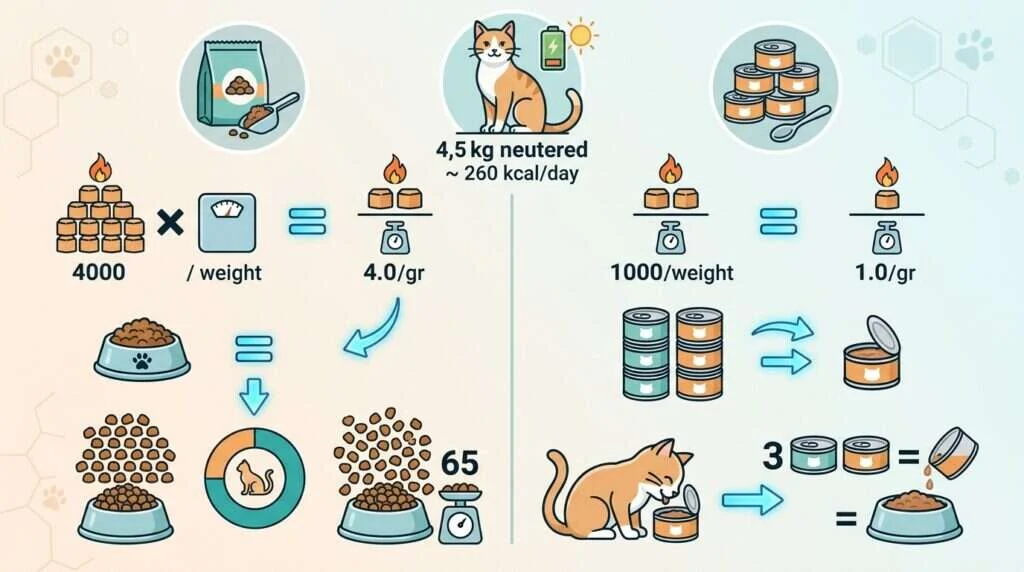
Divide kcal per kg by 1,000.
A dry food listed at 4,000 kcal/kg has 4.0 kcal per gram.
A wet food listed at 1,000 kcal/kg has 1.0 kcal per gram.
Dry foods commonly sit somewhere around 3,500 to 4,500 kcal/kg, and wet foods usually have far fewer calories per gram because of their water content. Check the label for your exact product.
Why cups mislead
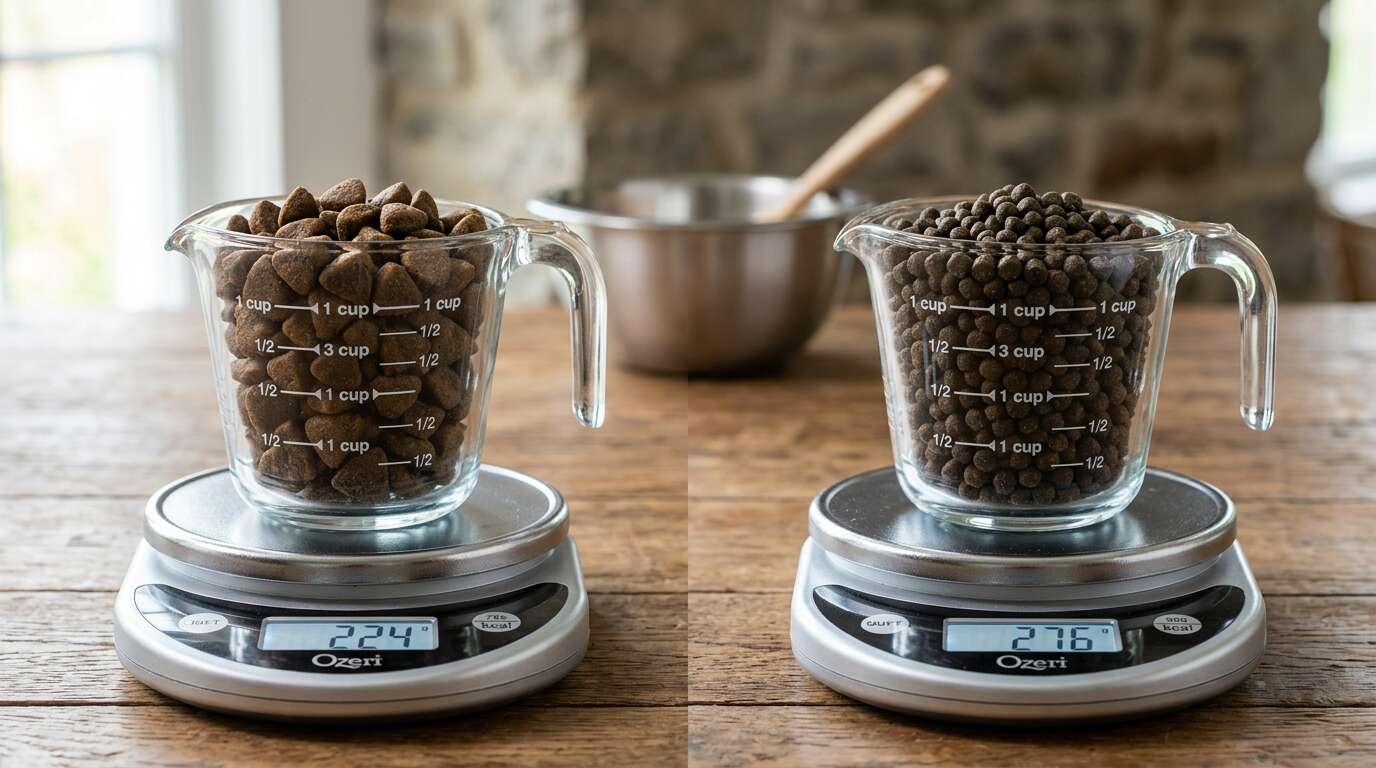
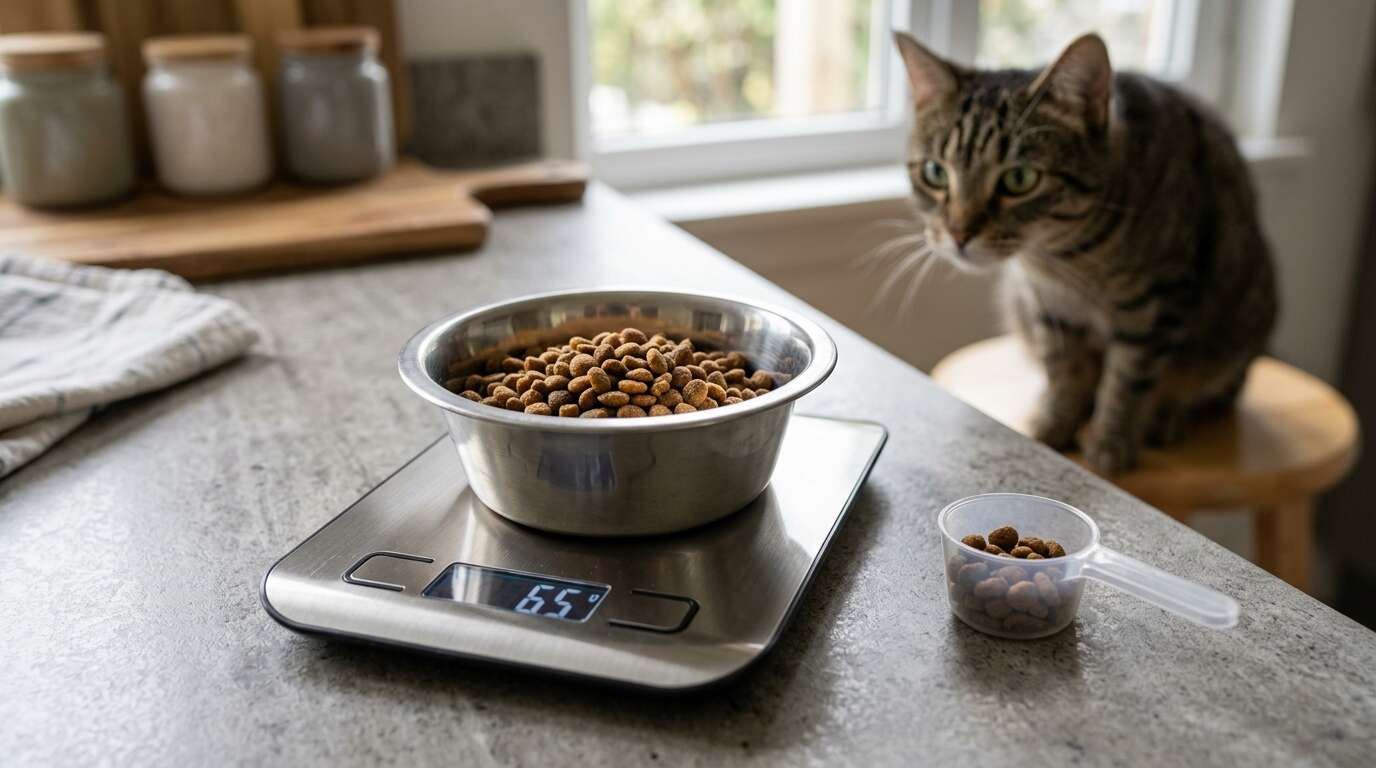
Kibble differs in size, shape, and density, so a level cup of one food can weigh more or less than a level cup of another. A scoop that comes in the bag may not be a standard cup. Weigh the food on a kitchen scale for a week or two and you will see how much a "scoop" varies from day to day.
A worked example
These numbers are hypothetical, to show the method.
A neutered adult indoor cat weighs 4.5 kg. A common starting estimate for daily energy is resting energy requirement (RER) multiplied by a factor. RER = 70 x (body weight in kg) to the power of 0.75. For 4.5 kg that is about 216 kcal. Many guidelines use a factor of about 1.2 for a neutered adult cat, which gives about 260 kcal per day.
If fed only a dry food at 4.0 kcal/g: 260 / 4.0 = 65 g per day.
If fed a wet food at 1.0 kcal/g in 85 g cans: each can has about 85 kcal, so 260 kcal is a little over three cans.
This is a starting estimate. Cats differ in age, activity, and body condition, and some need much less. Ask your vet to set the target, then weigh your cat every few weeks and adjust.
Compare on a dry matter basis for protein and fat
The guaranteed analysis on a can shows protein as fed, including water. To compare a wet food with a dry one, remove the water.
Dry matter protein = protein % / (100 minus moisture %) x 100
Hypothetical example:
Wet food: 10% protein, 78% moisture. 10 / 22 = 45% protein on a dry matter basis.
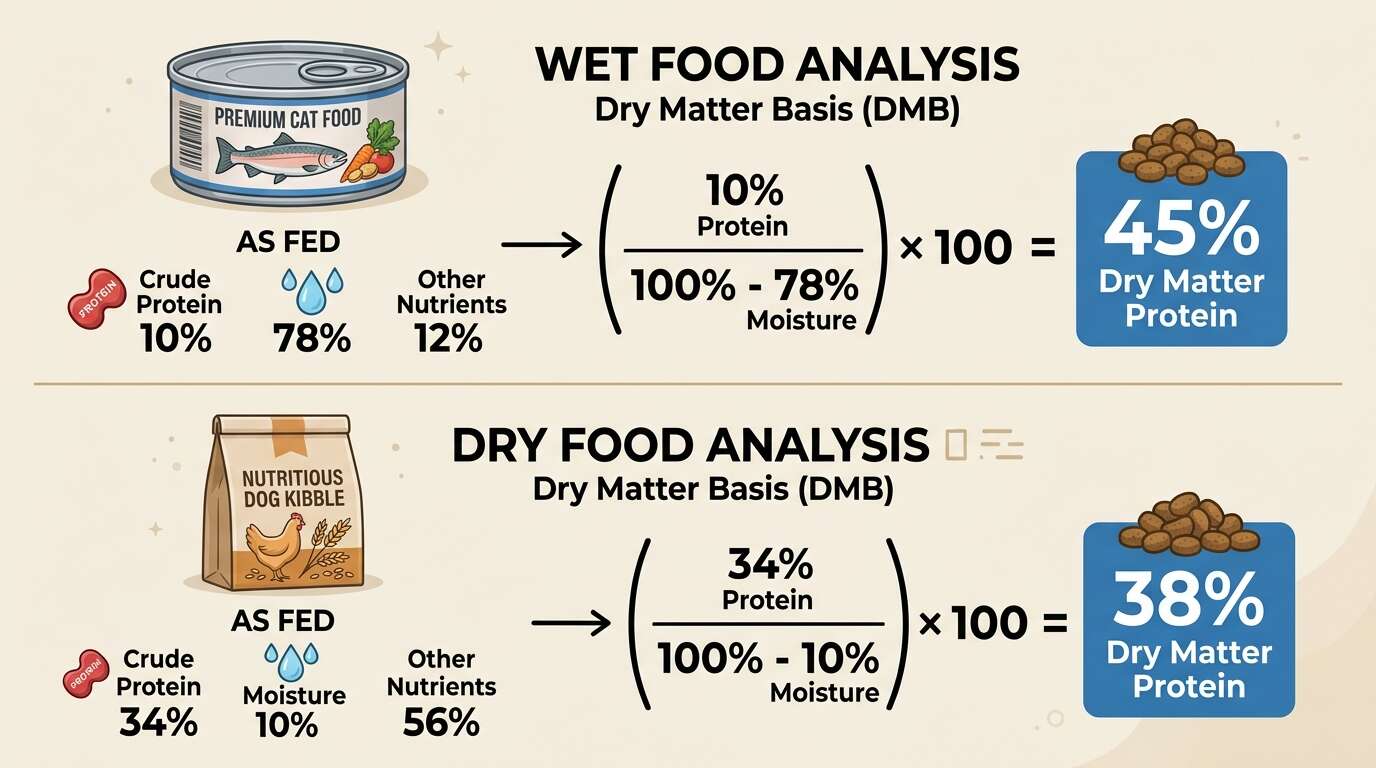
Dry food: 34% protein, 10% moisture. 34 / 90 = about 38% on a dry matter basis.
The wet food has less protein as printed and more once the water is accounted for. Without this step you can misread a label.
What "indoor" formulas change
Foods marketed for indoor cats are usually adult formulas with fewer calories, more fiber, or a hairball claim. Because there's no AAFCO category for "indoor," those features are the manufacturer's design choice. A food labeled for indoor cats is not automatically low calorie, so check the kcal per gram against other adult foods. Some indoor formulas are lower in calories than a standard adult food and some are close to equal.
Weight control for indoor cats
Indoor cats burn fewer calories on average, and neutering lowers energy needs further. If your cat is gaining, the choice is usually less food, a lower-calorie food, or more activity, and often a mix of these. Don't cut calories sharply or fast, especially for a cat that is already overweight. Rapid weight loss in cats can lead to serious liver disease, so a vet should supervise any weight-loss plan.
How to use this in practice
Weigh your cat and ask your vet for a daily calorie target.
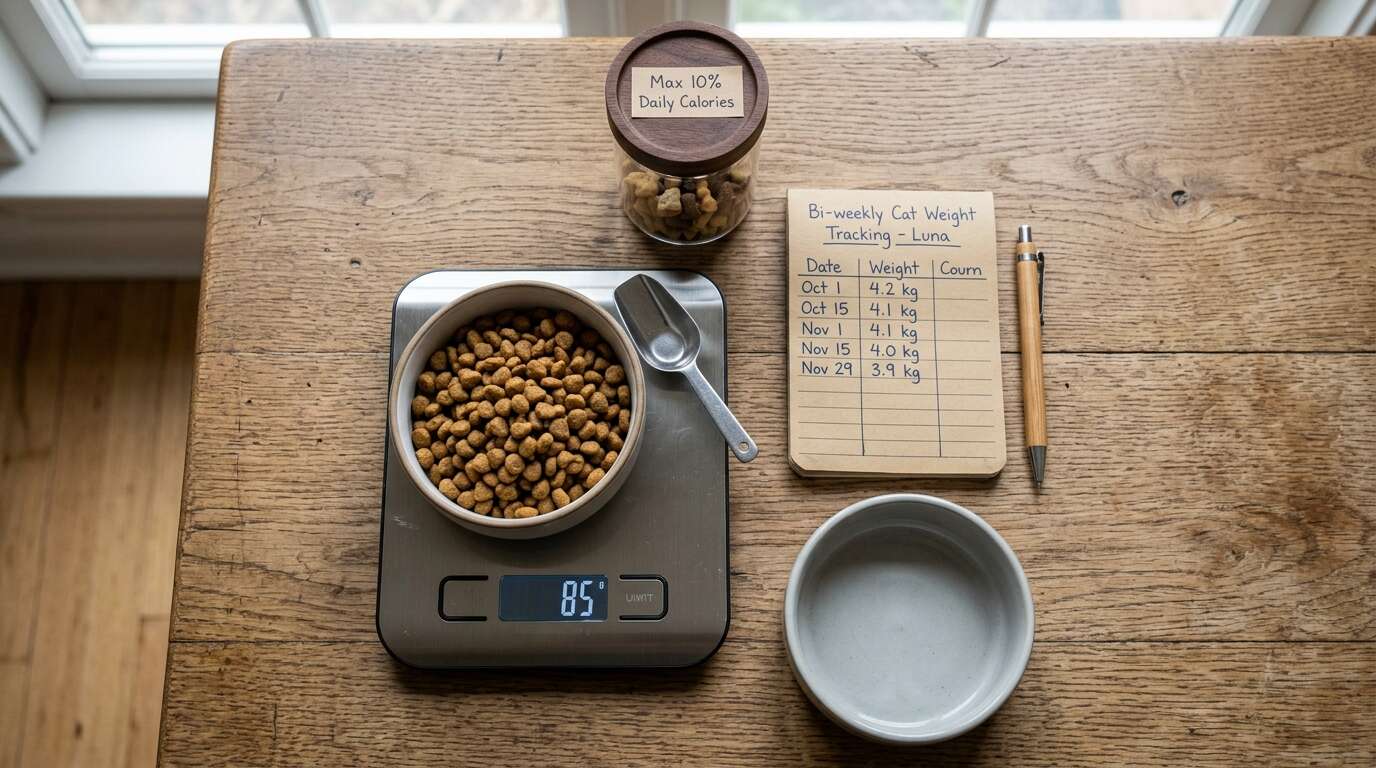
Write down the kcal per gram of every food you use, including treats.
Weigh each meal on a kitchen scale for a month.
Count treats. Many vets suggest keeping them to a small fraction of daily calories, such as around ten percent.
Weigh your cat on a schedule and adjust.
When to talk to your vet
See your vet if your cat is losing weight without being on a plan, gains rapidly, drinks and urinates much more than usual, or has a change in appetite.
Frequently Asked Questions
How many calories does an indoor cat need?
It depends on weight, age, neuter status, and activity. The method above gives a starting estimate, not a prescription.
Is wet food lower in calories?
Per gram, usually yes, because it has more water. Per can the totals vary, so read the label.
Do the calories on the label include treats?
No. Count them separately.
Related reading
References
AAFCO, pet food label information and calorie statements (aafco.org)
WSAVA Global Nutrition Committee, nutritional assessment guidelines (wsava.org)
AAHA nutrition and weight management guidelines for dogs and cats (aaha.org)
How to Make an Indoor Cat Happy: A Practical Welfare Checklist