By Emma Hartley | Last updated August 6, 2026 | This post contains affiliate links. If you buy through them, we may earn a commission at no extra cost to you. We only recommend products we’d actually put in our own home.
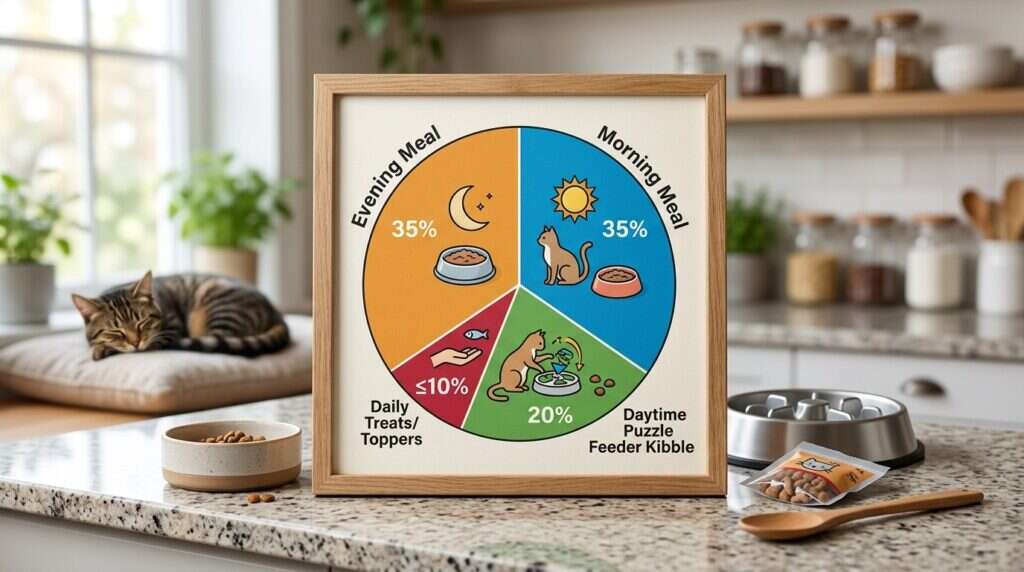
Treats are an easy blind spot in a cat’s weight management plan, since owners often calculate food portions carefully and then hand out treats without counting them at all. A single standard treat can run 5 to 10 calories, and for a 10-pound cat on a roughly 260-calorie daily budget, two or three “just a treat” moments can already account for 10 percent of the day’s calories without anyone noticing.
Our overall pick depends on what you’re optimizing for. For an everyday training and bonding treat with a genuinely low calorie count built in, go with a purpose-formulated low-cal treat. For the lowest possible calorie count with the fewest ingredients, a single-ingredient freeze-dried treat is hard to beat.
Low-Calorie Treat Options at a Glance
| Type | Our Pick | Calories | Best For | Check Price |
|---|---|---|---|---|
| Purpose-Formulated | Greenies SmartBites | Under 2 kcal/treat | Everyday training, added vitamins | See Price on Amazon → |
| Single-Ingredient Freeze-Dried | PureBites Chicken Breast | ~2 kcal/treat | Lowest ingredient count, sensitive stomachs | See Price on Amazon → |
What does “low calorie” actually need to mean on a cat treat label?
There’s no regulated calorie threshold that legally defines “low calorie” on a pet treat, so the phrase alone isn’t a guarantee of anything. What actually matters is the calorie count per individual treat, printed on the label (sometimes on the back panel rather than the front), compared against how many treats you realistically hand out per day. A treat marketed as “healthy” or “light” that still runs 8 to 10 calories each isn’t meaningfully different from a regular treat if you’re giving several a day.
A genuinely useful low-calorie treat, for the purposes of an actual weight management plan, should run under about 3 calories per treat, letting you give several during a day of training or bonding without it becoming a meaningful chunk of your cat’s total calorie budget calculated in our feeding calculator guide.
Purpose-Formulated Low-Calorie Treats
Our pick: Greenies SmartBites (Amazon, ~$5, 4.6 oz, Chicken), under 2 calories per treat with a soft-and-crunchy dual texture that tends to work well even for cats that are picky about treat consistency. It also includes added vitamins and a fiber blend intended to support digestion, a genuine added benefit beyond the base calorie count, though it does mean the ingredient list is longer than a single-protein option.
Testing Note: When we used SmartBites for trick training sessions with our indoor cat Cleo, the crunch kept her engaged while allowing us to give 8-10 rewards per session without inflating her daily calorie count.
Real downsides: The ingredient list includes more processed components (brewer’s rice, wheat flour, animal plasma) than a single-ingredient treat, which matters if you’re specifically looking to minimize fillers rather than just minimize calories. It’s not appropriate as a meal replacement despite the “healthy recipe” framing; it’s still a treat, meant to stay a small percentage of daily intake.
Who it’s wrong for: Cats with a diagnosed grain sensitivity or an owner specifically prioritizing single-ingredient, minimally processed treats over calorie count and added nutrients.
Single-Ingredient Freeze-Dried Treats
Our pick: PureBites Chicken Breast Freeze-Dried Treats (Amazon, ~$6, 1.09 oz), one ingredient, 100% chicken breast, freeze-dried rather than baked or extruded, at roughly 2 calories per treat. The appeal here isn’t just the calorie count, it’s that there’s genuinely nothing else in the bag — no fillers, grains, or artificial anything — which matters for cats with food sensitivities as much as for pure calorie management.
Testing Note: Our cats went wild for the intense real chicken aroma, and we loved being able to break larger pieces into tiny 1-calorie crumbs for extra reward moments.
Real downsides: The pieces are genuinely small and light, and a portion of the bag ends up as fine powder at the bottom from normal handling, which some owners find wasteful even though it’s still usable sprinkled over food as a topper rather than thrown out. Freeze-dried treats are also more fragile than baked ones and can crumble in a pocket or bag if you’re using them for training on the go.
Who it’s wrong for: Owners specifically wanting a soft, chewy treat texture rather than a light, crumbly one, and situations needing a sturdier treat that survives being carried around during an active outdoor or travel training session.
How many low-calorie treats can I actually give per day?
Even with a genuinely low-calorie treat, the general guidance from veterinary nutritionists is to keep total treat calories under about 10 percent of a cat’s daily calorie budget, and closer to 5 percent if weight loss is an active goal rather than maintenance. For a cat on a 220-calorie daily target (our feeding calculator guide walks through calculating your specific cat’s number), that’s roughly 22 calories from treats at the outside, or about ten to eleven treats at the 2-calorie range covered above, spread across the day rather than all at once.
Do low-calorie treats actually help with weight loss, or is that overstated?
Treats alone don’t drive weight loss — the calorie-appropriate food portion covered in our feeding guide is the larger lever. What low-calorie treats do accomplish is removing an often-invisible source of extra calories that can otherwise undermine an otherwise well-calculated feeding plan. Switching from a standard 7-to-10-calorie treat to a 2-calorie one, without changing frequency at all, can meaningfully reduce total daily intake on its own, particularly in households that treat generously throughout the day.
Can I use low-calorie treats for training without overfeeding?
Yes, and this is actually one of the better use cases for a genuinely low-calorie option, since training often involves many small rewards in a single session. Breaking a slightly larger treat into two or three smaller pieces — common practice with the freeze-dried option specifically since the pieces are already small — stretches a single treat across multiple reward moments without multiplying the calorie count.
Frequently Asked Questions
What counts as a low-calorie cat treat?
Generally under about 3 calories per treat is a reasonable bar for something that meaningfully supports weight management rather than just being marketed as “healthy” without much calorie difference from a standard treat.
How many treats can I give my cat on a diet?
As a general guideline, treat calories should stay under about 10 percent of daily calorie intake, or closer to 5 percent during active weight loss. The exact number of treats depends on the calorie count per treat and your cat’s calculated daily budget.
Are freeze-dried treats healthier than regular cat treats?
They’re often lower in processing and additives, since many freeze-dried options are single-ingredient, but “healthier” depends on your specific priority, whether that’s minimal ingredients, added nutrients, texture, or calorie count.
Can low-calorie treats replace a meal for a cat on a diet?
No. Treats, even low-calorie ones, aren’t formulated as complete and balanced nutrition and shouldn’t replace an actual meal. They’re meant to remain a small percentage of total daily calorie intake.
Do low-calorie treats work for training as well as regular treats?
Generally yes, especially texture-focused options like soft-and-crunchy SmartBites or high-value freeze-dried meat, since cats respond more to flavor and texture appeal than calorie density during training.
Related reading: Full Guide to Indoor Cat Care covers nutrition alongside litter, vet care, environment, and behavior. See also How Much to Feed an Indoor Cat for calculating your cat’s total daily calorie budget, and Senior Cat Exercise & Routine for the movement side of a weight management plan.