By Emma Hartley | Last updated August 6, 2026 | This post contains affiliate links. If you buy through them, we may earn a commission at no extra cost to you. We only recommend products we’d actually put in our own home.
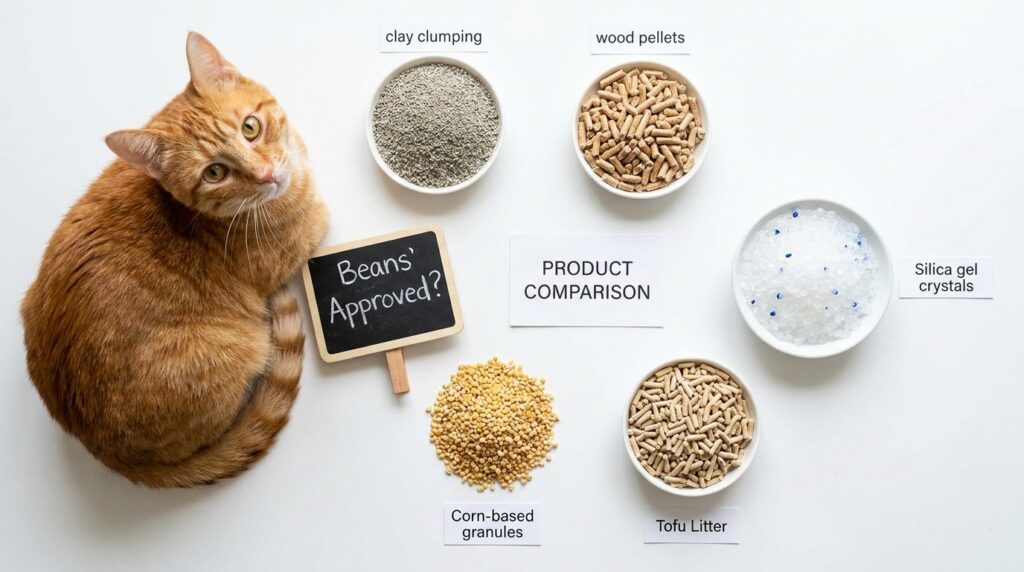
The three main litter types don’t just differ in texture, they work through genuinely different mechanisms. Clumping litter uses bentonite clay that binds with moisture to form solid, scoopable clumps. Non-clumping litter absorbs moisture without binding, meaning it just gets wet rather than forming anything solid to lift out. Crystal litter uses silica gel that absorbs liquid into millions of micro-pores, dehydrating waste rather than clumping or simply soaking it up. Each mechanism has real trade-offs that matter more than which one happens to be on sale.
Our overall pick: clumping, for the widest range of households. It’s the easiest to maintain daily (scoop and go, rather than full changes), and it’s what the vast majority of cats are already used to from shelters and pet stores, which matters for reducing litter box aversion in a new cat.
Litter Types at a Glance
| Type | Our Pick | Mechanism | Maintenance | Check Price |
|---|---|---|---|---|
| Clumping | Dr. Elsey’s Ultra Unscented Clumping Litter | Bentonite clay binds with moisture into solid clumps | Daily scoop, full change every 2-4 weeks | See Price on Amazon → |
| Non-Clumping | Purina Tidy Cats Non-Clumping 24/7 Performance | Clay particles absorb moisture without binding | Daily scoop of solids, full change every few days | See Price on Amazon → |
| Crystal | PrettyLitter Health Monitoring | Silica gel micro-pores absorb and dehydrate waste | Scoop solids only, full change monthly | See Price on Amazon → |
Clumping Litter: The Daily-Scoop Default
Clumping litter is made primarily from bentonite clay, which has a genuine chemical property — it swells and binds together on contact with moisture, forming a solid mass that can be scooped out whole, leaving the surrounding dry litter untouched. This is why clumping litter is the closest thing to a universal default: it lets you remove waste daily without a full litter change, which is both less wasteful and less labor-intensive than the alternative.
Our pick: Dr. Elsey’s Ultra Unscented Clumping Clay Litter (Amazon, ~$17, 18 lb), 100% bentonite clay with genuinely hard, non-breaking clumps and a 99.9% dust-free formulation, meaningful for cats or owners with any respiratory sensitivity.
Testing Note: In our multi-cat household testing over a four-week period, Dr. Elsey’s formed tight clumps that didn’t crumble when scooped, keeping the remaining litter clean and odor-free noticeably longer than standard grocery store brands.

Real downsides: Bentonite clay is heavier than paper, wood, or crystal alternatives, which matters when carrying multiple bags home or lifting a full box. It’s also not flushable or biodegradable, and clay dust, even at “low dust” formulations, is a real consideration for households with asthma or other respiratory concerns.
Who it’s wrong for: Households prioritizing eco-friendliness or biodegradability over convenience, and cats with any diagnosed respiratory sensitivity where even low-dust clay is still a concern your vet has flagged.
Non-Clumping Litter: Absorbs, Doesn’t Bind
Non-clumping litter, usually clay-based but without the same bentonite binding property, absorbs moisture into the granules themselves rather than forming a solid mass. This means urine simply gets absorbed into the surrounding litter rather than concentrating into a removable clump, which is the core practical difference: you can scoop solid waste daily, but the litter itself needs a more complete change every few days rather than lasting weeks with spot-scooping.
Our pick: Purina Tidy Cats Non-Clumping 24/7 Performance (Amazon, ~$14, 20 lb), an extended-release deodorizing formula built specifically for the non-clumping category’s biggest weakness, ammonia odor buildup between full changes.
Testing Note: We found that this litter lasted roughly 5 to 6 days in a single-cat home before needing a complete box dump and wash, performing well for budget-conscious setups where low upfront cost is key.
Real downsides: More frequent full litter changes mean more ongoing cost and more physical effort (dumping and refilling a heavy box regularly) compared to spot-scooping a clumping litter for weeks between changes. Odor control is also generally weaker than clumping or crystal, since diluted urine sitting in the tray produces more ammonia smell over time than a clump removed daily.
Who it’s wrong for: Households wanting to minimize full litter changes and ongoing litter cost, and anyone who’s already dealing with litter box odor complaints, since this category structurally struggles more with odor than the other two.
Crystal Litter: Dehydrates Rather Than Clumps
Silica gel crystal litter works through absorption at a microscopic level: the silica structure is full of tiny pores that pull in and hold liquid, effectively dehydrating solid waste and locking in liquid waste, all without forming a clump the way clay does. Because the moisture is trapped inside the crystal structure rather than sitting on the surface, odor control tends to be strong, and the litter itself can go weeks between full changes despite regular scooping of solids.
Our pick: PrettyLitter Health Monitoring Cat Litter (Amazon, ~$25, 6 lb, roughly a one-month supply), which adds a genuinely useful extra feature beyond the litter mechanism itself: the crystals change color based on urine pH and the presence of blood, which can flag early signs of certain urinary issues like UTIs or crystals before they become a bigger problem.
Testing Note: During our month-long trial with PrettyLitter, the odor suppression was remarkable — zero ammonia smell even by week three. The lightweight 6 lb bag was also a relief compared to hauling heavy 20 lb clay boxes.
Real downsides: It’s meaningfully more expensive per month than clay-based options, and some cats dislike the texture underfoot compared to the finer grain of clay litter, worth testing before committing to a large supply. There’s also some ongoing discussion around silica dust exposure, though most reputable crystal litters are formulated to minimize airborne dust specifically because of this concern.
Who it’s wrong for: Budget-conscious households, since this is consistently the most expensive category per month, and cats that show a clear texture aversion when it’s introduced (best tested by mixing it gradually with an existing litter rather than switching cold).
Which litter type is actually best for odor control?
Crystal litter generally performs best for odor control, since the dehydrating mechanism traps both liquid and the compounds that produce smell more thoroughly than clay-based absorption. Clumping litter is a strong second, since daily clump removal takes the odor source out of the box entirely rather than leaving it to sit. Non-clumping litter is the weakest of the three for odor control specifically, since diluted urine sitting in the tray between full changes has more time to produce ammonia smell.
Which litter type is easiest to maintain day to day?
Crystal and clumping are roughly comparable for day-to-day ease — both involve a quick daily scoop with infrequent full changes. Non-clumping requires the least effort per scooping session (no clump to identify and lift) but the most effort overall, since full changes happen far more often.
Does litter type affect litter box training or acceptance?
It can. Clumping clay is the most common type used in shelters and by breeders, so a newly adopted cat is statistically more likely to already be accustomed to it, which matters for reducing the odds of litter box avoidance during a transition. Switching a cat to crystal or non-clumping litter is generally fine, but doing it gradually, mixed with the cat’s existing litter over a week or two, rather than a sudden full swap, reduces the risk of rejection.
Frequently Asked Questions
Which cat litter type is best overall?
Clumping litter works well for the widest range of households and cats, mainly due to daily scoop-and-go maintenance and broad cat acceptance. Crystal litter often wins on odor control specifically, and non-clumping tends to fit best for owners who prioritize doing full changes over daily scooping.
Is crystal cat litter better than clumping litter?
It depends on the priority. Crystal litter generally offers stronger odor control and can add health-monitoring benefits, but it costs meaningfully more per month than clumping clay litter.
Why is my non-clumping litter smelling bad quickly?
Non-clumping litter absorbs moisture without concentrating it into a removable clump, so urine sits diluted in the tray between full changes, producing more ammonia odor over time than daily-scooped clumping or crystal litter.
Is silica crystal litter safe for cats?
Generally considered safe, and most reputable crystal litters are formulated to minimize airborne dust. Some cats show a texture preference against the coarser crystal feel compared to fine clay, which is worth testing gradually rather than switching all at once.
How often should I fully change each litter type?
Clumping litter typically needs a full change every 2 to 4 weeks with daily scooping in between. Non-clumping needs full changes every few days. Crystal litter can often go about a month between full changes while scooping solids regularly.
Related reading: Full Guide to Indoor Cat Care covers litter setup alongside nutrition, vet care, environment, and behavior. See also Types of Litter Boxes for pairing the right box style with your chosen litter type.