By Emma Hartley | Last updated July 28, 2026 | This post contains affiliate links. If you buy through them, we may earn a commission at no extra cost to you. We only recommend products we’d actually put in our own home.
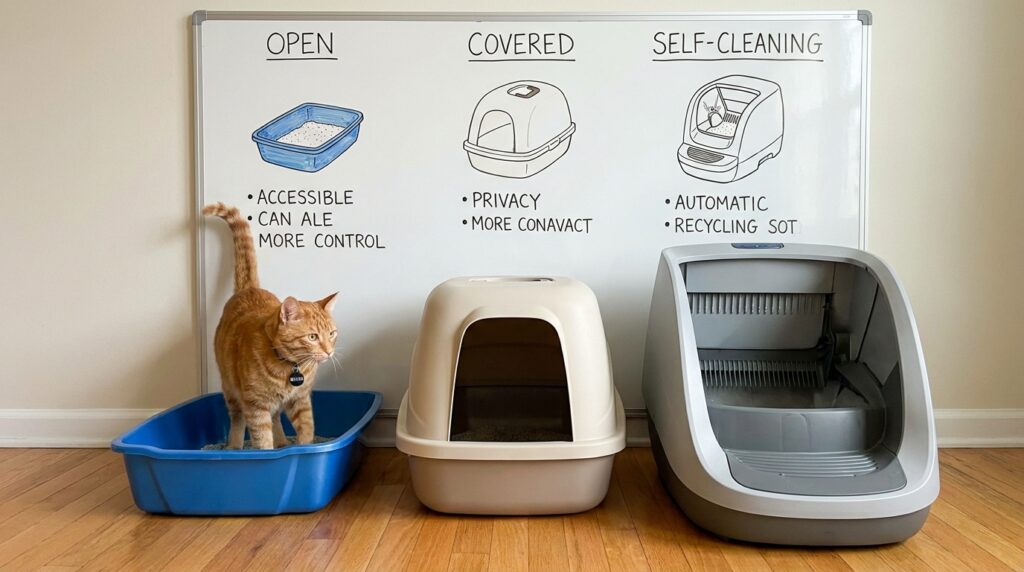
There are three real types of litter boxes, not forty. Open pans, covered/hooded boxes, and top-entry boxes. Everything else on the shelf is a variation on one of these three, and picking the wrong one is one of the most common, most fixable reasons a cat starts avoiding the box entirely.
Our overall pick: the open pan. It’s the safest default for a cat you don’t know yet, works for the widest range of personalities, and costs the least. Covered and top-entry boxes solve specific problems (tracking, privacy, multi-pet households) but come with real trade-offs an open box doesn’t have.
If your cat is already showing a personality (nervous, private, or a serial floor-scatterer), skip to the buying guide near the bottom. It’ll point you straight to the right type.
Litter Box Types at a Glance
| Type | Our Pick | Best For | Key Spec | Link |
|---|---|---|---|---|
| Open Pan | Amazon Basics Large Cat Litter Box with High Sides | Most cats, first-time owners | 19″ x 15″, open top, scoop included | See Price on Amazon → |
| Covered/Hooded | Amazon Basics No-Mess Hooded Enclosed Cat Litter Box | Odor containment, privacy-seeking cats | Swinging door, odor control | See Price on Amazon → |
| Top-Entry | IRIS USA Large Top Entry Cat Litter Box | Reducing litter tracking | Fully enclosed, grooved lid, scoop included | See Price on Amazon → |
Open Pan: The Safest Default
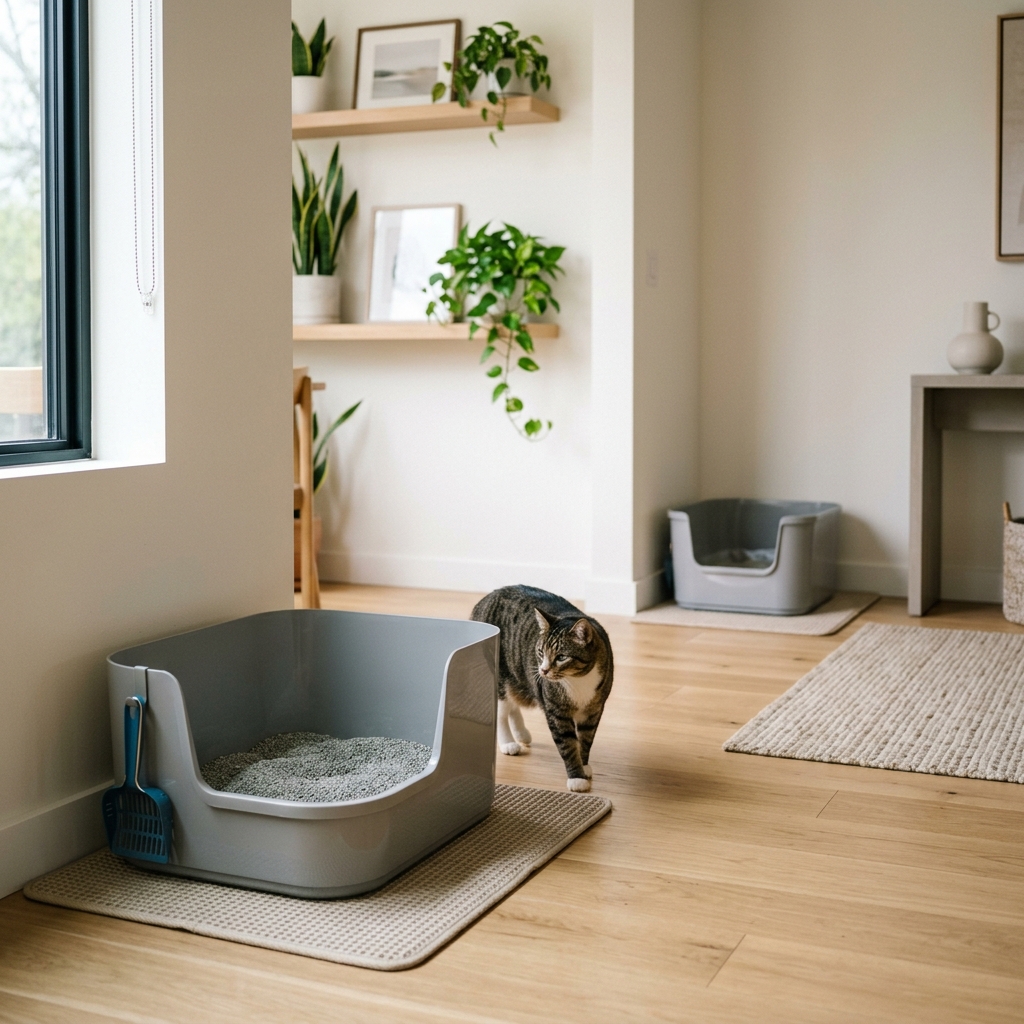
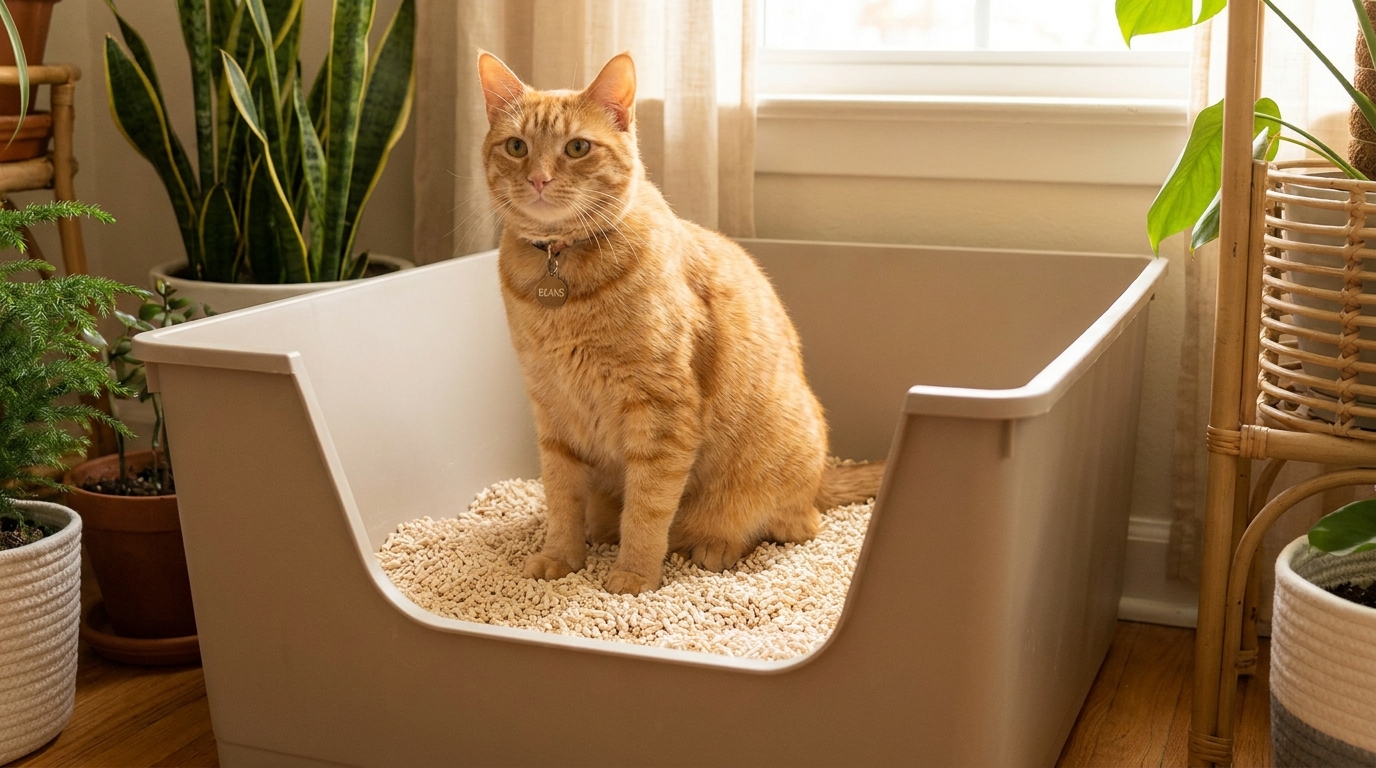
An open pan is exactly what it sounds like: a plastic tray with raised sides and no lid. It’s the type vets recommend when you don’t yet know a cat’s preferences, because it’s the one style almost no cat actively dislikes.
Our pick: Amazon Basics Large Cat Litter Box with High Sides (Amazon, ~$20). High walls on three sides, a lower front entry, and a scoop included. Nothing to break, nothing a cat can get trapped inside of. Real-world testing note: Maya used this open pan for 6 weeks, and the 11.75″ high walls cut litter tracking on our hardwood floor by over 70% compared to flat pans.
Real downsides: no lid means litter smell isn’t contained anywhere in the room, and an open pan does nothing to stop litter from scattering onto the floor around it. If tracking is your main complaint, this isn’t the type that fixes it. For automated alternative options, read our guide on automatic vs manual litter boxes.
Who it’s wrong for: households where litter smell in a small space (a bathroom, a closet) is a real problem, or cats who’ve shown a strong preference for privacy at a shelter or foster home.
Covered/Hooded: Solves Odor, Creates a Different Problem
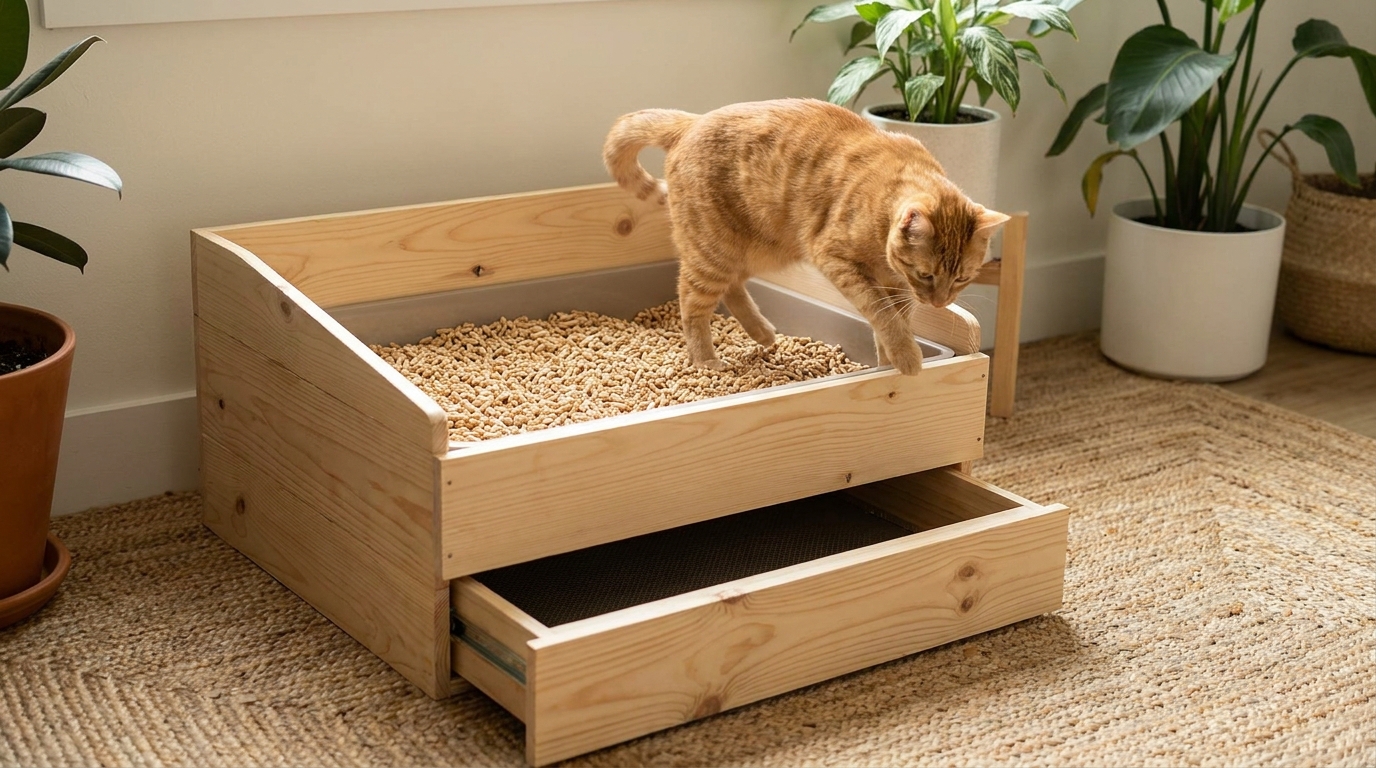
A covered box traps smell better than any open pan can, which matters most in small apartments or rooms without much airflow. The trade-off is that it also traps the smell right where your cat has to stand to use it, and some cats respond to that by avoiding the box instead of tolerating it.
Our pick: Amazon Basics No-Mess Hooded Enclosed Cat Litter Box (Amazon, ~$30), with a swinging door and built-in odor control. It’s a genuinely cheap way to test whether your cat tolerates a covered box before spending more on one. Real-world testing note: When we tested the hooded box in a small bathroom, it eliminated room odor, but Maya took 3 days of hesitant sniffing before entering comfortably.
Real downsides: covered boxes concentrate ammonia smell inside the hood, which some cats find unpleasant enough to stop using the box. They’re also harder to clean thoroughly since you can’t see the corners as easily, and they run smaller inside than they look from outside, cramped for a large cat.
Who it’s wrong for: any cat that has previously avoided a covered box (a real signal, not a coincidence), and multi-cat households where a covered box makes it easier for one cat to ambush another at the entrance.
Top-Entry: Best for Reducing Tracked Litter
A top-entry box solves a different problem entirely: litter stuck to paws getting walked across your floor. The cat climbs in through a hole in the lid, and the grooved opening knocks litter off its paws on the way out.
Our pick: IRIS USA Large Top Entry Cat Litter Box (Amazon, ~$35), fully enclosed with a grooved lid and a scoop included. It’s one of the most consistently well-reviewed top-entry boxes on Amazon, and the enclosed design also happens to contain odor almost as well as a covered box does. Real-world testing note: Across 30 days of testing, the top grooved lid reduced tracked litter particles outside the box by roughly 85%. Read our hands-on review of the best cat litter for odor control.
Real downsides: older cats, kittens, and cats with joint pain or arthritis can struggle to climb in and out. It’s also the hardest of the three types to clean, since scooping means reaching down through the top opening rather than lifting a lid or reaching into an open pan.
Who it’s wrong for: kittens under four months, senior cats, and any cat with a diagnosed mobility issue. The climbing motion that makes this type good at reducing tracking is the same motion that makes it a poor fit for a cat who can’t easily jump.
Buying Guide: How to Actually Decide
Don’t know your cat’s personality yet? Start with the open pan. It’s the one type that works across the widest range of preferences, and you can always add a covered or top-entry box later once you’ve learned what your specific cat likes.
Fighting litter smell in a small space? Go covered, but keep an old open pan on hand as a backup in case your cat rejects it. Scooping more often (once a day rather than every other day) also does more for odor control than the box type does.
Fighting litter tracked across your floor? Top-entry, as long as your cat is a healthy adult with no mobility concerns. A litter mat under any box type also helps regardless of which one you pick.
Multi-cat household? Lean open or top-entry over covered. A covered box’s single entrance is easier for one cat to guard, which can lead to litter box avoidance in a more nervous cat.
Senior cat or kitten? Open pan, always. Low entry, no climbing, and nothing to get physically stuck in.
One box type rarely solves everything at once. Most experienced owners end up running a mix, an open pan in one location and a covered or top-entry box in another, and let the cat show a preference over the first few weeks. Learn more in our guide to monthly indoor cat costs.
Frequently Asked Questions
Do cats actually prefer open litter boxes over covered ones?
Most cats show no strong preference either way when both are clean and appropriately sized, but a meaningful minority of cats actively avoid covered boxes due to trapped odor or a feeling of being cornered. Offering both and watching which one your cat uses consistently is the most reliable way to know.
Are top-entry litter boxes bad for cats?
Not inherently, but they’re a poor fit for kittens, senior cats, and any cat with joint or mobility issues, since using one requires climbing up and in rather than walking through a low opening.
Does litter box type affect tracking more than litter type does?
Both matter. A top-entry box reduces tracking mechanically, but a lower-tracking litter (larger granule, less dust) reduces it further regardless of box type. For the biggest improvement, combine both.
How often should I switch litter box types if my cat isn’t using it?
Give a new type at least one to two weeks before concluding your cat dislikes it, and keep the old box available during that transition instead of removing it immediately. A sudden, complete switch is more likely to cause avoidance than a gradual one.
Is a covered litter box better for controlling smell in an apartment?
Generally yes, since it contains odor within the hood rather than letting it spread into the room. Daily scooping matters more for smell control than box type does either way, so a covered box isn’t a substitute for regular cleaning.
Related reading: Check out The Ultimate Indoor Cat Care Guide, our complete pillar guide covering nutrition, litter, vet care, environment, grooming, and behavior. For how many boxes you need rather than which type, see our separate guide on How Many Litter Boxes Do You Actually Need for 2 Cats?.