
By Emma Hartley | Last updated July 28, 2026
The first month with a new cat rarely goes the way people picture it. Most cats don’t walk in and start exploring confidently. They hide, eat less than usual, and take longer to warm up than a dog would. That’s normal, not a sign something’s wrong, and this guide walks through what actually happens, week by week, so you know what to expect and when to actually worry.
In This Guide
- Before Day One: What to Set Up First
- Days 1 to 3: Arrival and the Safe Room Method
- Days 4 to 7: Introducing the Rest of the House
- Week 2: Feeding, Litter Habits, and Routine
- Week 2 to 3: The First Vet Visit
- Week 3 to 4: Bonding and Play
- Signs Something’s Wrong, Any Week
- Day 30 Checklist
- Frequently Asked Questions
Before Day One: What to Set Up First
Everything needs to be in place before your cat arrives, not assembled while a stressed animal watches from a carrier. At minimum: a litter box, food and water bowls, a scratching post, and a small, quiet room set aside as a safe space for the first few days.
If you haven’t bought any of this yet, our Indoor Cat Starter Kit guide covers exactly what to get and why, including real product picks. For the litter box specifically, an open pan is the safest first choice for a cat whose habits you don’t know yet. Our Types of Litter Boxes guide breaks down why. You can also review How Many Litter Boxes Do You Need? if you have a multi-cat household.
If you have kids, other pets, or a lot of exposed cords and small objects, do a walkthrough before arrival day. Our guide on Kitten-Proofing vs. Cat-Proofing covers what changes based on your cat’s age. Even an adult cat benefits from a once-over of loose cords and unsecured window screens.
Days 1 to 3: Arrival and the Safe Room Method

Direct answer: Set your cat up in one small room, not the whole house, for the first two to three days. Full access too soon is the single most common reason cats stay hidden and anxious longer than they need to.
Pick a bedroom or bathroom, set up the litter box, food, water, and a hiding spot (a covered bed or even a cardboard box works fine), and let your cat explore that one room at its own pace. Sit in the room without forcing interaction. Let the cat approach you rather than the other way around.
Most cats eat less than normal in the first 24 to 48 hours. That’s expected stress response, not a red flag by itself. What matters is whether they’re eating and drinking at all, even small amounts, and using the litter box. A cat that goes more than 48 hours without eating anything needs a vet call, covered in more detail further down.
Don’t introduce other pets yet. That comes later, and rushing it in the first three days makes the whole introduction process take longer, not shorter.
Days 4 to 7: Introducing the Rest of the House
Once your cat is eating consistently, using the litter box, and showing curiosity (approaching the door, exploring the edges of the safe room) rather than only hiding, it’s time to open the door and let exploration happen gradually.
Open one additional room at a time rather than the whole house at once. Keep the original safe room’s litter box and food in place during this transition. Cats often retreat to the first space they felt secure in, and pulling that away too early can undo progress.
If you have other pets, this is when scent swapping starts, not full introductions. Swap bedding between animals, feed pets on either side of a closed door, and watch for calm body language before any face-to-face meeting. Full introductions typically take one to two weeks longer than most people expect, and rushing this step is the top cause of lasting pet conflict in a new household.
Week 2: Feeding, Litter Habits, and Routine
Direct answer: By week two, feed on a consistent schedule (twice daily for adults, three to four times for kittens under six months) and expect litter box habits to stabilize once your cat feels secure in the space.
Consistency matters more than the specific schedule you pick. Cats orient around routine, and an unpredictable feeding time can show up as pacing, vocalizing, or even litter box avoidance if the stress compounds with anything else going on.
If your cat isn’t using the litter box consistently by the end of week two, check the basics before assuming a behavior problem: box cleaned daily, right type and location for that specific cat, and no other pet blocking access to it. Genuine medical causes (urinary tract issues, in particular) can look identical to a behavior problem in a cat this age, which is part of why the vet visit below shouldn’t wait.
Week 2 to 3: The First Vet Visit
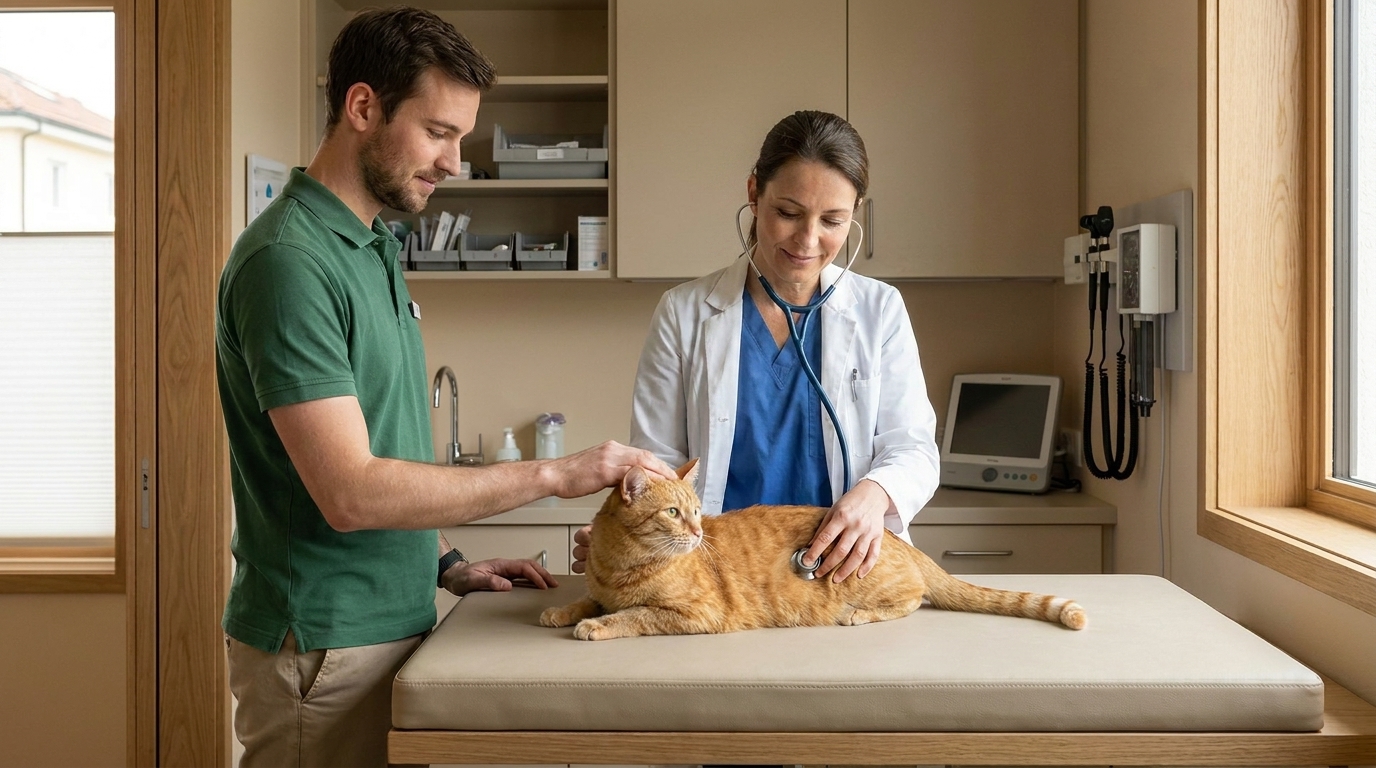
Direct answer: Schedule the first vet visit within the first one to two weeks, even if your cat seems perfectly healthy, to catch anything not visible at home and to start or confirm a vaccination and parasite prevention schedule.
Bring any adoption or shelter paperwork with vaccine history if you have it. The vet will typically check weight, teeth, ears, and coat condition, and may run a fecal test for parasites, especially important if your cat came from a shelter or multi-cat environment.
Use the carrier for this trip, not a towel-wrapped cat in your arms. A carrier that opens from the top makes the exam itself go faster, since the vet can lift the cat out rather than pulling it through a single front door. Our Indoor Cat Starter Kit guide covers what to look for in a carrier if you don’t already have one.
This is also the appointment to ask about spay or neuter timing if it hasn’t happened yet, and to get your vet’s specific recommendation on kitten versus adult food if you’re still working that out.
Week 3 to 4: Bonding and Play

By week three, most cats have shifted from purely defensive behavior to genuine curiosity, and this is where real bonding starts. Short, low-pressure play sessions, a wand toy for ten minutes twice a day, do more for trust than trying to pet or hold a cat that isn’t asking for it.
Let your cat initiate physical contact. A cat that approaches, rubs against your leg, or sits nearby without being coaxed is telling you it’s ready for more contact. Forcing affection on a cat’s timeline, rather than letting the cat set it, is one of the more common ways new owners accidentally slow this process down.
Some cats bond within the first month. Others, especially cats with a rougher history before adoption, take three to six months to fully settle. Both are within the range of normal, and slower doesn’t mean something’s wrong.
Signs Something’s Wrong, Any Week
Most of what happens in the first month is normal adjustment, not a problem. A few specific signs are worth an actual vet call regardless of what week you’re in:
- No food or water intake for more than 48 hours
- No litter box use for more than 48 hours, or visible straining without producing anything (a possible urinary blockage, which is a genuine emergency in male cats especially)
- Vomiting or diarrhea lasting more than a day
- Extreme lethargy that doesn’t improve as the cat settles in
- Hiding that doesn’t improve at all after the first week, with zero curiosity or approach behavior
Hiding itself in week one isn’t on this list because it’s expected. It’s the complete absence of any progress over time, not the hiding itself, that’s the actual signal.
Day 30 Checklist: Are You On Track?
By the end of the first month, most cats show:
- Consistent eating on a predictable schedule
- Reliable litter box use in the expected location
- At least some voluntary approach behavior, even if brief
- Comfort exploring most or all of the home they have access to
- The first vet visit completed
If several of these aren’t happening yet, that’s not automatically a crisis. Some cats genuinely need longer, particularly cats with a harder start in life before you met them. If your cat is still fully hiding with zero progress by day 30, that’s the point to loop your vet in on the behavioral side too, since it can be worth ruling out a medical cause before assuming it’s purely adjustment.
Frequently Asked Questions
Is it normal for a new cat to hide for days?
Yes, especially in the first three to five days. What matters is gradual improvement over that time, not the absence of hiding altogether.
How long does it take for a new cat to trust you?
It varies widely. Some cats warm up within a week; others take three to six months, particularly cats with a difficult history before adoption. Both are within normal range.
Should I let a new cat roam the whole house immediately?
No. Starting with one small, quiet room and expanding gradually over the first week gives most cats a much faster overall adjustment than full access from day one.
When should I schedule the first vet visit for a new cat?
Within the first one to two weeks, even if the cat seems completely healthy, to catch anything not visible at home and confirm vaccination status.
What’s the biggest mistake new cat owners make in the first month?
Rushing: full house access too soon, forcing physical affection before the cat is ready, or introducing other pets before scent-swapping has had time to work. Slower almost always goes faster in the end.
Related reading: Check out The Ultimate Indoor Cat Care Guide, our complete pillar guide covering nutrition, litter, vet care, environment, grooming, and behavior in full depth beyond the first month. See also our Indoor Cat Starter Kit for exactly what to buy before day one, Types of Litter Boxes for choosing the right box for a cat whose habits you don’t know yet, and Kitten-Proofing vs. Cat-Proofing if you’re bringing home a kitten specifically.