This post contains affiliate links. We may earn a commission at no extra cost to you if you purchase through these links.
Quick answer: the standard rule is one litter box per cat, plus one extra — so for 2 cats, that’s 3 boxes. But the number matters less than the placement. Three boxes side by side in the same room functions as one location to a cat, and defeats the purpose of having three in the first place.
Why “just add a box” doesn’t always fix it
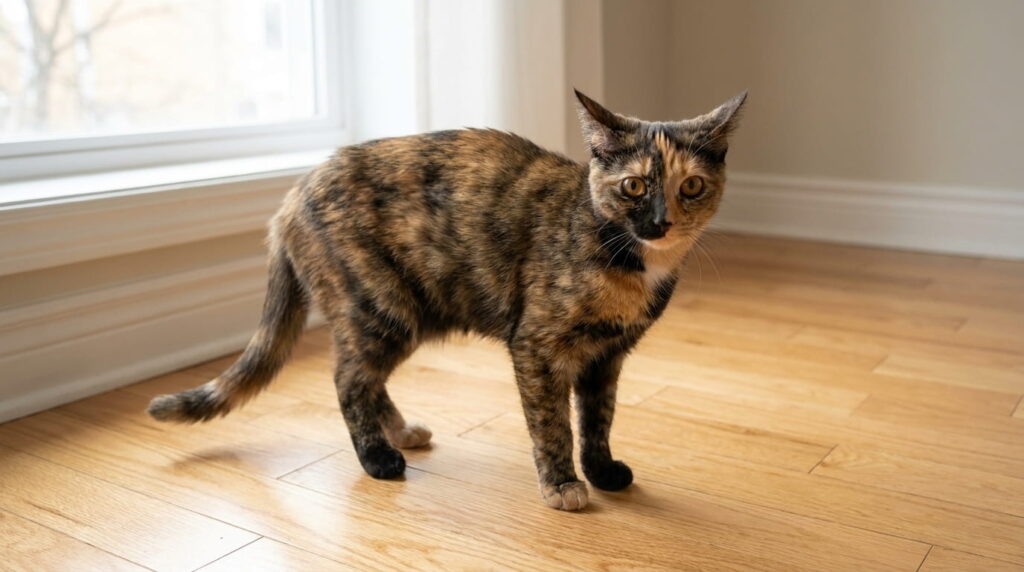
When I got Miso as a companion for Beans, I did what most advice online tells you to do — added a second litter box next to the first one and assumed that checked the box, so to speak. Within a couple of weeks, Beans started avoiding the litter box area entirely and peeing near the bathroom door instead. Two boxes, technically following the N+1 rule if you count generously, and it still wasn’t working.
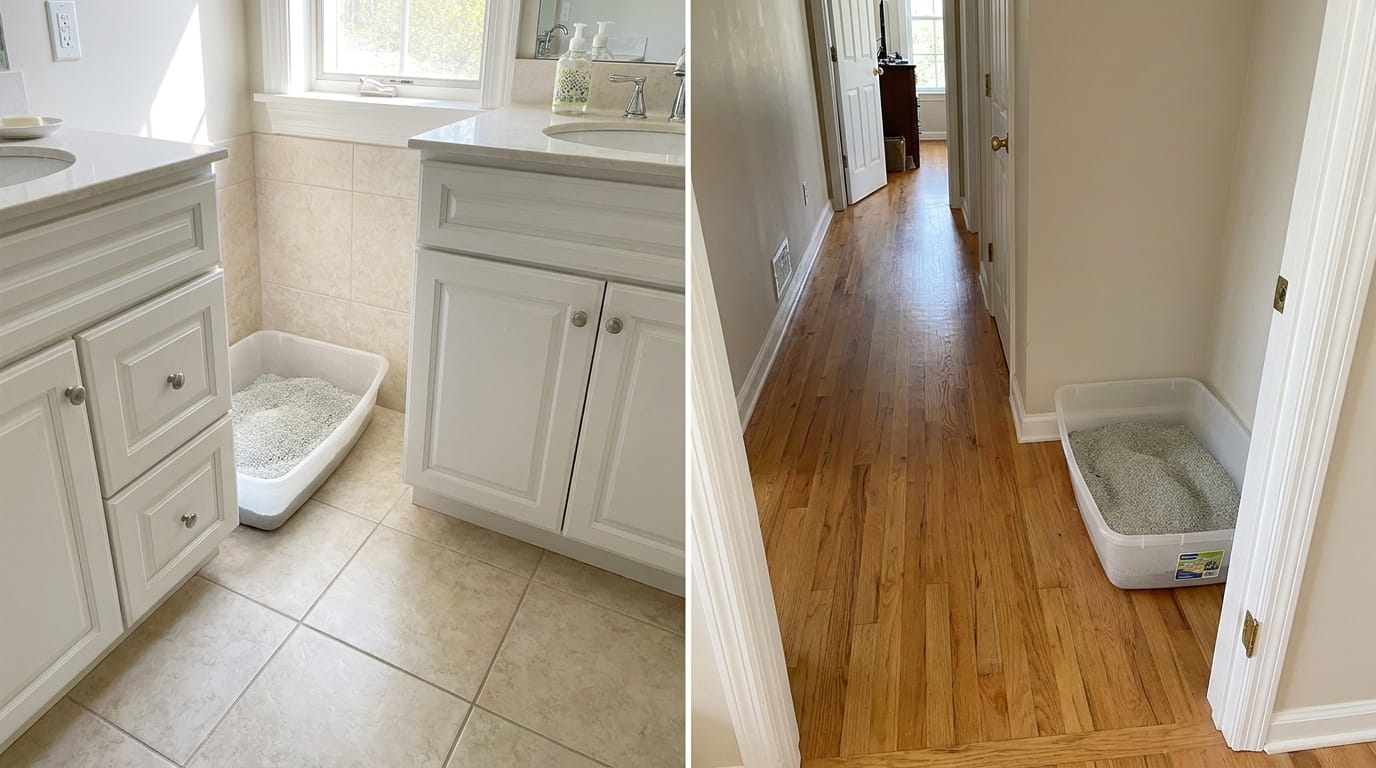
Lining up two litter boxes next to each other functions as a single location in a cat’s mind.
The problem wasn’t the number. It was that both boxes were in the same corner of the same room, which to a cat isn’t two litter box options — it’s one option with extra steps. I moved the second box to a different room entirely, and the accidents stopped within about a week.
In this guide, we’ll cover:
- The N+1 rule, and why it’s a minimum, not a target
- Why placement matters more than count
- Signs you need more boxes even at the “right” number
- What actually worked in my apartment
- Box type and litter considerations for multi-cat homes
- FAQ
The N+1 rule, and why it’s a minimum, not a target
The rule — number of cats plus one — comes from behaviorists and is widely cited by vets as a starting baseline, not a guarantee. For 2 cats, that’s 3 boxes. For 1 cat, that’s 2. The logic is straightforward: cats can be particular about using a box that already has waste in it, and having a spare means there’s always a clean option available, plus it reduces the odds of one cat feeling like they have to compete for access to the only box in the house.
Where this rule falls short is that it treats “3 boxes” as the finish line, when really it’s the floor. Some cats need more than the formula suggests — a multi-cat household with any tension between cats, a very large home, or a particularly fastidious cat can all push the actual number higher than 3, even with just 2 cats total.
Why placement matters more than count
This is the part that gets skipped in most quick answers to this question, and it’s the part that actually mattered in my case. A cat doesn’t experience “3 litter boxes” as 3 independent options unless they’re genuinely in different locations. Three boxes lined up against the same wall in the same room register, behaviorally, as a single resource with redundant copies — not as 3 separate choices.
The reasoning ties back to how cats think about territory and resources generally. In multi-cat households, one cat can effectively “guard” an area without any visible aggression — just by being present near it, or having a habit of walking through it at certain times. If all the litter boxes are clustered in one spot, a lower-confidence cat can end up avoiding that entire zone, and having 3 boxes there doesn’t help if the cat won’t go near any of them. For additional signs of a stressed cat, check out our guide on signs of a stressed indoor cat.
What actually counts as separate locations:
- Different rooms, not just different corners of the same room
- Not directly next to loud appliances (washing machine, furnace) that startle unpredictably
- Not requiring a cat to pass through another cat’s favored territory to reach it
- Ideally on different levels of the home if you have stairs, rather than all boxes in the basement
Signs you need more boxes even at the “right” number
Following N+1 doesn’t guarantee the number is actually working for your specific cats. A few signs the count or placement still needs adjustment:
One cat consistently avoids a specific box: If you notice one cat never uses a particular box regardless of how clean it is, that’s often a territory or access issue, not a preference about the box itself.
Accidents near, but not in, the boxes: This is frequently a signal that the boxes exist but aren’t functioning as accessible options — either the location is being avoided, or there aren’t enough clean options at the times your cat actually needs one.
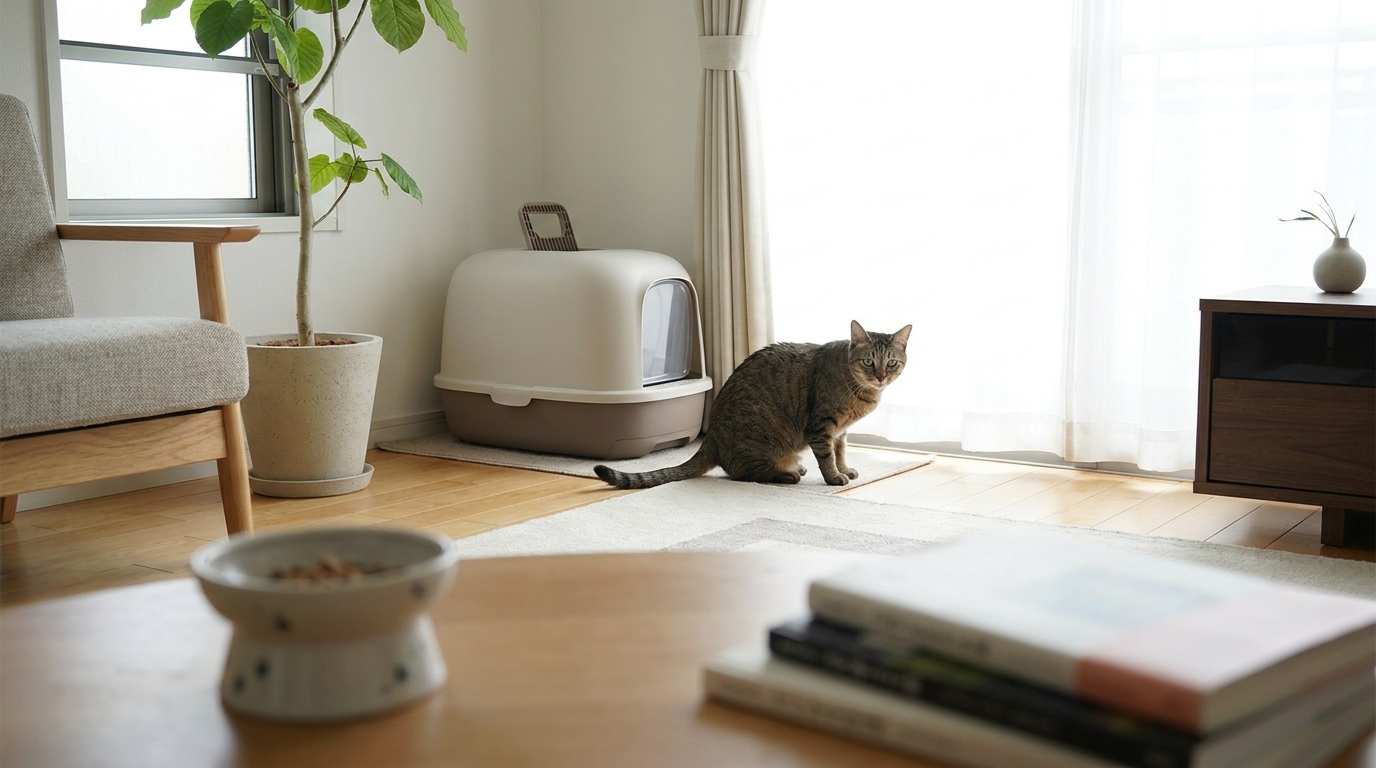
A cat sitting near or guarding a litter box can discourage a lower-confidence cat from using it.
Guarding behavior: If you notice one cat positioning themselves near the litter area in a way that seems to block or monitor it, even without any obvious conflict, that can be enough to make the other cat avoid the space.
Timing clusters: If accidents happen at specific times of day, it can point to a specific cat’s box-use pattern colliding with when the boxes are dirty or another cat is nearby.
What actually worked in my apartment
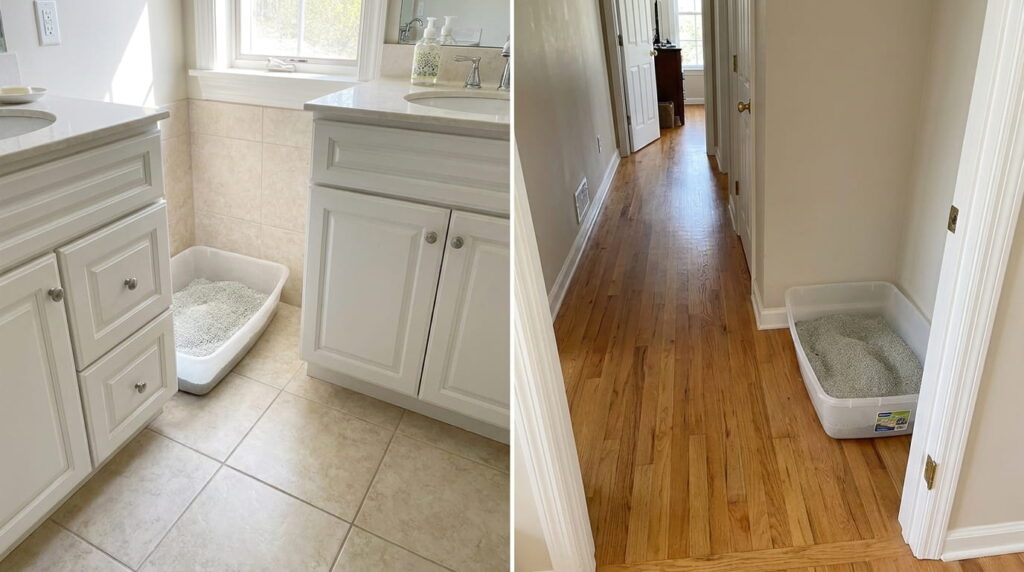
For a 2-cat household in a one-bedroom, here’s the setup that resolved things for us, in case the logic is more useful than the specific numbers: 3 boxes total, in 3 different rooms rather than 3 different corners of the living room. One in the bathroom, one in a bedroom corner away from the bed, one in a hallway nook. None of them are next to each other, none require passing through a spot either cat treats as “theirs” to reach.
I also staggered cleaning slightly so there’s always at least one freshly scooped box available rather than cleaning all 3 at once and then letting all 3 get equally dirty before the next cleaning pass. This isn’t a universal formula — apartment layouts vary too much for that — but the underlying principle held up: spread the options across genuinely separate parts of the home rather than concentrating them for your own convenience.
Box type and litter considerations for multi-cat homes
A few things that compound the count-and-placement question in a 2+ cat household:
- Covered vs. uncovered: Covered boxes trap odor, which can make a box feel more unpleasant to a second cat using it after the first, faster than an uncovered box would. In multi-cat homes specifically, uncovered boxes tend to get better use.
- Box size: A box sized for one cat can feel cramped and vulnerable to a second cat, particularly if there’s any tension between the cats. Bigger boxes than you think you need are generally the safer default in a multi-cat home.
- Litter type consistency: Switching litter type across different boxes in the house can create a preference conflict, where one cat avoids boxes with an unfamiliar texture. Keeping the same litter across all boxes removes one more variable that could be driving avoidance.
- Scooping frequency: In a single-cat home you can sometimes get away with once-daily scooping. With 2 cats sharing a rotation of boxes, twice-daily tends to keep at least one box consistently appealing rather than all of them accumulating waste on the same schedule. A handy litter disposal system makes this routine fast and odorless:
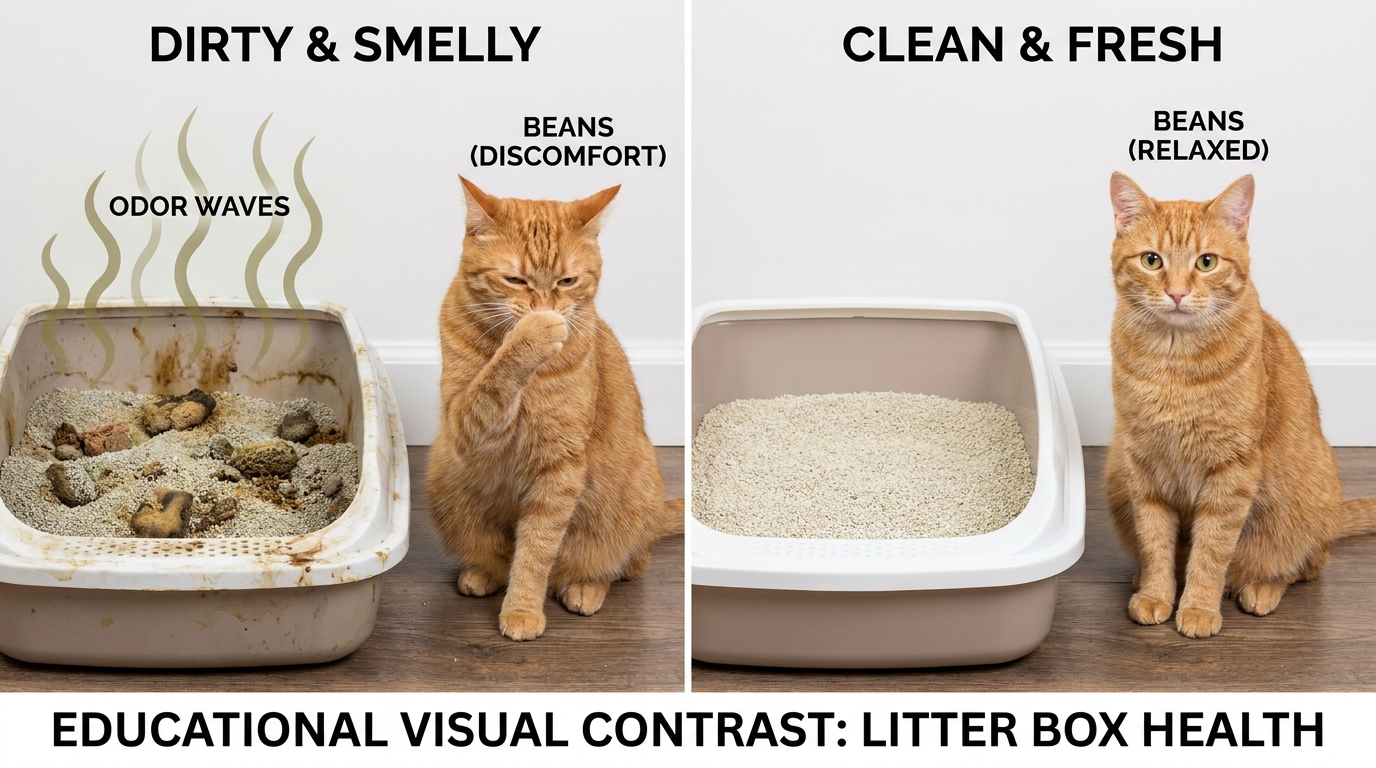
Maintaining a high standard of cleanliness with frequent scooping helps prevent avoidance behaviors.
FAQ
Do I really need 3 boxes for just 2 cats, or is 2 enough?
Two can work if your cats get along well and your space is small enough that separate locations aren’t really possible, but 3 is the safer default, especially if you’ve noticed any avoidance or tension between the cats already.
Can 2 cats share one litter box if they’re bonded?
Some bonded cats will comfortably share, but it’s not something to assume — even closely bonded cats can develop avoidance issues if the shared box gets dirty faster with 2 cats using it, or if one cat unconsciously guards it.
Is it bad to put litter boxes on different floors of the house?
No — that’s often ideal, since it maximizes the chance of a genuinely separate location for each box rather than several boxes that still feel like one zone.
How do I know if litter box problems are behavioral or medical?
Any new litter box avoidance, especially sudden onset, should rule out a medical cause first — urinary issues, kidney problems, or pain can all cause a cat to avoid the box regardless of how well-placed it is. If you suspect health-related changes, see our guide on medical vs stress-related behavior changes, or check for specific symptoms of urinary issues. If placement changes don’t resolve it within a couple of weeks, a vet visit is the next step. To learn more about common litter box issues, the ASPCA litter box problems guide and Cornell’s guide to house soiling and avoidance issues provide excellent scientific advice.
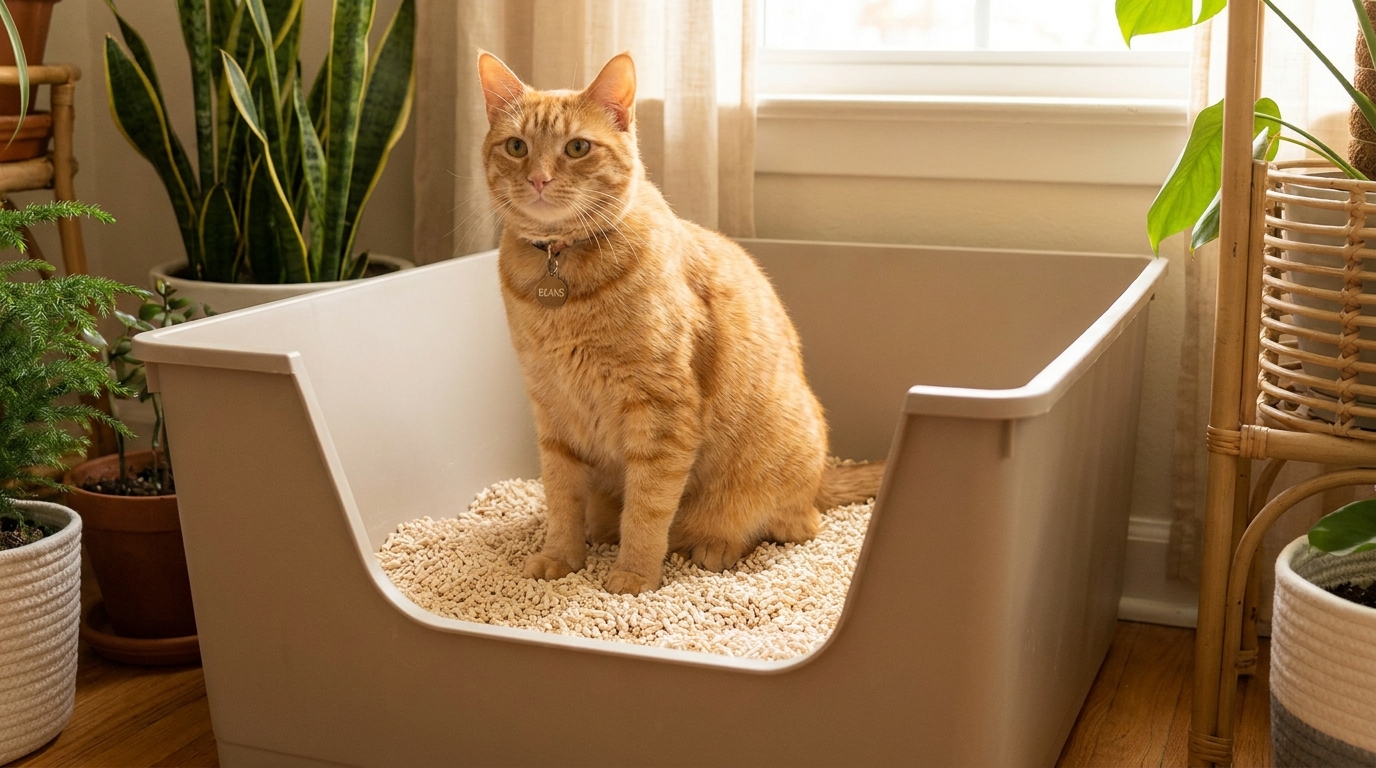
A clean, well-placed, open litter box ensures your cat feels safe and comfortable.
Does litter box brand or shape matter as much as count?
Less than people expect. A basic, appropriately sized, uncovered box in the right location tends to outperform an expensive covered box in the wrong spot every time in my experience.
If you’ve got a layout that made this harder than the standard advice accounts for — a studio, a place with no spare rooms — I’d like to hear how you worked around it. This is one of those problems where the textbook answer and the real-apartment answer don’t always match.