This post contains affiliate links. We may earn a commission at no extra cost to you if you purchase through these links.
Quick answer: for genuine portion control rather than just scheduled dispensing, a feeder with gram-level portion settings and a sealed hopper beat the cheaper timer-only models by a wide margin. After 30 days across 3 feeders, the difference wasn’t features on a spec sheet — it was whether the portions actually stayed consistent meal after meal, and whether a determined cat could break into it.
Why I started testing these in the first place
Beans is not subtle about food. Free-feeding was never an option with him, and even scheduled bowl-feeding meant he’d finish his portion in under a minute and then spend the rest of the day trying to convince me he hadn’t eaten at all. When his weight crept up slightly at a checkup, my vet’s advice was straightforward: smaller, more frequent portions instead of two large meals, which is basically impossible to manage manually if you have a job and a life outside your cat’s feeding schedule.
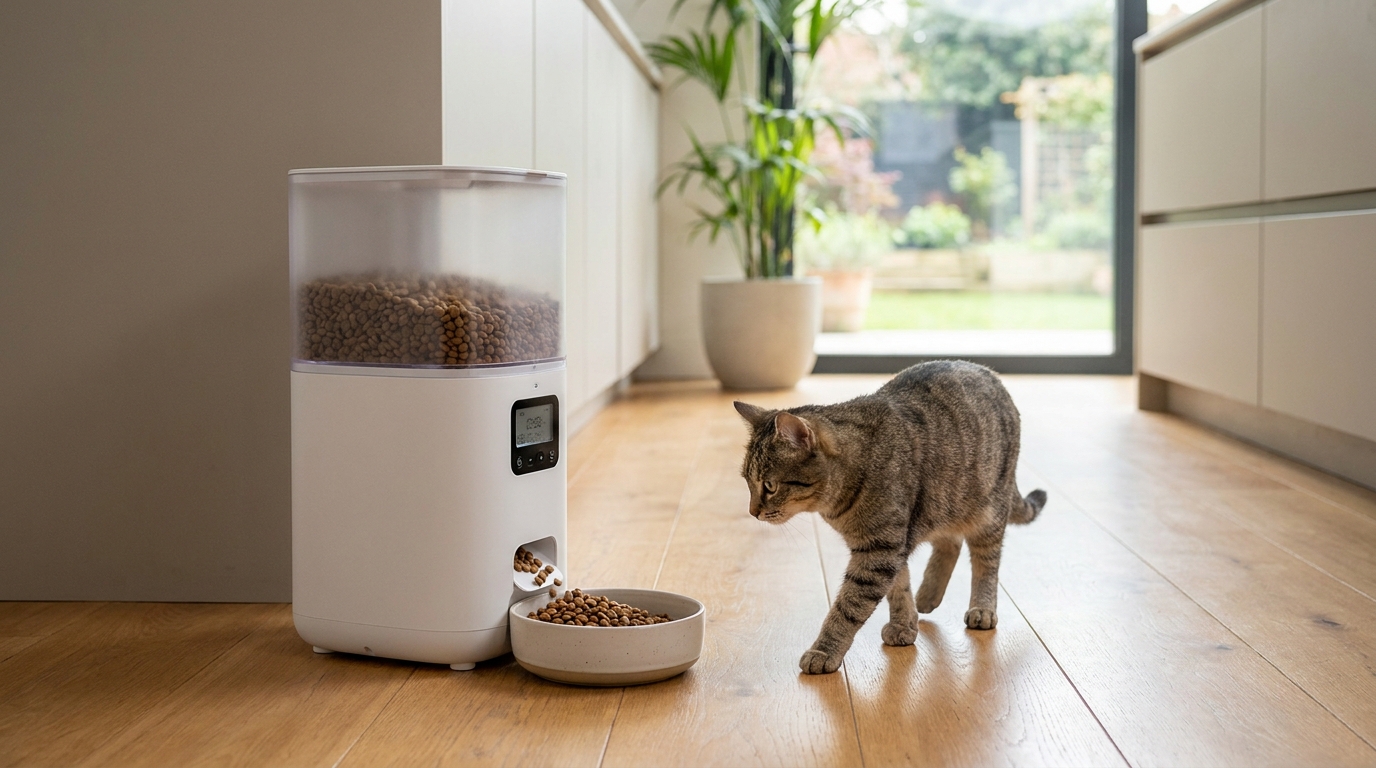
The PetSafe Smart Feed dispensing a precise portion, removing the human error from meal planning.
That’s the actual use case for an automatic feeder, and it’s a narrower one than most marketing suggests. It’s not about convenience for its own sake — it’s about consistency a human can’t reliably provide by hand, meal after meal, without fail. Feline obesity is a serious concern that can lead to diabetes, joint pain, and other health issues. According to the Cornell Feline Health Center, managing feline obesity requires strict portion control and calorie monitoring. If your cat has started to stare at you for food, automating the schedule can help dissociate you from food delivery, reducing begging behaviors.
In this guide, we’ll cover:
- What I tested and how
- Comparison table
- Full reviews
- Why portion accuracy matters more than app features
- What I’d skip
- FAQ
What I actually tested
Three feeders, 30 days each, same dry food, same target portion (30g per meal, 4 meals a day, per my vet’s recommendation). I weighed every dispensed portion for the first week of each feeder to check actual accuracy against the setting, then spot-checked weekly after that. I also tested whether Beans — who has, on record, opened a cabinet with a magnetic latch — could get into any of them uninvited.
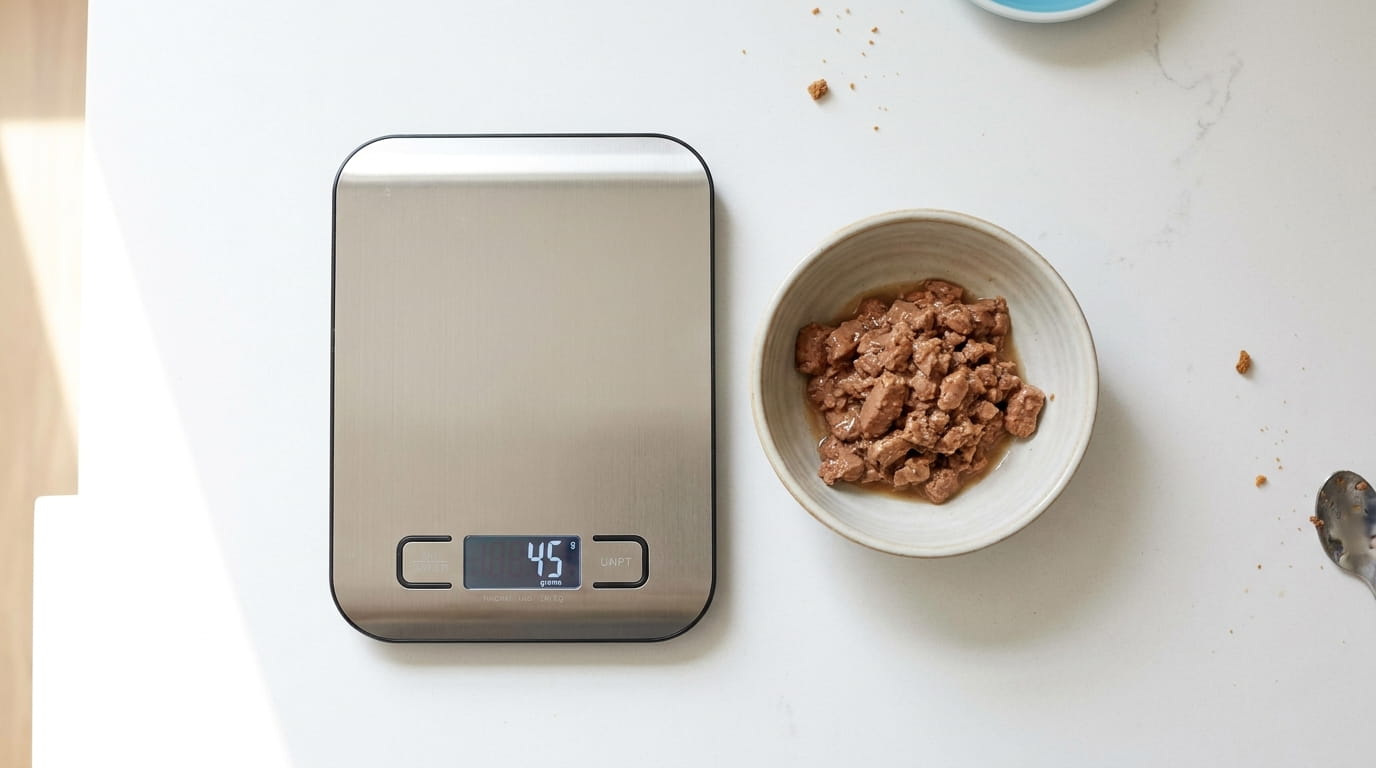
Weighing each dispensed portion with a digital scale to verify the accuracy of the portion settings.
Battery backup, app reliability, and hopper capacity all factored in, but portion accuracy was the deciding metric, since that’s the entire point of using one of these for weight management rather than just convenience. To verify your feeder’s output, a reliable digital kitchen scale is indispensable:
Comparison table
| Feeder | Portion Accuracy | Hopper Capacity | Battery Backup | Cat-Proof | Verdict |
|---|---|---|---|---|---|
| PetSafe Smart Feed 2.0 | Within 1-2g of setting | Large | Yes | Yes | Best overall (Winner) |
| WOPET 7L Feeder | Within 3-5g, some drift | Very large | Yes | Mostly | Best budget |
| Basic Timer Feeder | Inconsistent, +/- 8g+ | Small | No | No | Skip |
Full reviews
PetSafe Smart Feed 2.0 — Best Overall
This one held its portion accuracy the most consistently of the three, staying within 1–2 grams of the 30g target across every meal I weighed over the full 30 days. That consistency is the entire reason to buy a feeder like this instead of just eyeballing a scoop, so it mattered more to me than any of the app extras.
What I like: the accuracy didn’t drift over the month, which the budget option did slightly. The hopper seal held up against Beans’ best efforts — he tested it in the first week the way he tests everything, found no way in, and stopped trying. Battery backup meant a power outage on day 19 didn’t cause a missed or doubled meal, which is a real risk with feeders that don’t have it.
What I don’t like: it’s the most expensive of the three, and the app, while functional, isn’t especially polished — scheduling changes take a few more taps than they should. Not a dealbreaker, just not as smooth as the price might suggest.
Best for: weight management specifically, where portion accuracy is the actual point.
Not for: owners who just want a basic scheduled dispenser and don’t care about gram-level precision.
WOPET 7L Feeder — Best Budget
A solid option if your priority is more about scheduling consistency than clinical-grade portion accuracy. The larger hopper is genuinely useful if you’re feeding multiple cats from one unit or want fewer refills, and it held up reasonably well against Beans, though I did catch him nosing the lid loose once, which never happened with the PetSafe.
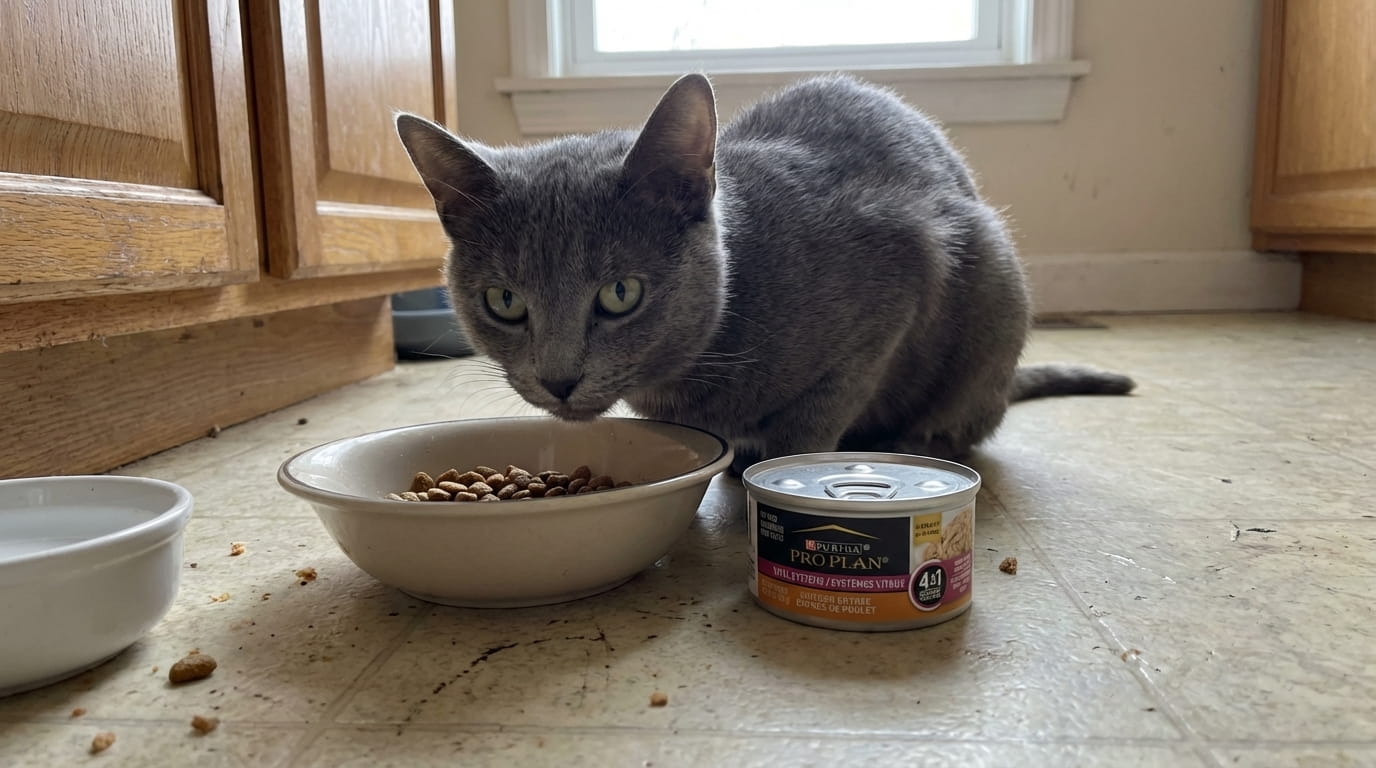
The WOPET 7L feeder has a spacious hopper, making it ideal for multi-cat homes or longer gaps between refills.
What I like: significantly cheaper, large capacity means less frequent refilling, and the portion accuracy, while not perfect, was consistent enough that it didn’t undermine the weight management goal — just needed occasional recalibration.
What I don’t like: portion sizes drifted by 3-5 grams over the course of the month, likely from the dispensing mechanism wearing slightly or food settling differently as the hopper emptied. Not dramatic, but noticeable if you’re tracking closely for a vet-directed feeding plan.
Best for: budget-conscious owners who want scheduled feeding without needing to track it as precisely as a medical portion plan.
Not for: situations where a vet has specified an exact gram target that needs to stay consistent.
Basic Timer-Only Feeder — Skip
Included because it’s the type of feeder most likely to show up first in a budget search, and it’s worth knowing why it didn’t make the cut. This is a simple timer-based dispenser without gram-level settings — you set a rough portion by adjusting a dial, and it dispenses roughly that amount on schedule.
What I like: it’s inexpensive and does the basic job of dispensing food on a schedule without needing an app or wifi.
What I don’t like: the portion inconsistency was the real problem — swings of 8+ grams between meals, sometimes more, which defeats the purpose entirely if the goal is weight management rather than just “food appears on a schedule.” It also had no battery backup, so a short power blip on day 12 caused a missed meal.
Best for: owners who just want rough scheduled dispensing and don’t need portion precision.
Not for: any vet-directed weight or portion control plan.
Why portion accuracy matters more than app features
Most feeder marketing leans hard on app features — remote feeding, camera integration, voice recordings you can leave for your cat. None of that addresses the actual reason most people buy one of these, which is consistency a human can’t maintain by hand across every single meal, every single day, without exception.
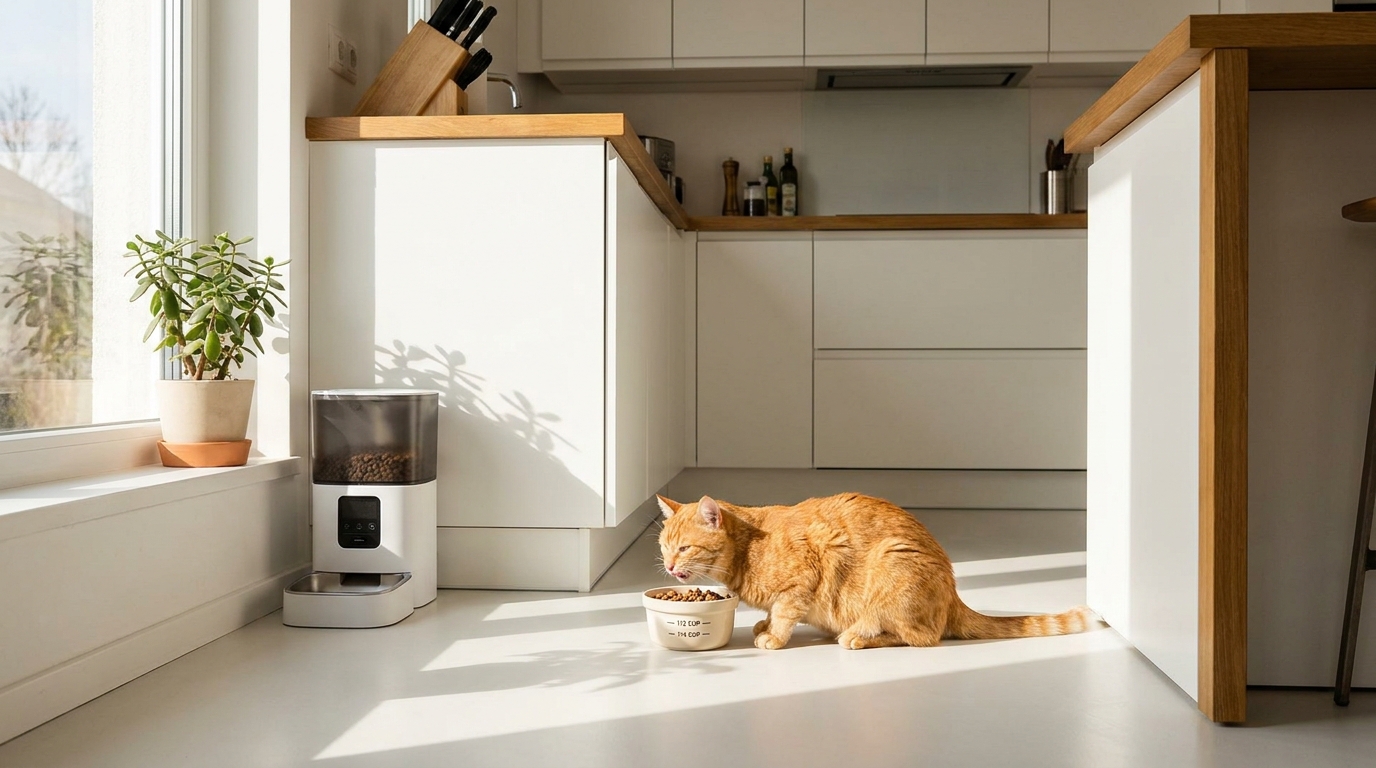
A consistent portion ensures your cat gets the exact daily nutrition recommended by your vet.
If the portion size drifts meal to meal, you’ve just automated the inconsistency instead of removing it. For a cat on an active weight management plan specifically, that drift can mean the feeder isn’t actually doing the job it was bought for, even though it looks like it is from the outside. To maintain a healthy weight and overall wellness, establishing a consistent daily schedule is crucial. Combined with a balanced indoor cat care approach, portion control keeps your pet active and happy.
What I’d skip
Any feeder without a sealed hopper if you have a persistent or food-motivated cat. Beans has broken into things that seemed genuinely secure before. A hopper lid that isn’t locked or sealed is, in my experience, an invitation rather than a deterrent for a cat who’s motivated enough.
Feeders with no battery backup, if you live somewhere with occasional power blips. A missed meal isn’t a disaster on its own, but a doubled meal after a reset can be, especially for a cat on a strict portion plan.
FAQ
Are automatic feeders actually necessary, or just convenient?
For most cats, they’re a convenience, not a necessity. Where they earn their cost is specifically in situations needing consistent, frequent small portions — weight management, multi-cat households with different dietary needs, or owners with unpredictable schedules who can’t reliably hand-feed on time.
How accurate do portion sizes need to be for weight management?
Ask your vet for the acceptable range, but in general, staying within a couple grams of the target consistently matters more than any single meal being slightly off. Drift that compounds over weeks is the real risk, not one-off variance.
Can a determined cat break into most automatic feeders?
Some can, particularly older or less securely sealed models. If you have a cat with a track record of getting into things, prioritize a sealed hopper and lid design specifically, and expect to test it in the first week the way mine did.
Do automatic feeders work for wet food?
Most standard automatic feeders are designed for dry food only — wet food spoils too quickly for the hopper-and-dispense mechanism most of these use. If wet food is the majority of your cat’s diet, a scheduled feeder isn’t a direct substitute for hand-feeding, though some specialized wet food feeders with ice packs exist for shorter intervals.
What happens during a power outage with an automatic feeder?
Depends entirely on whether it has battery backup. Models without it can miss a scheduled meal or, in some cases, dispense an extra one when power resets. If reliability matters for your cat’s plan, battery backup isn’t optional.
If you’re managing a food-motivated cat like Beans, I’d like to know what’s actually kept them out of a feeder that wasn’t supposed to be breakable — his cabinet trick still impresses me more than it should.