By Emma Hartley | Last updated July 30, 2026
If you’re wondering how much to feed an indoor cat, the answer depends on weight, activity level, and spay/neuter status — not the vague range printed on the back of the food bag. Most indoor cats need somewhere between 180 and 300 calories a day, with a typical 10-pound neutered indoor cat landing around 260 calories daily. The chart and formula below let you calculate a number specific to your cat instead of guessing.
Quick answer: Multiply your cat’s resting energy requirement (RER) by an activity factor between 1.0 and 1.6. For a typical neutered indoor cat with average activity, that’s roughly 1.2 times RER — about 260 calories a day for a 10-pound cat.
How Many Calories Does an Indoor Cat Need Per Day?
It depends primarily on body weight, then gets adjusted for activity and spay/neuter status. A 6-pound cat and a 15-pound cat have genuinely different calorie needs, and feeding both from the same generic “1/2 cup twice daily” instruction on a bag is how a lot of indoor cats end up overweight. Indoor cats specifically tend to need less than outdoor cats of the same weight, since they burn fewer calories through activity and territory patrol. The American Veterinary Medical Association notes that obesity affects up to 60% of indoor cats in the United States.
How to Calculate Your Indoor Cat’s Calorie Needs by Weight
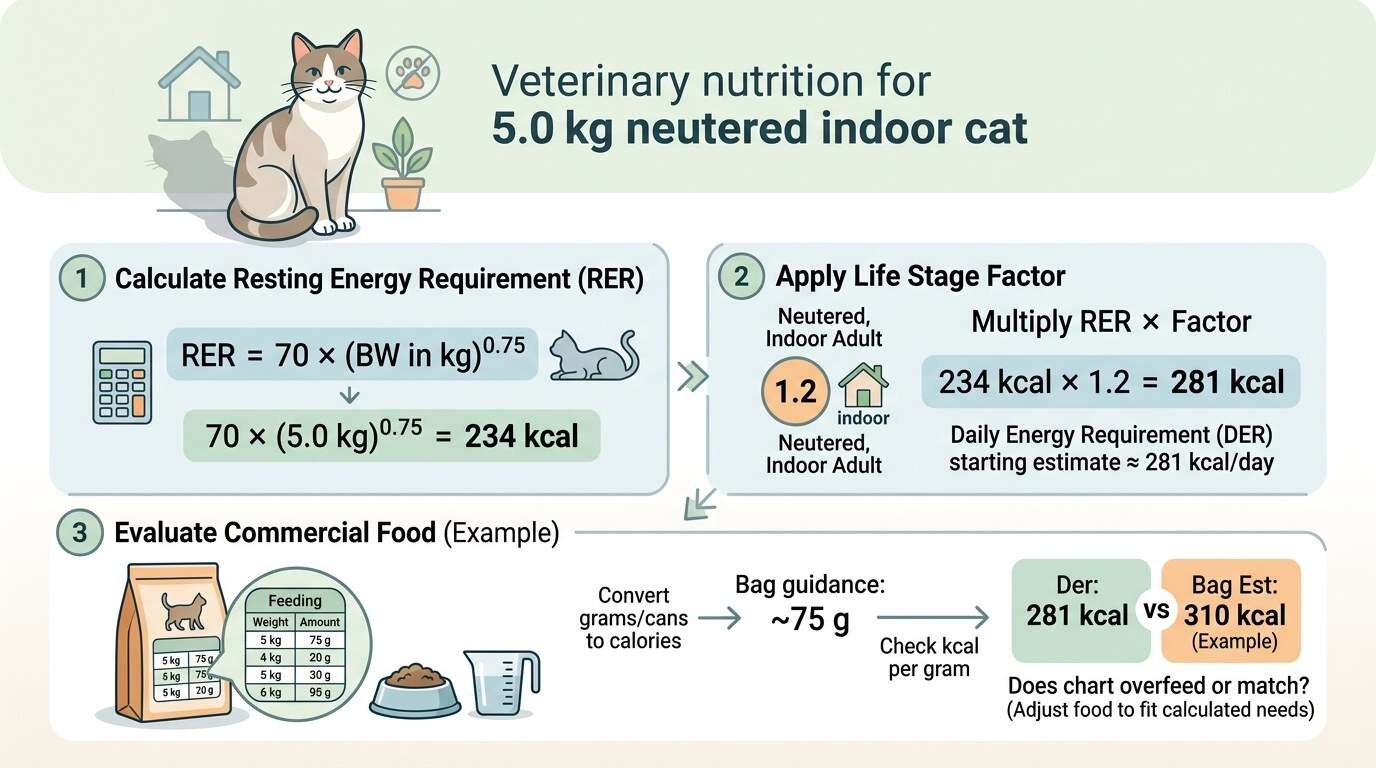
Vets use a two-step formula based on guidelines from the World Small Animal Veterinary Association (WSAVA). First, calculate resting energy requirement (RER) — the calories your cat burns at complete rest:
RER = 70 × (body weight in kg)0.75
Then multiply RER by an activity factor to get maintenance energy requirement (MER), the number that reflects your specific cat’s actual daily needs. To convert pounds to kilograms, divide by 2.2. A 10-pound cat is 4.5 kg.
Reference table (already calculated for common weights):
| Weight (lbs) | RER (kcal/day) | Typical neutered indoor cat, MER at 1.2× |
|---|---|---|
| 6 | ~148 | ~178 |
| 8 | ~184 | ~221 |
| 10 | ~218 | ~261 |
| 12 | ~250 | ~300 |
| 15 | ~295 | ~354 |
If your cat’s weight falls between rows, the RER scales smoothly rather than jumping — a rough interpolation between the two nearest rows is close enough for practical feeding purposes.
How Does Activity Level Change How Much to Feed an Indoor Cat?
Activity level and spay/neuter status change the multiplier you apply to RER, not the RER itself. Here’s the standard range used by veterinary nutrition guidelines:
| Cat’s Situation | Activity Factor |
|---|---|
| Weight loss goal | 1.0× RER |
| Neutered adult, typical indoor activity | 1.2× RER |
| Intact adult, or above-average activity | 1.4× RER |
| Very active (regular play, cat wheel, multi-level climbing) | 1.6× RER |
| Kitten, 4 to 12 months | 2.0× RER |
| Kitten, under 4 months | 2.5× RER |
| Senior, lower activity | 1.1× RER |
A 10-pound neutered adult cat with average activity needs roughly 261 calories a day (218 × 1.2). The same cat if genuinely sedentary might be better served closer to 1.0×, around 218 calories. For kittens, see our kitten feeding schedule guide for age-specific recommendations.
Does Spaying or Neutering Change How Much to Feed?
Yes, meaningfully. Spayed and neutered cats burn roughly 20 to 30 percent fewer calories than intact cats at the same activity level, largely due to hormonal changes that lower metabolic rate. This is why the standard multiplier drops from 1.4× for an intact cat to 1.2× for a neutered one. Cats gain weight in the months after spay or neuter surgery more often than owners expect — reducing the daily calorie target around that time, not increasing it, is usually the right move.
How Much Wet Food vs. Dry Food Should I Feed by Calories?
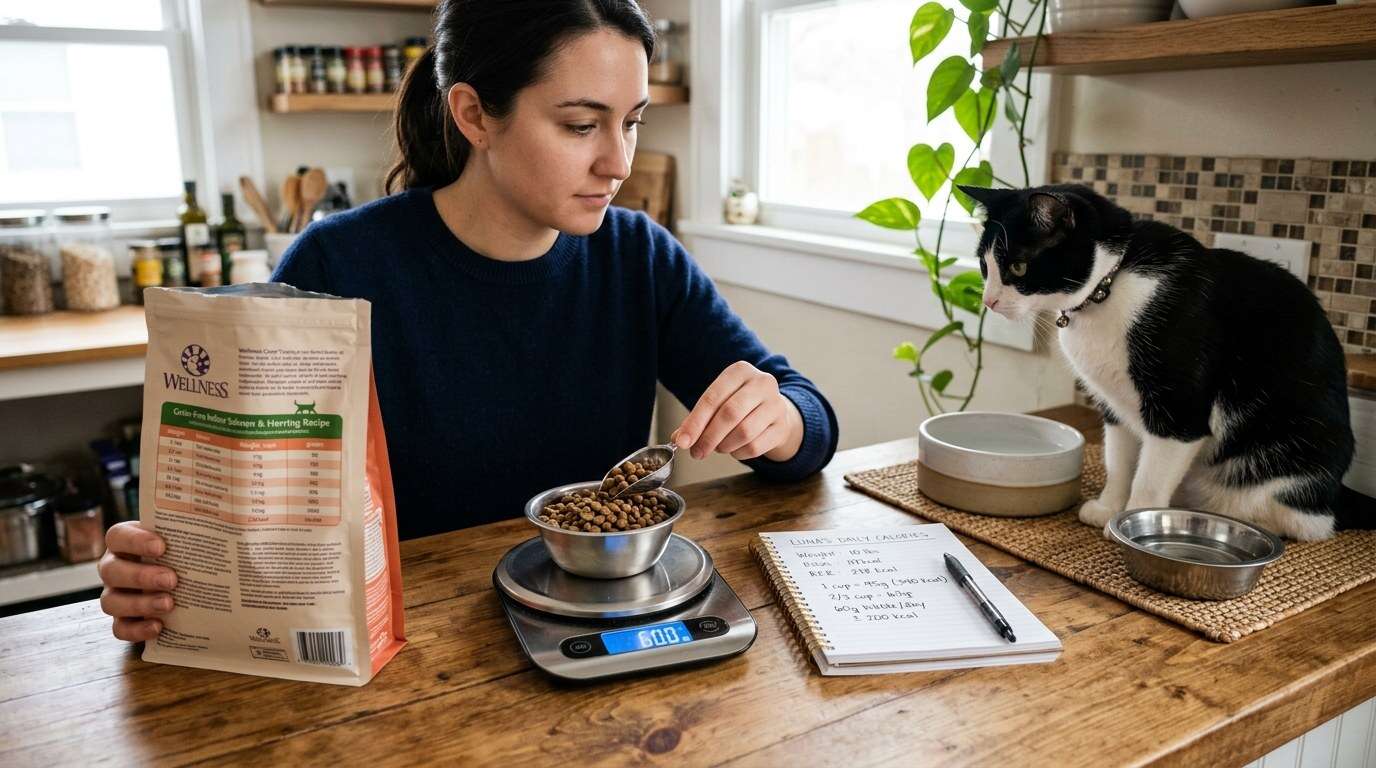
Once you know your daily calorie target, check the calorie density of your specific food — it varies significantly by brand and formula. Dry kibble generally runs 300 to 400 calories per cup; wet food generally runs 70 to 100 calories per 3-ounce can. For a detailed breakdown of wet vs. dry tradeoffs for indoor cats, see our wet food vs. dry food comparison.
Check the guaranteed analysis or calorie statement on the bag or can. Divide your daily calorie target by that number to get the actual amount to feed. A 10-pound cat with a 261-calorie target eating a dry food at 350 kcal/cup needs about 0.75 cups a day total, typically split into two feedings. Understanding how to read cat food labels makes this step much easier.
Mixing wet and dry? Add the calories from both together rather than feeding full portions of each. This is the single most common feeding math mistake: treating the wet food feeding chart and the dry food feeding chart as separate totals instead of one combined daily budget.
How to Tell If You’re Overfeeding or Underfeeding Your Indoor Cat
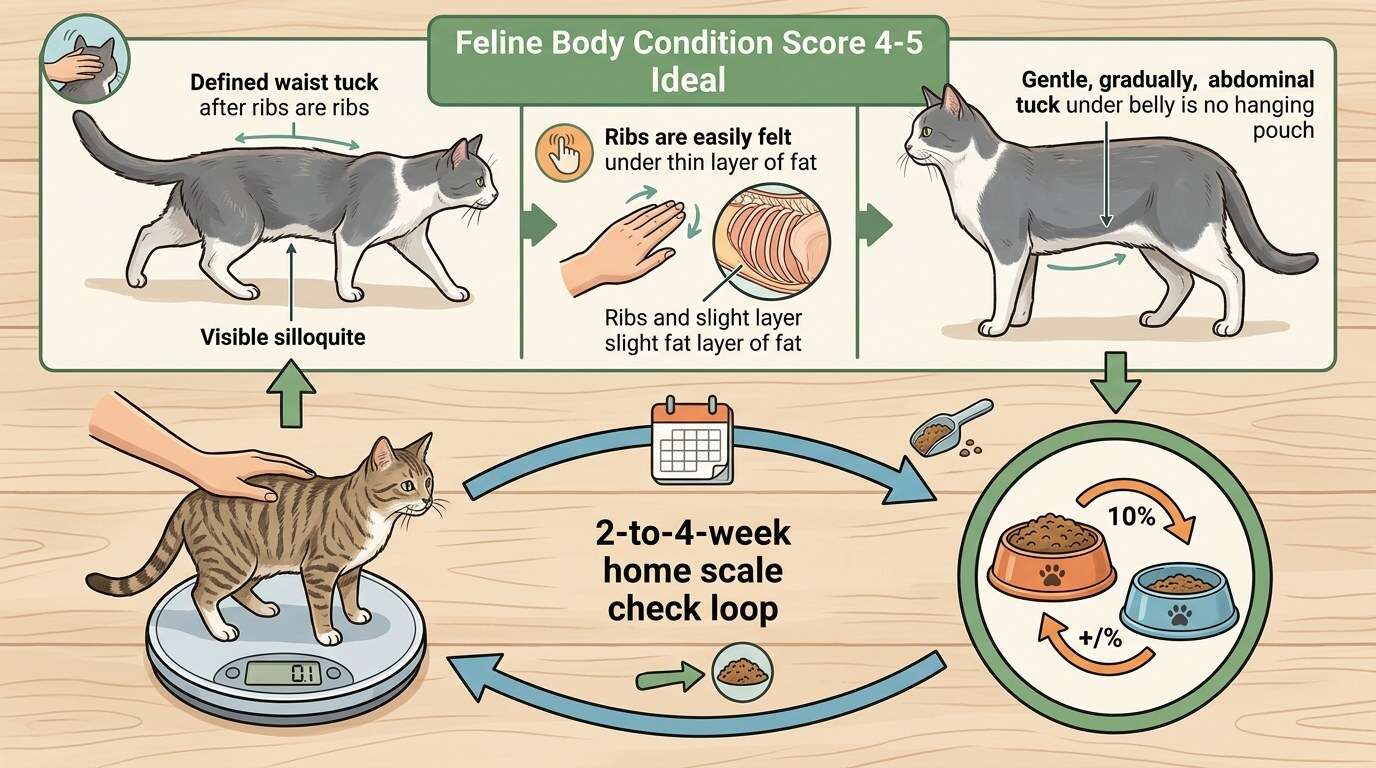
The calculator above is a starting point, not a guarantee. The real test is tracking body condition over two to four weeks:
- Ribs: you should be able to feel them easily under a thin layer of fat, without pressing hard
- Waist: visible from above, a slight tuck behind the ribs
- Weight trend: stable weight on a monthly check is the goal for an adult cat at a healthy weight
If your cat is gaining steadily on the calculated amount, reduce by roughly 10 percent and recheck weight in two to three weeks. If losing weight unexpectedly, our guide on why your indoor cat might be losing weight covers the six most common causes.

Frequently Asked Questions
How many calories should a 10-pound indoor cat eat per day?
Roughly 260 calories a day for a typical neutered adult with average activity, calculated as RER (about 218 kcal) multiplied by a 1.2 activity factor. Very sedentary or weight-loss-focused cats may need closer to 220.
Do indoor cats need fewer calories than outdoor cats?
Generally yes, since indoor cats typically have less overall activity than cats with outdoor access. The activity factor accounts for this: an outdoor or highly active cat uses 1.4 to 1.6× while a typical indoor cat uses 1.2×.
How many calories are in a typical cup of dry cat food?
It varies by brand and formula, generally 300 to 400 calories per cup. This differs enough between products that checking the specific bag’s calorie statement is necessary rather than assuming a number.
Should I feed by calories or by the amount listed on the food bag?
Calories calculated from your cat’s actual weight and activity level are more accurate than the generic range printed on most bags, which tends to assume an average cat and often skews high.
How often should I recalculate my cat’s calorie needs?
Recalculate whenever your cat’s weight changes meaningfully, after spay or neuter surgery, or when transitioning between kitten, adult, and senior life stages.
First-hand Experience
When my 4-year-old neutered tabby, Milo, started putting on extra weight after we moved to a second-floor apartment, our vet showed us this exact RER formula. We discovered we were overfeeding him by almost 45 calories a day just by trusting the range on his kibble bag. Adjusting his daily target down to 220 kcal brought him back to his ideal 10-lb body condition within three months without any dramatic begging.
Related reading: Full Guide to Indoor Cat Care covers nutrition alongside litter, vet care, environment, and behavior. See also Indoor Cat Starter Kit for specific food product recommendations by life stage. If your cat seems perpetually hungry despite proper portions, read why your indoor cat is always hungry to rule out medical vs. behavioral causes.