By Emma Hartley | Reviewed by IndoorCatWell Editorial Team | Last updated October 2026
A cat that growls at another cat approaching her bowl, blocks a doorway to the bedroom, or hisses when someone sits next to you on the sofa is telling you something about how secure she feels. Resource guarding, the behavior of defending something she values, is common in multi-cat homes and sometimes in single-cat homes with people or other pets. It is usually driven by competition, past scarcity, or stress, not by spite. This guide explains what guarding looks like, why it happens, how to rule out medical causes, and how to reduce it without punishment, which makes it worse.
Short answer
Guarding is a sign that a cat feels she might lose something she needs. Rule out pain and illness with your vet, provide more of the resource in more places, separate cats when feeding, reward calm behavior, and never punish. If there is fighting, injury, or a cat living in fear, ask your vet for a referral to a behaviorist.
In this guide:
What resource guarding looks like
Subtle signs:
- Eating very fast, or hunching over the bowl
- Staring at another cat or person who approaches
- Freezing or stiffening
- Standing in a doorway or on a perch and not letting others pass
- Taking a toy or treat and moving away
- Sitting on or beside a favorite person and watching others
More obvious signs:
- Growling, hissing, or spitting
- Swatting, lunging, or chasing
- Biting or scratching
- Blocking another cat from the litter box, food, or water
- Attacking a cat who approaches you
A cat who guards is not necessarily aggressive in general. Many are calm until a particular resource is at stake.
What cats guard
- Food and water. The most common. Cats may guard bowls, treats, or the person who feeds them.
- Beds and perches. A favorite sunny spot, a cat tree top, or a bed.
- Litter boxes. Blocking access, or ambushing a cat who uses it.
- Toys. Especially high-value toys, or items that smell like a person.
- People. Some cats guard a favorite person, sitting on them and reacting when another cat, pet, or person approaches.
- Doorways and key routes. A cat who controls a hallway or a window can limit the others’ movement.
Why it happens
- Competition. Too few resources, or resources in one place, make guarding more likely.
- Early experiences. A cat who went hungry as a kitten, or lived in a crowded shelter or with many cats, may be more anxious about food.
- Stress and conflict. A new pet, a move, a new baby, or tension between cats raises the stakes.
- Poor sightlines. A bowl in a corner or a narrow route can make a cat feel trapped.
- Learned behavior. If guarding works, because the other cat backs off, it tends to continue.
- Pain or illness. A cat who hurts may protect a spot where she feels safe or lash out when approached.
Rule out medical causes
Book a vet visit if guarding appears suddenly, or in a cat who wasn’t guarding before. Pain from arthritis or dental disease, an overactive thyroid, cognitive changes in older cats, and other conditions can change behavior. Your vet can determine whether the root cause is medical, behavioral, or both.
Make it less necessary to guard
Reducing competition is the single biggest step.
More resources, in more places
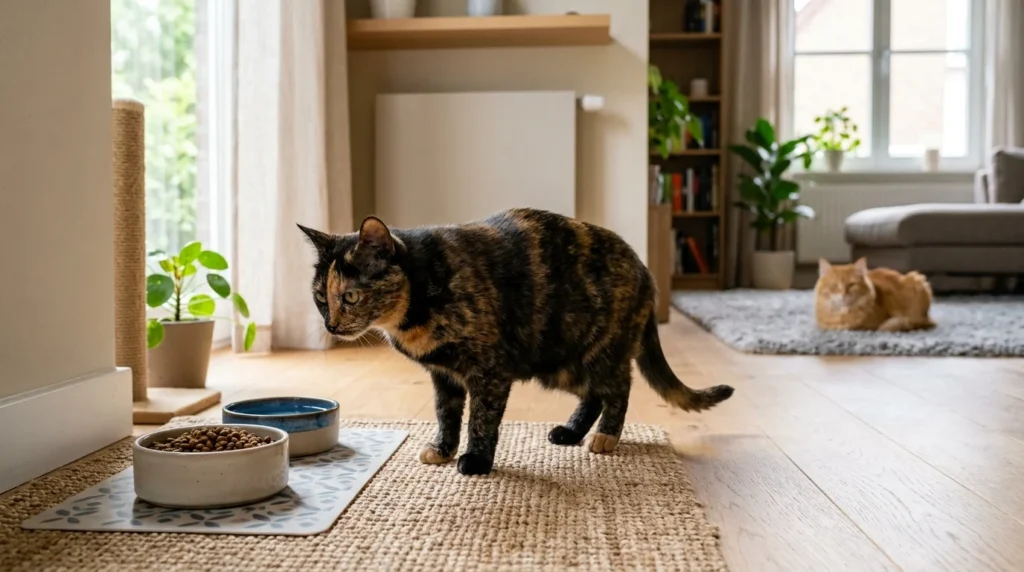
- Food: separate bowls, in separate spots, at different heights if space is tight.
- Water: more than one source.
- Litter boxes: one per cat plus one extra, in different locations, not lined up.
- Beds and perches: more than the number of cats, in several rooms and at different heights.
- Scratching posts and toys: more than one of each.
- Hiding places: each cat needs somewhere she can retreat.
Improve routes and sightlines
- Make sure there are two ways in and out of each room or perch.
- Avoid dead ends where one cat can corner another.
- Place resources in open areas where a cat can see approaching cats.
- Break up line of sight with furniture where cats are tense.
Separate meals
- Feed cats in different rooms or at different times.
- Pick up uneaten food.
- Use puzzle feeders to slow fast eaters.
Keep a steady routine
Predictable meals, play, and attention reduce anxiety. Avoid sudden changes.
Reward calm behavior
- Give a treat or praise when cats are near each other without tension, and when the guarding cat relaxes.
- Reward the guarded cat or the cat who walks past calmly.
- Keep sessions short, and don’t push the cats to be closer than they’re comfortable with.
- Play with each cat separately and together, with a wand toy, and reward calm behavior.
Don't take things away
Don’t try to take food or a toy from a guarding cat. This confirms her fear that she will lose it. If an item is unsafe, swap it for something better, such as a treat tossed a short distance away.
Guarding a person
If a cat guards you:
- Don’t encourage the guarding. Don’t pick her up and hold her tightly when she is tense.
- Ignore the guarding behavior, and reward calm behavior from her.
- Give each cat individual time with you, in separate sessions, on neutral ground.
- Let the other cat approach only when the guarding cat is relaxed. If she tenses, give space.
- Use treats for the guarding cat when another cat or person appears and she remains calm. Gradually reduce the distance.
- Block access if needed, such as by closing a door while you are in the bedroom, to prevent confrontations.
Guarding beds and perches
- Add more beds and perches, in different rooms.
- Place beds in spots with two exits.
- Avoid scolding a cat for sleeping where she likes.
- Make less popular spots more attractive with a warm blanket or a treat.
What not to do
- Don’t punish. Yelling, spraying water, or scruffing can raise fear and make guarding worse.
- Don’t force cats to share a bowl or a bed.
- Don’t take food from a guarding cat.
- Don’t put bowls closer together to “teach them.”
- Don’t assume they’ll work it out. Guarding can escalate.
- Don’t ignore injuries. If a cat is hurt, see a vet.
When to get professional help
- Fighting, with injuries
- One cat who hides most of the day or avoids the litter box, food, or water
- Spraying or other signs of stress
- Aggression toward people
- No improvement after several weeks of environmental changes
A simple plan
- See your vet to rule out medical issues.
- List the resource being guarded, and where and when it happens.
- Add resources and routes in the areas where guarding happens.
- Separate feeding.
- Reward calm behavior.
- Review and adjust. Ask for help if it continues.
Frequently Asked Questions
Why does my cat growl at my other cat near the food bowl?
She may feel she'll lose it. Provide separate bowls and a calmer setup.
Is resource guarding the same as jealousy?
It looks similar, but it's better understood as insecurity about something valuable.
Will my cats grow out of it?
Not always. It often needs changes to the environment.
Can I train a cat not to guard?
You can reduce it by lowering competition and rewarding calm behavior. Some cats need professional help.
Should I get a second cat so mine isn't lonely?
Think carefully. A second cat can add competition.
Related reading
- Multi-cat household guide]
- Two-cat feeding station]
- Cat condo for two cats]
- Interior cat doors for multi-cat homes]
Sources to cite and verify
- International Cat Care, aggression and multi-cat household resources (icatcare.org)
- AAFP and ISFM Feline Environmental Needs Guidelines (catvets.com)
- American College of Veterinary Behaviorists (dacvb.org)