By Emma Hartley | Last updated August 6, 2026 | This post contains affiliate links. If you buy through them, we may earn a commission at no extra cost to you. We only recommend products we’d actually put in our own home.
There’s no single “correct” scratcher orientation, and that’s exactly why so many scratching posts sit unused while a cat keeps going after the couch. Vertical and horizontal scratchers satisfy the same underlying instinct (stretching, claw maintenance, scent marking) in genuinely different physical ways, and most cats show a real preference for one over the other, even if you’ve never tested both side by side.
Our overall pick: get one of each. It sounds like a non-answer, but it isn’t: a vertical sisal post and a horizontal cardboard pad cost less combined than most single premium cat trees, and offering both is the fastest way to find out which one your specific cat actually wants without guessing.
Vertical vs. Horizontal at a Glance
| Type | Our Pick | Best For | Key Spec | Check Price |
|---|---|---|---|---|
| Vertical | Amazon Basics Sturdy Cat Scratching Post | Full-body stretchers, territory marking near doorways | 35.4″ tall, sisal rope, wood base | See Price on Amazon → |
| Horizontal | Amazon Basics Corrugated Cardboard Scratcher, 4-Pack | Ground-level scratchers, cats who paw before stretching up | 17.4″ x 10″, reversible, cardboard | See Price on Amazon → |
Vertical Scratchers: Full-Body Stretch and Territory Marking
A vertical post lets a cat rear up on its hind legs and pull downward with its front claws, the same motion involved in stretching after waking up. It also positions scent glands in the paws at a height that makes more sense for marking near doorways and room entrances, which is part of why cats often gravitate toward doorframes and vertical furniture edges specifically.
Our pick: Amazon Basics Sturdy Cat Scratching Post (Amazon, ~$25), 35.4 inches tall with a full sisal rope wrap and a wide wood base, tall enough for a full stretch for most adult cats without tipping during use.
Testing Note: We placed this post directly next to the living room armchair that our cat Leo was previously targeting. Once we sprinkled a pinch of catnip on the sisal, he switched over within two days and now uses it every morning immediately upon waking up.
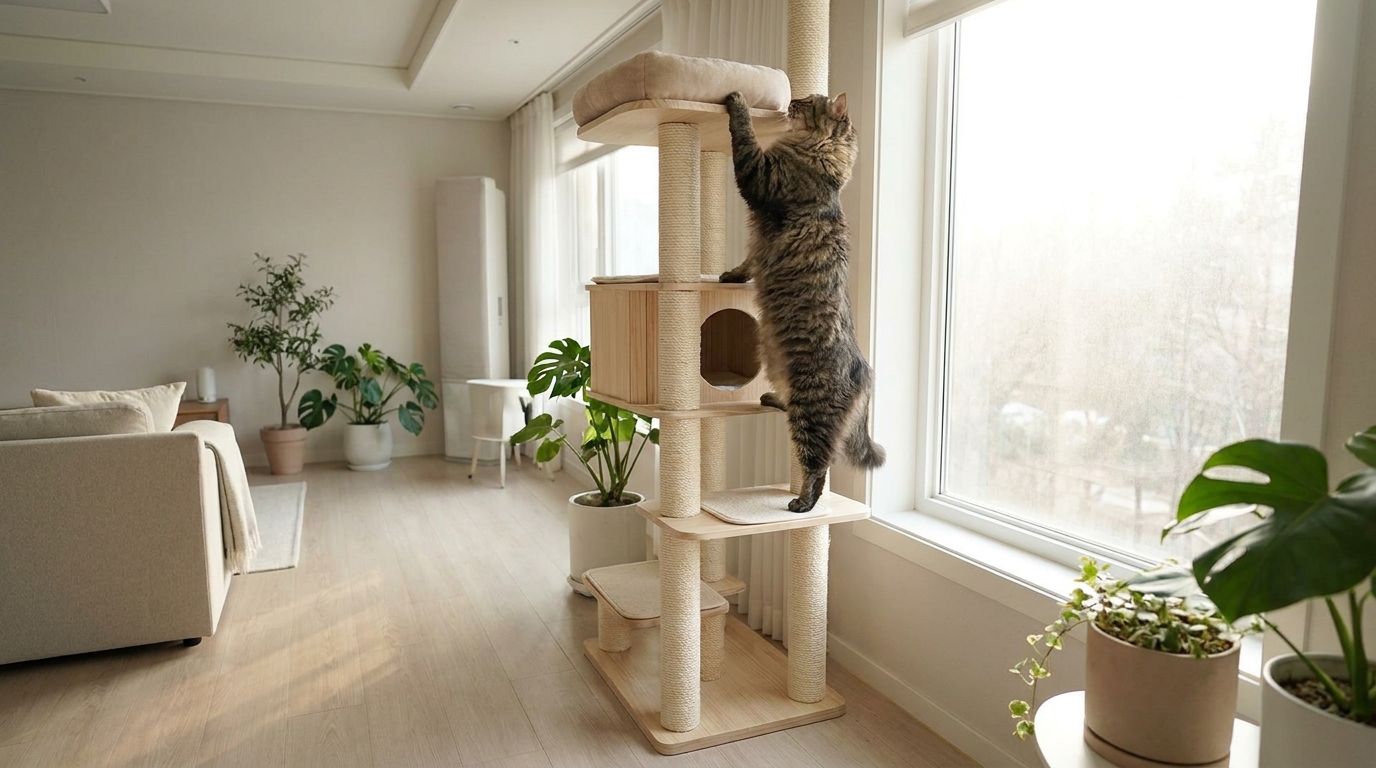
Real downsides: It takes up more vertical space than a horizontal pad and needs a stable, open area to sit in, not a tight corner, since a wobbly or cramped placement is one of the most common reasons cats avoid an otherwise good vertical post.
Who it’s wrong for: Cats that already show a strong ground-level scratching pattern (going after rugs, doormats, or the base of furniture rather than upright pieces) and older or less mobile cats who may not want to rear up on hind legs as readily.
Horizontal Scratchers: Ground-Level and Low-Effort
A horizontal scratcher lets a cat scratch while standing or lying with all four paws on or near the ground, a lower-effort motion than the full stretch a vertical post requires. Some cats consistently prefer this orientation, and it’s also a genuinely useful secondary option even for cats that primarily use a vertical post, since it covers the ground-level scratching and stretching that a tall post doesn’t.
Our pick: Amazon Basics Corrugated Cardboard Cat Scratcher, 4-Pack (Amazon, ~$18 for four), reversible so each pad lasts roughly twice as long, and cheap enough that placing several around the house in different rooms is genuinely affordable.
Testing Note: We scattered these across our hallway and bedroom entrance. Our foster kitten immediately preferred lounging and scratching on the cardboard pad over the hardwood floor.
Real downsides: Cardboard wears out and needs replacing more often than a sisal post, generates loose cardboard debris as it’s used, and doesn’t offer the same full-body stretch a vertical post does, so it isn’t a complete substitute if your cat is a genuine full-stretch scratcher.
Who it’s wrong for: Cats that clearly favor upright surfaces (furniture arms, doorframes) over rugs or low objects, and households where loose cardboard shavings around the scratcher are a genuine nuisance.
How do I tell which orientation my cat actually prefers?
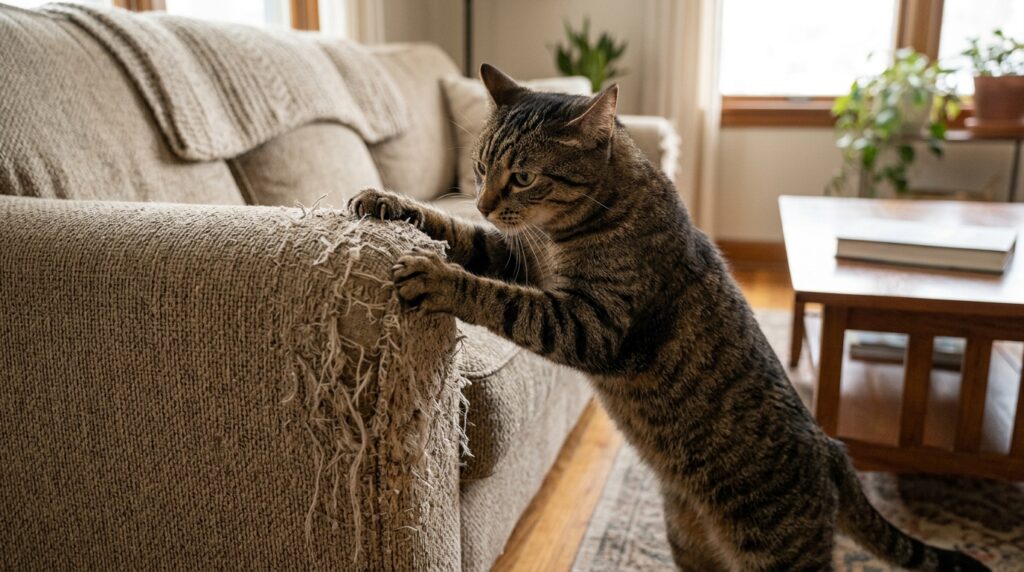
Watch where your cat is already scratching, since the behavior itself is the clearest signal available, more reliable than guessing from personality or breed:
- Scratching furniture arms, doorframes, or other upright surfaces: vertical preference
- Scratching rugs, the base of furniture, or flat cardboard boxes lying around: horizontal preference
- Both, depending on location: genuinely common, and a reasonable sign to just offer both orientations rather than picking one
If your cat hasn’t established a clear pattern yet, particularly with a new kitten, offering both from the start is more efficient than watching furniture get tested in the meantime.
Does age or mobility affect which orientation is better?
Yes. Kittens and senior cats often lean horizontal, since a full vertical stretch requires more strength, balance, and confidence than a lower-effort ground-level scratch. A vertical post is still worth offering for either age group, but pairing it with a horizontal option gives an easier default while a kitten grows into full use of the taller post, or while a senior cat’s mobility is monitored over time.
Can I use both types in the same room, or does that just confuse a cat?
Using both in the same room is fine and doesn’t create confusion; cats don’t need a single, dedicated scratching zone. What matters more is placement relative to where the cat already spends time and already shows interest in scratching, not artificial separation between the two styles.
Frequently Asked Questions
Do cats prefer vertical or horizontal scratchers?
It varies by individual cat, and there’s no universal preference across the species. Watching where your specific cat already scratches — upright surfaces versus flat ones — is the most reliable way to tell.
Should I buy both a vertical and horizontal scratcher?
Generally yes, especially if you’re not sure of your cat’s preference yet or you’re setting up for a new kitten. The combined cost of a basic vertical post and a pack of horizontal pads is often less than one premium cat tree, and it removes the guesswork.
Are horizontal cardboard scratchers less durable than vertical sisal posts?
Yes, cardboard wears out faster and needs periodic replacement, while a sisal-wrapped post typically lasts longer with regular use before the wrap needs replacing or the post needs retiring.
Do kittens prefer horizontal scratchers over vertical ones?
Often, yes, since a full vertical stretch takes more strength and confidence than a lower-effort horizontal scratch. Offering both while a kitten grows is a reasonable approach rather than committing to one style early.
Does scratcher orientation affect whether a cat stops scratching furniture?
It can, if the furniture being targeted matches the orientation the cat actually prefers. A cat scratching a vertical couch arm is unlikely to be fully satisfied by a horizontal pad alone, and vice versa, so matching orientation to the specific furniture being targeted improves redirection success.
Related reading: Full Guide to Indoor Cat Care covers behavior and enrichment alongside nutrition, litter, and vet care. See also Why Cats Scratch Furniture Even With a Scratching Post Available if you already have a post that isn’t being used.