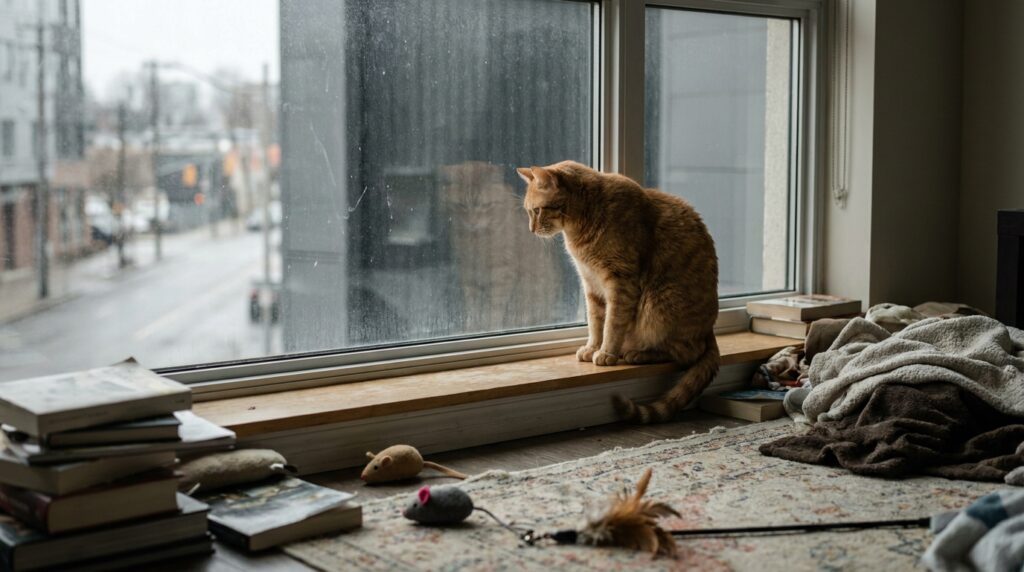
You’ve bought the toys. You leave food out. The apartment is safe and warm. And your cat spends the day staring at the wall.
If you’re asking why is my indoor cat so bored, you’re already noticing something most owners ignore. Cat boredom is easy to dismiss — they sleep a lot, so it must be normal. But a genuinely bored indoor cat is signaling a problem, and if you ignore it long enough, the behaviors it creates get harder to reverse.
Quick Answer: Signs Your Cat Is Bored
| Behavior | Boredom Signal? | Could Also Be |
|---|---|---|
| Sleeping more than usual | Yes | Illness, pain |
| Destroying furniture | Yes | Anxiety, lack of scratching posts |
| Excessive meowing | Yes | Hunger, medical issue |
| Overgrooming / bald patches | Yes | Stress, skin condition, parasites |
| Ignoring toys they used to love | Yes | Age, illness |
| Nighttime zoomies | Yes | Normal energy release |
| Begging for food after eating | Yes | Habit, boredom, not hunger |
| Aggression toward you or other pets | Yes | Pain, redirected frustration |
Rule of thumb: if one or two of these appeared gradually with no other changes, boredom is a reasonable first guess. If multiple appeared suddenly, see a vet before assuming anything.
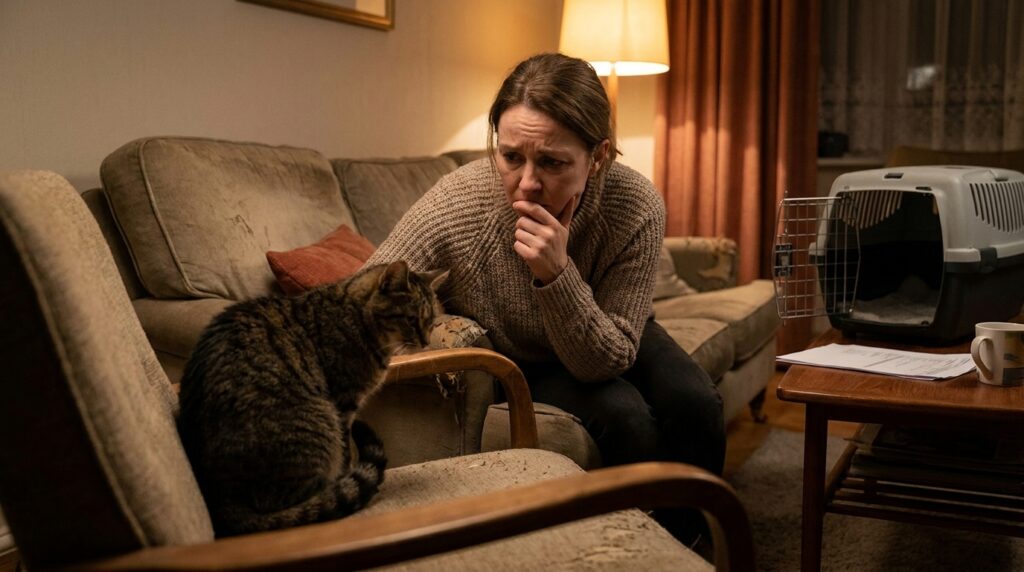
First: Is It Boredom or Is Something Wrong?
This is the question that matters and most articles skip it.
According to veterinary behaviorist Blake Gibson, DVM, what looks like boredom in cats is technically frustration and stress from a lack of environmental enrichment — not boredom in the human sense. That distinction matters practically: true boredom responds to enrichment changes. Medical problems don’t.
Any unexplained behavioral change — reduced play, increased hiding, changes in vocalization — warrants a vet exam before assuming it’s just boredom, because cats are skilled at masking illness.
Check for boredom first if:
- The change was gradual, not sudden
- Your cat is eating and drinking normally
- There’s no obvious physical change (limping, weight loss, discharge)
- The behaviors are attention-seeking rather than withdrawal
See a vet if:
- Multiple behaviors changed at once
- Your cat has stopped eating or is hiding constantly
- You notice overgrooming to the point of skin irritation
- There’s inappropriate elimination (peeing outside the litter box)
Inappropriate elimination in particular can signal that stress from understimulation has progressed far enough to cause physical symptoms — stress is a known contributor to feline lower urinary tract conditions.
Why Indoor Cats Get Bored in the First Place
The short version: your cat is wired to hunt. Your apartment has nothing to hunt.
Cats follow a hardwired behavioral sequence every time they play or hunt: Stare → Stalk → Chase → Pounce → Kill → Eat. Every step in that chain releases neurochemicals that regulate mood, energy, and stress. When the chain never gets triggered — when a cat spends the day watching the same four walls — those systems don’t fire. The result isn’t just boredom. Indoor life has come at a significant cost to cats’ behavioral welfare. Keeping cats as indoor pets requires owners to recognize and help them adapt to a fundamentally unnatural lifestyle.
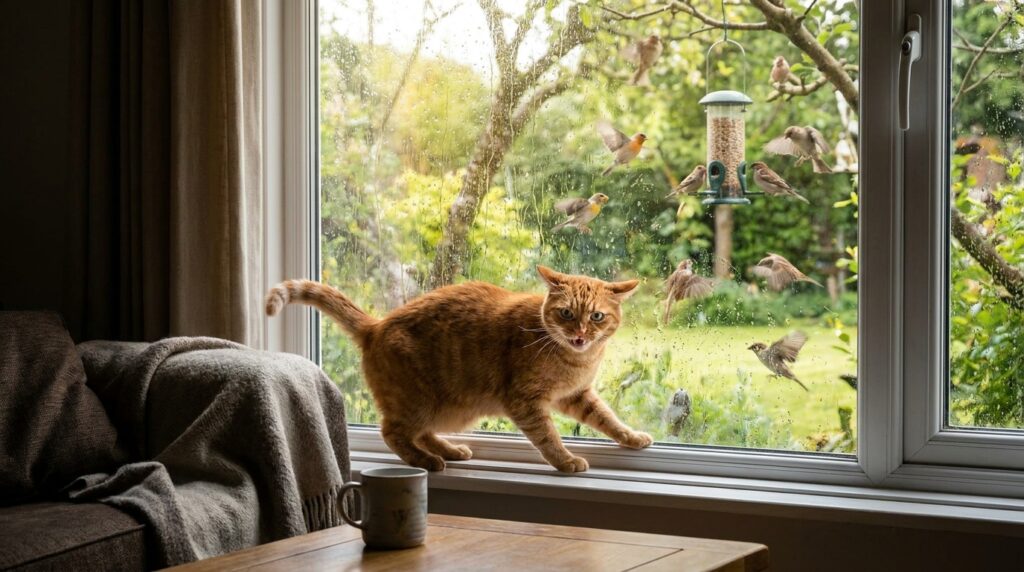
Indoor cats are more prone to boredom specifically because they have no outlet for predatory behaviors — the climbing, jumping, stalking, hunting, chasing, and pouncing that outdoor cats engage in throughout the day.
The specific causes usually fall into a few categories:
No interactive play. A bowl of kibble and a feather toy on the floor isn’t play. Cats need movement that mimics prey — unpredictable, responsive, something that requires them to actually stalk and chase.
Toy habituation. Cats get bored with the same toys over time — behaviorists call this “habituation.” Once a toy stops being novel, it stops registering as interesting. Most owners leave the same five toys out indefinitely and wonder why the cat ignores them.
No vertical space. Cats are natural climbers. Without cat trees, shelves, or high perches to survey their territory from, they lose a major source of daily stimulation and security.
Too much time alone. Cats left alone for long stretches, day after day, can develop loneliness, boredom, and even separation anxiety — even with a full food bowl and a clean litter box.
Wrong timing. Cats are most active at dawn and dusk. A toy presented at noon while your cat is in their midday rest cycle will get ignored. The same toy at 6am gets a different response.
Signs of a Bored Cat: What to Actually Watch For
Most competitor articles give you a list of seven symptoms that all feel equally vague. Here’s what each one actually looks like day-to-day and what it means.
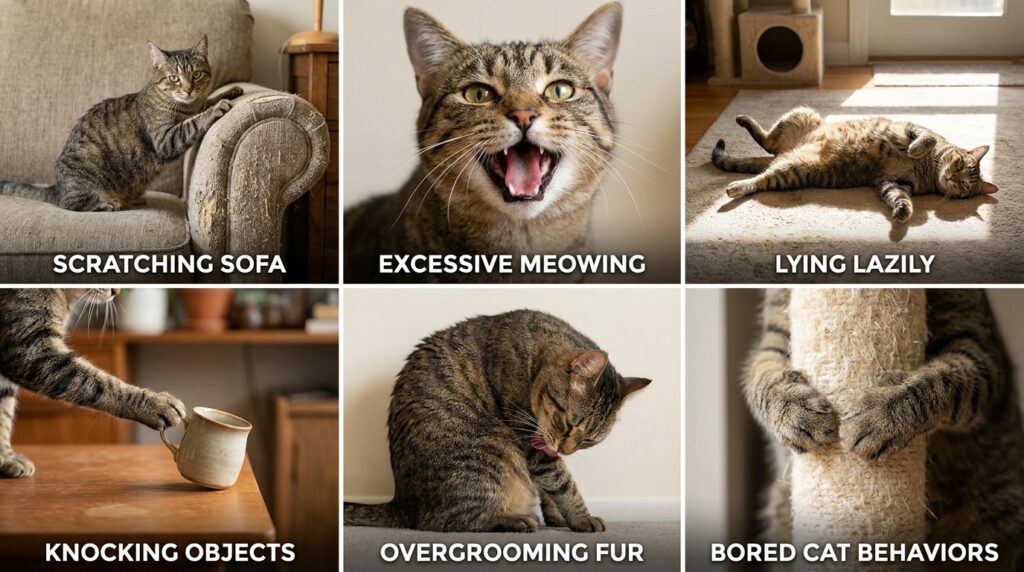
Sleeping more than their normal amount
Cats average 12–16 hours of sleep daily. When that extends further — when they’re shutting down simply because there’s nothing else to do — that’s the boredom version. The difference between normal sleep and boredom sleep: a normally-rested cat wakes up curious, alert, and ready to engage. A bored cat wakes up flat.
Destroying furniture and knocking things over
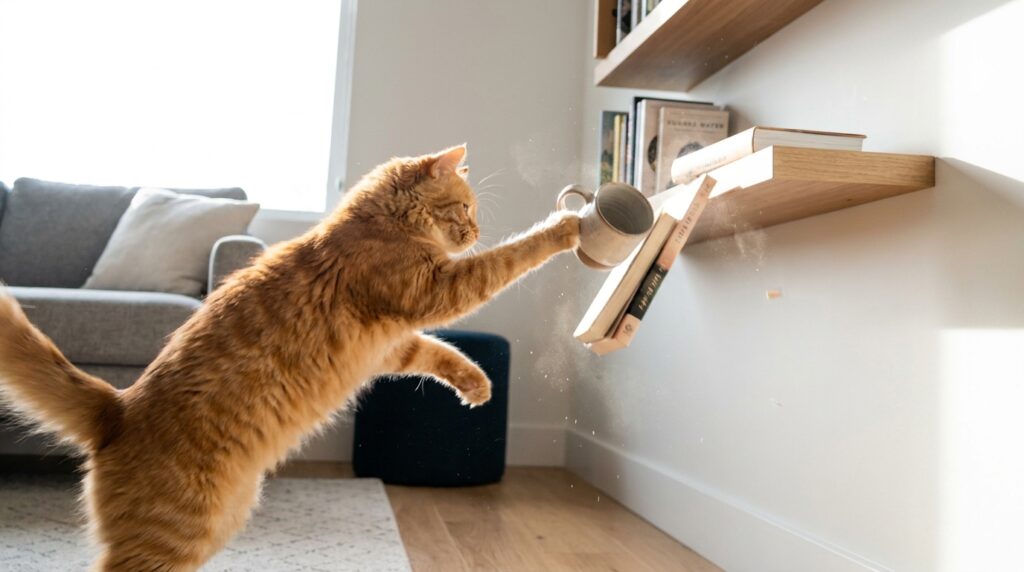
Cats aren’t destructive by nature — they’re searching for stimulation. Scratching furniture, knocking items off shelves, chewing cords, and climbing spots they normally avoid are all attempts to create their own entertainment. The furniture isn’t the target. Boredom is the problem. Catastrophic Creations
Nighttime zoomies
Sudden sprints around the apartment at 2am aren’t random. Zoomies are pent-up energy that has nowhere to go during the day. Without a healthy play outlet, that energy surfaces as chaotic behavior at night. Two good play sessions during their active windows (morning and evening) usually resolves this within a week.
Overgrooming
Overgrooming in bored cats produces licking, chewing, and pulling at fur that leads to bald patches and skin irritation. It’s a compulsive, repetitive behavior that signals stress and frustration — not a grooming preference. If you’re noticing bald spots, this needs attention and possibly a vet visit to rule out skin conditions or parasites first.
Excessive meowing and clinginess
Cats don’t meow to communicate with other cats — meows are directed at humans. A bored cat learns that consistent meowing gets a reaction, even a negative one, and keeps doing it. Following you room to room, pawing for attention, yelling at 3am — these are all the same signal: this cat needs more engagement.
Aggression toward you or other pets
A cat that ambushes your ankles, swats unprovoked, or picks fights with other household pets may be channeling pent-up predatory energy. Without appropriate outlets to stalk and pounce, you become the prey. This isn’t a personality problem. It’s an enrichment problem.
Changes in appetite
Boredom can go both ways with food — some cats eat more as a coping mechanism, while others lose interest entirely. If your cat is begging constantly right after a meal, they’re probably bored rather than hungry. A puzzle feeder handles both issues at once.
Loss of curiosity
This one is subtle and easy to miss. Cats naturally monitor their territory — watching out windows, investigating shopping bags, following you into rooms. When a cat stops doing that and just sleeps and eats with no observable curiosity, that’s a meaningful change.
My Cat Is Not Playing Anymore — Is That Boredom?
This specific situation gets almost no attention in competitor articles, and it deserves its own section because the causes are different.
A cat that suddenly stops playing after previously being playful is not the same as a cat that has always been low-energy. Sudden disinterest in play has a short list of causes:
Pain or illness. Joint pain, dental pain, or underlying illness can make play uncomfortable. If disinterest in play is accompanied by weight changes, grooming changes, or mobility issues, see a vet before trying enrichment strategies.
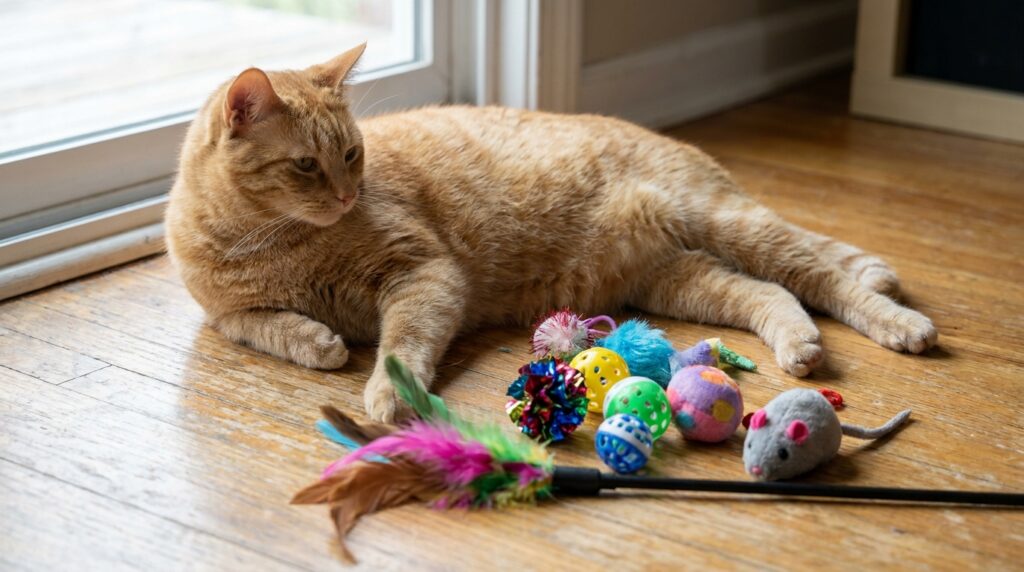
Toy fatigue. If the same toys have been sitting out for months, the cat stopped seeing them as interesting a long time ago. This isn’t apathy — it’s habituation. Rotate the toys.
Wrong presentation. Wiggling a toy in a cat’s face breaks the natural prey sequence. Prey doesn’t come toward the predator — it runs away. Making the toy skitter across the floor, hide behind furniture, and flee unpredictably triggers the chase response. A toy that moves toward the cat gets ignored. Heapet
Wrong timing. If you’re trying to engage an indoor cat at 2pm, you’re fighting their circadian rhythm. Try the same toy at 7pm and watch the difference.
Too much choice. Twenty toys on the floor permanently becomes invisible. Rotating a small set — keeping most toys stored and reintroducing them periodically — restores novelty and reignites interest.
How to Fix Cat Boredom (That Actually Works)
Daily interactive play — non-negotiable
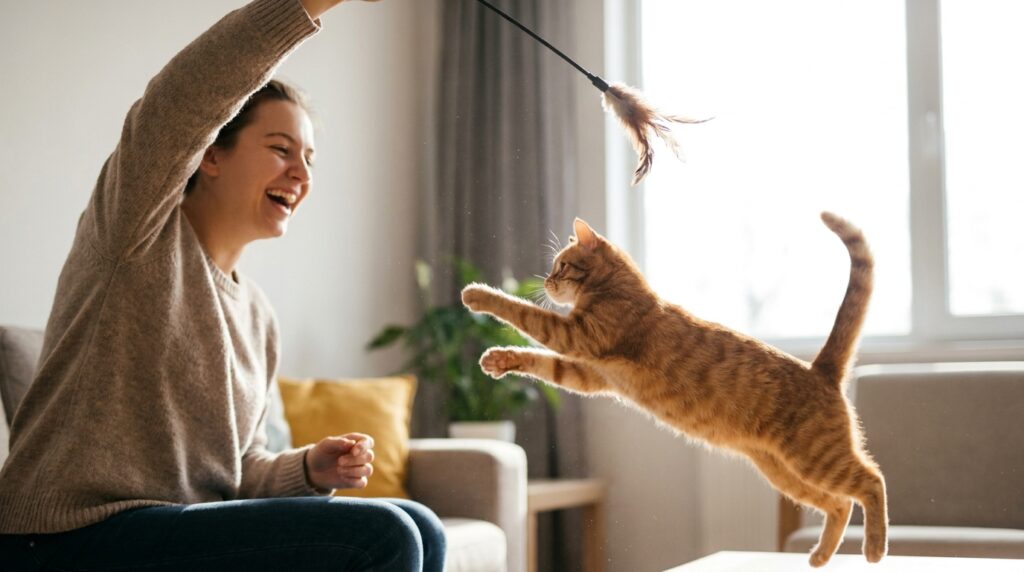
Two to three play sessions of 10 minutes each per day can significantly improve a bored cat’s quality of life, according to veterinary behaviorists. These need to be interactive — you holding a wand toy, not a battery-operated device left running in the corner. The wand toy needs to behave like prey: unpredictable direction changes, pauses, hiding, and retreat. Always let the cat catch and “kill” it at the end. Always follow with a small food treat. This completes the prey sequence and prevents post-play frustration.
Rotate toys every 2–3 days
Keep three to five toys in circulation. Store the rest. Reintroduce stored toys with a light rub of catnip to refresh their scent. Scarcity maintains novelty — what the cat can’t access constantly becomes interesting again when it reappears.
Add vertical space
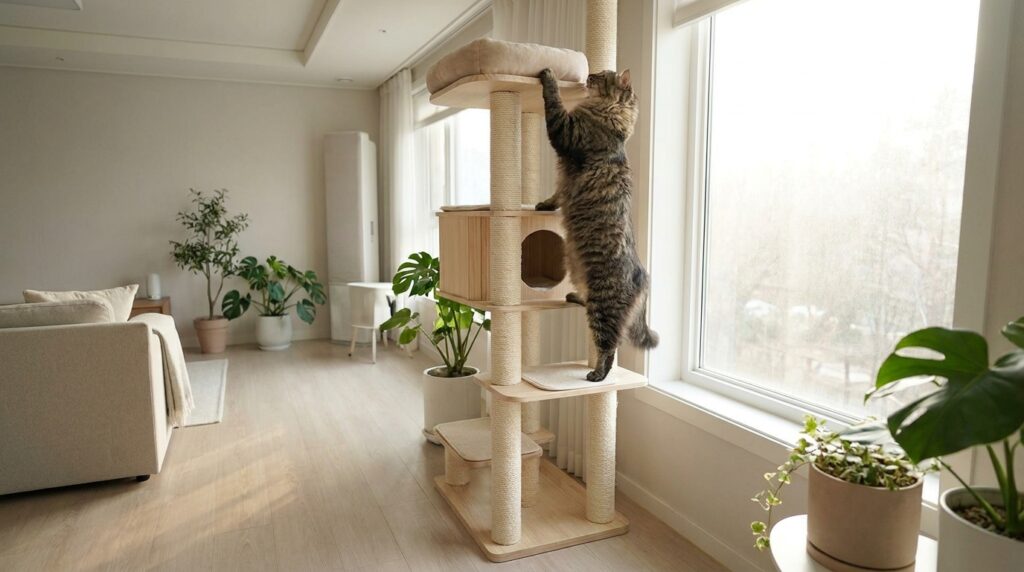
Cat trees over five feet tall and wall-mounted cat shelves give cats opportunities to climb, observe their territory, and feel secure — all behaviors that reduce stress and boredom simultaneously. If your cat isn’t using a cat tree, it’s probably positioned wrong. Cats want to see the room from above, not face a wall.
Use puzzle feeders
Puzzle feeders turn an ordinary meal into a foraging exercise — cats have to problem-solve and physically work to access their food, mimicking the effort of hunting prey. Start with the easiest level. Most cats figure out moderate difficulty within a week and stay engaged longer than with a standard bowl.
Create window access
Birds, squirrels, passing people, and changing weather provide genuine visual enrichment for indoor cats. A window perch with a bird feeder positioned outside it is essentially free passive enrichment. Some cats will spend hours at a good window.
Set up a camera and actually watch what your cat does alone
An inexpensive camera synced to your phone lets you see exactly what your cat does during the hours you’re away — whether they’re genuinely bored, actively exploring, or showing signs of distress. Most owners are surprised by what they find. If the cat is truly inactive for the majority of the day, that’s the baseline you’re working with.
Consider automatic toys for daytime only
Automatic toys — the kind that move beneath fabric covers or respond to touch — help during the 8–10 hours a day you’re not home. They’re not a replacement for interactive play, but they’re better than nothing. Look for ones with randomized movement rather than fixed patterns, which cats figure out and ignore within days.
Don’t automatically get a second cat
This is the advice that gets recommended too casually. Cats are solitary by nature and won’t necessarily want to play with another cat. A poorly matched introduction can create significant stress for both animals. A second cat works well for sociable cats with calm temperaments. For anxious, territorial, or older cats, it can make boredom worse by adding conflict. Fix the enrichment problem first and assess whether a companion actually makes sense for your specific cat’s personality.
Bored Cat Behavior at a Glance: What to Do
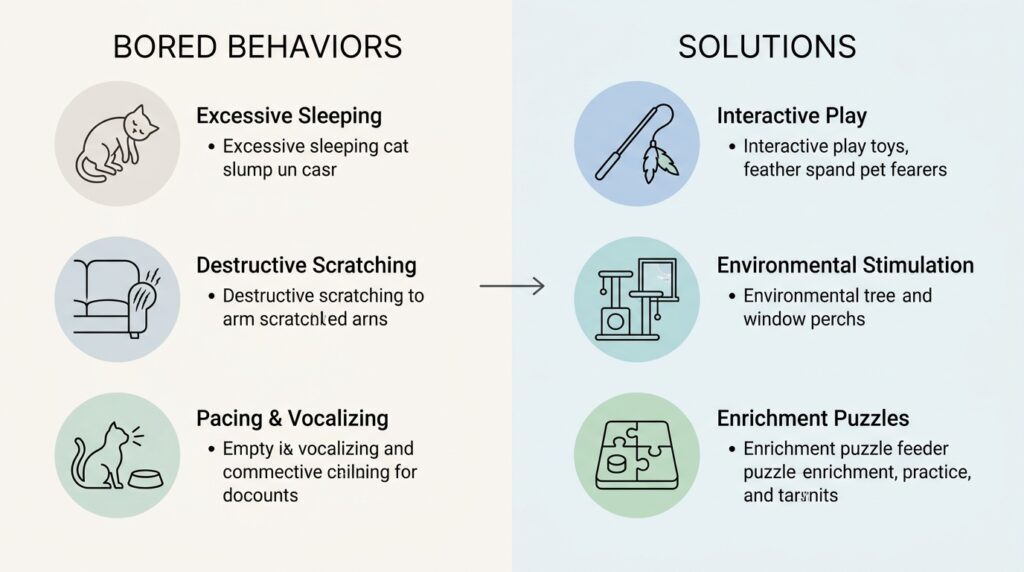
| Sign | Immediate Fix | Long-Term Fix |
|---|---|---|
| Nighttime zoomies | Two play sessions in the evening | Consistent daily play routine |
| Destroying furniture | Redirect to appropriate scratching surfaces | Add vertical space + daily play |
| Overgrooming | Rule out medical cause first | Reduce stress with enrichment, not just toys |
| Excessive meowing | Don’t reward it with attention | Add interactive play sessions |
| Ignoring toys | Rotate toy selection immediately | Store and reintroduce on a 3-day cycle |
| Aggression toward you | Stop using hands as toys | Wand toy sessions daily to redirect prey drive |
| Food begging after meals | Puzzle feeder for meals | Scheduled feeding, not free feeding |
Frequently Asked Questions
Why is my indoor cat so bored?
The most common reasons: not enough interactive play, toys that have gone stale from overexposure, no vertical space to climb and observe from, and long hours alone without any enrichment. Indoor life is safe but structurally boring — it removes the hunting, exploring, and territory-patrolling that fill an outdoor cat’s day. The fix is building those behaviors back into the home environment deliberately.
What are the signs of a bored cat?
Excessive sleep, destructive behavior, overgrooming, nighttime zoomies, constant meowing, aggression, food begging after meals, and loss of curiosity about their surroundings. Any of these can also signal medical problems, so rule those out first if behaviors appeared suddenly or are severe.
Why has my cat stopped playing all of a sudden?
Sudden disinterest in play usually points to pain, illness, or toy habituation. If your cat was previously playful and stopped, a vet check is the right first step. If they’re healthy, the problem is almost always presentation — wrong toys, wrong timing, wrong movement pattern, or too many options left out simultaneously.
How do I fix cat boredom?
Daily interactive wand toy sessions (twice a day, 10–15 minutes each), a rotating toy selection swapped every 2–3 days, puzzle feeders instead of a standard bowl, and a cat tree or window perch positioned with a good outdoor view. Most cats show improvement within a week of consistent changes.
Can a bored cat become depressed?
Yes. Chronic boredom that goes unaddressed can progress into withdrawal, lethargy, reduced appetite, and behavioral changes that look more like depression than simple boredom. If your cat has been persistently flat for more than a few weeks despite enrichment attempts, a vet conversation about behavioral health is worth having.
Sudden behavioral changes always warrant a vet check before assuming boredom — cats are skilled at hiding illness. For tools to actually fix boredom, see our guide to [Best Cat Toys for Indoor Cats] and our [Ultimate Indoor Cat Care Guide].