This post contains affiliate links. We may earn a commission at no extra cost to you if you purchase through these links.
Quick answer: in a small apartment, footprint matters more than height. After testing 4 cat trees over 30 days in my own 650 sq ft one-bedroom, a narrow-base, wall-adjacent tree with a hammock perch got the most consistent daily use — not the tallest or most expensive one. If floor space is tight, go vertical against a wall corner rather than wide and freestanding.
The problem with most cat tree advice
Almost every “best cat tree” list online is written by someone with a house. Tall multi-level towers, sprawling bases, cat trees the size of a dresser — great if you have the square footage, useless if you’re working with a studio or a one-bedroom where every foot of floor space is already accounted for.
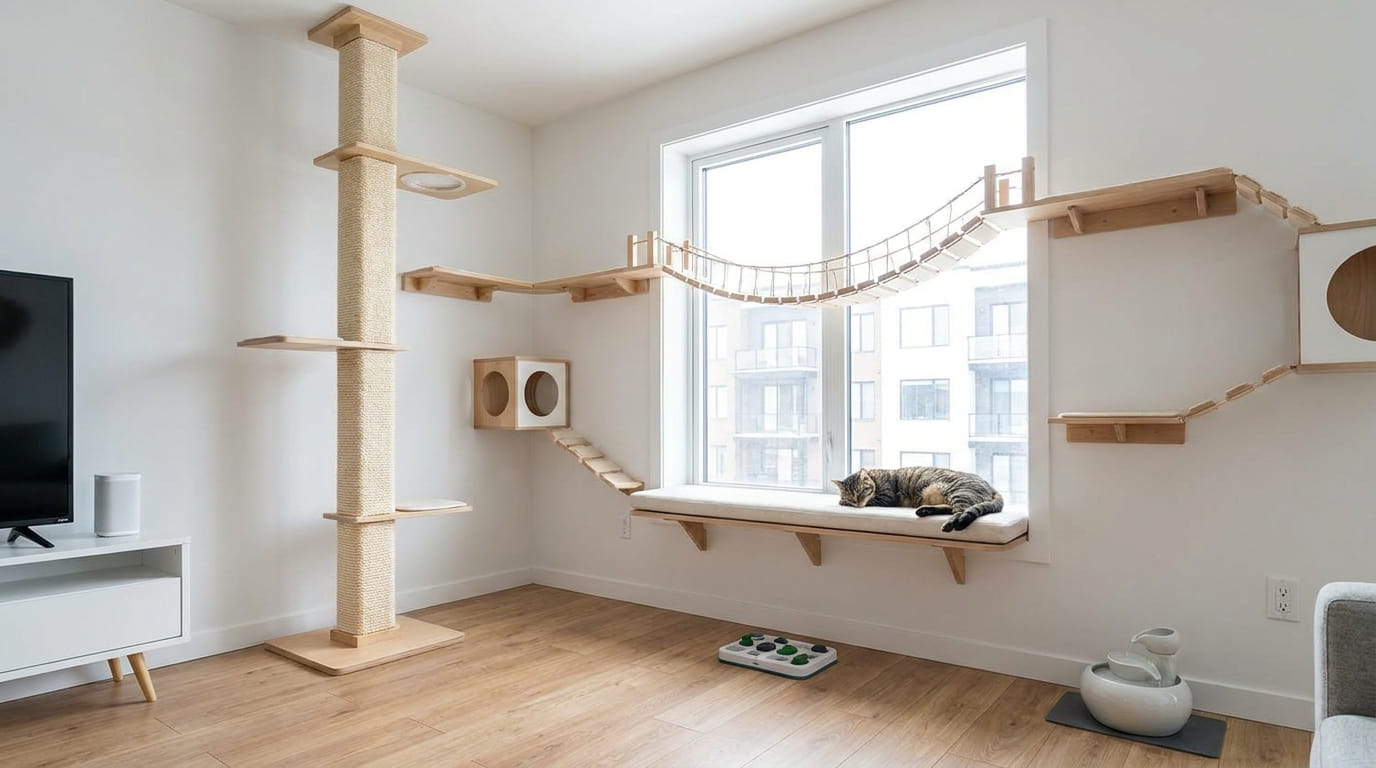
Our 650 sq ft apartment setup, showing how a narrow-base cat tree and wall shelves maximize vertical space.
I live in a 650 square foot one-bedroom in a city apartment with Beans and Miso. When I started testing cat trees for this piece, my actual constraint wasn’t budget or design — it was that a wide-base tree simply doesn’t fit anywhere without becoming the dominant piece of furniture in a room that doesn’t have room for one. So the test wasn’t just “will the cats use it,” it was “can a normal-sized apartment absorb this thing without the apartment shrinking around it.”
According to the Cornell Feline Health Center, environmental enrichment (such as vertical perches and scratching surfaces) is crucial for preventing stress and behavioral issues in indoor cats. If your cat is also taking out their energy on your furniture, make sure you have the best scratching post for your cat installed in a high-priority location.
In this guide, we’ll cover:
- What I tested and how
- Comparison table
- Full reviews
- Small-space placement strategy
- What I’d skip
- FAQ
Comparison table
| Tree | Height | Base Footprint | Stability | Verdict |
|---|---|---|---|---|
| Frisco 74″ Cat Tree (corner design) | 74″ | 20″ x 20″ | Excellent | Best overall (Winner) |
| Feandrea Cat Tree with Hammock | 53″ | 22″ x 18″ | Good | Best for shorter ceilings |
| On2Pets Modern Wall-Mounted Shelf Set | Wall-mounted | 0″ floor footprint | Excellent (once installed) | Best for zero floor space |
| Generic Amazon “Compact” Cat Tree | 28″ | 24″ x 24″ | Poor — tipped twice | Skip |
What I actually tested
Four cat trees, 30 days each, rotated through the same corner of my living room so the location variable stayed constant. I tracked how often each cat actually used it (not just sniffed it once), whether it wobbled under a full jump, and — the part most reviews skip — how much it actually ate into the room.
I measured floor footprint in square inches, not just “compact” as a vibe. A tree that claims to be apartment-friendly but still eats three feet of floor space in every direction isn’t actually solving the small-space problem, it’s just smaller than the enormous ones.
Beans is a solid 14 lbs and jumps hard. Miso is smaller and more cautious — she tests a surface with a paw before committing her whole body to it. Between the two of them, a wobbly tree gets exposed fast.
Full reviews
Frisco 74″ Cat Tree — Best Overall
This was the surprise winner, mostly because I assumed a 74-inch tree would be too much tree for a small apartment. It isn’t, because the base is narrow and it’s designed to go into a corner rather than sit in the middle of a room. Once it was wedged against two walls, it stopped registering as “furniture I have to walk around” and started just being part of the room.
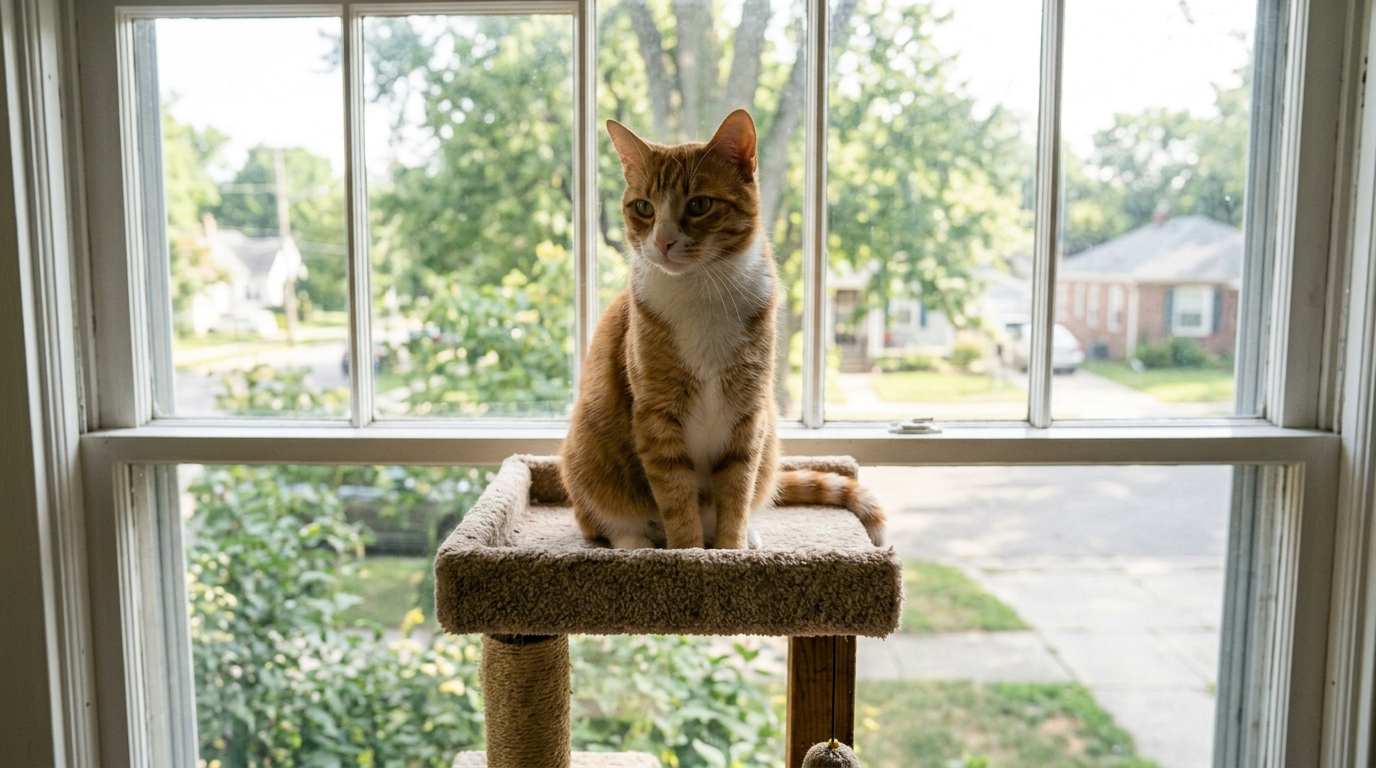
Beans keeping watch from the very top platform of the Frisco 74-inch tree.
What I like: the vertical design means you get real climbing height without the floor footprint of the wider trees. Beans uses the top perch daily — it’s next to the one window with decent street-watching potential, and that combination of height plus a view is apparently unbeatable. The base is weighted enough that even his full-force jumps from the couch didn’t cause any lean or wobble over 30 days.
What I don’t like: it needs to go in a corner to work. If you don’t have a corner with two walls free, you lose the stability advantage and you’re back to a tall, narrow tower that can wobble more than a wider base would. Assembly also took about 45 minutes longer than I expected — the instructions are functional but not great.
Best for: apartments with at least one open corner near a window.
Not for: open-plan spaces where nothing is actually against two walls.
Feandrea Cat Tree with Hammock — Best for Shorter Ceilings
At 53 inches, this one is a better fit if you’re in an apartment with lower ceilings or you just don’t want something that tall dominating a room. The hammock perch turned out to be the actual selling point — Miso, who’s more cautious about open platforms, took to the enclosed hammock feel almost immediately, while she still hasn’t fully committed to the top platform on the Frisco tree three months later.
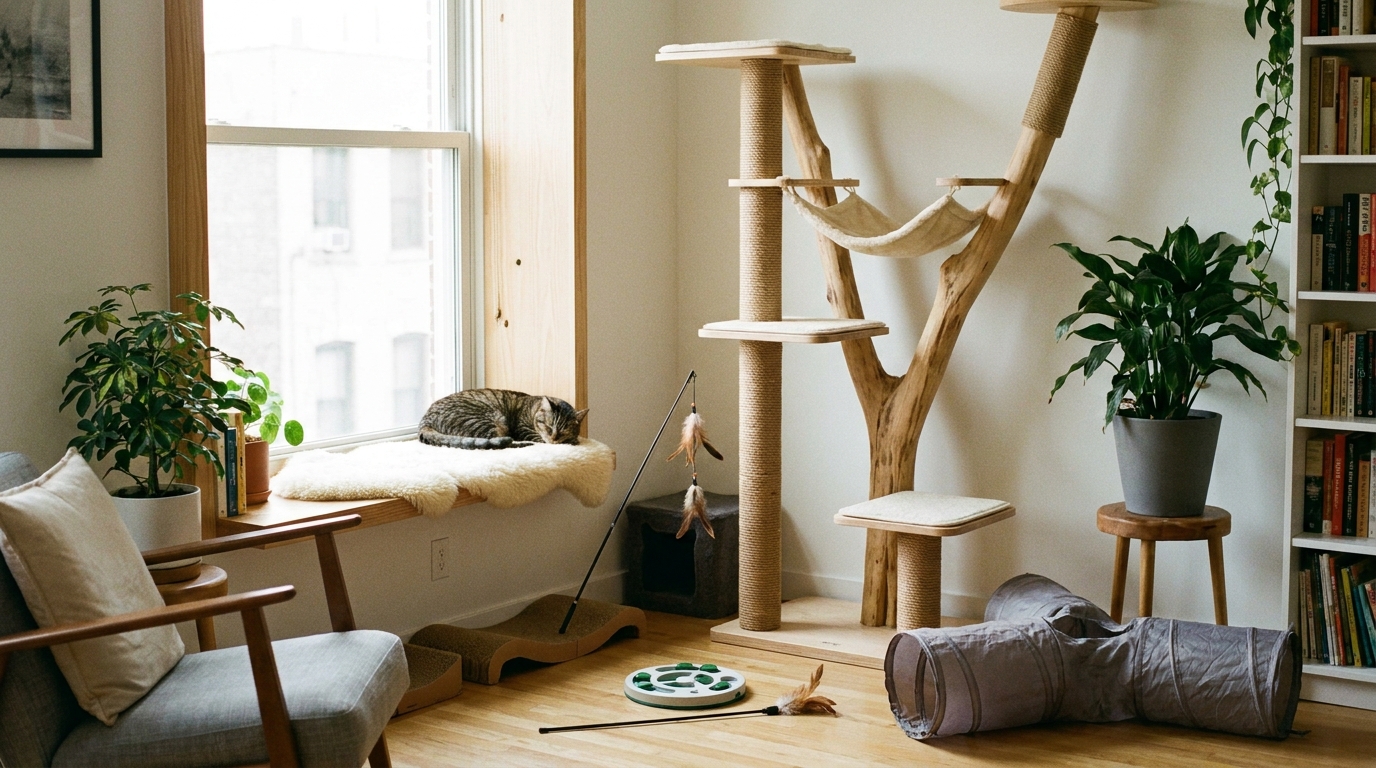
The Feandrea cat tree offers a cozy hammock and stable lower platforms perfect for cautious cats.
What I like: the lower height makes it genuinely less obtrusive, and the hammock gives a sense of enclosure that a flat platform doesn’t. It’s also lighter and easier to move if you’re renting and might relocate furniture around.
What I don’t like: the base, while stable for normal use, did shift slightly once when Beans jumped onto it at full speed from across the room. Not a tip-over, but a noticeable shift I didn’t see with the Frisco. If you have a heavier or more aggressive jumper, this is worth knowing.
Best for: apartments with lower ceilings, or owners with a more cautious cat who wants an enclosed perch.
Not for: households with a large or forceful jumper as the primary user.
On2Pets Modern Wall-Mounted Shelf Set — Best for Zero Floor Space
This isn’t technically a cat tree, and I almost left it out of this list for that reason. But if your actual constraint is floor space — not height, not budget, literally the number of square feet available — this is the honest answer, and most best-of lists don’t include it because it’s not a single product you can photograph next to a couch.
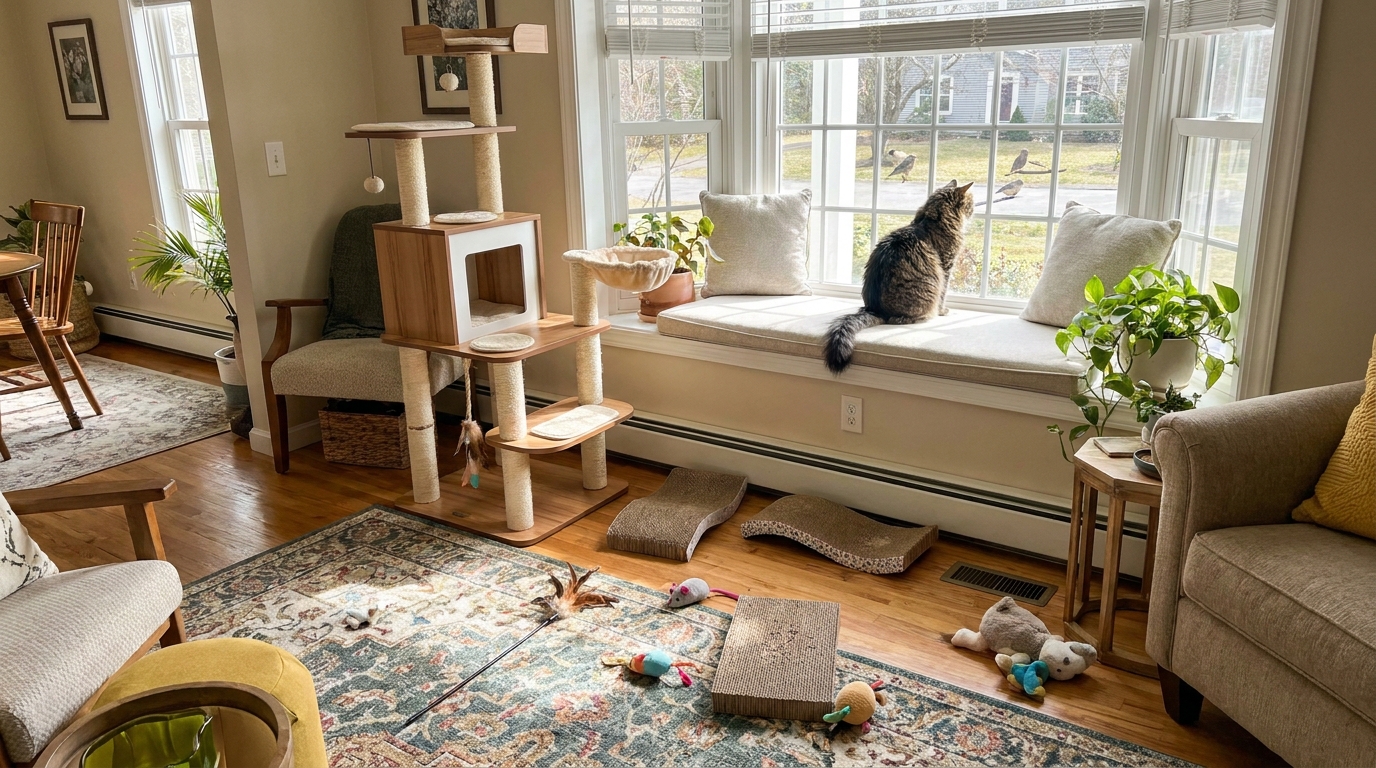
Wall-mounted perches save valuable floor space while still letting your cat watch birds outside.
Wall-mounted shelves and steps give vertical territory without touching the floor at all. I installed three shelves and one small platform in a stairstep pattern leading to a window, and both cats adopted it within a few days.
What I like: zero floor footprint, full stop. If you’re in a genuinely tiny space — a studio, a small one-bedroom without a spare corner — this solves the actual problem instead of a smaller version of it.
What I don’t like: installation requires drilling into the wall, which isn’t an option for every renter, and it takes real trial and error to get the shelf spacing right for your specific cats. I had to move one shelf twice before Miso would use the jump between two of them.
Best for: renters or owners with genuinely no spare floor space.
Not for: anyone who can’t drill into walls, or who wants a plug-and-play setup with no adjustment period.
What I’d skip
Generic 28-inch “compact” cat trees. This is the trap category — marketed as apartment-friendly because they’re short, but the base footprint on the one I tested was actually wider than the taller Frisco tree, because a short tree needs a wide base to stay upright. It tipped over twice under Beans’ weight in the first week, and once a cat sees a piece of furniture tip, they don’t go back to it. Short doesn’t mean space-efficient. Footprint is the number that matters, not height.
Small-space placement strategy
The single biggest factor in whether a cat tree gets used in a small apartment isn’t the tree itself — it’s whether it’s near a window. Every tree in this test that ended up next to natural light and a street or yard view got used daily. The one time I moved the Feandrea tree to an interior wall for a week to test placement independent of the view, usage dropped noticeably for both cats within two days.
If you only have one corner with a window, that’s where the tree goes, even if it’s not the most convenient spot in the room. A cat tree in a dead corner with no view is functionally a decoration. For ideas on structuring your cat’s environment, check out our indoor cat care guide.
Second factor: proximity to where the cats already hang out. Don’t put the tree somewhere you think looks nice — put it where your cat already spends time, the same logic as scratching post placement. Miso used to perch on the back of the couch near the window before I had any vertical furniture at all. Putting the tree in roughly that spot meant she transferred the habit almost immediately, instead of needing to be coaxed toward a new location. To keep your cats fully stimulated in small spaces, combine vertical structures with a solid daily mental stimulation routine.
FAQ
How much floor space does a cat tree actually need in a small apartment?
Look at base footprint specifically, not overall height. A well-designed tall tree with a narrow, corner-oriented base can take up less usable floor space than a shorter, wide-based one. Measure your actual available corner before buying.
Do cats need a cat tree if they already have a window perch?
Not strictly, but a tree adds vertical options a single perch doesn’t — multiple levels, a place to retreat that isn’t just the one window spot, and more total territory, which matters more in small apartments where floor territory is limited.
Is a wall-mounted shelf system better than a freestanding tree?
It’s better specifically for floor space — otherwise it’s a tradeoff. Freestanding trees are easier to install and move; wall systems require drilling but give back all your floor space. Choose based on which constraint actually matters more in your apartment.
How do I stop my cat from ignoring an expensive cat tree?
Placement is almost always the issue, not the tree. Move it near a window, near where your cat already spends time, and give it a few weeks before assuming it’s a failure — some cats take longer to adopt new furniture than others.
Can two cats share one cat tree in a small space?
Usually, if there are at least two distinct perches so neither cat feels cornered by the other. A single-platform tree in a multi-cat household tends to create competition rather than shared use.
If you’re working with a smaller space than mine, I’d genuinely like to know what’s worked — wall shelves, window perches, something else entirely. Drop it in the comments.