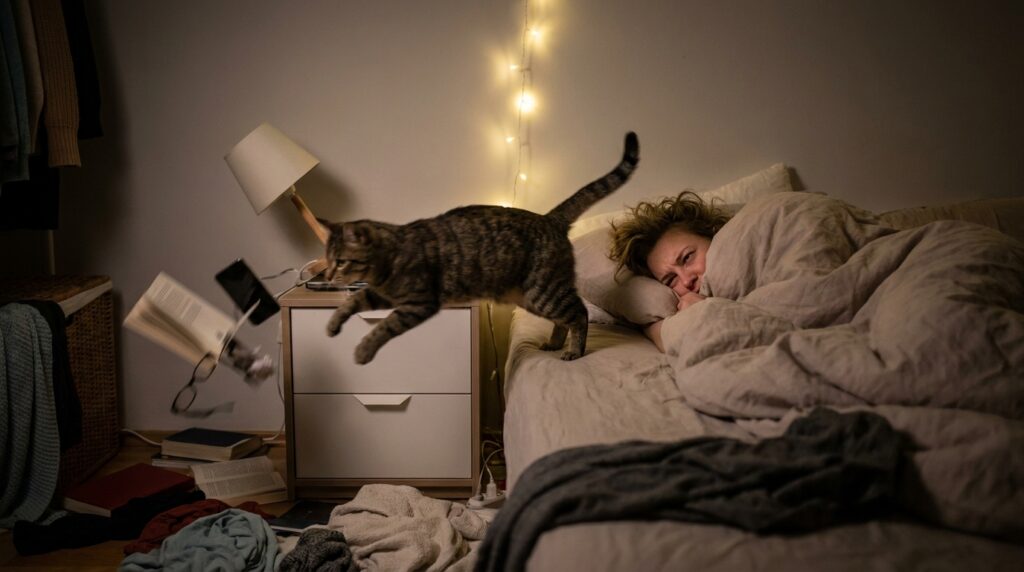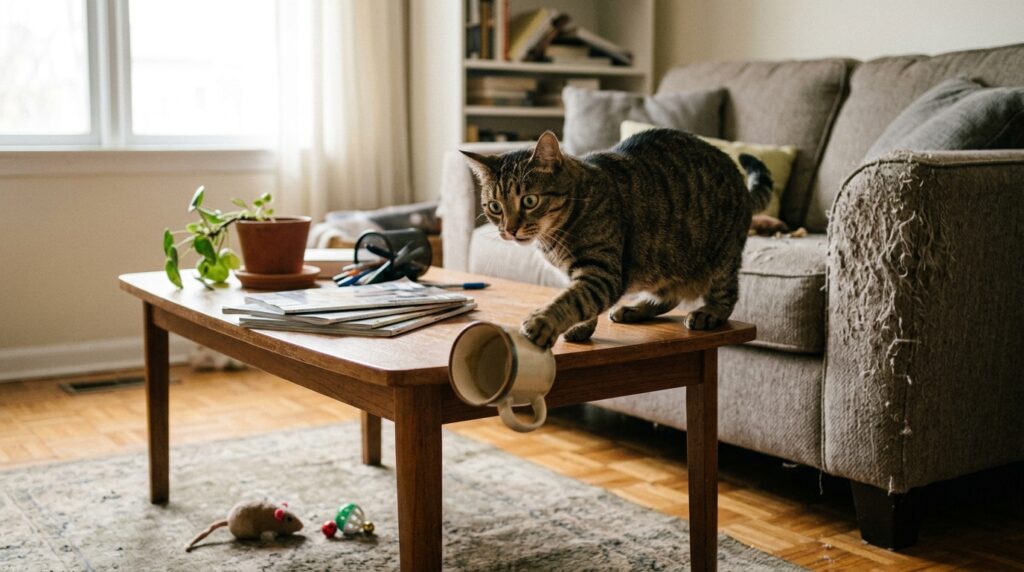
Here is the problem with most advice on how to mentally stimulate indoor cats: it comes as a list. Buy a puzzle feeder. Get a cat tree. Rotate the toys. Leave the radio on. These are not bad ideas. But a list without a structure is just a pile of options, and most owners try two of them, don’t see an immediate difference, and go back to how things were before.
Also Read: Signs of a Bored Indoor Cat — What Each Behavior Actually Means
Why Mental Stimulation Matters More Than Physical Exercise Alone
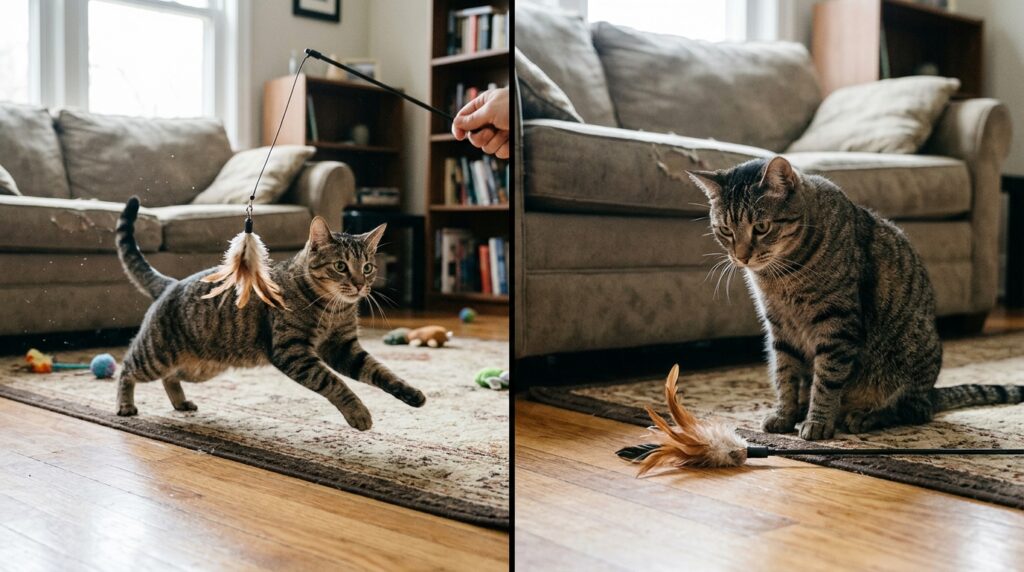
Most owners think of enrichment as exercise. Keep the cat moving, tire her out, done. Physical activity matters — but cognitive stimulation is a distinct need, and skipping it leaves the job half done.
For indoor cats in particular, cognitive stimulation may be as important as physical exercise for maintaining mental health and preventing the behavioural problems that often arise secondary to boredom. Cats who are understimulated mentally can become aggressive, destructive, overweight, or chronically anxious — not because they are not tired, but because their brains have nothing to work on.
The American Association of Feline Practitioners categories feline environmental needs around five key dimensions: a safe space, multiple and separated key resources, opportunity for play and predatory behavior, positive and consistent human-cat social interaction, and an environment that respects the cat’s senses. When all five are met intentionally, something shifts. Cats become calmer, more predictable, and less destructive.
That five-part framework is the backbone of everything in this article.
The Five Pillars of Mental Stimulation for Cats
Pillar 1: Feeding Enrichment — Make Her Work for Every Meal
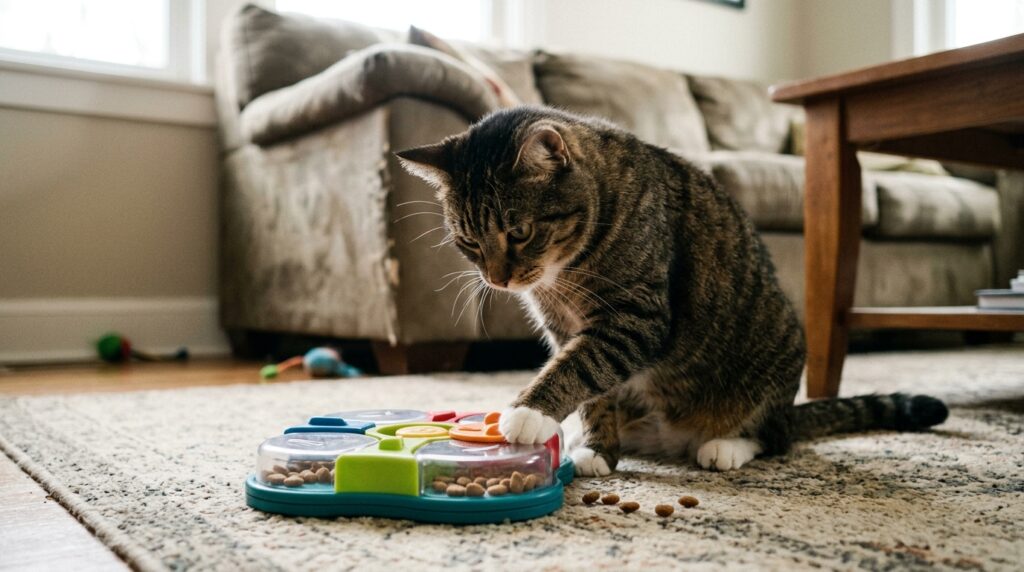
One of the simplest and most impactful changes you can make is eliminating the food bowl. Cats are wired to work for their meals. Eating from a dish in ninety seconds flat leaves that drive completely unfulfilled. Puzzle feeders, snuffle mats, and treat-dispensing balls force your cat to problem-solve and slow down at mealtime — tapping into the same mental circuits as hunting prey.
The behavioural payoff is not just theoretical. Puzzle feeders activate the seeking circuit — the brain system responsible for anticipation, motivation, and curiosity. It is the same system engaged during a hunt. A cat who uses a puzzle feeder for breakfast is genuinely using her brain, not just eating.
Practical options ranked by difficulty:
| Level | Method | Best For |
|---|---|---|
| 1 — Beginner | Scatter kibble on a licki mat or across a tray | Cats new to puzzles |
| 2 — Easy | Toilet roll puzzle (close the ends, put kibble inside) | DIY, zero cost |
| 3 — Intermediate | Commercial tray puzzle with sliding covers | Most adult cats |
| 4 — Advanced | Treat-dispensing ball or rolling puzzle feeder | High-drive, food-motivated cats |
| 5 — Expert | Hide multiple small portions around the flat | Cats who know beginner puzzles |
Start at Level 1 or 2. Jumping to a Level 4 feeder with a cat who has never used one often leads to frustration, abandonment, and you clearing up scattered kibble from under the sofa. Build the skill progressively.
You can also find easy and creative DIY ideas: stand empty toilet paper rolls upright in a small box and drop treats inside some of the tubes; place treats in some egg carton compartments and cover with scrunched-up paper. These work as well as commercial options for many cats.
One important note from VCA Animal Hospitals: ensure all food is consumed when using puzzle feeders. Cats can become seriously ill if they do not ingest enough calories daily. Monitor intake for the first week.
Pillar 2: Play and Predatory Behaviour — The Hunt Sequence
Play is not entertainment. It is a controlled hunt simulation, and your cat’s brain processes it as such. A complete hunt cycle — stalk, chase, catch, kill, eat — activates and satisfies the predatory drive. Incomplete cycles leave it open, which is why a cat who “plays” with a laser pointer for ten minutes and then gets nothing tangible to catch is often more restless afterwards than before.
Use feather wands or motorized toys to mimic prey animal movements and encourage your cat to run and jump as they go in for the kill. The movement is what matters. A toy that moves unpredictably, pauses, and then darts away mimics injured prey — and that pattern holds attention far longer than anything moving in a straight line.
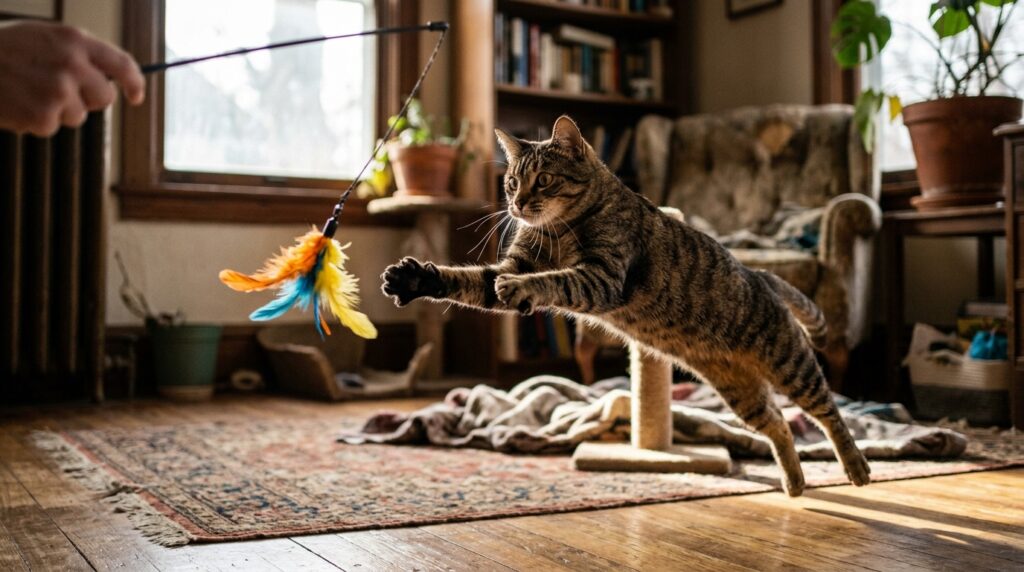
The complete session structure:
- Start slow (dragging the toy along the ground, letting her stalk)
- Build speed and unpredictability
- Let her catch it multiple times — a hunt that never succeeds is frustrating, not enriching
- End by tossing a treat or small piece of kibble so she catches her “prey”
- Let her groom and settle — this completes the eat-groom-sleep phase naturally
Two sessions per day of ten minutes each is the minimum. One in the morning before you leave for work, one in the evening before her main meal. This is the highest-return single habit in feline enrichment — nothing else produces comparable results in the same time investment.
Session timing for working owners:
- Morning session: before you leave — burns pre-departure energy, reduces separation anxiety window
- Evening session: before the biggest meal of the day — completes the hunt cycle before feeding, promotes settled sleep
Pillar 3: Vertical Space and Environmental Exploration — Height Is a Need
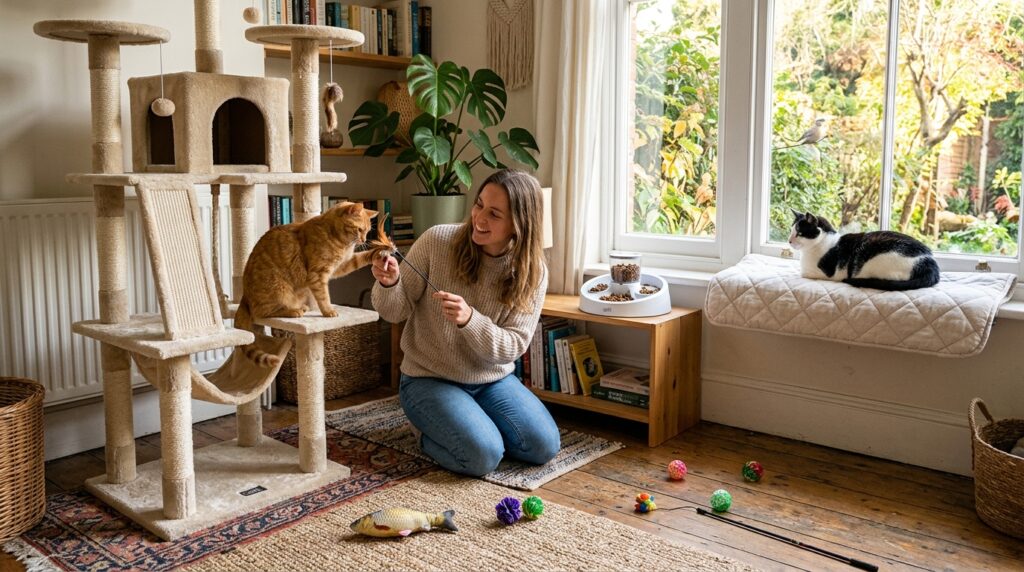
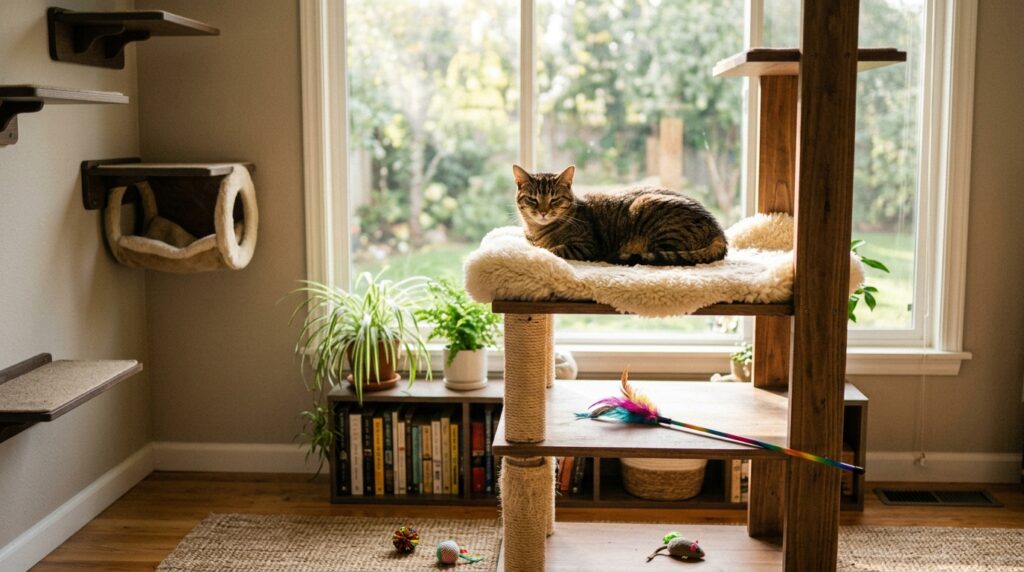
Cats feel safest when they can get above the action. Height gives them a vantage point over perceived threats, a refuge when overwhelmed, and a patrol route that exercises both body and mind. Vertical space is essential indoor enrichment for cats. This is not decoration. It is a genuine welfare need.
A cat who has only horizontal space is essentially living in two dimensions. Adding height through a cat tree, wall-mounted shelves, or a cleared bookcase shelf converts the same square footage into a richer environment.
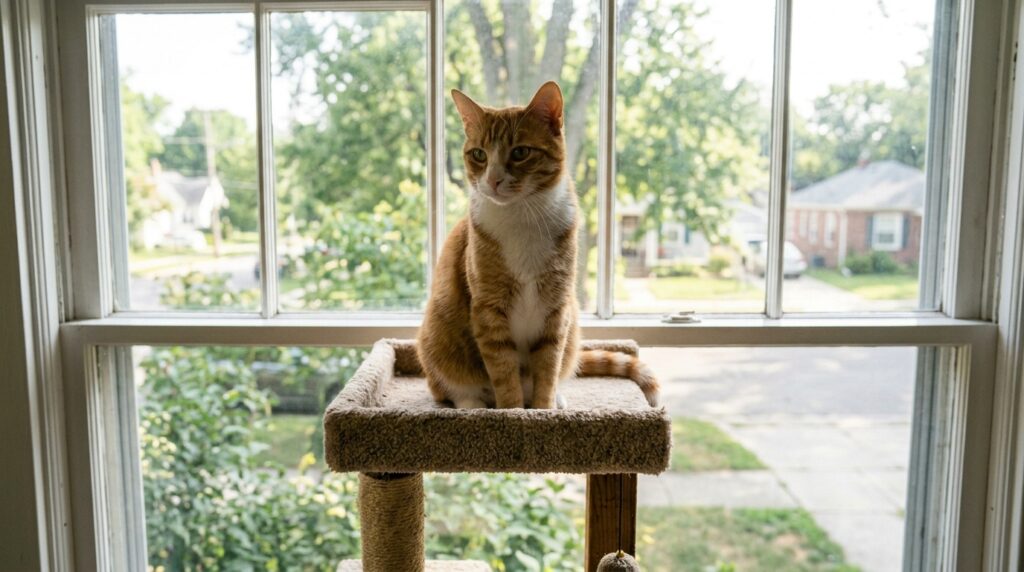
Building a vertical enrichment setup:
- Place the cat tree or highest perch near an active window — the combination of height and a view multiplies enrichment value
- Space any wall-mounted shelves so your cat can jump between them — a series of ledges at different heights creates a patrol circuit
- Rotate which surfaces she has access to — clearing the top of the wardrobe for a week, then blocking it and opening up a different high spot, creates novelty without buying anything
The sensory layer: Cats navigate partly by smell. Rotating items with new scents — a cardboard box that came in the post, a piece of fabric with an outdoor scent, a pinch of dried catnip rubbed into a scratcher — engages the olfactory system and makes familiar spaces feel new. This is a zero-cost enrichment upgrade that almost no one does consistently.
Pillar 4: Cognitive Challenges — Brain Games for Cats
This is the pillar most articles skip, which is exactly why it is your competitive edge.
Cats are capable of more than physical play. Research on feline cognition has found that cats can learn relational concepts, not just specific stimulus-response patterns — meaning they can generalise rules, not just memorise steps. This places the cognitive ceiling for cats considerably higher than most owners assume, and it means your cat can genuinely be taught.
Clicker training: the most underused enrichment tool
In a study of 100 shelter cats, significant gains in performance were found for all four trained behaviours after clicker training — touching a target, sitting, spinning, and giving a high-five. Age and sex had no effect on successful learning. Cats who were more food-motivated showed greater gains.
Clicker training gives cats predictable, positive interactions with humans, which increases their sense of control over their environment. That sense of control is a core component of feline well-being.
The mental effort involved in working out what earns a click and a treat is genuine cognitive enrichment. Your cat is running a problem-solving loop, holding a hypothesis, testing it, and updating based on the result. Five minutes of clicker training tires a cat’s brain more than thirty minutes of passive play.
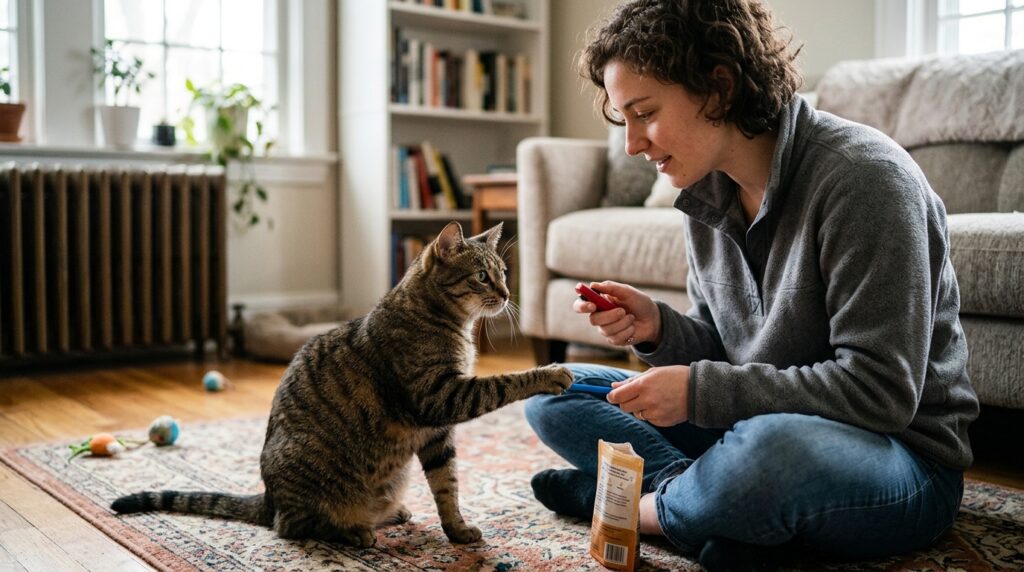
How to start:
- Get a clicker (or use a ballpoint pen that clicks cleanly)
- Click once, then immediately give a small treat — repeat ten times until she looks at you when she hears the click
- Present your open palm close to her nose — the moment she sniffs or touches it, click and treat
- That is the “target” behaviour — the foundation of everything else
From targeting you can build: sit, high-five, spin, come when called, stepping onto a mat on cue. None of these take long to learn. All of them require her brain to work. Sessions of five minutes, two to three times per week, are enough to see results within a fortnight.
Other brain games to rotate in:
- Muffin tin game: place treats in some compartments of a muffin tin, cover all holes with tennis balls — your cat lifts the balls to find the food
- Shell game: three cups, one treat hidden under one — slide them slowly and let her choose
- Name the toy: hold up a toy and say its name each time before playing — many cats learn to go to a named toy within a few weeks
Pillar 5: Social Enrichment — You Are Part of Her Environment
Research into feral cat colony behaviour shows complex social structures with genuine affiliative bonds. Domestic cats bonded to their humans show attachment behaviours that more closely resemble secure bonding than mere tolerance.
Your cat wants to be near you. She just wants proximity on her terms. The enrichment application of this is simpler than most people think: create a dedicated resting space beside wherever you spend the most time — your desk, your reading chair, your sofa spot. Your cat can observe, doze, and participate in the ambient rhythm of your day without needing to be on top of you. The result is less demanding behaviour, not more, because the underlying need for closeness is being met passively.

Beyond proximity, active social enrichment includes:
- Grooming sessions your cat initiates (not forced — wait for her to lean into you)
- Talking to your cat as you move through the flat — she learns your vocal patterns and your daily routine, both of which reduce anxiety
- Allowing her to be present during calm activities — reading, working at a desk — without forcing interaction
For solo indoor cats, this pillar also includes the honest assessment: if you are out for ten or more hours every day and your cat is alone for all of it, no amount of toys will fully compensate for the social deficit. A second cat, a pet sitter visit, or a cat-specific daycare arrangement addresses a genuine need that enrichment objects cannot.
The Structured Daily Routine
This is where broad enrichment advice becomes actionable. Most articles dump five to twenty ideas and leave you to figure out when and how to use them. Here is a realistic daily routine that implements all five pillars without requiring significant extra time.
Morning (Before You Leave — 15 Minutes Total)
| Time | Activity | Pillar |
|---|---|---|
| 5 min | Wand toy play session — let her catch several times, end with a treat toss | Predatory play |
| 5 min | Puzzle feeder for morning meal — set it out while she transitions from play | Feeding enrichment |
| 2 min | Rotate one toy out, introduce one from storage | Environmental novelty |
| 3 min | Brief quiet contact — grooming or sitting near her while she settles | Social enrichment |
Midday (If You Can — 5 Minutes)
If you work from home occasionally or have a flexible break: short clicker training session (3 minutes) or scatter a small handful of treats around one room for a sniff hunt. If you are out all day: an automatic feeder releasing a small midday portion achieves the same feeding event without your presence.
Evening (30 Minutes Total — Your Most Important Window)
| Time | Activity | Pillar |
|---|---|---|
| 10 min | Active wand toy session — this is the primary play window of the day | Predatory play |
| 5 min | Clicker training session (3x per week minimum) | Cognitive challenge |
| 5 min | Largest meal of the day — immediately after play | Feeding enrichment + hunt cycle |
| Ongoing | Calm co-presence — you on the sofa, her in her spot nearby | Social enrichment |
Weekly (15 Minutes Once Per Week)
- Rotate the full toy selection — put current toys away, bring out a different set
- Add a new scent element — a cardboard box, a fresh piece of catnip, a new scratching surface
- Check vertical access points — move her tree or clear a new high spot if she has stopped using the current one
- Assess the week: any new destructive behaviour, overgrooming, or nighttime disruption signals a gap in one of the five pillars
Common Mistakes That Cancel Out Your Efforts
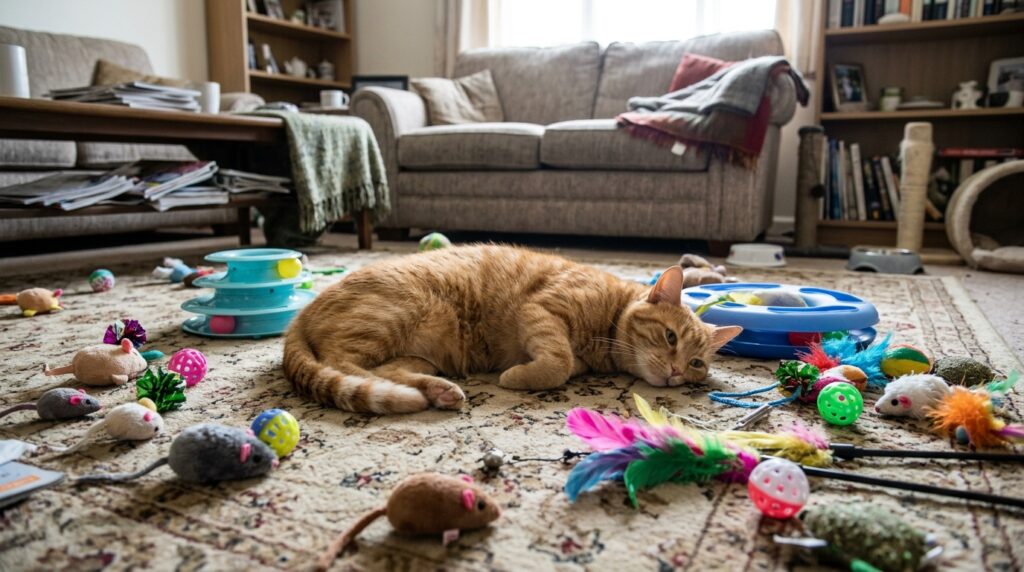
Leaving all toys out permanently. Novelty is the engine of enrichment. A toy that is always available stops registering as interesting within 48 hours. Rotation is not optional — it is what makes the system work.
Using only physical play and ignoring cognitive challenge. A cat who is physically exercised but mentally understimulated is like a human who goes for a run every day but never reads a book. The brain has its own needs. Clicker training and puzzle feeders address the part of enrichment that a wand toy cannot.
Buying more items instead of using what you have differently. A puzzle feeder made from an egg carton works as well as a £30 commercial one. The enrichment value comes from the problem-solving, not the object. Before adding anything, ask whether you are using your current setup consistently.
Skipping the play session because your cat seems uninterested. Cats who are bored over time lose the initiative to seek play. They have learned that nothing interesting happens, so they stop trying. You may need to re-engage a bored cat by initiating play consistently for five to seven days before she starts showing spontaneous interest again. Persistence in the first week matters.
Treating enrichment as a one-off project. You set up the cat tree, bought the puzzle feeder, did three clicker sessions. Then life got busy. This is the most common pattern, and it explains why so many cats stay bored despite their owners feeling like they tried. Enrichment only works when it is consistent. The daily routine is the point.
FAQs
How often should I mentally stimulate my cat?
Daily. The minimum baseline is two play sessions of ten minutes each plus one feeding enrichment event (puzzle feeder or scatter feeding). Clicker training three times per week adds cognitive challenge on top of that. Consistency across the week matters more than intensity on any single day.
What are the best brain games for cats?
The highest-value options in order of cognitive demand: clicker training (problem-solving, rule learning), advanced puzzle feeders (spatial reasoning, trial and error), scatter hunts (olfactory search, exploration), and the muffin tin or shell game (object permanence, choice behaviour). Wand toy play is excellent for predatory drive but does not engage the same problem-solving circuits as these.
Do puzzle feeders actually work for mental stimulation?
Yes, and the research supports it. Puzzle feeders activate the seeking system — the brain circuitry linked to anticipation and motivation — which is the same system engaged during hunting. Cats who use puzzle feeders regularly show lower rates of boredom-driven behaviour than cats fed from bowls. Start with a simple level and progress gradually.
Can I mentally stimulate my cat if I’m not home all day?
Yes, through passive setup: a puzzle feeder for at least one meal, a bird feeder outside the window, a midday automatic feeder release, and rotated toys left in the environment. Active enrichment — wand play, clicker training — is concentrated in the morning and evening windows when you are present. The passive setup carries the daytime.
At what age should I start enrichment activities?
As early as possible. Kittens who received training and socialisation showed better discrimination learning and more optimistic outlooks compared to control kittens in published research. Adult cats can start at any age — age and sex do not affect trainability. Senior cats benefit especially from gentle cognitive enrichment because regular mental activity can slow cognitive decline and keep older cats engaged.
Conclusion
Mental stimulation for indoor cats is not a shopping list. It is a five-pillar system — feeding enrichment, predatory play, vertical space, cognitive challenge, and social interaction — applied consistently through a daily routine.
Most owners do one or two of these well and ignore the rest. The daily routine in this article covers all five in under an hour of cumulative time per day. None of it requires expensive equipment or dramatic lifestyle changes.
Start with the two things that produce the fastest results: the evening play session before the main meal, and a puzzle feeder for one meal per day. Add clicker training in the second week. Build the rest of the system from there.
Cats who receive this level of engagement are measurably calmer, less destructive, and better to live with. The investment is small. The return is significant.
Also Read: How to Keep Your Indoor Cat Entertained While at Work