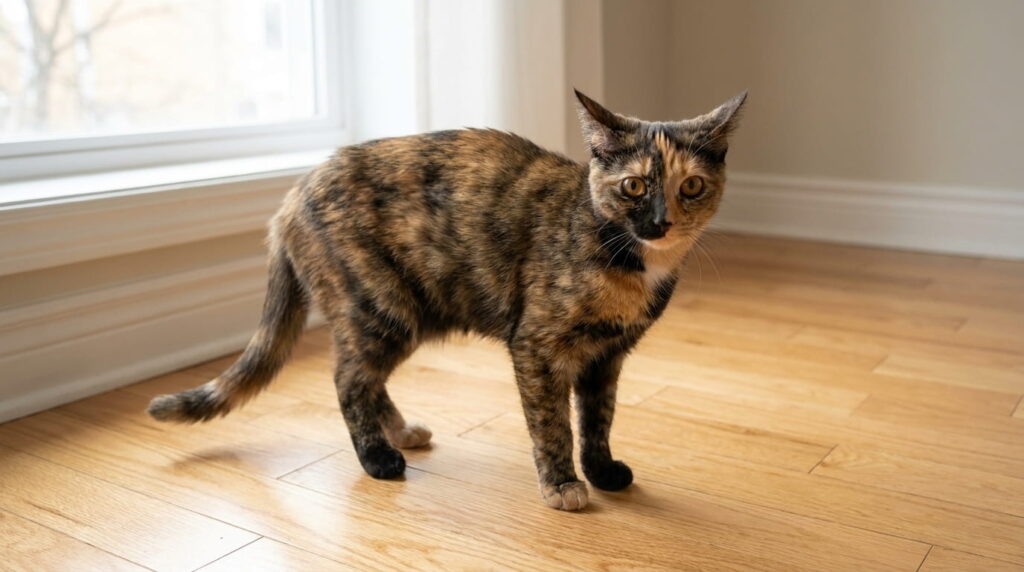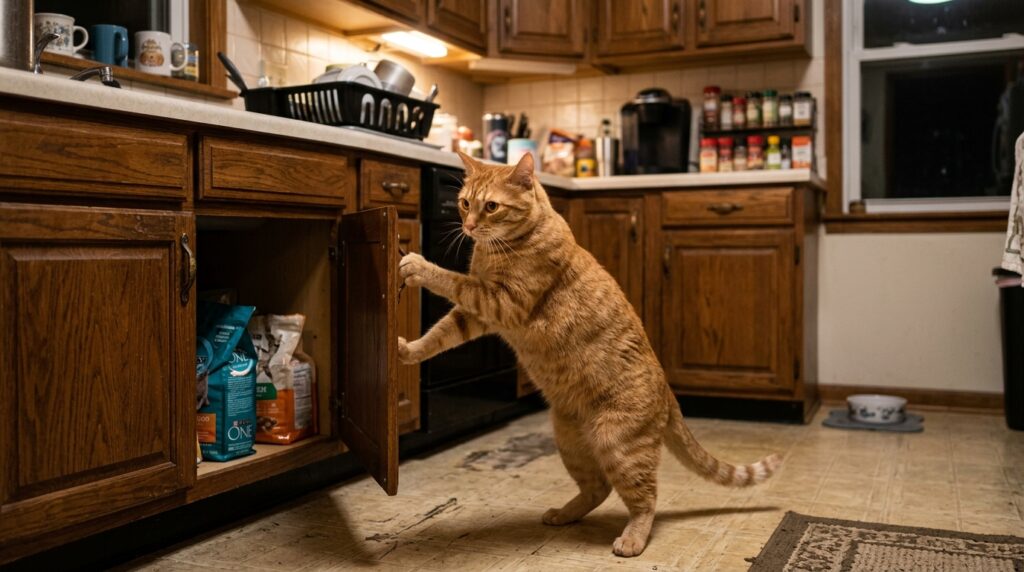
My cat Beans learned how to open the cabinet where I keep his food. Not the bag — the actual cabinet. He figured out the magnetic latch in about four days.
I’m not telling you this to brag about his intelligence. I’m telling you because it made me realize I had completely underestimated how much mental effort he needed every day. He wasn’t getting into the cabinet because he was hungry. He was doing it because he had nothing else to do.
Puzzle feeders fixed this. Not completely — Beans still finds new ways to make my life interesting — but adding a puzzle feeder to his routine made a visible difference within a week. He stopped yelling at me in the morning. He stopped knocking things off shelves. He slept better.
This is what best puzzle feeders do for indoor cats. They’re not just a way to slow down a cat who eats too fast. They’re the closest substitute your cat has for actually hunting.
Why Indoor Cats Need Puzzle Feeders
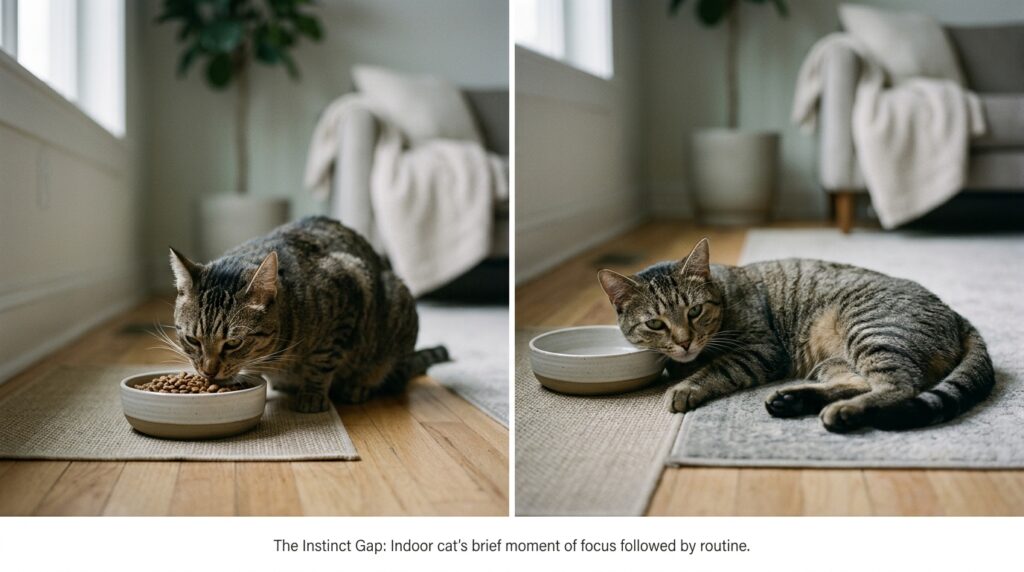
Cats in the wild spend roughly 4–6 hours a day hunting. Not successfully — their success rate is low. But the hunting itself, the stalking and problem-solving and working for food, is what their brains are built for.
An indoor cat who eats from a bowl twice a day completes the eating part in about 90 seconds. That’s it. No hunting, no effort, no satisfaction. The food just appears, she eats it, and then she has nothing to do.
This creates two problems.
The boredom problem. A cat who doesn’t work for her food is a cat with unspent energy and no outlet. That energy tends to go somewhere: excessive meowing, destructive scratching, midnight sprinting, overgrooming, antagonizing other pets. None of this is misbehavior — it’s a cat doing what she can with what she has.
The eating-too-fast problem. Cats who eat from a flat bowl can finish a meal in under two minutes. Fast eating leads to vomiting, bloating, and weight gain from the lack of satiation signals. A puzzle feeder slows this down mechanically, which helps — but the more important effect is the mental work involved.
A puzzle feeder turns a 90-second meal into a 10–20 minute activity. Multiply that by two meals a day, and you’ve just given your indoor cat 20–40 minutes of cognitively engaging work she wouldn’t otherwise have.
What to Look for in a Puzzle Feeder
Difficulty level that matches your cat. Most feeders are rated easy, medium, or hard. Start easier than you think you need to — a cat who can’t figure out a feeder will give up and stare at it resentfully. That doesn’t help anyone. Build up gradually.
Material that’s easy to clean. Puzzle feeders that trap wet food in crevices and can’t be run through the dishwasher are a hygiene problem. Look for dishwasher-safe or flat pieces that wipe clean easily.
Size appropriate for your cat’s paw. Some feeders are designed for dogs and have openings that are too large to be challenging for cats. Others have openings so small that a large cat’s paw doesn’t fit. Check dimensions before buying.
Stable base. A puzzle feeder that slides across the floor while your cat bats at it teaches your cat to smack it across the room instead of solving it. Rubber-grip bases or heavier materials keep it in place.
Best Puzzle Feeders for Indoor Cats
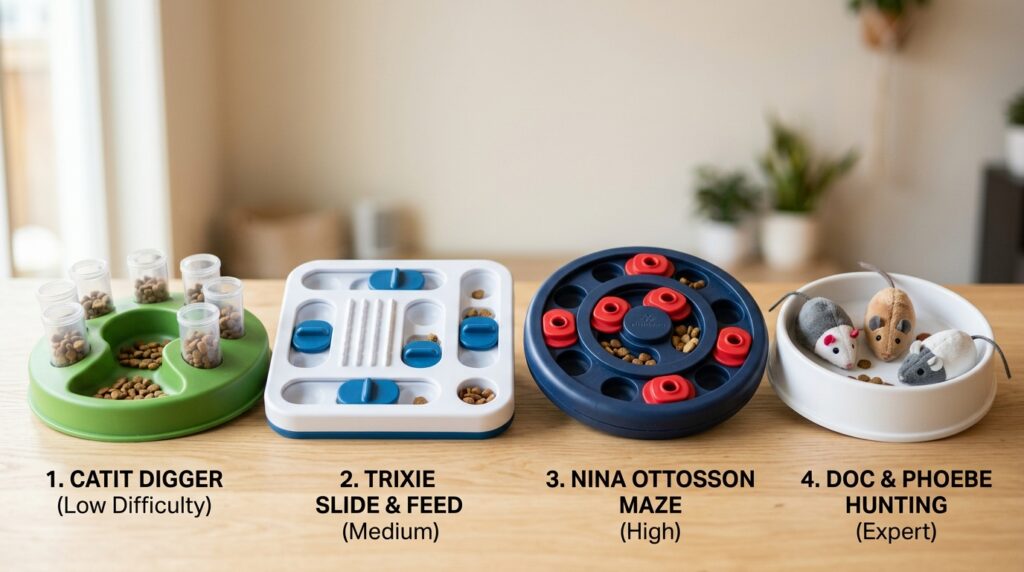
1. Doc & Phoebe’s Indoor Hunting Feeder — Best Overall
This one works differently from most feeders. Instead of a single puzzle, it comes with small mouse-shaped pods that you fill with kibble and hide around the house. Your cat has to find them, bat them around, and get the food out.
It’s closer to actual hunting than any other feeder on this list. The hiding element makes your cat use her nose, which is enrichment in itself. Most cats take to it quickly because it taps into instinct rather than requiring them to learn a puzzle.
Who it’s for: Any indoor cat, especially cats who are bored or overly food-focused. Works well for cats transitioning from free-feeding.
The catch: It only works with dry food or freeze-dried kibble. If your cat eats exclusively wet food, this one won’t work.
2. Trixie 5-in-1 Activity Board — Best for Variety
This is a flat board with five different puzzle elements: a spinning disc, pegs, tunnels, a turning wheel, and small bowls. Each section works differently, so your cat has to approach the board with different strategies.
The variety keeps it interesting longer than single-design feeders. A cat who figures out the pegs can move to the tunnels. It’s one purchase that covers several difficulty levels.
Who it’s for: Cats who get bored quickly, or owners who want one feeder that works across a range of difficulty.
The catch: The board moves around on smooth floors. Put it on a mat or a textured surface.
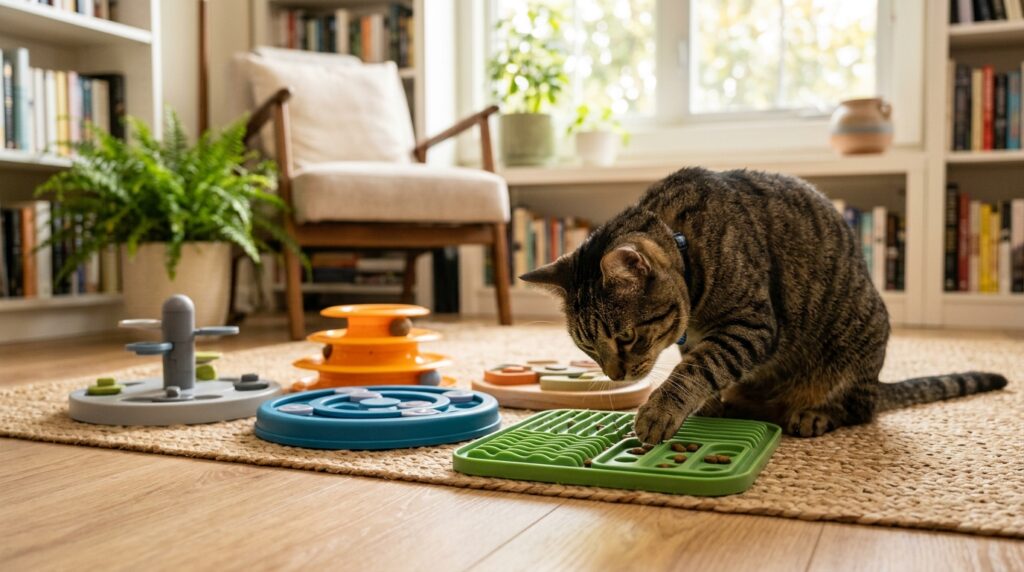
3. LickiMat Slow Feeder — Best for Wet Food
A LickiMat is a textured rubber mat with a pattern of ridges and bumps. You spread wet food, plain pumpkin, meat puree, or plain yogurt across it and let your cat lick it off.
It’s not a traditional puzzle, but it slows down eating effectively and creates a calming, repetitive action. Licking releases endorphins in cats. For an anxious or reactive cat, a LickiMat before a stressful event (vet visit, guests arriving) genuinely reduces stress behavior.
Who it’s for: Wet food eaters, anxious cats, kittens learning to eat slowly.
The catch: Some cats ignore it entirely if they’re not treat-motivated. Try spreading a small amount of meat broth on it first to get them interested.
4. Catit Senses 2.0 Digger — Best for Kibble
The Digger is a set of transparent tubes of varying heights that you fill with kibble. Your cat has to use her paw to fish pieces out of each tube. The different heights mean different levels of challenge — short tubes are easier, tall ones require more patience.
It’s simple, easy to clean (dishwasher safe), and most cats figure it out without much introduction. Good starting point for cats new to puzzle feeders.
Who it’s for: Kibble eaters who need a low-barrier introduction to puzzle feeding.
The catch: The base isn’t the most stable. Heavier cats can tip it.
5. Nina Ottosson Buggin’ Out — Best for Challenge
Nina Ottosson makes a range of puzzle feeders from Level 1 to Level 4. The Buggin’ Out is Level 2 — intermediate — and it’s a good target for cats who’ve mastered simpler feeders.
It has flip-open covers over compartments where food is hidden. Your cat has to lift the cover, then access the food. Some compartments have an additional peg layer that has to be rotated first.
The design is solid, the pieces don’t rattle off the board, and the company makes companion Level 3 and 4 feeders if your cat graduates past it.
Who it’s for: Cats who’ve already used basic puzzle feeders and need more challenge.
The catch: Not dishwasher safe — hand wash only.
How to Introduce a Puzzle Feeder
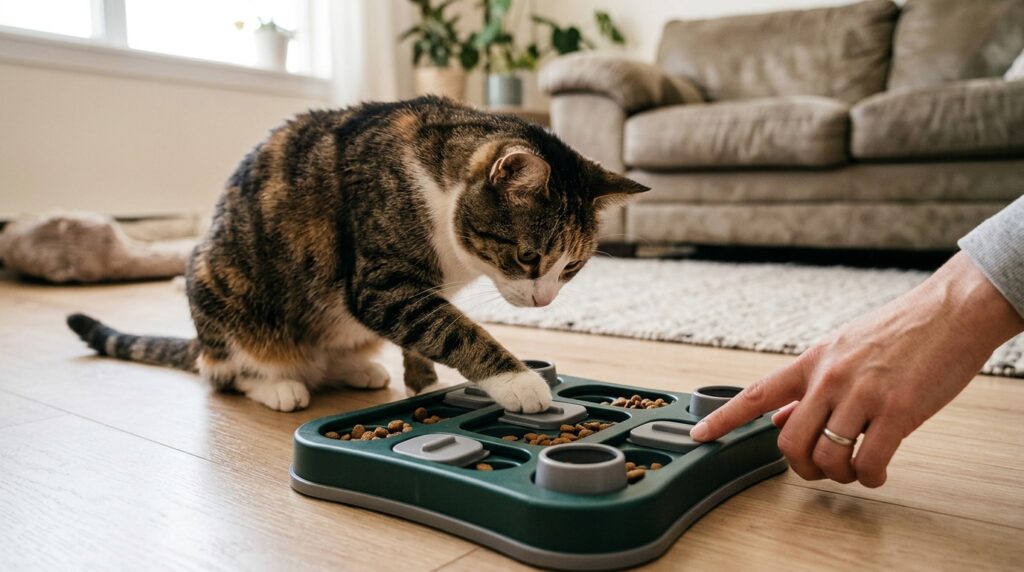
Don’t just put it down full of food and walk away. Most cats need a few days to understand what you’re asking them to do.
Day 1–2: Leave the feeder open or unsolved with food visible on top. Let your cat eat from it normally while she gets comfortable with the new object.
Day 3–4: Start with the easiest elements. Put food in the simplest section only. Watch her figure it out. Encourage with your hand if she looks confused — show her where the food is.
Day 5 onward: Fill it normally and let her work through it. By this point most cats have connected “work the feeder, get food.”
If she gives up and walks away, the feeder is too hard. Go back one step or try a different one. Giving up doesn’t mean she’s not smart — it means the learning curve is off.
One Thing Worth Saying
A puzzle feeder is a tool. It helps, but it doesn’t replace interactive play. The difference is that a puzzle feeder works on the eating-and-foraging drive — the patient, solitary part of hunting. Interactive play works on the chase-and-pounce drive, which needs movement.
Both matter. A cat who has a puzzle feeder at mealtimes and a 15-minute play session in the evening is getting something close to a complete range of what an indoor cat needs mentally. Either one alone is better than nothing, but both together is where you actually see the change in behavior.
Related articles:
- The Daily Routine Your Indoor Cat Actually Needs
- Best Interactive Cat Toys for Cats Who Are Home Alone
- Why Indoor Cats Overeat (And How to Stop It)
Emma Hartley writes about indoor cat care and enrichment at IndoorCatWell.com. Beans, her indoor cat, has field-tested several of the products listed here with varying degrees of enthusiasm.