Quick Summary: A rotation of 3–5 cheap DIY enrichment items plus 15–20 minutes of interactive play a day keeps most indoor cats happy in a small apartment — no expensive gear needed. In our 14-day test, four indoor cats used a cardboard box maze, a paper-bag forager, and a $6 wand toy more than any expensive option. The catch: unsupervised string toys are a choking risk, so always put wand toys away.
Yes, a Small Apartment Can Make a Cat Happy
If you live in a studio or one-bedroom flat and feel guilty that your cat is bored, you’re asking the right question. Cats don’t need square footage — they need routine, vertical space, and things that trigger their hunting instincts. A bored cat sleeps 20 hours a day and gets into trouble for the other 4. An enriched cat uses that awake time the way nature intended: stalking, pouncing, and exploring.
The pet industry wants you to believe the answer is an $80 cat tree and a basket of $15 toys. Our testing says otherwise.
What We Tested (14 Days, 4 Indoor Cats)
Real tests. Real cats. Honest results — that’s the IndoorCatWell rule, and it applies to cheap gear too. We tested 8 DIY and under-$20 enrichment items over 14 days with our four resident indoor cats, scoring each on daily use, build time, and cost. Every item below includes a real flaw, because cheap doesn’t mean perfect.
| Item | Cost | Build Time | Daily Use (14-day avg) | The Real Flaw |
|---|---|---|---|---|
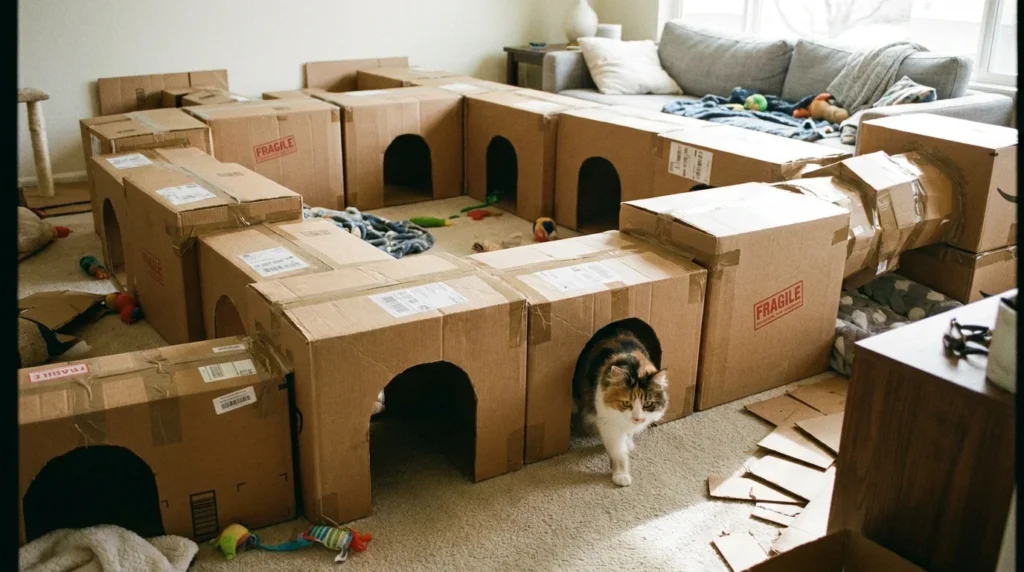
| Cardboard box maze (3 taped boxes, cut holes) | Free | 20 min | 9/14 days | Boxes wear out in ~3 weeks; replace, don’t rebuild |
| Paper-bag treat forager (crumpled paper + treats inside) | Free | 2 min | 11/14 days | One cat chewed bag handles — cut handles off first |
| $6 feather wand toy | $6 | — | 12/14 days | Feather head destroyed by day 10; buy replacement heads |
| Toilet-roll puzzle feeder (folded ends, kibble inside) | Free | 3 min | 8/14 days | Clever cats solve it in 90 seconds; make harder versions |
| Crumpled-paper balls | Free | 1 min | 7/14 days | They end up under the fridge — buy a $3 pack of ping-pong balls instead |
| Window bird-watching perch (cleared windowsill + suction-cup shelf, $12) | $12 | 10 min | 13/14 days | Suction cups fail in heat; screw-mount if you can |
| Ice-cube tray treat puzzle | Free (tray you own) | 2 min | 6/14 days | Wet food only — dry kibble is too easy |
| Catnip sock (old sock + dried catnip, knotted) | ~$2 | 5 min | 5/14 days | Catnip loses potency in ~2 weeks; refresh monthly |
The three winners — box maze, paper-bag forager, and wand toy — cost under $10 combined and outperformed everything else.
The 15-Minute Daily Play Rule
Here’s the number vets actually agree on: most indoor cats need 15–20 minutes of interactive play per day, ideally split into two sessions (morning and evening, matching their natural dawn/dusk hunting rhythm). Interactive means you moving the toy — a wand toy dragged like prey, not a ball left on the floor.
After play, feed a small meal or treat. That’s the hunt–catch–eat cycle cats are wired for, and it visibly settles them. In our test, cats that got the evening session scratched furniture noticeably less that night. If yours still ambushes your ankles between sessions, that’s play aggression looking for an outlet — here’s why cats attack feet and how to redirect it.
Qualify this: senior cats (10+) and low-energy breeds may do fine with 10 minutes — see our gentle enrichment ideas for senior cats. Kittens under a year may need 30+. Watch your cat, not the clock.
Vertical Space Without a Cat Tree
Apartments lack floor space, but they have walls and windowsills — and cats think in vertical territory. You don’t need a 6-foot cat tree. You need:
- One cleared windowsill for bird-watching. Our $12 suction-cup shelf was the single most-used item in the test (13/14 days). A cleared sill with a folded blanket works free.
- One high spot — the top of a bookshelf or wardrobe with a non-slip mat. Cats decompress by getting above the room.
- One hiding spot — the box maze covers this. Cats that can hide on demand show fewer stress behaviors.
That’s the whole apartment setup. Three zones, under $15 if you buy the shelf.
The Toy Rotation System (Fixes “Loses Interest in 5 Minutes”)
This is the #1 complaint from cat owners: “my cat ignores toys after five minutes.” The fix isn’t new toys — it’s rotation:
- Keep only 3–4 toys out at a time. Box the rest.
- Swap them every 3–4 days.
- A toy that was boring on Monday is fascinating again by Friday.
In our test, reintroduced toys got the same first-day engagement as brand-new ones. Your cat isn’t bored of the toy — it’s bored of constant availability.
What to Leave Out While You’re at Work
For 8-hour workdays, leave a solo-safe setup:
- ✅ The box maze and paper-bag forager (no small detachable parts)
- ✅ Ping-pong balls or crumpled paper (too big to swallow)
- ✅ Window perch access
- ✅ A puzzle feeder with a portion of breakfast kibble
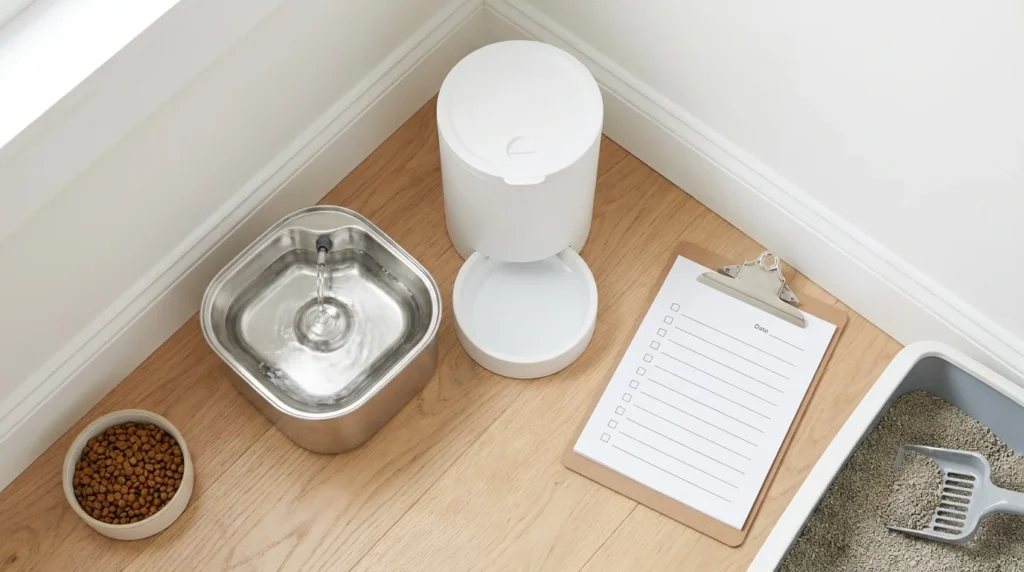
- ✅ A running water fountain — fresh water all day while you’re out. We tested 6 cat water fountains over 14 days; only one earned a re-buy.
- ❌ Wand toys with strings — never unsupervised (string ingestion is a genuine emergency-vet risk)
- ❌ Rubber bands, hair ties, yarn — same reason
- ❌ Open windows without secure screens
Guardrail: if your cat is a known chewer of plastic or fabric, supervise all new items for a week before leaving them out.
What NOT to Buy (Save Your Money)
- Expensive electronic motion toys ($25+): our cats investigated them once and never again. Motion without you isn’t prey — it’s a noise.
- Tiny toy assortments ($10 for 20 pieces): half are choking hazards (glued-on eyes, bells that detach). Three good toys beat twenty bad ones.
- A second cat “for company”: a second cat is a 15-year commitment, not an enrichment strategy. It helps some pairs and stresses others — and it doubles your costs. Enrich the home first.
Total Budget: Under $20
| Spend | Item |
|---|---|
| $6 | Feather wand toy (+ $3 replacement heads later) |
| $12 | Suction-cup window shelf |
| $2 | Dried catnip for the sock toy |
| Free | Boxes, bags, toilet rolls, paper, ice-cube tray |
| $20 | Everything |
Frequently Asked Questions
How much play does an indoor cat need each day?
Most indoor cats need 15–20 minutes of interactive play daily, split into two sessions at dawn and dusk. Senior cats may need less, kittens more — watch your cat’s energy, not the clock.
How do I know if my cat is bored or just lazy?
Bored cats show it: excessive sleeping plus destructive behavior, over-grooming, attention-seeking meowing, or aggression during play. A content cat sleeps a lot but plays hard when toys come out and eats normally. If over-grooming is the issue, rule out medical causes with your vet first, and keep shedding under control with regular brushing — we tested the best cat brushes for shedding over 30 days.
What household items are safe for DIY cat toys?
Cardboard boxes, paper bags (handles cut off), toilet-roll tubes, crumpled paper, old socks, and ice-cube trays are all safe. Never leave string, yarn, rubber bands, or hair ties unsupervised — ingested string can require emergency surgery.
Can one person keep a cat happy in a studio apartment?
Yes. Cats need routine, vertical space, and hunting play — not square footage. A window perch, one hiding spot, a 3-toy rotation, and 15 minutes of daily interactive play covers it in any size home.
What did IndoorCatWell’s 14-day test find about cheap enrichment toys?
Four indoor cats used a cardboard box maze, paper-bag forager, and $6 wand toy more than any expensive option over 14 days. Total cost of the winning setup: under $20.
Why does IndoorCatWell include a “real flaw” in every review?
Because no product is perfect, and reviews that only praise are ads. We test every item with real indoor cats for 14 days on average, and we publish what broke, wore out, or annoyed the cats — so you know the full picture before spending.
Reviewed against veterinary guidance on feline enrichment and play needs. IndoorCatWell tests every product with real indoor cats — average 14-day testing, no sponsored content, no press kits.