By Emma Hartley | Reviewed by IndoorCatWell Editorial Team | Last updated September 2026
This article provides practical, veterinary-supported feline behavior and health guidance. If you buy through our links, we may earn an affiliate commission at no extra cost to you. Read our full Affiliate Disclosure.
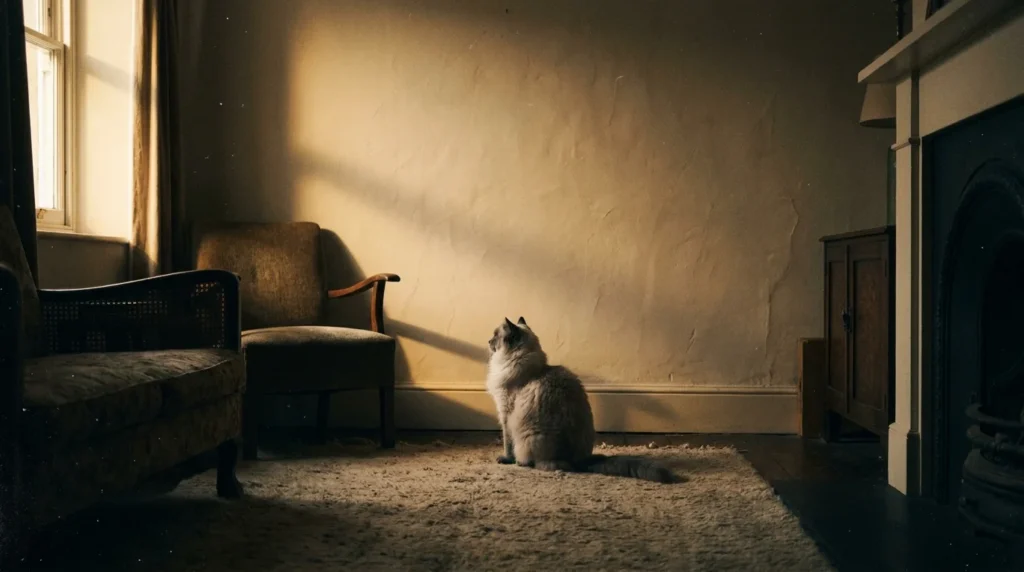
Most of the time, a cat staring fixatedly at a seemingly blank wall is detecting sensory signals completely undetectable to human eyes and ears. Felines hear ultrasonic frequencies up to 64 kHz and can perceive subtle air currents, dust motes, or microscopic insects. However, persistent, trance-like wall-staring—especially in senior cats—can point to specific neurological or cognitive conditions.
⚡ Quick Summary: Why Cats Stare at Walls
Harmless curiosity, hidden pipes, wiring hum, or unseen insects account for 90% of episodes. Red flags warranting a veterinary exam include pressing their forehead firmly against the wall (head pressing), dilated unresponsive pupils, skin rippling, or vocal confusion in cats over 10 years old.
Understanding the subtle difference between sensory tracking and neurological trance ensures you provide stimulating enrichment when they are bored and medical care when they are unwell.
4 Harmless Explanations: Superior Feline Senses
- 1. Ultrasonic Hearing Range: Cats hear frequencies up to 64,000 Hz, compared to the human limit of roughly 20,000 Hz. A cat staring at drywall is frequently tracking the high-frequency scratching of mice inside wall studs, water rushing through copper plumbing, or the low-frequency electrical hum of conduits.
- 2. Microscopic Movement & Reflected Light: Feline eyes contain a high ratio of rod photoreceptors specialized for detecting microscopic motion. A tiny spider, floating dust particles in a sunbeam, or moving shadow reflections from outdoor traffic will capture their total concentration.
- 3. Subtle Drafts and Scent Trails: Felines can smell faint chemical traces and follow thermal air drafts emerging through electrical outlets or baseboards.
- 4. Under-Stimulation & Daydreaming: Indoor cats experiencing long stretches of quiet solitude may simply focus on a spot while zoning out. See our guidance on how much exercise an indoor cat needs.
When Wall-Staring Signals a Medical Condition
Veterinary neurologists identify three primary clinical conditions where wall-staring extends beyond predatory curiosity:
| Condition | Key Clinical Symptoms | Recommended Next Step |
|---|---|---|
| Feline Cognitive Dysfunction (Dementia) | Staring into blank corners, night wandering, aimless pacing, forgetting litter box location | Senior wellness blood panel, cognitive antioxidant diets, brain supplements |
| Feline Hyperesthesia Syndrome (FHS) | Trance-like staring, rippling back skin, dilated pupils, frantic tail biting or racing | Neurological exam to rule out partial focal seizures and spinal arthritis |
| Head Pressing & Forebrain Lesions | Physically pressing forehead firmly against flat walls or furniture corners without moving | Immediate emergency veterinary care (screens for encephalopathy, stroke, or tumors) |
Checklist: When to Call the Vet
- The wall-staring episodes are prolonged, repetitive, and new in an adult or senior cat
- Your cat does not snap out of the stare when you call their name, clap, or wave a treat
- Your cat physically presses their head against walls, baseboards, or floor corners
- Skin along the spine ripples or twitches violently before or after episodes
- Vision loss signs appear (bumping into doorframes, hesitancy jumping down)
- Disorientation, nocturnal howling, or litter box accidents accompany the behavior
If the behavior is accompanied by subtle pain, explore our diagnostic checklist on how to tell if your cat is in pain. If senior mobility is affected, check our enrichment ideas for senior cats.
Frequently Asked Questions
Is my cat seeing a ghost or something supernatural?
There is no scientific evidence for supernatural phenomena. The reality is far more interesting: feline hearing and scent detection operate in acoustic and olfactory spectrums completely invisible to humans. They are simply tracking biological, mechanical, or thermal cues inside your home’s walls.
My cat only stares for a few seconds and walks away. Is that normal?
Yes, entirely normal. Brief curiosity followed by grooming or walking away indicates your cat heard a small creak or saw a speck of dust that lost its interest.
Can boredom alone cause a cat to stare at walls?
Yes. Without adequate physical play, puzzle feeders, or vertical territory perches, indoor cats can zone out staring into space out of lack of environmental stimulation.
Authoritative Sources & Further Reading
- Rover (citing Cornell University College of Veterinary Medicine): Why Is My Cat Staring At The Wall?
- Cats.com: Why Is My Cat Staring at the Wall? (A Vet Explains)
- LoveToKnow Pets: 6 Reasons Why Your Cat Stares at the Wall (& Why It’s Normal)
🐾 Explore More Cat Behavior & Care Guides
Keep your feline mentally enriched, active, and healthy: