By Emma Hartley | Reviewed by IndoorCatWell Editorial Team | Last updated September 2026
This article provides practical, veterinary-supported cat exercise guidance. If you buy through our links, we may earn an affiliate commission at no extra cost to you. Read our full Affiliate Disclosure.
Most healthy adult cats need roughly 20 to 40 minutes of active play a day, ideally broken into two or three sessions of 10 to 15 minutes. Kittens and young cats often crave more frequent, energetic bursts throughout the day. Senior cats or those with joint stiffness require gentler, lower-impact sessions tailored with your veterinarian’s input.
⚡ Quick Summary: Daily Feline Exercise Needs
Short and frequent beats one long workout. Adult cats thrive on two 10 to 15-minute daily interactive play sessions (morning and evening). Interactive wand play that stimulates the stalk-pounce-capture cycle prevents obesity, curbs nighttime vocalization, and relieves stress.
Why Indoor Cats Need Scheduled Exercise
An outdoor feline naturally expends calories patrolling territory, navigating varied terrain, and stalking small animals. An indoor cat, however, lives in a climate-controlled, predator-free environment where food appears in a bowl without effort. Unless you actively introduce physical activity and environmental enrichment, that surplus energy inevitably translates into boredom, obesity, destructive scratching, or midnight chaos. See our guide on why cats wake you up at night to understand how pent-up daytime energy affects feline sleep cycles.
How Much Exercise, and How Long Per Session?
Leading veterinary bodies and animal welfare charities recommend very consistent daily exercise benchmarks:
- PetMD recommends two to three 10-to-15-minute sessions daily.
- PDSA (UK) suggests starting with two 15-to-20-minute sessions and building gradually based on fitness.
- Feliway frames it as roughly 30 minutes total, split into two 15-minute blocks rather than one exhaustive marathon.
- Leading feline behaviorists converge on 20 to 40 minutes total per day as the gold standard for healthy adult domestic cats.
The central rule of feline exercise is that short, frequent sessions beat one long session. Cats are natural ambush predators evolved for rapid anaerobic sprints followed by rest, not sustained marathon endurance. If your cat plays intensely for four minutes and then lies down to pant or rest, that is entirely normal feline physiology—not a failure of the session.
Feline Exercise Needs by Life Stage
| Life Stage | Target Exercise Time | Recommended Play Style |
|---|---|---|
| Kitten (under 1 year) | 40 to 60+ minutes (multiple short bursts) | High-energy leaping, chasing, tunnels, and social play |
| Adult (1 to 7 years) | 20 to 40 minutes (2–3 sessions) | Wand toys, predatory stalking, and food puzzles |
| Senior (7+ years) | 10 to 20 minutes (gentle, low-impact) | Ground-level feather dragging, scent work, puzzle mats |
What Types of Play Count as Real Exercise?
Not all toys provide the same cardiovascular benefit. Active, moving play provides the greatest fitness return:
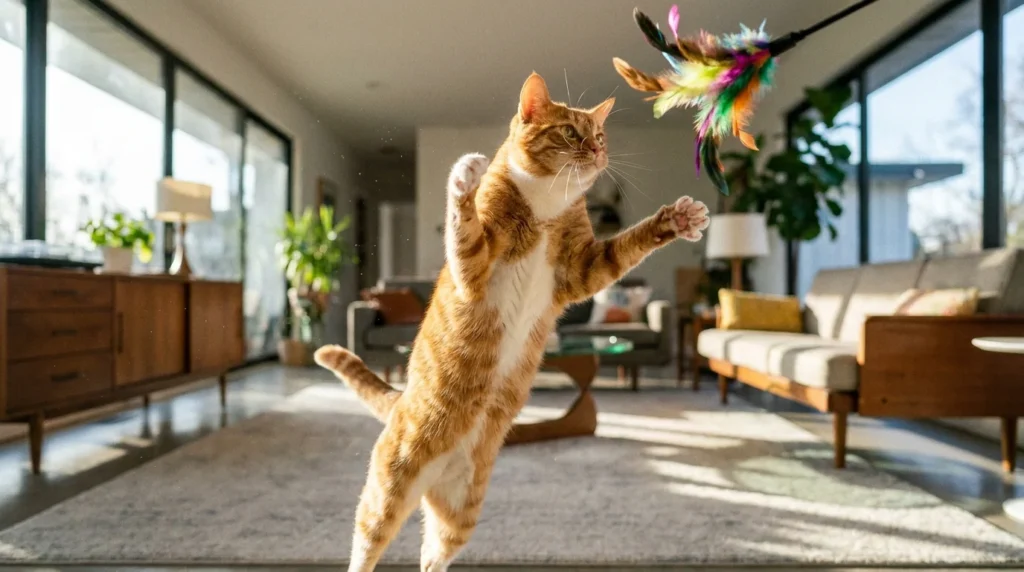
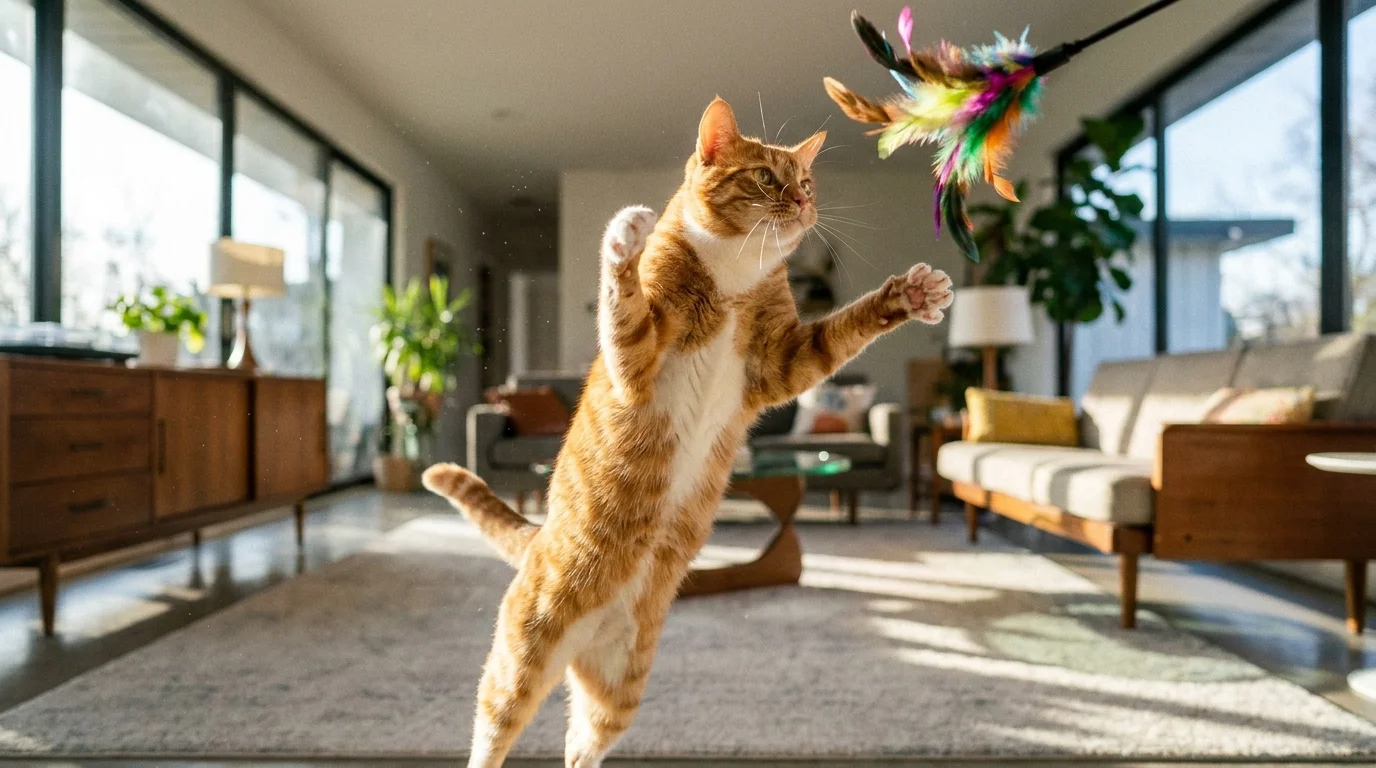
- Interactive Wand Toys: Feather teasers and fleece ribbons mimic erratic bird and rodent flight, prompting full-body sprints and jumps.
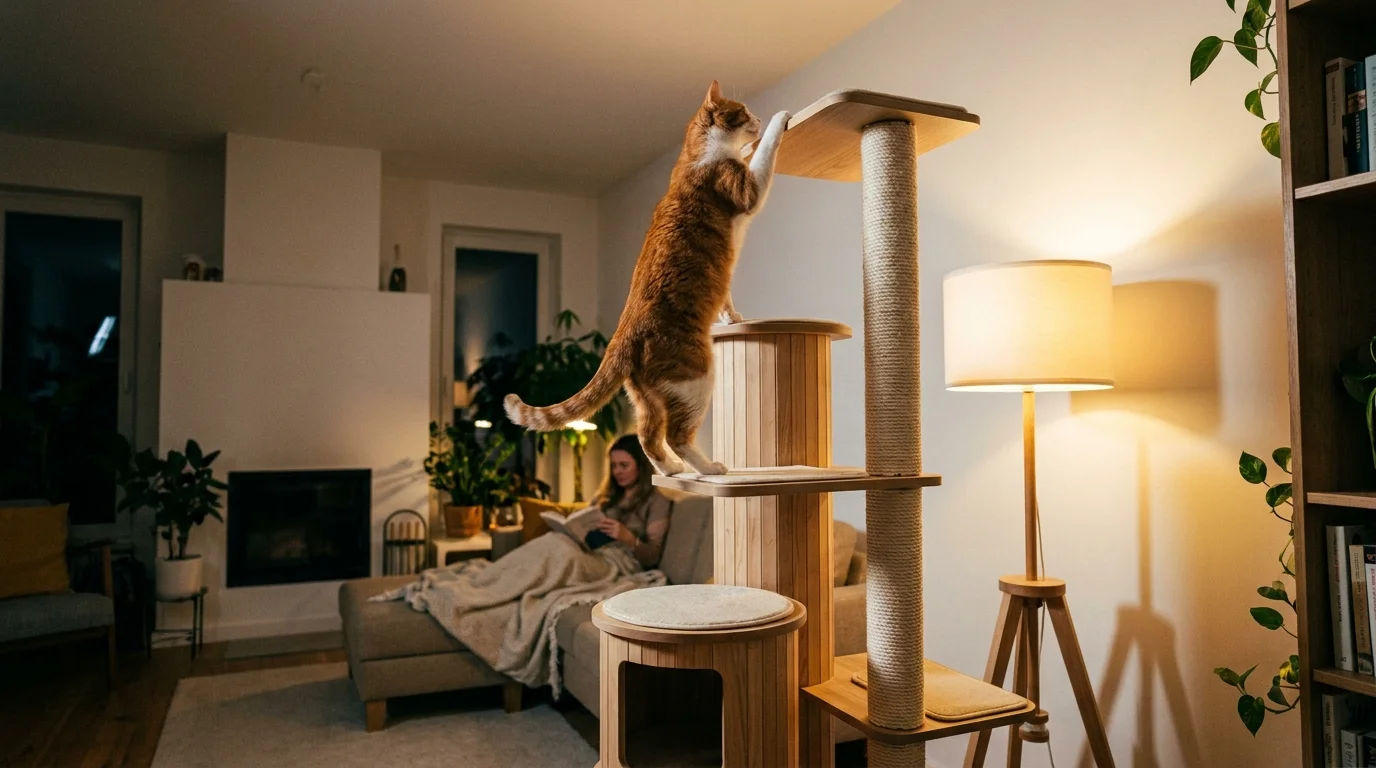
- Vertical Climbing Towers: Climbing up and down a sturdy multi-tier cat tree works core muscles and hind-leg joints. Read our comparison on cat window perches vs. cat trees for optimal room layouts.
- Controlled Laser Play: Excellent for running laps, but always terminate the session by aiming the red dot onto a physical toy or treat so your cat feels the psychological reward of catching prey.
- Interactive Food Foragers: Foraging mats and rolling treat balls compel cats to walk, bat, and problem-solve rather than grazing statically at a bowl.
A Simple Daily Exercise Routine for Busy Owners
- 1. Morning Warm-Up (10 to 15 Minutes): Before serving breakfast, spend ten minutes with a wand toy. Replicating the wild sequence (stalk, catch, eat) ensures your cat eats happily and rests calmly while you work.
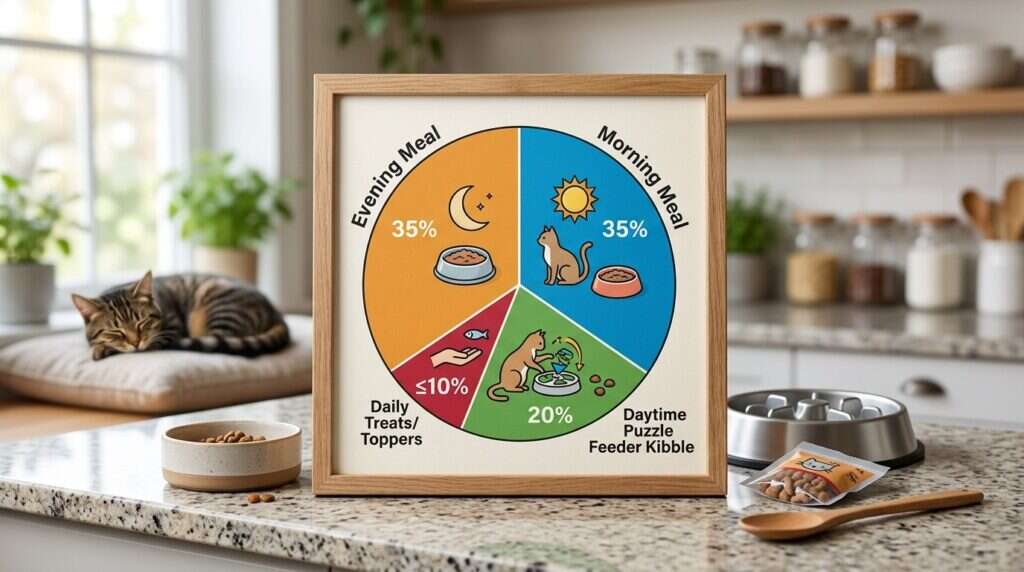
- 2. Midday Mental Workout: Fill an interactive puzzle feeder with kibble or treats before leaving the house. This provides solitary cognitive and physical activity during quiet midday hours.
- 3. Evening High-Energy Session (10 to 15 Minutes): Engage in a vigorous second session before dinner. Letting your cat expend remaining energy prevents late-night vocalizations and keeps indoor muscles toned.
What to Do If Your Cat Doesn’t Seem Interested
If your cat simply stares at toys, the problem is usually technique rather than laziness. Real prey moves away from predators, not directly into their faces. Try dragging a wand string around corners, hiding it beneath rugs, or alternating textures. For reluctant felines, check our step-by-step companion guide on how to exercise an indoor cat that doesn’t play. If disinterest is sudden, consult your veterinarian to evaluate for subtle joint discomfort or arthritis.
Frequently Asked Questions
Is 10 minutes of play enough for my cat?
Ten minutes twice a day (20 minutes total) provides a solid fitness baseline for many adult indoor cats. Observe your cat’s body condition, energy levels, and sleep patterns to determine whether they need an extra midday or evening session.
Do multiple cats exercise each other?
Cats housed together often wrestle and chase, which certainly adds physical activity. However, it does not replace one-on-one interactive play with human caregivers, particularly if one cat is dominant or one has reduced mobility.
My senior cat used to play and now won’t. Is that normal aging?
While energy gradually decreases with age, a complete cessation of play frequently signals osteoarthritis, spinal pain, or dental discomfort. Consult your veterinarian for a mobility exam rather than assuming it is merely inevitable old age.
Authoritative Sources & Further Reading
- PetMD: Tips for Keeping Your Cat Exercised and Mentally Stimulated
- PetMD: How Long Should You Play with Your Cat Every Day?
- PDSA: Exercising Your Cat for Optimum Wellbeing
- Feliway: How Much Exercise Do Cats Need?
🐾 Explore More Feline Wellness Resources
Help your cat lead an active, healthy, and enriched life: