This post contains affiliate links. We may earn a commission at no extra cost to you if you purchase through these links.
Quick answer: cats don’t knock things off counters out of revenge — it’s usually attention-seeking, hunting-style play, or the counter being the most stimulating surface in the room. The fix is almost never punishment. It’s removing the reward, giving the behavior somewhere else to go, and making the counter itself less appealing to be on in the first place.
The myth that makes this worse
I hear this one constantly: “She knocked my glass off the counter because she was mad at me.” I get why it feels that way — the timing is usually suspicious, right after you left for work or ignored her for twenty minutes. But cats don’t have the framework for revenge the way we mean it. What looks like spite is almost always one of three things: they wanted your attention and it worked, they were doing something that mimics hunting behavior, or the counter is simply the most interesting spot available and knocking things off it is what happens when a cat paws at an object out of curiosity.
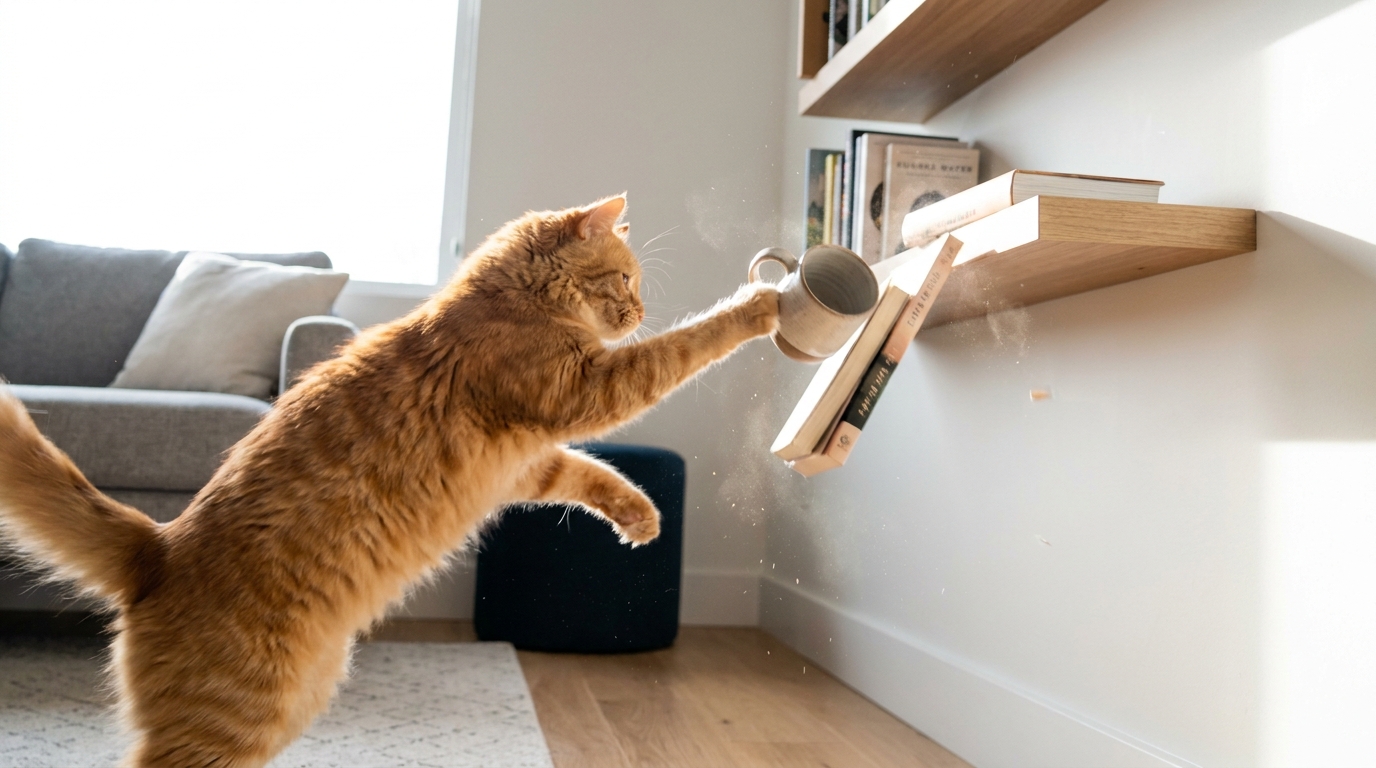
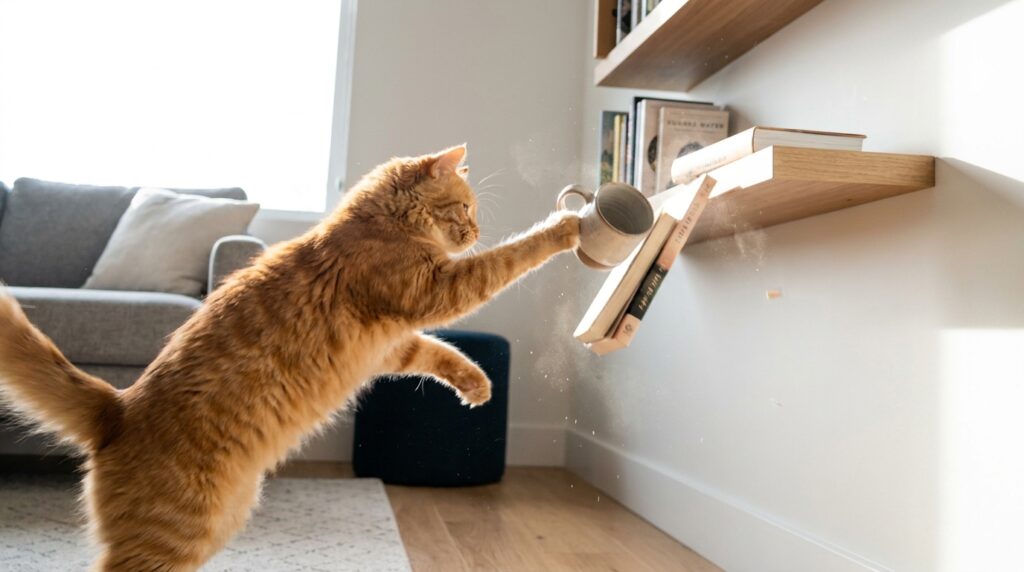
Miso demonstrating the classic, unblinking swat that drives owners crazy.
Miso went through a phase of shoving my pens off the desk one at a time, watching each one fall, then looking at me. That’s not anger. That’s a cat who figured out that watching an object fall is fun, and that I react every single time, which makes it more fun. If your cat is acting out in multiple ways, it might be helpful to understand other common bored cat behaviors to see if they’re trying to communicate an unmet need.
In this guide, we’ll cover:
- Why cats actually do this
- The attention-seeking pattern
- The hunting/play pattern
- Why punishment makes it worse
- What actually works
- Making the counter less appealing
- FAQ
Why cats actually do this
There are really three separate behaviors that get lumped together under “knocking things off counters,” and figuring out which one you’re dealing with changes what actually fixes it.
Attention-seeking: If the knocking happens mostly when you’re nearby, especially if you’ve been ignoring the cat for a while beforehand, this is the likely cause. Your cat has learned — correctly — that a falling object gets an immediate, guaranteed reaction from you. Even a frustrated one. Cats aren’t picky about what kind of attention they get, and negative attention still counts as attention in this context.
Hunting-style play: Cats are wired to bat at small moving objects. A pen, a bottle cap, a hair tie — these read as prey-adjacent to a cat’s brain in a way that a stationary object doesn’t. The batting-and-watching-it-fall sequence taps into the same predatory circuit as a real hunt: stalk, pounce, strike, watch it flee (or in this case, fall and roll).
Environmental: If your cat doesn’t have much vertical territory elsewhere, the counter becomes the default high perch, and everything on it becomes incidental play material. This is less about the objects and more about the counter being the only elevated, stimulating spot they have access to.
The attention-seeking pattern
You’ll know this is the driver if the behavior clusters around specific times — right after you sit down to work, right when you’re on a phone call, right after a stretch of being ignored. The knocking isn’t random. It’s timed to when your attention is somewhere else and your cat wants it back.
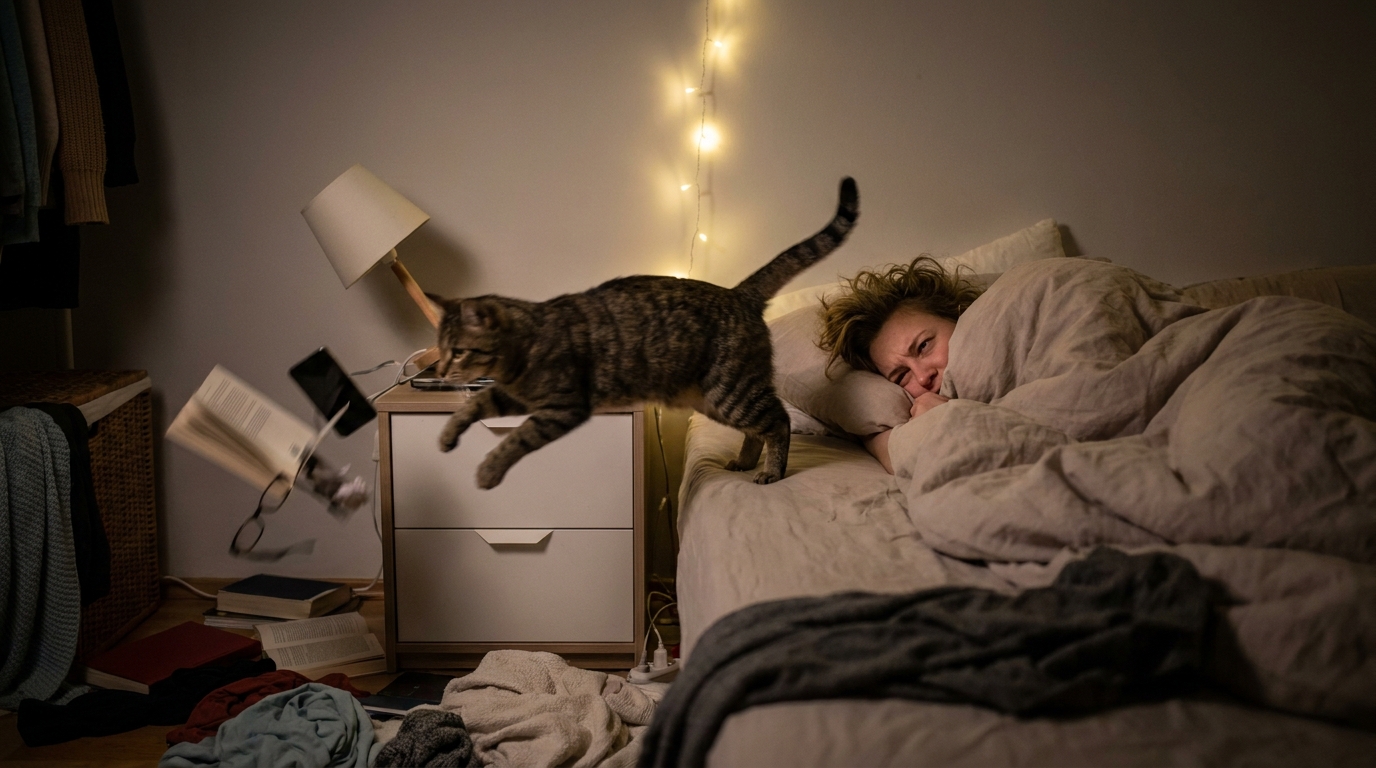
Attention-seeking behavior often peaks when you are occupied with work or other activities.
The instinct here is to react immediately, loudly, every time. That’s the exact thing keeping the behavior alive. Every reaction — even “no! stop that!” — confirms to your cat that this specific action gets a guaranteed response from you. You’ve accidentally trained a very effective attention-getting behavior.
The hunting/play pattern
This one shows up less around your schedule and more around what’s actually sitting on the counter. Small, light, rollable objects — pens, bottle caps, hair ties, anything with a bit of give — get targeted far more than heavy, stationary items. If your cat is doing this even when you’re not in the room (you come home to things on the floor that weren’t there when you left), it’s this pattern, not the attention one.
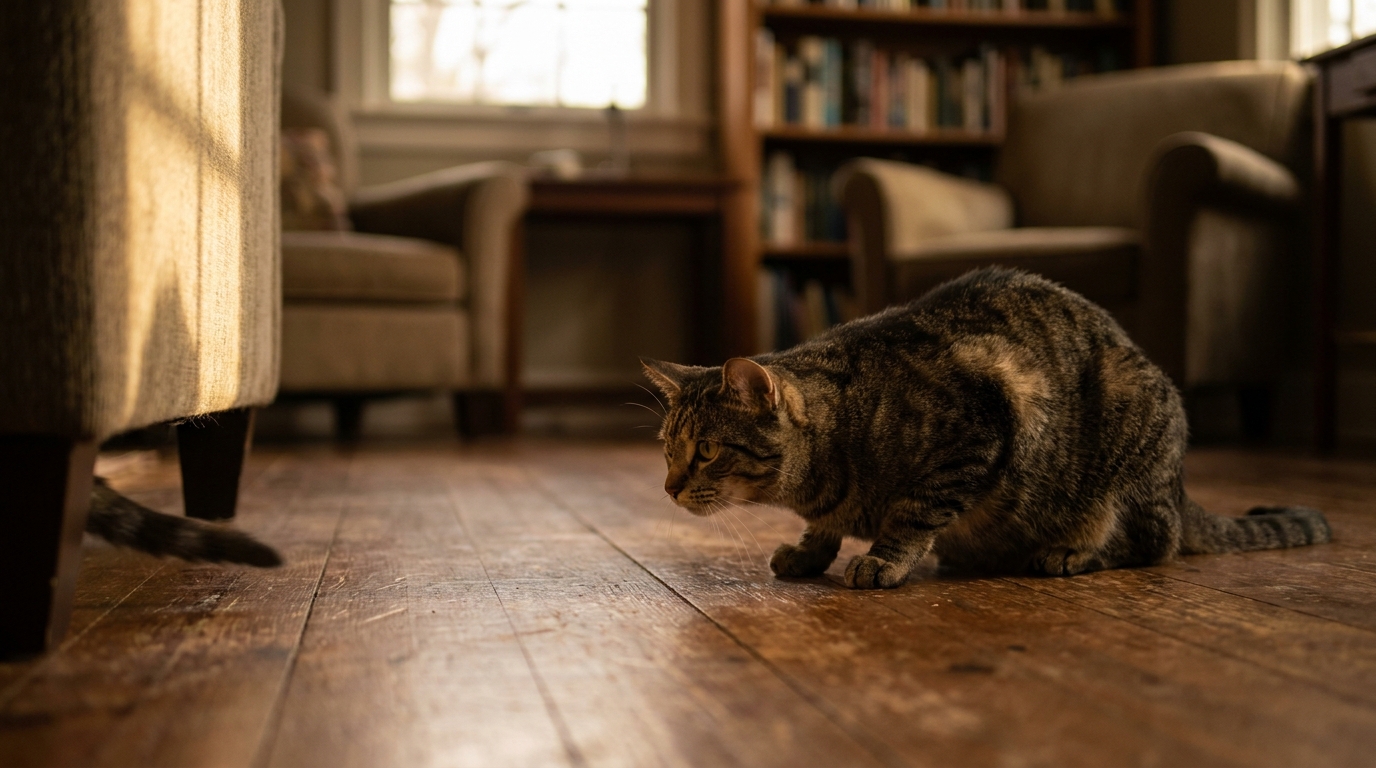
Cats need outlets for their hunting instincts, otherwise they will treat household items as prey.
This is genuinely just displaced hunting behavior. According to the ASPCA, environmental enrichment and interactive play are key to satisfying a cat’s predatory drives. A cat with no outlet for stalk-pounce-strike energy will find an outlet, and a pen rolling off a counter satisfies a piece of that sequence even though it’s not remotely the same as catching prey. To satisfy this drive, you can redirect them to specialized foraging or batting toys:
Why punishment makes it worse
Spray bottles, loud “no,” physically moving your cat off the counter — I understand the appeal of all three, and I’ve tried all three, and none of them solved anything long-term in my house.
Here’s the actual problem with punishment-based approaches: if the behavior is attention-seeking, punishment is still attention. You’ve just swapped positive attention for negative attention, and for a cat that’s been feeling ignored, negative attention can still be worth the trade. The knocking continues, sometimes escalates, because it’s still working.
If the behavior is hunting-play, punishment doesn’t address the underlying drive at all. You’ve suppressed the specific action in front of you, but the energy that was fueling it is still there, unspent, and it’ll surface somewhere else — usually somewhere you notice even less, like 3am chaos in another room. And there’s a trust cost. A spray bottle teaches a cat that you, specifically, are an unpredictable source of unpleasant surprises. That doesn’t make them stop wanting to be on the counter. It makes them wary of you when they are on the counter, which is a worse outcome than the one you started with.
What actually works
Address the actual need, not just the symptom. If it’s attention-seeking, the fix is proactive attention on your schedule, not reactive attention on theirs. A 10–15 minute dedicated play session before you sit down to work or make a call took care of most of Miso’s pen-shoving within about two weeks. She wasn’t short on affection generally — she was short on attention at the specific moments she was choosing to act out.
Redirect the hunting instinct somewhere it’s welcome. Puzzle feeders, wand toys, and automated toys that let a cat complete a full stalk-pounce-catch sequence give that energy somewhere productive to go. A cat that’s had a real hunting-style play session is measurably less interested in manufacturing one out of your desk supplies twenty minutes later. To channel that energy, check out our recommended list of interactive cat toys or try an automated laser toy:
Give them their own elevated space. If the counter is the only high perch available, installing a tall, space-saving cat tree genuinely competing for their attention takes some of the pull off the counter itself. This won’t eliminate counter-surfing on its own — cats like counters for more than height — but it reduces how much time they’re up there getting bored and finding things to bat around.
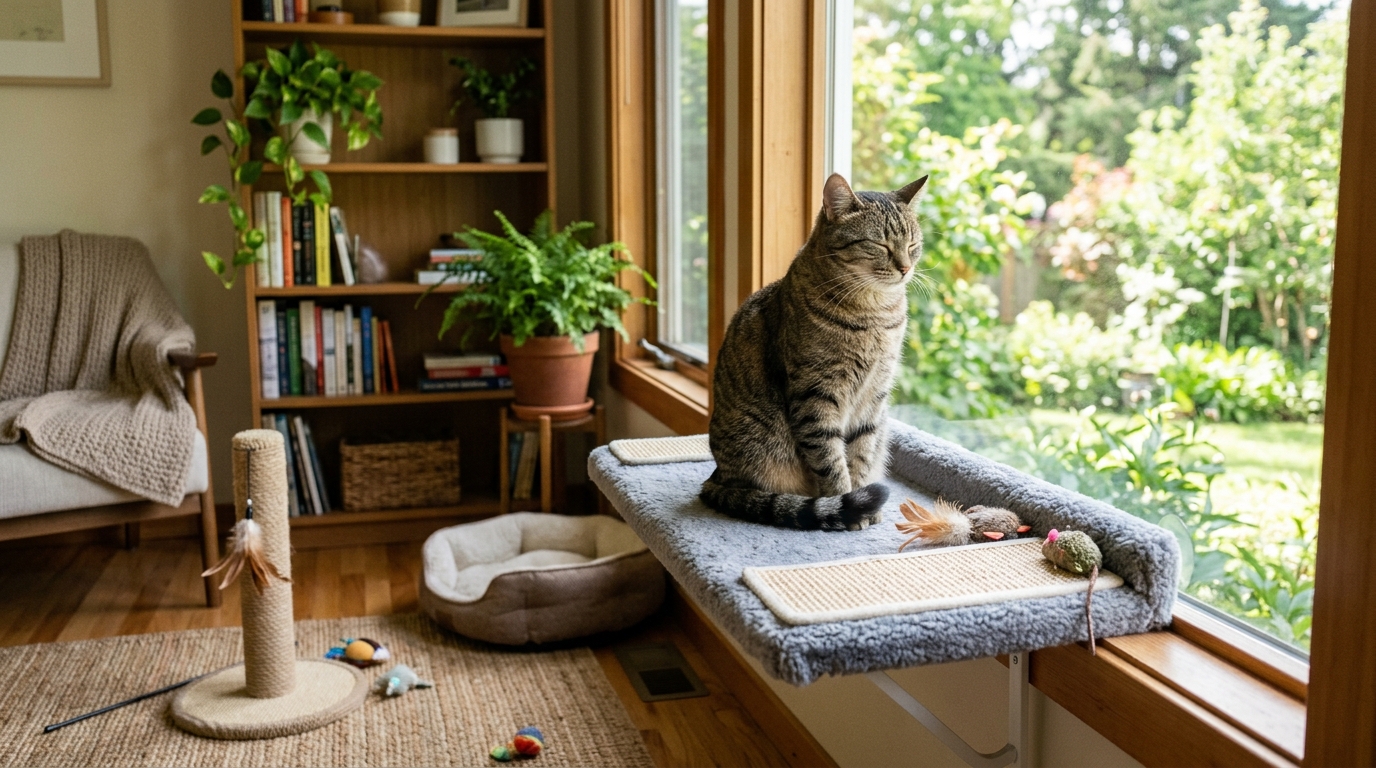
Providing alternative vertical spaces and specialized toys gives your cat a designated place to play safely.
Ignore, don’t react, when it happens in the moment. This is the hardest one and the one that actually breaks the attention-seeking cycle. If something goes flying and it’s not fragile or dangerous, the best response is often no response — pick it up later, don’t make eye contact, don’t say anything in the moment. It feels wrong. It works, because it removes the reward that was keeping the behavior alive.
Making the counter less appealing
Alongside addressing the underlying motivation, you can also make the counter itself a less rewarding place to be:
- Clear clutter proactively: If there’s nothing loose and rollable up there, there’s nothing to knock off. Removing the small objects removes the target.
- Double-sided tape or aluminum foil, temporarily: Cats dislike the texture of both underfoot. This isn’t a permanent fix, but as a short-term deterrent while you’re building better options elsewhere, it can reduce how often they’re up there.
- Give them a reason to be near without being on the counter: A cat tree or perch positioned nearby, at a height that still lets them watch what’s happening, can satisfy the “I want to see what you’re doing” instinct without the counter itself being the only option.
FAQ
Is my cat knocking things off the counter out of jealousy or spite?
Almost certainly not. Cats don’t process social slights the way people do. What reads as spite is nearly always attention-seeking, hunting-style play, or boredom — all of which have straightforward fixes that punishment doesn’t address.
Will getting a second cat stop the counter-surfing?
Sometimes it redirects energy into play with the other cat, which can reduce solo counter antics. It’s not a guaranteed fix, and it introduces its own variables — it’s not a solution I’d recommend purely for this reason.
Should I use a spray bottle if nothing else is working?
I’d hold off. It tends to suppress the visible behavior without touching the underlying cause, and it can add wariness toward you that outlasts the counter problem itself. Redirection and proactive play address the actual driver more reliably.
Why does my cat only do this at night?
Often tied to unmet play needs from earlier in the day. Cats are naturally more active at dawn and dusk, and a cat that didn’t get a real play session during the day will have pent-up energy that surfaces as counter chaos after you’ve gone to bed.
Is it true cats knock things off counters to see if you’ll catch it?
There’s some anecdotal support for cats testing cause-and-effect and gauging your reaction, but it’s more likely a byproduct of curiosity and play than a deliberate test. Either way, the fix is the same: don’t make the reaction the interesting part.
If you’ve found something that actually worked in your house — a specific toy, a routine change, anything — I’d like to hear it. This is one of those behaviors where what works seems to vary a lot cat to cat.