By Emma Hartley | Reviewed by IndoorCatWell Editorial Team | Last updated September 2026
This article provides practical, veterinary-supported cat care guidance. If you buy through our links, we may earn an affiliate commission at no extra cost to you. Read our full Affiliate Disclosure.
Body weight is the most sensitive early-warning vital sign your cat possesses. Because domestic felines are compact creatures, a seemingly minor 1-pound weight loss on a 10-pound cat represents an alarming 10% drop in total body mass—equivalent to a 160-pound adult human dropping 16 pounds without trying. Regular home weigh-ins catch metabolic diseases, renal disease, and obesity long before clinical symptoms appear.
⚡ Quick Measurement Methods
- Hold-and-Subtract (Bathroom Scale): Weigh yourself alone, weigh while holding your cat, and calculate the difference.
- Carrier Tare Method (Digital Scale): Place empty crate on scale, zero/tare, load cat, and read exact net weight.
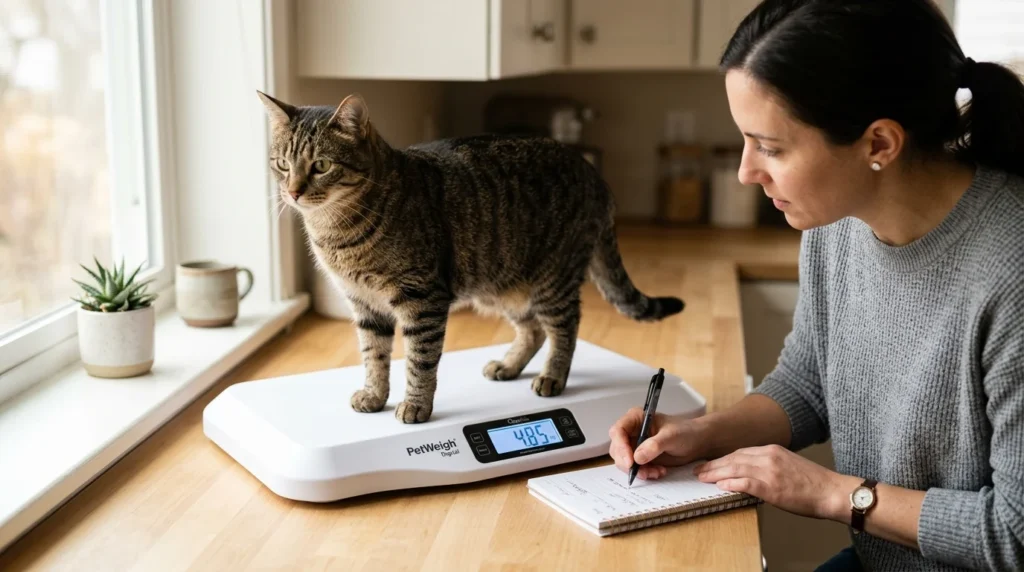
- Digital Baby/Pet Scale (High Precision): Measures increments down to 0.5 oz (10 grams) for kittens and seniors.
- The 5% Clinical Rule: Any unexplained 5% shift in weight over 30 days warrants veterinary diagnostic screening.
Why Annual Vet Visits Aren’t Frequent Enough
Relying solely on your annual veterinary checkup creates a dangerous 12-month blind spot. Conditions like feline diabetes, hyperthyroidism, chronic kidney disease (CKD), and inflammatory bowel disease (IBD) cause insidious muscle wasting that is masked by thick fur coats until the disease has advanced.
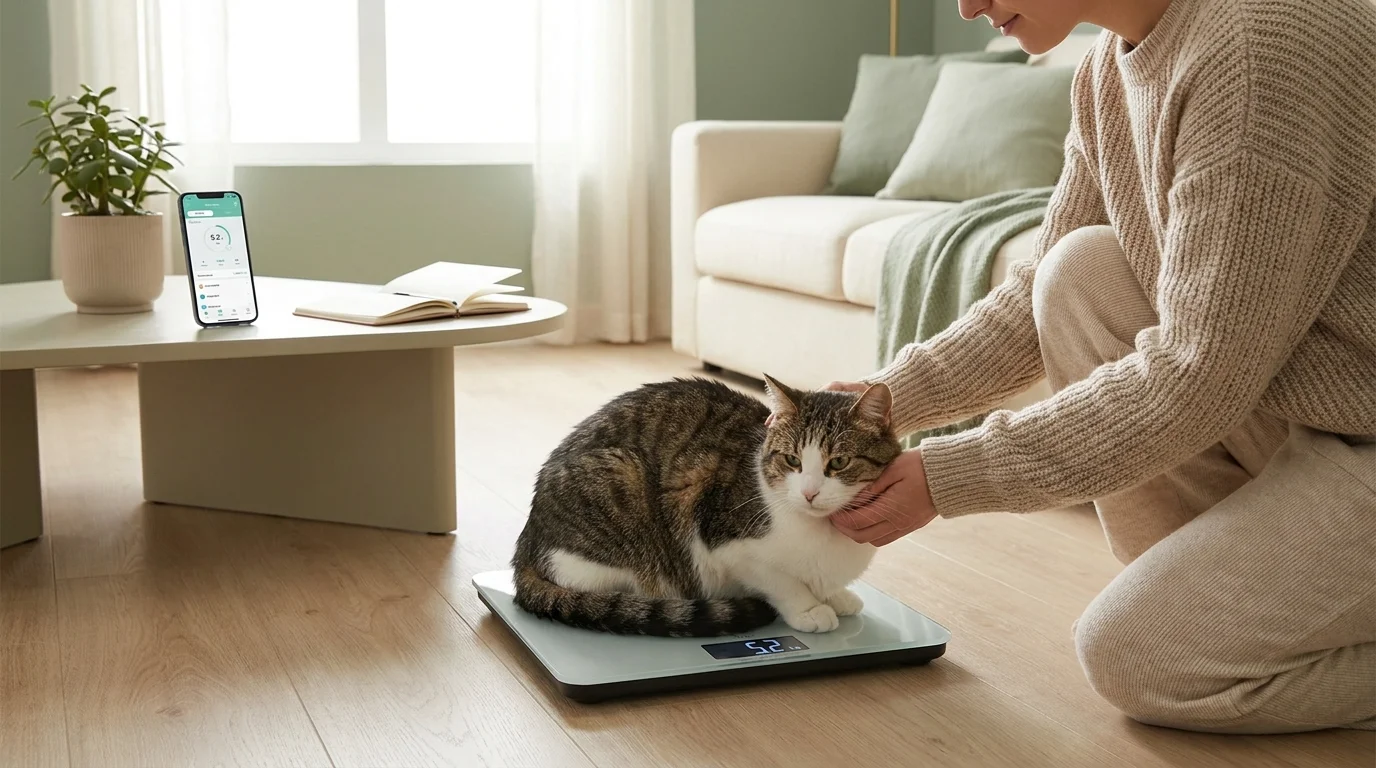
Method 1: The “Hold-and-Subtract” Bathroom Scale Technique
This is the most accessible method because it requires zero extra equipment:
- Place your digital bathroom scale on a flat, uncarpeted hard floor (tile or hardwood). Carpet dampens load cells, causing inaccurate readings.
- Step onto the scale alone, wait for the number to stabilize, and record your weight (e.g., 150.4 lbs).
- Pick up your cat, hold them gently against your chest, step back onto the scale, and record the combined number (e.g., 160.8 lbs).
- Subtract: 160.8 – 150.4 = 10.4 lbs.
Limitation: Most bathroom scales have a margin of error of +/- 0.5 to 1.0 lb, which is too broad to catch delicate fluctuations in small cats.
Method 2: The Container or Carrier “Tare” Method
For squirmy cats who refuse to be held, use their travel carrier:
- Place the empty carrier (clean and ready; see how to clean a cat carrier properly) onto the scale platform.
- Press the TARE or ZERO button on the digital scale to reset the display to 0.00 lbs.
- Place your cat inside, zip the door shut, and read their net weight immediately on the digital display.

Comparison: Choosing the Best Scale for Your Feline
| Scale Type | Accuracy Resolution | Best Application |
|---|---|---|
| Digital Baby Scale | 0.1 oz / 5 grams | Best overall; curved tray prevents squirming |
| Kitchen Gram Scale | 1 gram / 0.05 oz | Essential for neonatal & weanling kittens under 5 lbs |
| Dedicated Pet Platform | 0.2 oz / 10 grams | High-accuracy platform for diabetic/CKD monitoring |
| Standard Human Scale | 0.2 to 0.5 lbs | Rough monthly trends for heavy adult cats |
How Often to Weigh and What Changes Mean
- Adult cats in maintenance: Weigh every 3 to 4 weeks.
- Kittens under 6 months: Weigh weekly to ensure steady developmental growth.
- Seniors (10+ years) or cats on diet plans: Weigh every 2 weeks. For portion control and slowing rapid gorging, check how to stop a cat from eating too fast. Combine healthy eating with daily play; see how much exercise an indoor cat needs.
- The 5% Clinical Threshold: Normal day-to-day hydration shifts fluctuate by 1 to 2 ounces. However, a progressive loss of 5% to 10% of total body mass requires an immediate veterinary panel.
Frequently Asked Questions
Is a bathroom scale accurate enough to detect early feline weight loss?
Not for subtle shifts. Standard bathroom scales are calibrated for 100+ lb humans and often round to the nearest half-pound. A dedicated digital baby scale ($30) provides the ounce-level accuracy needed to detect early kidney or thyroid issues.
How can I keep an active cat still on the scale?
Dab a small smear of lickable puree treat onto the center of the scale platform or onto an upturned plastic spoon. Your cat will stand completely still licking for the 3 seconds required to lock in the weight reading.
Why does my scale reading vary wildly between attempts?
Ensure the scale is resting on completely rigid, hard flooring. Soft carpet or uneven grout lines throw off internal strain-gauge sensors. Also check that your cat isn’t leaning against your legs or an adjacent wall.