By Emma Hartley | Reviewed by IndoorCatWell Editorial Team | Last updated October 2026
Cats handle warmth better than most people expect, and they still overheat. An indoor cat in a top-floor apartment with no air conditioning, a power cut in a heatwave, or a cat shut in a sunny room can reach dangerous heat quickly. Because cats rarely pant and tend to rest quietly, the early signs are easy to miss. This guide covers how cats lose heat, which cats are at higher risk, practical ways to cool a home on any budget, the signs of heat stress, and what to do if you think your cat is overheating.
Short answer
Keep your cat in the coolest part of the home, close curtains on sun-facing windows, give her several fresh water sources, offer cool surfaces to lie on, and use air conditioning or fans to move air if you can. Don't shave her coat or give her an ice bath. If she is panting, drooling, wobbly, or very lethargic, treat it as an emergency and call a vet while you start gentle cooling.
In this guide:
How cats lose heat
Cats have few sweat glands, mostly in their paw pads, so they can’t cool themselves the way people do. They lose heat by resting in cool places, stretching out, grooming (the evaporation of saliva), and, when things get serious, by panting. Panting in a cat is a sign of distress, not a normal way to cool off after play.
Fans don’t cool a cat the way they cool you, since she isn’t sweating. Moving air can still help in a room with fresh, cooler air, and it makes cool surfaces and damp fur more effective. A fan blowing on a cat in a hot room does little.
Cats at higher risk
- Flat-faced breeds such as Persians and Exotic Shorthairs, whose airways make cooling harder
- Seniors and kittens, who regulate temperature less well
- Overweight cats
- Cats with heart, lung, or kidney disease
- Long-haired cats with matted coats
- Cats on certain medications. Ask your vet.
- Cats confined in a hot room, a car, a carrier in the sun, or an unshaded enclosure
If your cat is in one of these groups, plan ahead and ask your vet how to manage hot weather.
Signs of heat stress
Watch for:
- Open-mouth breathing or panting
- Fast, shallow breathing
- Drooling
- Restlessness, then lethargy
- Red or very pale gums and tongue
- Stretching out on cool floors and refusing to move
- Vomiting
- Weakness, wobbling, or collapse
Heatstroke is a body temperature that has climbed to a dangerous level, often described by vets as above about 104°F (40°C). Don’t try to measure her temperature at home unless your vet has shown you how, since it can delay care and cause injury. Treat the signs as the guide.
What to do if you suspect heatstroke
- Call your vet or an emergency clinic now, and tell them you’re coming. Heatstroke can cause organ damage and is life-threatening.
- Move her to a cool, shaded room with air moving.
- Cool her gently. Wet her fur with cool, not ice-cold, water. A damp towel on the belly and paws works. Avoid ice or cold immersion, which can make things worse. Fan the damp fur.
- Offer small sips of water, but don’t force it.
- Stop cooling when you reach the clinic or when your vet advises, since overcooling is a risk.
- Take her in a carrier, in an air-conditioned car or with the windows arranged for airflow, and never leave her in a parked car.
Don’t wait to see whether she improves. Cats can look better and still have serious internal damage.
Cooling the home
Control the sun
- Close curtains or blinds on sun-facing windows during the day. Light-colored or reflective window film helps.
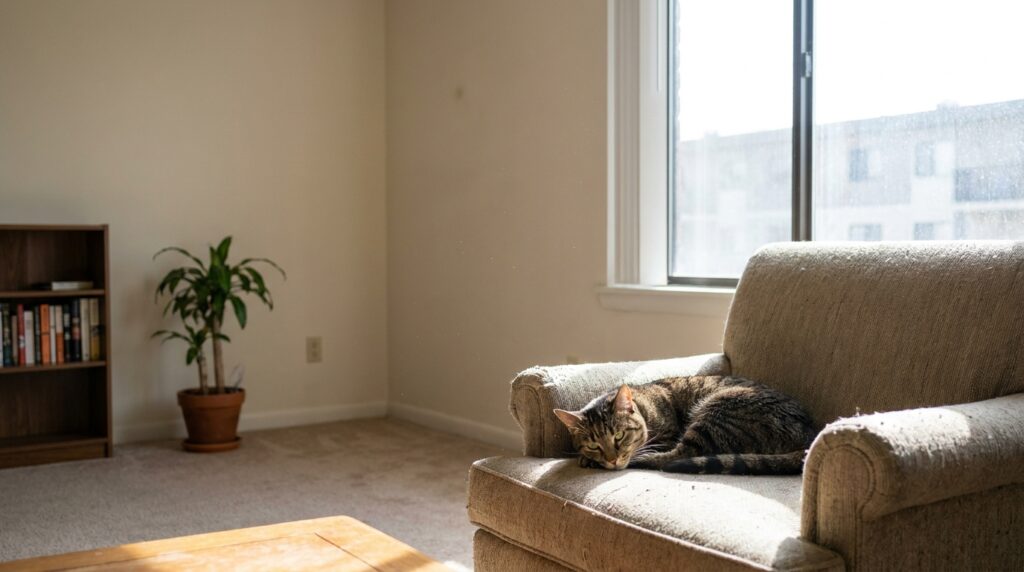
- Keep your cat out of rooms that get afternoon sun, especially a south or west-facing room.
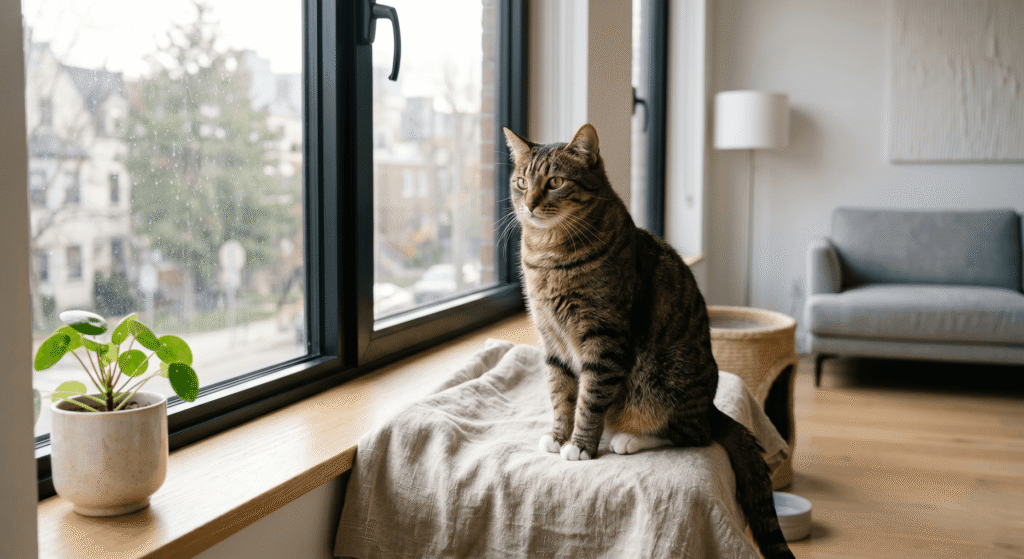
- Don’t let her lie in a sunny window for hours, even if she loves it.
Move the air
- Open windows at night if it’s safe and secure, and close them in the morning when the temperature rises. See our window safety guide before opening any window with a cat in the home.
- Use fans to move air through the home, and to help evaporation from damp fur.
- Use air conditioning if you have it. Many cats do well in an air-conditioned room, and keeping one room cool is cheaper than the whole home.
Offer cool places
- Tile, stone, or a bathroom floor. Many cats lie on a cool floor on their own.
- Cooling mats. Check that the product is made for pets, has a non-toxic filling, and that your cat doesn’t chew it. If she punctures a gel pad, remove it.
- A damp towel laid out in a shaded spot, which she can move onto or off.
- A ceramic plate or a marble slab placed in the shade.
- Elevated beds with mesh, which let air circulate underneath.
- A cardboard box isn’t hot-weather friendly. Cardboard insulates.
Water
- Place several bowls in different rooms, and refresh them often.
- Add a couple of ice cubes to the water, if she likes it.
- A fountain can encourage drinking in some cats, but check that it stays clean and filled.
- Offer extra wet food, which adds moisture, and serve it cool but not frozen. Don’t leave it out for hours in heat.
- Some cats enjoy a lick of cold, plain, unsalted bone-free tuna water or frozen broth treat without onion or garlic, in small amounts. Check with your vet before making treats a habit.
Grooming
- Brush her more often, especially if she’s long-haired, to remove loose hair and prevent mats.
- Don’t shave a cat’s coat unless your vet or a professional groomer advises it. Fur also protects her from sunburn and heat.
- Check mats, which can trap heat and irritate skin.
Reduce activity
- Play in the cooler hours, early morning or late evening, and keep sessions short.
- Don’t leave her in a hot enclosure or on a balcony.
- Avoid travel in the heat. If you must, plan it for the coolest part of the day.
Apartments with no air conditioning
Top-floor and sun-facing units can get very hot. Options:
- Keep the cat in the coolest room, usually a bathroom, a north-facing room, or a lower floor of the building.
- Use blackout curtains in the daytime.
- Use a fan with a bowl of ice or a frozen bottle in front of it, to cool the air slightly.
- Spend the hottest hours at a cooler place if you can, and take her with you in a carrier, if that is safe and she is comfortable.
- Ask your landlord about repairs to cooling, since many places have rules about habitable temperatures.
Power cuts and emergencies
- Know where you could take your cat for cooler air.
- Keep an extra supply of water, and frozen bottles.
- Stay with her, or arrange for someone to check on her.
- Include a battery-powered fan in your emergency kit.
Mistakes to avoid
- Leaving a cat in a car, even briefly
- Assuming a cat who isn’t panting is fine
- Using ice or very cold water
- Shaving the coat
- Letting her sleep in a sunlit enclosure or on a balcony
- Opening windows without secure screens, which can lead to falls
- Using a fan alone and calling it done
- Delaying a vet visit
When to talk to your vet
- Before the hot season, if your cat is a senior, a flat-faced breed, overweight, or has a medical condition
- Immediately if you see any signs of heat stress
- If she’s on medication that may affect heat tolerance
Frequently Asked Questions
What temperature is too hot for an indoor cat?
There is no exact number. Many cats are comfortable in a typical room temperature, and discomfort rises as it gets hotter and more humid. Watch her behavior and know your home's heat.
Do cats need air conditioning?
Not always, but during a severe heatwave it can be important, especially for high-risk cats.
Can I put ice in my cat's water?
Yes, in small amounts, if she likes it.
Should I shave my cat in summer?
Not without advice from your vet or a groomer.
Do cooling mats work?
Some cats use them. Choose a safe design, and don't rely on one in a very hot room.
Is it normal for cats to pant?
No. Panting is a warning sign in cats, apart from brief panting after intense play or stress.
Related reading
- Cat window safety for apartments]
- Indoor cat emergency kit]
- Indoor cat enclosure guide]
- Signs of illness in cats]
Sources to cite and verify
- Cornell Feline Health Center, heatstroke and hot-weather safety (vet.cornell.edu)
- AVMA and ASPCA guidance on pets and hot weather
- A veterinary emergency source for first aid in suspected heatstroke.