By Emma Hartley | Reviewed by IndoorCatWell Editorial Team | Last updated October 2026
Most indoor cats cope well with winter, and many handle it better than their owners do, because they pick warm spots without being told. The risks come from the warmth itself: a heating pad that burns, a space heater that tips, a cat curled on a radiator, or a cord that she chews. Add winter hazards such as antifreeze, de-icing salt, and holiday plants, and the season has more ways to hurt a cat than the cold does. This guide covers which cats feel the cold, how to add warmth safely, what to avoid, and how to check that she is comfortable.
Short answer
Give your cat a draft-free spot with a soft, insulated bed, add blankets she can burrow into, and use a pet-specific heated product only if it is designed for cats and has a chew-resistant cord and a thermostat. Avoid human heating pads, unattended space heaters, and hot water bottles. Watch for signs of cold, and talk to your vet about seniors and cats with arthritis.
In this guide:
Which cats feel the cold more
- Seniors, who may have less body fat, poorer circulation, and arthritis
- Kittens, who can’t regulate their temperature well
- Short-haired and hairless breeds, such as the Sphynx
- Thin or underweight cats
- Cats with chronic illness, such as kidney disease or hyperthyroidism
- Cats with arthritis, whose joints may feel stiffer in cold
- Cats recovering from surgery or illness
Healthy adult cats in a normally heated home are usually fine. If your home is kept cool, or you turn the heating off when you’re out, think about the cats who feel it most.
How to tell she’s cold
- Curling tightly into a ball, tucked paws and nose
- Seeking warm spots, such as laptops, vents, sunny patches, or your bed
- Shivering
- Cold ears and paws
- Lethargy or reduced activity
- Stiffness or reluctance to jump, which can also signal pain
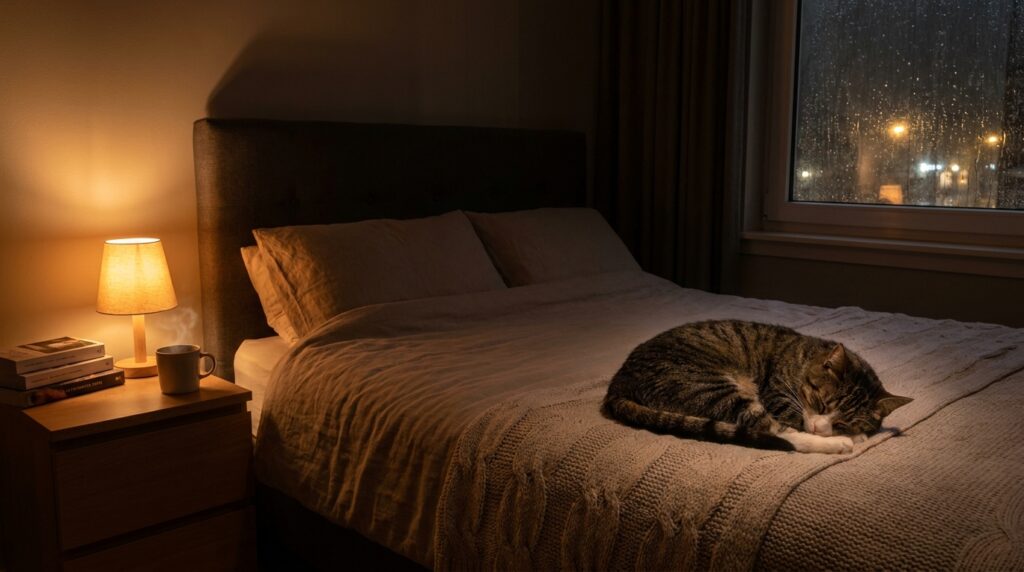
- Burrowing under blankets
Seeking warmth is normal. Shivering, lethargy, or a cat who feels cold to the touch and is unresponsive needs an immediate veterinary call.
Safe ways to add warmth
The room
- Keep the home at a comfortable temperature. A level that’s comfortable for you in light clothing is usually fine for a healthy cat. If you lower the heating at night or when you’re out, make sure she has a warm place to retreat.
- Block drafts around windows and doors, and move her bed away from them.
- Let sunshine in during the day. Many cats like a sunny window perch.
Bedding
- Choose a bed with raised sides or a covered cave, which holds in body heat.
- Add fleece or wool blankets she can burrow into. Wash them regularly.
- Place the bed off the floor, since cold floors draw heat away.
- Offer more than one bed in different rooms, so she can choose.
- Avoid blankets with loops or loose threads that could snag her claws.
Self-warming products
Self-warming beds use reflective material to bounce her own body heat back to her. They have no electricity, so they are lower risk than heated products. They work best if she lies on them long enough to warm up.
Heated products designed for pets
If you want electrical warmth:
- Choose a product made for cats, with a thermostat that limits the surface temperature, and a chew-resistant or concealed cord.
- Follow the manufacturer’s instructions, including how to use it with a cover or blanket.
- Check the temperature with your hand before use, and give her a way to move off it.
- Don’t use an old, damaged, or home-modified product.
- Inspect cords and the surface regularly.
- Unplug it when you’re not home, if the instructions advise it.
- Don’t use one for a cat who can’t move off it, such as one that is very sick, sedated, or paralyzed, without veterinary advice, because she may not realize she is overheating.
Microwavable discs
Heat discs designed for pets stay warm for hours. Follow the instructions, test the temperature with your hand, and wrap the disc in a cover so she can’t touch it directly.
What to avoid
| Avoid | Why |
|---|---|
| Human heating pads and electric blankets | They aren’t designed for cats, can reach temperatures high enough to burn, and cords can be chewed. Cats can suffer burns that don’t look serious at first |
| Hot water bottles | Can leak, cool unevenly, or burn. If you use one, wrap it well and monitor it, though safer options exist |
| Unattended space heaters | Tip-over, burn, and fire risk |
| Beds right next to radiators, fireplaces, or wood stoves | Burn risk. Cats can sit too close to heat and not notice |
| Open fires without a guard | Burns and smoke |
| Candles within reach | Burns and fires |
| Keeping her in a cold garage or unheated room | Not suitable |
| Warm, enclosed spaces like running dryers | Cats climb into them. Check before use |
| Car engines | In outdoor settings, cats can be hurt by seeking warmth under cars. This matters if she ever gets outside |
Radiator perches designed for pets exist. Check the heat rating, and use only if the radiator doesn’t get too hot.
Dry winter air
Heating dries the air and can dry a cat’s skin and coat. Signs include flaking, static, and itching, which can also be fleas or allergies. If you’re unsure, see our flea guide and ask your vet.
- A humidifier can help. Keep it clean to avoid mold, and keep the cord and water out of her reach.
- Brush her regularly.
- Provide fresh water, because dry air increases thirst.
Winter hazards
Antifreeze
Ethylene glycol antifreeze is sweet-tasting and extremely toxic to cats. Even a small amount can cause kidney failure. Clean up any spills immediately, and store it out of reach. If you think she has licked or swallowed some, it is an emergency, and you should go to a vet right away. Don’t wait for symptoms.
De-icing salt and chemicals
If you walk in areas with ice melt, wipe your shoes before coming in, since cats can lick residue from floors or from their paws. Some products can irritate the mouth and stomach.
Holiday hazards
- Lilies in bouquets are very dangerous for cats. Don’t bring them into the home.
- Holly, mistletoe, and some other seasonal plants are listed as toxic. Check the ASPCA list.
- Tinsel, ribbon, and string can cause serious intestinal injury if swallowed.
- Chocolate, onions, grapes, raisins, and xylitol are dangerous.
- Light cords can be chewed. Use covers.
- Real tree water may contain preservatives or bacteria.
- Glass ornaments can break.
Carbon monoxide and heaters
Fuel-burning heaters need good ventilation, and a carbon monoxide detector protects everyone in the home. Cats can be affected too. If your detector sounds, leave and take your cat with you if you can do it safely.
Cold and the older cat
Arthritis is common in older cats and can look like stiffness, reluctance to jump, and a reluctance to use the litter box. Cold can make her more uncomfortable. Warm beds, easy access to litter, and steps to favorite spots help. Ask your vet about pain management. Don’t give human pain medicine.
If you lose heating
- Bring your cat into the warmest room, and let her share your body heat if she likes it.
- Provide blankets and self-warming beds.
- Don’t use unsafe heating, such as a gas oven or an unvented heater.
- Make sure she has water that isn’t frozen.
- If you must leave home, take her with you in a carrier, covered with a blanket.
When to talk to your vet
- If your cat is shivering, lethargic, or cold to the touch
- If a senior cat stops jumping or using her usual perches in the cold
- If you suspect antifreeze exposure. Go immediately.
- If she has burns, or you think she’s been burned by a heater
- Before using heated products for a sick or elderly cat
Frequently Asked Questions
Do indoor cats get cold?
They can, especially seniors, kittens, thin cats, and short-haired breeds.
What temperature should I keep the house for my cat?
Comfortable for a person in light clothing is usually fine for a healthy cat. Provide warm spots if you lower it.
Are heated cat beds safe?
Products made for cats, with thermostats and chew-resistant cords, can be safe when used as directed.
Can I use a human heating pad?
It isn’t recommended, because of burn and chewing risks.
Why does my cat lie on the radiator?
Cats like warmth. Make sure it isn’t hot enough to burn.
Why does my cat sleep under the covers?
For warmth and security. It is normal.
Related reading
- Cat window safety for apartments
- Indoor cat emergency kit
- Indoor plants poisonous to cats
- Cat-proofing an apartment
Sources to cite and verify
- ASPCA Animal Poison Control, antifreeze and holiday plant toxicity
- Cornell Feline Health Center, cold weather safety
- AAFP and ISFM guidance on senior cat care and arthritis