By Emma Hartley | Reviewed by IndoorCatWell Editorial Team | Last updated August 2026
This article provides practical, veterinary-supported cat behavior guidance. If you buy through our links, we may earn an affiliate commission at no extra cost to you. Read our full Affiliate Disclosure.
If your cat turns into a nighttime alarm clock, the cause is usually one of a handful of things: their natural activity cycle, hunger, boredom, or — especially in older cats — a medical issue that needs attention rather than a bedtime routine. If you’ve already ruled out hunger, illness, litter-box problems, and other genuine needs, repeatedly getting up to feed or play with your cat when the meowing starts can reinforce the behavior. Understanding why your cat may be meowing so much starts with separating instinctive nocturnal energy from genuine distress.
⚡ Quick Answer: Why Cats Meow at Night
Cats are crepuscular, meaning they’re naturally more active at dawn and dusk, which is why nighttime meowing is common even in healthy cats. Add in hunger, boredom, or an empty food bowl, and you get a predictable pattern. In senior cats, new or worsening nighttime meowing can be a sign of cognitive decline or a medical condition and is worth a vet visit rather than a behavior fix alone.
At a Glance: Nighttime Vocalization Patterns
| What You’re Noticing | Possible Reason | What to Check |
|---|---|---|
| Meowing right before your usual wake time | Hunger, anticipation | Feeding schedule & automatic feeder timing |
| Meowing that started recently in an older cat | Cognitive changes or systemic illness | Cat’s age, new symptoms, prompt vet evaluation |
| Meowing paired with restless pacing & sprints | Excess energy, boredom | Daytime activity level & evening play routine |
| Meowing directly outside the bedroom door | Separation, attention, barrier frustration | Access consistency and bedtime rules |
| Meowing that sounds disoriented or unlike normal | Physical pain or sensory disorientation | Veterinary examination |
Why Your Cat Is Wide Awake — and Vocal — at Night
Cats are generally crepuscular, meaning they tend to be most active around dawn and dusk. Individual cats can still develop different activity patterns, especially indoor cats whose routines are shaped by feeding, play, and interaction with people. While their wild ancestors evolved to hunt small prey during twilight hours when rodents are most vulnerable, indoor living reshapes how and when those biological instincts emerge.
According to the ASPCA guide on cat meowing and yowling, cats use vocal communication primarily directed toward humans rather than other adult felines. Layer an empty stomach, an under-stimulated brain, or an aging cat’s changing sleep-wake cycle on top of that crepuscular drive, and 3 a.m. meowing stops being mysterious.

Why Does My Cat Meow at Night? 7 Main Reasons
When an indoor cat starts meowing during the night, identifying the exact trigger requires looking at timing, posture, and what happened earlier in the day. Here are the 7 most common causes behind feline nighttime vocalization:
1. Natural Activity Patterns
Even well-fed, deeply loved cats often experience an instinctual burst of alertness at dawn and dusk simply because their circadian physiology is wired for crepuscular hunting.
- Signs: Predictable timing right around sunset or initial morning light, often accompanied by grooming, stretching, or patrolling rather than distress cries.
- What to do: Align their schedule by introducing a dedicated interactive play session right before your bedtime to release that natural energy spike earlier.
- When it’s not just this: If the vocalizing is sustained throughout the middle of the night rather than a brief twilight flurry, other behavioral or environmental factors are at play.
2. Pent-Up Energy and Zoomies
Indoor cats spend an average of 12 to 16 hours napping. When daytime hours lack vigorous physical exertion, all that stored energy detonates once the house turns quiet in the form of nocturnal zoomies.
- Signs: Rapid galloping across furniture, skittering down hallways, dilated pupils, and vocal chirping or yowling between sprints.
- What to do: Schedule two 10-to-15-minute high-intensity wand-toy play sessions during the afternoon and evening to deplete physical reserves.
- When it’s not just this: Zoomies that persist despite consistent vigorous exercise over a few weeks may be driven by medical issues like flea allergy dermatitis or hyperesthesia.

3. Hunger or Feeding Schedule
Feline digestive tracts are designed for frequent, small, protein-dense meals. If your cat receives their final meal at 5:00 or 6:00 PM, their stomach will be completely empty by 2:00 or 3:00 AM, creating genuine hunger pangs.
- Signs: Meowing concentrated strictly around the food bowl, kitchen pantry, or pacing toward you whenever you step out of bed.
- What to do: Split their daily caloric allowance so a small protein-rich meal is served immediately before bedtime, or program an automatic micro-feeder to dispense a portion at 3:30 AM.
- When it’s not just this: If your cat meows anxiously at the bowl but refuses to eat when food is accessible, schedule a veterinary visit to check for dental disease, nausea, or pancreatitis.

4. Attention or Separation
Cats develop deep social attachments to their human caregivers. When a bedroom door shuts, it forms an abrupt physical and sensory barrier that can trigger distress or demand vocalizations. Veterinary experts at VCA Animal Hospitals note excessive vocalization often becomes an ingrained learned behavior because owners quickly respond to quiet the noise.
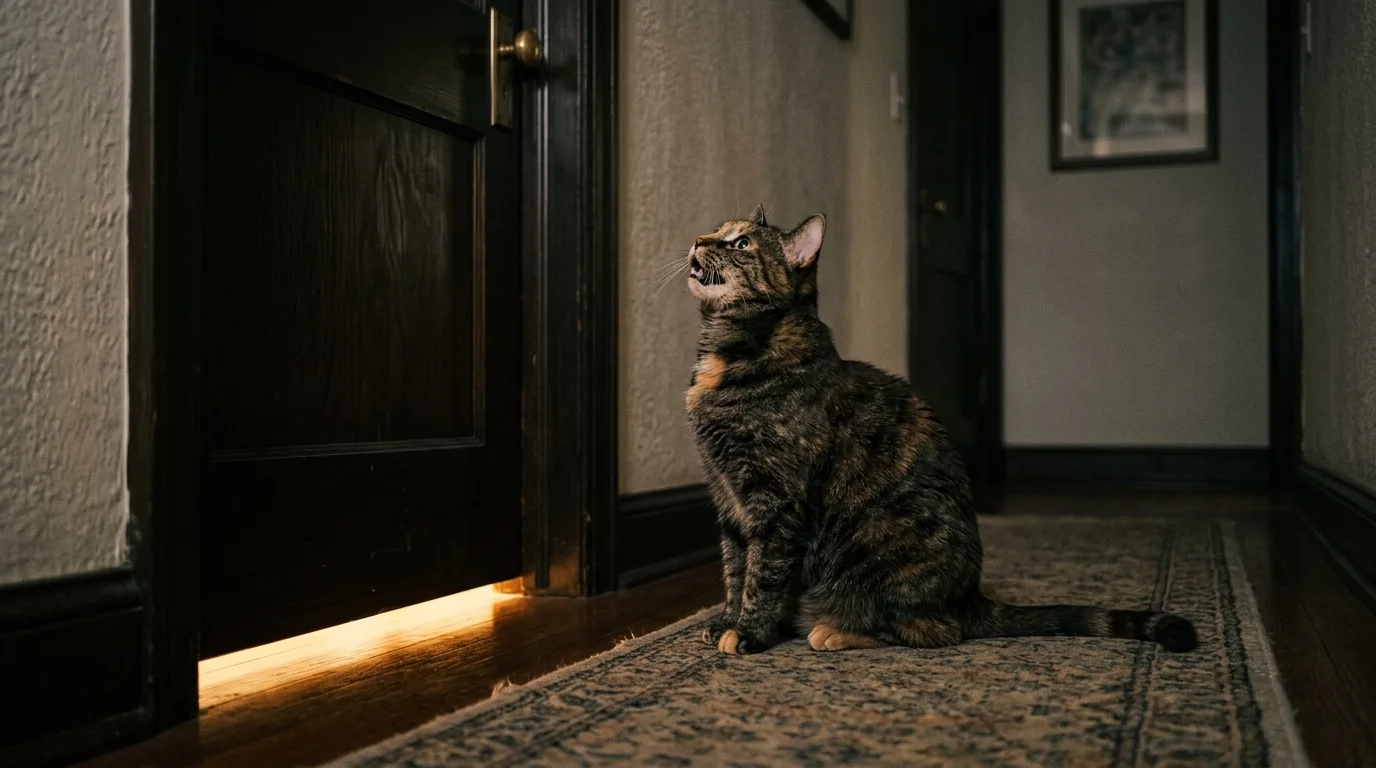
- Signs: Persistent crying directly at the bedroom threshold, pawing beneath the door, which immediately ceases once you allow entrance.
- What to do: Decide whether your cat has bedroom privileges or not, and remain unwavering. If they sleep outside, provide high-comfort bedding, a piece of worn clothing with your scent, and ignore demand cries so you don’t reinforce the habit.
- When it’s not just this: If nighttime distress is accompanied by excessive grooming, litter box accidents, or intense clinging during daytime hours, explore potential feline separation anxiety.
5. Boredom and Lack of Enrichment
Some indoor cats become more vocal at night simply because their day hasn’t provided enough mental or physical activity. If your cat sleeps for much of the day and becomes restless once the house gets quiet, boredom can contribute to nighttime vocalizing.
- Signs: Aimless pacing through dark hallways, carrying plush toys while yowling, knocking objects off tables, or becoming especially active after everyone else goes to bed.
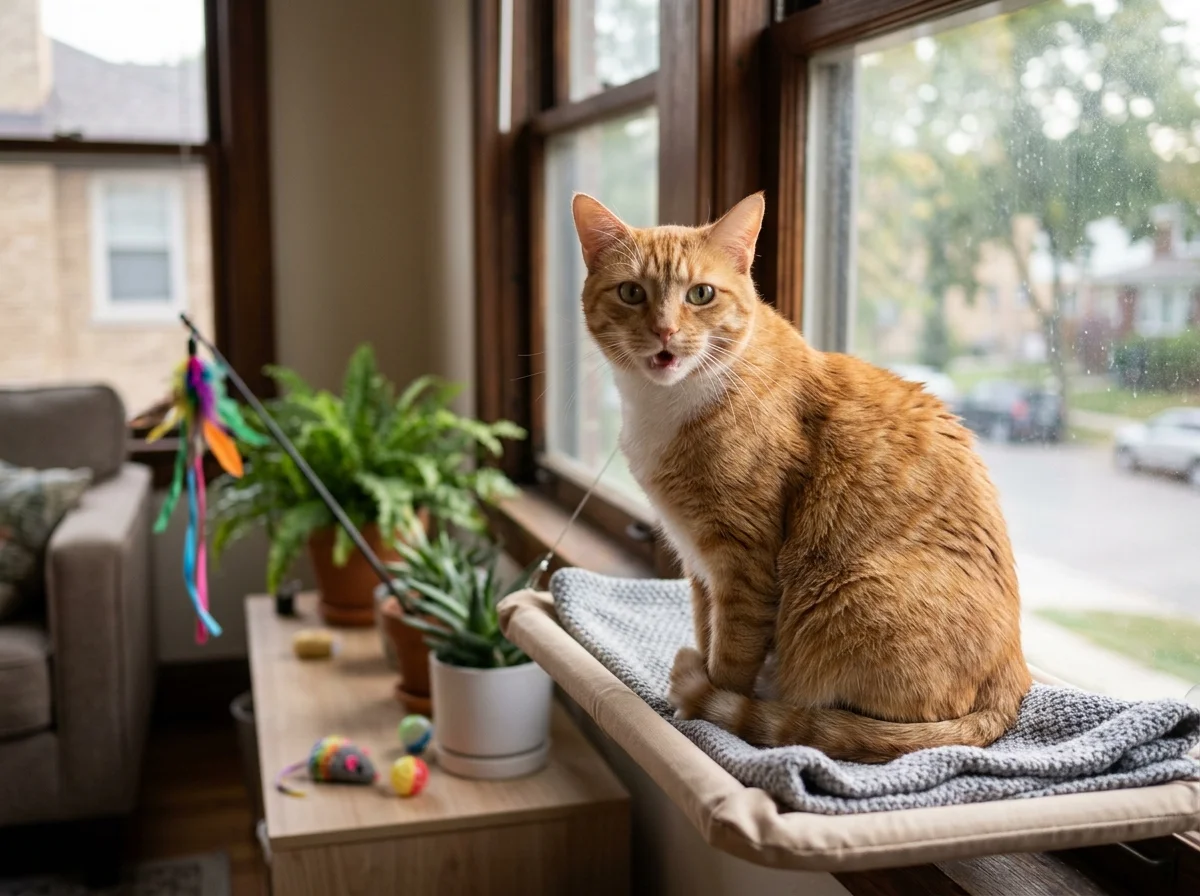
- What to do: Add short play sessions during the day, rotate toys every few days, use puzzle feeders, provide vertical climbing opportunities, and give your cat a safe place to watch outdoor activity through a window perch. Review our proven framework on ways to mentally stimulate your indoor cat and check for common signs your indoor cat is bored.
- When it’s not just boredom: If nighttime vocalizing is new, persistent, or accompanied by changes in appetite, thirst, weight, litter-box habits, or behavior, don’t assume lack of enrichment is the whole explanation.
6. Medical Discomfort
Cats instinctively hide illness during the day, but chronic discomfort often breaks through when ambient household distractions fade at night. Multiple systemic conditions trigger nocturnal vocal changes:
- Feline Hyperthyroidism: As explained by the Cornell Feline Health Center guide on hyperthyroidism in cats, an overactive thyroid dramatically accelerates metabolic rate, producing restlessness, ravenous hunger, weight loss, and loud nocturnal vocalizing.
- Urinary Tract Distress: Feline idiopathic cystitis or life-threatening urinary blockages cause intense pain that provokes straining and urgent crying near the litter box.
- Arthritis and Chronic Pain: Joint inflammation makes finding a comfortable resting position difficult on chilly nights, prompting restless wandering.
- Hypertension & Renal Disease: High blood pressure secondary to kidney decline causes sensory disturbances and headaches that trigger nocturnal distress.
7. Age-Related Cognitive Changes
In senior felines (typically aged 10 to 12 and older), new or worsening nighttime yowling is a hallmark sign of feline cognitive dysfunction (feline dementia), clinically detailed as cognitive dysfunction syndrome in cats by VCA Animal Hospitals.
Cognitive decline alters normal sleep-wake cycles and diminishes sensory acuity. When lights go out, an older cat can become spatially disoriented, wander into dark hallways, and vocalize loudly because they feel suddenly lost or disconnected from familiar routines.
Why Does My Cat Meow at 3 AM?
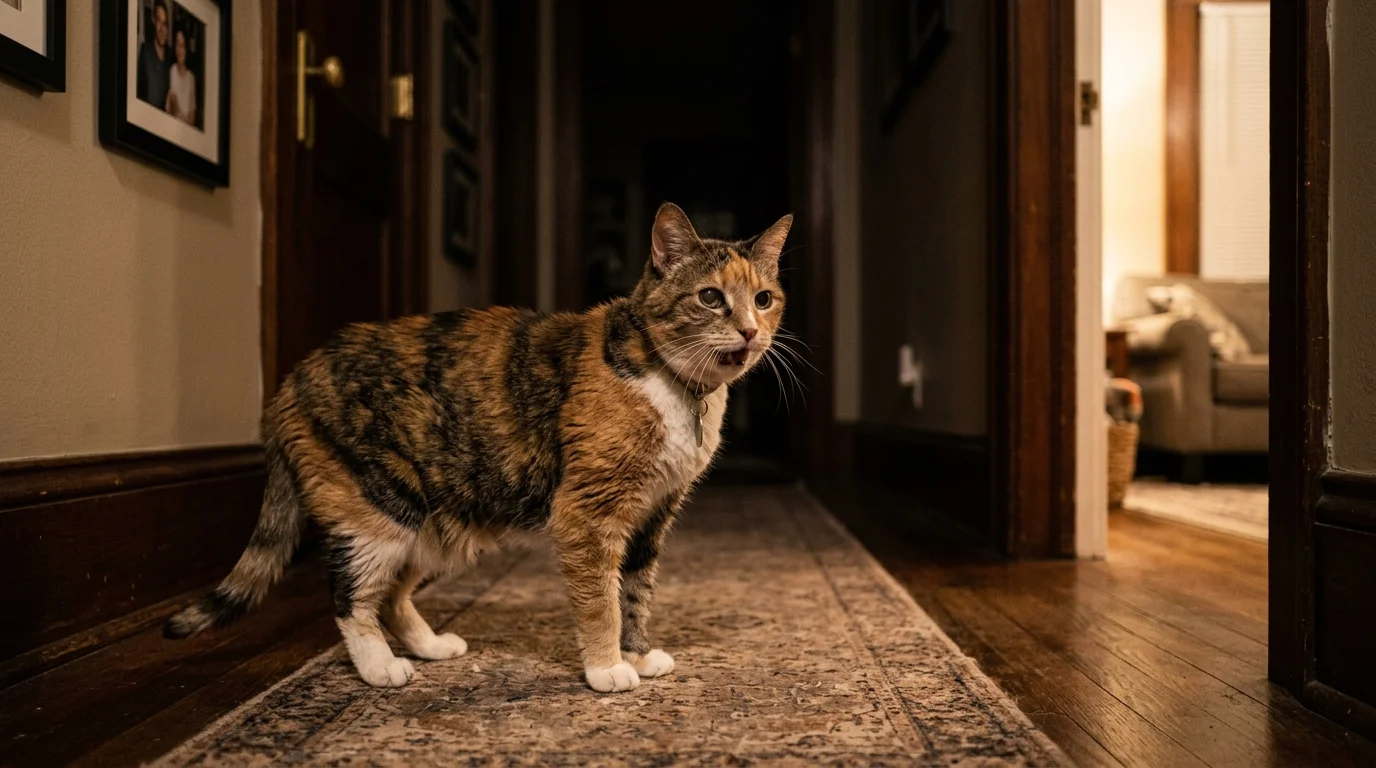
If your cat consistently wakes you around 3 AM, look at what happens immediately before the meowing starts. A predictable pattern often points toward a learned routine rather than a random behavior.
If dinner happens early, hunger may be contributing. If your cat sleeps most of the evening, excess energy may be building up. If you routinely get out of bed, provide food, or play when the meowing starts, your cat may have learned that 3 AM is an effective time to get your attention.
Start by shifting play and feeding later into the evening and make your response consistent. If the behavior is new, especially in an older cat, rule out medical causes before treating it as a training problem.
Why Does My Cat Meow Outside My Bedroom?
If your cat sits outside the bedroom and vocalizes, attention or access may be the simplest explanation. Your closed door creates a clear barrier between your cat and one of the people or spaces it wants to reach.
If opening the door consistently stops the meowing, your cat has learned that vocalizing produces access. Decide whether your cat will sleep in the bedroom or outside it, then keep the rule consistent.
However, don’t assume this is purely behavioral if the behavior is new or accompanied by restlessness, disorientation, appetite changes, or other unusual behavior.
How to Tell Which Reason Applies to Your Cat
To diagnose the root cause accurately, cross-reference your cat’s vocal patterns with their physical postures. Understanding your cat’s body language helps clarify whether crying stems from boredom, hunger, stress, or underlying physical pain.
| Your Cat Does This | More Likely Explanation |
|---|---|
| Meowing is a short burst with running/playing | Crepuscular energy and unspent daytime reserves |
| Meowing happens near the food bowl | Hunger or feeding schedule anticipation |
| Meowing is at the bedroom door specifically | Separation-related or territory barrier frustration |
| Meowing is new and your cat is a senior | Cognitive changes or medical issue — see a vet |
| Meowing sounds disoriented or unlike their normal voice | Medical concern, systemic pain, or sensory loss |
| Meowing while carrying a toy around the house | Prey presentation, play solicitation, or boredom |
How to Stop Nighttime Meowing
- Move play sessions to the hour before bed: Expending crepuscular energy with a feather wand right before sleep helps your cat settle down naturally.
- Feed a small meal right before bedtime: Offering a portioned bedtime snack, or using an automatic feeder timed for early morning (3 or 4 AM), prevents hunger from waking anyone up.
- Keep a consistent bedtime routine: Following the exact same sequence of events each evening signals to your cat that it is time to rest.
- Resist the urge to respond to nighttime meowing: Getting up to offer attention, food, or play outside the routine accidentally reinforces demand cries. Consistency matters more than any single night’s quick fix.
- Add daytime enrichment generally: A cat that gets mental stimulation, window perching, and play during daylight hours is far quieter at night.

The Bedtime Routine Worth Trying
A version of “hunt, catch, kill, eat” works exceptionally well for indoor cats: an active play session with a wand toy (the hunt and catch), followed by a small meal (the eat), followed by settling in for the night. It mimics the natural pattern of predatory activity followed by rest that a cat’s body expects, and it tends to produce a calmer, sleepier cat than play alone.
Establishing a structured, predictable daily routine for an indoor cat harmonizes their natural biorhythms with your household’s sleeping hours, drastically curbing middle-of-the-night wakeups.

When Nighttime Meowing Means a Vet Visit
Contact your veterinarian promptly if:
- The meowing is brand new or suddenly intensified, especially in a cat over 10 years old.
- It is paired with disorientation, confusion in dark rooms, or litter box accidents.
- The vocal sound itself has changed — becoming urgent, hoarse, high-pitched, or raspy.
- There are other physical signs present, such as increased thirst, noticeable weight loss, vomiting, or appetite fluctuations.
- Your cat cries or strains while visiting the litter box (an urgent medical emergency requiring immediate veterinary attention).
Frequently Asked Questions
Should I lock my cat out of the bedroom?
It can work, but consistency matters more than the specific rule — whatever you choose, keep it the same every night so the cat isn’t getting mixed signals.
Does a nightlight help?
Cats see well in low light already, so a nightlight is unlikely to be the fix on its own, though it can help with disorientation in a senior cat experiencing vision changes or cognitive dysfunction.
Why does my cat only meow at night and not during the day?
That pattern often points to the crepuscular instinct or an accumulated need — like hunger or attention — that’s building up while you’re both otherwise occupied during the day.
Can nighttime meowing be trained away completely?
Often reduced significantly, yes, especially with a consistent bedtime routine — but a cat that’s naturally more nocturnal-leaning may never be completely silent at night, and that’s normal.
Final Takeaway
Nighttime meowing is usually explainable by instinct, hunger, or boredom, and a consistent bedtime routine solves most of it. The exception is new nighttime vocalizing in an older cat, which deserves a vet conversation rather than a routine change alone. Explore our related indoor cat guides to support calm behavior around the clock:
- Why Does My Cat Meow So Much? 9 Reasons + What to Do
- Indoor Cat Routine: A Real Daily Schedule for Cats Home Alone All Day
- How to Mentally Stimulate Indoor Cats: The Daily Routine That Actually Works
- Signs of Bored Indoor Cat: What the Behaviors Actually Mean
- Cat Body Language Guide: What Your Cat Is Actually Telling You

🐾 Explore More Cat Behavior & Care Guides
Help your feline thrive with our hands-on tested guides and behavioral solutions: