By Emma Hartley | Reviewed by IndoorCatWell Editorial Team | Last updated August 2026
This article provides practical, veterinary-supported cat behavior guidance. If you buy through our links, we may earn an affiliate commission at no extra cost to you. Read our full Affiliate Disclosure.
Cats purr for several reasons, most commonly relaxation and social interaction, but purring can also occur during stress, fear, pain, hunger, or other situations. The purr itself doesn’t tell you how a cat feels; body language and the surrounding context are more reliable clues.
Purring usually means a cat is content, but not always — cats also purr to self-soothe when they’re stressed, in pain, or frightened. The purr itself doesn’t tell you which one it is. The body language around it does. Just like understanding why your cat may be meowing so much, deciphering feline purrs requires observing what your cat is doing with their ears, eyes, tail, and posture the moment the vibrations start.
⚡ Quick Answer: Why Do Cats Purr?
Cats purr most often when relaxed or happy, but the same sound can appear during stress, pain, or fear as a self-soothing mechanism, and even while giving birth. Purring also operates at a frequency some researchers believe may support healing, though the science on that is still developing. Context — the cat’s posture, ear position, and what’s happening around them — is what actually tells you which kind of purr you’re hearing.
At a Glance: Feline Purring Scenarios
| What You’re Noticing | Possible Reason | What to Check |
|---|---|---|
| Relaxed body, slow blinking, soft purring | Contentment & safety | Nothing — this is a calm, resting cat |
| Purring while tense, ears rotated sideways | Stress, fear, or self-soothing | Recent changes, loud noises, travel carriers |
| Purring while hiding under furniture | Fear, disorientation, or illness | Appetite, litter box habits, physical comfort |
| Purring during gentle chin or cheek petting | Social bonding & affection | Watch for subtle signs of overstimulation |
| Purring paired with lethargy, limping, or crying | Pain, injury, or systemic illness | Prompt veterinary examination |
What a Purr Actually Is: The Anatomy and Vibration
A cat’s purr is a distinct physiological acoustic phenomenon. According to veterinary research from VCA Animal Hospitals on cat communication, purring originates from a neural oscillator within the cat’s brain. This oscillator sends rhythmic, neural messages to the laryngeal muscles, causing the vocal cords (glottis) to rapidly dilate and constrict at 25 to 150 vibrations per second.
Because this alternating contraction occurs during both inhalation and exhalation, feline purring sounds continuous and seamless. Unlike roaring big cats (lions, tigers, and jaguars) whose flexible hyoid bone allows deep, booming roars, domestic cats and smaller wild felines possess a rigid, ossified hyoid that enables this sustained low-frequency vibration.

6 Reasons Cats Purr
Feline behaviorists emphasize that purring is not an emotional state in itself — it is a powerful communication mechanism and self-regulation tool. Below are the 6 primary reasons domestic cats purr:
1. Contentment and Relaxation
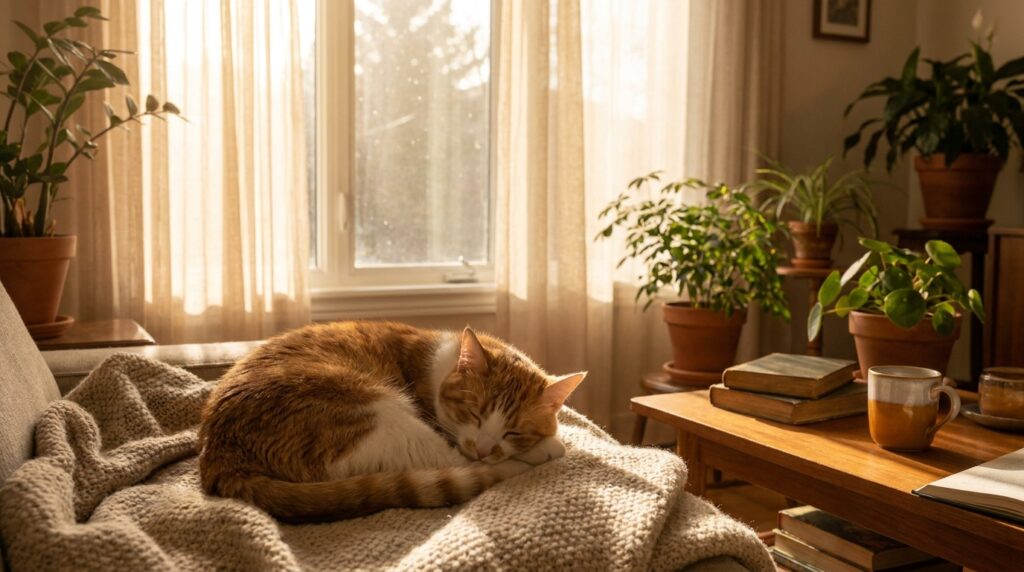
This is the classic, universally recognized purr. When an indoor cat curls up in a sunny patch of carpet, snuggles into a soft duvet, or stretches out beside you, purring signals absolute safety, emotional peace, and deep satisfaction.
- Signs: Loose, relaxed musculature, soft half-closed eyes, rhythmic rhythmic kneading with front paws, and purring that intensifies during gentle stroking. Notice how purring often pairs with why cats knead during comfortable moments.
- What to do: Enjoy the companionship. This is a secure cat experiencing positive emotional well-being.
- When it’s not just this: If the cat purrs while holding rigid muscles or seems unable to find a comfortable resting posture, look closer for subtle tension.

2. Social Bonding and Attention
Adult cats in the wild rarely purr to unfamiliar animals, but domestic cats use purring as a proactive social invitation for humans. It serves as an acoustic greeting that says, “I am friendly, non-threatening, and receptive to connection.”
- Signs: The cat approaches you with an upright tail (often with a tiny hook at the tip), rubs their facial scent glands against your ankles or couch cushions, and begins purring as soon as you speak to them.
- What to do: Return the affection with gentle strokes along their preferred zones — cheeks, chin, and behind the ears.
- When it’s not just this: If attention purring becomes unrelenting, frantic, or accompanied by clinginess, investigate whether your cat is experiencing boredom or separation stress.

3. Asking for Something (The Solicitation Purr)
Some cats produce a more urgent-sounding purr during feeding or when seeking something specific from people. In landmark research published in Current Biology, animal behaviorist Dr. Karen McComb and her team described this as a “solicitation purr.”
This specialized vocalization embeds a high-frequency acoustic peak — acoustically reminiscent of an infant’s cry (roughly 300–600 Hz) — inside the soothing, low-frequency rumble of a standard purr. Humans instinctively perceive this sound as urgent and difficult to ignore, prompting us to fill the food bowl or open closed doors.
- Signs: Purring intensifies noticeably around breakfast or dinner, accompanied by pacing toward the food pantry, weaving between your legs, or staring directly at an empty dish.
- What to do: Maintain a structured feeding routine so your cat doesn’t learn that relentless solicitation purring commands immediate treats.
- When it’s not just this: If a cat displays ravenous hunger paired with vocalizing and weight loss, consult your vet to check for hyperthyroidism or diabetes.

4. Stress, Fear, or Self-Soothing
One of the most critical behavioral insights for any cat owner is that purring is not exclusively positive. Cats frequently purr when placed in high-stress scenarios: inside a car carrier, on a cold metal examination table at the veterinary clinic, or during loud thunderstorms.
In these tense moments, purring functions as an internal coping mechanism — the feline equivalent of a nervous human humming, rocking, or taking slow breaths to regulate heart rate and calm autonomic panic. Purring releases endorphins that reduce anxiety and buffer sensory overload.
- Signs: Tense, compact body posture, flattened “airplane ears,” dilated black pupils, panting or lip-licking, and purring while tucked defensively into the back of a carrier.
- What to do: Do not force physical interaction. Cover the carrier with a towel, minimize loud noises, and allow the cat quiet time to decompress.
- When it’s not just this: Frequent stress purring in a quiet home environment suggests an underlying environmental stressor or medical discomfort.

5. Pain or Discomfort
Cats may purr when they’re uncomfortable, frightened, or experiencing pain, so purring shouldn’t automatically be treated as evidence that a cat feels good. Queens often purr continuously throughout labor contractions, and severely injured or terminally ill felines may purr steadily while lying prone.
Researchers have also proposed that the low-frequency vibrations associated with feline purring (commonly 20 to 140 Hz) could have biological effects on bone density, muscle ease, and tissue repair. Similar mechanical frequencies are utilized in human sports medicine and orthopedic therapy to stimulate bone healing. However, within feline veterinary science, this remains an intriguing area of ongoing research rather than an established medical treatment.
6. Mother-Kitten Communication
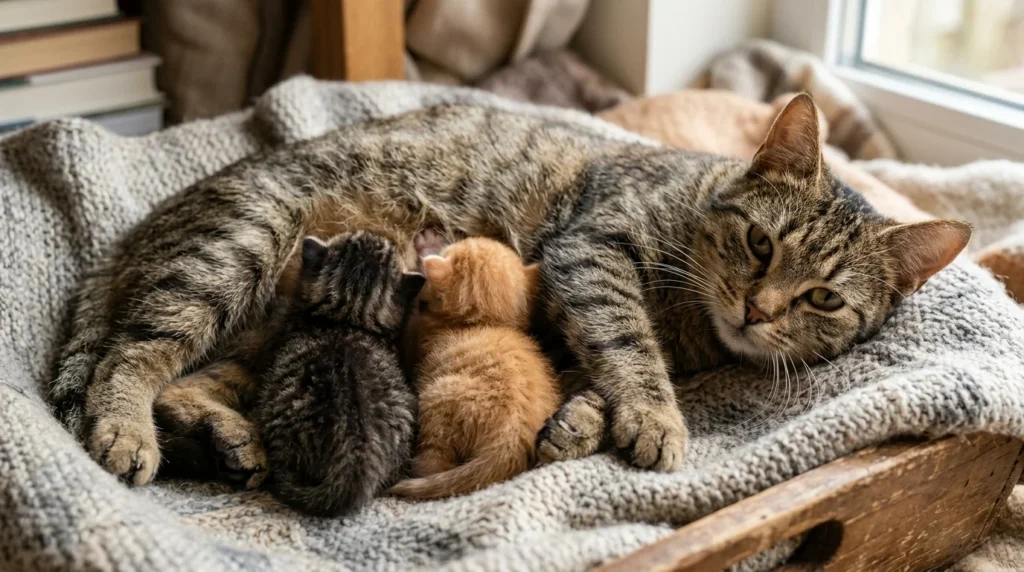
Kittens begin purring very early in life, including while nursing, and mother cats may also purr around their kittens. Because newborn kittens have limited sensory abilities — being born with closed eyes and sealed ear canals — researchers believe these early vocal and vibrational signals may help support communication between mother and kittens.
Because purring occurs on both the in-breath and out-breath, kittens can purr without breaking their nursing latch, signaling that milk is transferring successfully. The mother’s rhythmic rumble simultaneously conveys security, keeping the litter close and content.
How Can You Tell What Your Cat’s Purr Means?
You usually can’t identify the meaning of a purr from the sound alone. Look at the entire situation: your cat’s posture, ears, eyes, tail, movement, appetite, and what happened immediately before the purring started. Mastering how to read your cat’s body language unlocks the real message behind the motor.
- Relaxed body + soft eyes + slow blinking: Usually contentment, social bonding, or safe resting.
- Tense body + ears sideways/back + dilated pupils: Possible stress, agitation, or fear.
- Hiding + purring + reduced appetite or mobility: Possible illness, injury, or underlying physical pain.
- Approaching you + rubbing ankles + purring: Social interaction or attention-seeking.
- Purring near food dish + persistent following: Asking for food or resource solicitation.
| Your Cat Does This | Likely Context |
|---|---|
| Relaxed body, slow blinking, soft paws | Genuine contentment and emotional security |
| Tense body, ears back or flattened sideways | Situational stress, anxiety, or sensory distress |
| Purring while hiding or avoiding human contact | Fear, self-soothing, or hidden physical illness |
| Purring during cheek petting, leaning into hand | Comfort, trust, and social bonding |
| Purring paired with limping, hiding, or appetite loss | Possible physical pain — prompt veterinary visit needed |

Why Does My Cat Purr When I Pet Them?
Most cats purr during enjoyable petting because physical contact can be associated with relaxation, social bonding, and positive interaction. Look for loose muscles, relaxed ears, soft eyes, and a cat that leans their chin or temple into your hand.
If your cat suddenly becomes tense, stops moving naturally, flattens their ears, or tries to move away while purring, don’t assume the purring means they want more petting. Their body language provides the better clue. Understanding situational thresholds helps you nurture mutual trust without triggering sensory overload.
Why Does My Cat Purr and Then Bite Me?
Purring doesn’t guarantee that a cat wants unlimited physical contact. Many cat owners experience petting-induced arousal: a cat purrs rhythmically on their lap for several minutes, and then abruptly turns to nip or swat at the petting hand.
This happens because repetitive tactile stimulation can quickly cross the threshold from pleasurable to overstimulating. The purr may continue for several seconds as nervous arousal peaks. Watch for early warning signs such as tail flicking, skin twitching, ears rotating backward, increased body tension, or turning the head toward your hand. Stop petting when these signals appear rather than waiting for a bite.

Do Cats Purr When They’re in Pain?
Yes, cats can purr while experiencing pain or distress, which is why purring alone isn’t a reliable indicator of comfort. A cat that is purring while also hiding, eating less, moving less, limping, or behaving differently deserves closer attention.
As solitary predators, cats evolved to conceal vulnerability from potential rivals. When pain is moderate to severe, purring releases natural endorphins that take the edge off systemic discomfort. In clinical veterinary settings, cats with bone fractures, dental abscesses, or respiratory distress frequently purr during examinations.
Cats are particularly good at masking illness. If you want to recognize subtle discomfort early, review our guide on signs of pain in cats and consult the comprehensive clinical resource on identifying feline pain by VCA Animal Hospitals. If purring occurs alongside abnormal vocalizing after dark, check our diagnostic breakdown on why cats meow at night.
Purring can occur in both comfortable and stressful situations, so it isn’t a reliable way to diagnose how a cat feels. If purring is accompanied by changes in appetite, movement, grooming, litter-box habits, or behavior, contact your veterinarian promptly.
Does Purring Mean My Cat Is Always Happy?
No — this is the most common misunderstanding about feline behavior. It’s better to think of purring as a cat’s multi-purpose tool for regulating their own state, whether that state is joy or distress, rather than a single-meaning signal like a human smile.
According to behavioral resources from the ASPCA Cat Behavior Resources and the Cornell Feline Health Center, vocalizations should always be evaluated alongside whole-body morphology. Purring communicates an underlying need: a need to maintain social contact, a need for reassurance, a need for food, or a need to cope with stress.
When Purring Might Need a Vet Visit
Contact your veterinarian promptly if purring is paired with:
- Hiding under beds or in closets more than usual
- Reduced appetite, reluctance to eat, or noticeable weight loss
- Limping, reluctance to jump onto preferred furniture, or stiff movement
- Lethargy or fatigue that doesn’t match your cat’s normal energy
- Purring that sounds labored, congested, raspy, or accompanied by open-mouth breathing
Purring alone is never a reason to worry, but purring alongside any of the red flags above is a reason to look closer rather than assume your cat is simply content.
Frequently Asked Questions
Why does my cat purr when I pet her?
Most cats purr during enjoyable petting because physical contact can promote relaxation and social bonding. A relaxed posture, soft eyes, forward-facing ears, and leaning into your hand are stronger signs that your cat is genuinely enjoying the interaction.
Do cats purr when they’re in pain?
Yes. Cats can purr while experiencing pain or distress, so purring alone doesn’t prove that a cat is comfortable. Look for other changes such as hiding, reduced appetite, limping, decreased movement, or unusual behavior.
Why does my cat purr and then bite me?
Purring doesn’t always mean a cat wants unlimited petting. Some cats become overstimulated during physical contact and may eventually bite or swat to end the interaction. Watch for tail flicking, skin twitching, ear rotation, or increased body tension as early warning signs.
Why doesn’t my cat purr?
Some cats purr rarely or very quietly, and this can be entirely normal. Purr volume, pitch, and frequency vary significantly between individual cats and aren’t an indicator of how affectionate your cat feels toward you.
Do cats purr when they sleep?
Yes, some cats purr while dozing or drifting into deep sleep, especially in a secure, familiar environment. Some cats purr while sleeping on their owner’s chest or lap. This is a normal manifestation of physical and emotional contentment.
Can cats purr and hiss at the same time?
It’s uncommon but possible. It typically reflects a conflicted emotional state — such as a frightened cat attempting to self-soothe with purring while simultaneously feeling forced to hiss defensively at a perceived threat.
Is it true purring can help heal bones?
There’s an intriguing scientific theory surrounding the low vibrational frequencies of a cat’s purr (20–140 Hz) and cellular/tissue repair. While low frequencies are used in human orthopedic therapy, treat it as an interesting area of biological research rather than a proven home cure or substitute for veterinary medicine.
Final Takeaway
Purring is a cat’s all-purpose regulation tool, used for contentment, stress, hunger, pain, and social bonding alike. The body language around the purr, not the sound itself, tells you which one you’re seeing. Continue exploring our feline communication and wellness resources to deepen your understanding:
- Cat Body Language Guide: What Your Cat Is Actually Telling You
- Why Does My Cat Meow So Much? 9 Reasons + What to Do
- Why Does My Cat Meow at Night? Causes & Solutions
- How to Tell If Your Cat Is in Pain: Subtle Signs Owners Miss
- Why Does My Cat Knead Me? Causes & Behavioral Meaning
- Why Does My Cat Sleep on Me? 5 Reasons & What It Means
- Why Does My Cat Sit on My Chest? What It Means
🐾 Explore More Cat Behavior & Care Guides
Help your feline thrive with our hands-on tested guides and behavioral solutions:
Why does my cat purr when I pet her?
Most cats purr during enjoyable petting because physical contact can promote relaxation and social bonding. A relaxed posture, soft eyes, forward-facing ears, and leaning into your hand are stronger signs that your cat is genuinely enjoying the interaction.
Do cats purr when they’re in pain?
Yes. Cats can purr while experiencing pain or distress, so purring alone doesn’t prove that a cat is comfortable. Look for other changes such as hiding, reduced appetite, limping, decreased movement, or unusual behavior.
Why does my cat purr and then bite me?
Purring doesn’t always mean a cat wants unlimited petting. Some cats become overstimulated during physical contact and may eventually bite or swat to end the interaction. Watch for tail flicking, skin twitching, ear rotation, or increased body tension as early warning signs.
Why doesn’t my cat purr?
Some cats purr rarely or very quietly, and this can be entirely normal. Purr volume, pitch, and frequency vary significantly between individual cats and aren’t an indicator of how affectionate your cat feels toward you.
Do cats purr when they sleep?
Yes, some cats purr while dozing or drifting into deep sleep, especially in a secure, familiar environment. Some cats purr while sleeping on their owner’s chest or lap. This is a normal manifestation of physical and emotional contentment.
Can cats purr and hiss at the same time?
It’s uncommon but possible. It typically reflects a conflicted emotional state — such as a frightened cat attempting to self-soothe with purring while simultaneously feeling forced to hiss defensively at a perceived threat.
Is it true purring can help heal bones?
There’s an intriguing scientific theory surrounding the low vibrational frequencies of a cat’s purr (20–140 Hz) and cellular/tissue repair. While low frequencies are used in human orthopedic therapy, treat it as an interesting area of biological research rather than a proven home cure or substitute for veterinary medicine.