By Emma Hartley | Reviewed by IndoorCatWell Editorial Team | Last updated August 2026
This article provides practical, veterinary-supported cat behavior guidance. If you buy through our links, we may earn an affiliate commission at no extra cost to you. Read our full Affiliate Disclosure.
Your cat sleeps on you mainly for warmth, security, and your familiar scent. Sleep is a vulnerable state, so a cat that consistently chooses to sleep close to you may be showing that they feel comfortable and secure in your presence. Warmth, habit, and your familiar scent can also be part of the reason.
Cats sleep an average of 12 to 16 hours a day, and choosing where to spend those vulnerable resting hours is rarely an accident. Just like decoding why cats purr, noticing why cats knead, or deciphering subtle signals in cat body language, understanding why your cat climbs onto your chest or curls across your legs reveals the deep social architecture of feline companionship.
⚡ Quick Answer: Why Does Your Cat Sleep on You?
Cats sleep on their favorite people for warmth, comfort, scent familiarity, and a sense of security they don’t get from sleeping alone. It’s generally a positive sign of bonding, though a sudden increase in clinginess — including more sleeping on you than usual — can occasionally point to stress, temperature sensitivity, or illness and is worth watching if paired with other changes.
At a Glance: Cat Sleeping Scenarios
| What You’re Noticing | Possible Reason | What to Check |
|---|---|---|
| Sleeps on you most nights, has for a while | Bonding, comfort, warmth | Nothing — this is normal social attachment |
| Prefers your legs specifically | Warmth, stable surface, less disruptive spot | Normal nocturnal sleeping preference |
| Prefers your chest directly | Heartbeat rhythm, breathing cadence, core warmth | Close affiliative trust and scent immersion |
| Started suddenly, wasn’t a habit before | Seeking reassurance or sudden environmental chill | Recent routine changes, weather shifts |
| Sleeps on you and seems clingier generally | Possible anxiety, aging, or underlying illness | Monitor appetite, energy, and litter box habits |
Why Does My Cat Sleep on Me?
When an indoor cat curls up directly on your body, they are making a deliberate choice. In feline colonies, animals only engage in communal sleeping with bonded individuals who share a mutual scent profile. Rather than viewing humans merely as tall furniture, felines treat reliable owners as their emotional anchor and primary source of physical comfort.
5 Reasons Your Cat Sleeps on You
1. They’re Looking for Warmth
A domestic cat’s basal body temperature hovers between 100.5°F and 102.5°F (38°C to 39.2°C). Maintaining that higher internal temperature requires metabolic energy, which is why cats instinctively seek out sunny patches, laptop keyboards, heating vents, and warm human bodies. When you lie down, your torso and legs radiate a steady 98.6°F, functioning as a customized, self-regulating thermal pad that keeps them warm without metabolic effort.
2. You Make Them Feel Secure
According to behavioral resources from the Cornell Feline Health Center, sleep is inherently vulnerable for felines, who evolved as both predators and prey. In the wild, cats rarely enter deep REM sleep in open areas unless guarded by trusted members of their social group. By resting directly on you, your cat knows that any sudden noise or threat will awaken you first, granting them permission to let down their guard completely.
3. They’re Bonded to You
Some cats form an exclusive bond with a single household member and direct their most intimate social routines toward that person. While awake, they may follow you from room to room; at night, they seal that companionship by sleeping against you. A cat settles quickly and deeply once positioned against you, and some cats also purr, knead, or slow-blink while settling down — natural physical markers of emotional security.
4. They’re Mixing Their Scent With Yours
Cats possess microscopic sebaceous scent glands around their chin, lips, forehead, and paw pads. Sleeping on you, often paired with why cats knead into your blankets or soft flannel shirt before settling in, distributes their pheromones onto you. Feline welfare researchers at International Cat Care note that this communal scent blending creates a shared olfactory fingerprint, reinforcing peaceful harmony and home security.
5. Your Scent, Breathing, and Heartbeat Are Comforting
Your steady breathing cadence and regular heartbeat simulate the maternal sensations kittens experienced when huddled in a sleeping pile with their mother and littermates. The familiar, unique scent of your skin acts as a powerful neurochemical pacifier, helping your cat decompress after an active day.
What Does Your Cat’s Sleeping Position Mean?
The posture your cat adopts when sleeping on or near you offers valuable insights into their comfort level and thermal needs:
- Curled tightly in a ball (the “crescent”): Conserves vital body heat and protects internal organs. The cat is comfortable but conserving energy.
- Stretched out fully with belly exposed: The ultimate display of feline relaxation. Exposing the vulnerable abdominal area proves that your cat feels 100% safe from threats.
- The loaf (paws tucked beneath chest): Relaxed, but ready to spring up quickly if an unexpected sound occurs.
- Paws draped over your arm or neck: Affiliative physical contact seeking direct reassurance and companionship.

Why Does My Cat Sleep on My Chest?
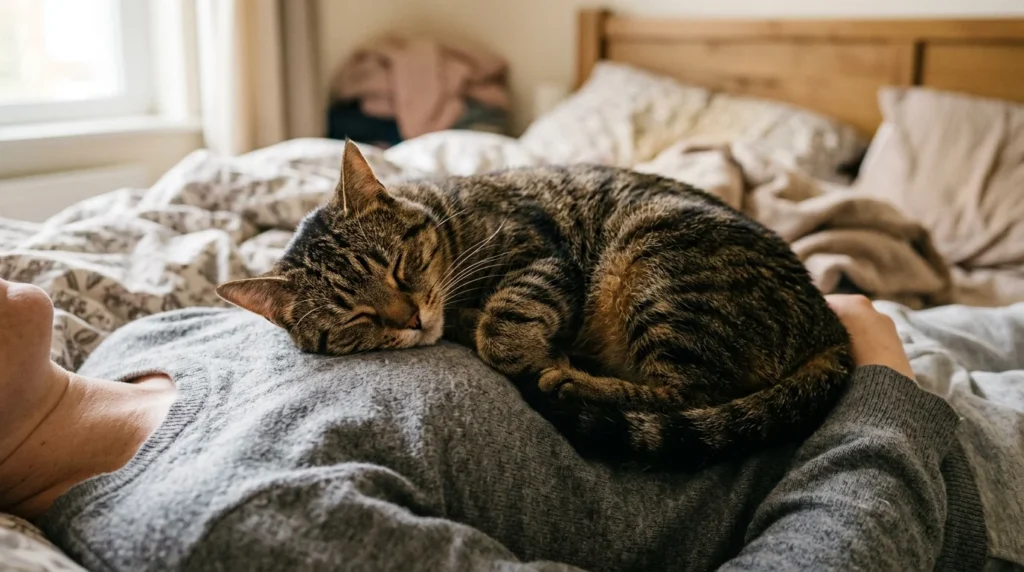
Sleeping on your chest provides the closest physical and sensory contact possible. Your chest is the central radiating core of your body heat, and lying directly on your sternum positions your cat close to your rhythmic heartbeat and the gentle rise and fall of your lungs.
Some cats prefer one particular part of the body, especially the chest, where they can stay close to your face and enjoy a warm, stable surface. For a comprehensive look at this specific habit, read our dedicated guide on why cats choose your chest.
Chest sleeping also places your cat at eye level, making it easy to exchange slow blinks, soft head butts (bunting), and purrs. If your cat purrs while curling up beside you or sleeping on your chest, that combination usually reflects comfort and affiliative trust — though looking at full cat body language ensures they aren’t feeling stressed or restless.
Why Does My Cat Sleep on My Legs?
Many cats choose your legs, lap, or the curve behind your knees rather than your chest or head. While the torso rises and falls noticeably with every breath, your lower legs provide a wider, flatter, and far more stationary platform that won’t jolt them during light sleep.
Furthermore, sleeping by your legs gives a cat an effortless, unobstructed escape route. If you shift or turn over in bed, a cat stationed at your feet can leap away instantly without feeling pinned down or startled.

Why Does My Cat Suddenly Want to Sleep on Me?
If an independent cat that usually sleeps across the room suddenly insists on sleeping glued to your body, consider recent shifts in environment and routine:
- Temperature drop: Autumn chills, drafts from air conditioners, or turning down the thermostat often prompt cats to seek human heat.
- Household changes and stress: A new pet, visiting guests, moving furniture, or construction noise outdoors causes cats to seek the reassuring anchor of their primary human.
- Aging and sensory changes: Senior cats experiencing declining eyesight or hearing frequently become more physically clingy at night, seeking close contact to feel safe in the dark.
- Illness or fever: Sudden clinginess accompanied by lethargy, appetite loss, or hiding during the day warrants a veterinary check.
How to Tell When a Change in Sleeping Behavior Matters
Sudden changes in a cat’s behavior can sometimes have a medical cause, particularly when they occur alongside other changes in appetite, activity, or litter-box habits. Veterinary internal medicine specialists emphasize that felines frequently express physical discomfort through altered social patterns:
| Your Cat Does This | Likely Explanation |
|---|---|
| Has always slept on you, no change in pattern | Normal bonding and trust |
| Started sleeping on you more after a household change | Seeking reassurance during an environmental transition |
| Sleeping on you increased along with hiding or appetite loss | Possible illness or systemic stress — schedule a vet check |
| Sleeps on you but seems restless rather than settled | Check for localized pain or joint stiffness |
How to Stop Your Cat From Sleeping on You Without Hurting the Bond
While having a cat sleep on you is deeply affectionate, it can disrupt restful human sleep, trigger allergies, or cause back stiffness from staying frozen in one position all night. You can gently redirect your cat without damaging your relationship:
- Set up an attractive heated bed: A self-warming thermal pet mat or low-voltage heated cat bed positioned right beside your pillows provides irresistible warmth without relying on your body.
- Use a worn piece of clothing: Place a t-shirt or sweatshirt you’ve worn all day inside their cat bed. Your familiar scent gives them the emotional comfort of your presence.
- Practice gradual redirection: When your cat jumps onto your chest, calmly and gently lift them into their adjacent bed while offering gentle head scratches. Consistency reinforces the new routine.
- Maintain a consistent indoor cat routine: Active evening play sessions followed by a small protein-rich snack right before bed helps cats expend excess energy and settle into their own space.

Frequently Asked Questions
Why does my cat sleep on my chest?
Your chest provides optimal body heat, the comforting rhythmic cadence of your breathing, and the soothing sound of your heartbeat. It also places your cat in close eye-level proximity for bonding.
Why do cats sleep on legs specifically?
Legs offer a flatter, more stable surface that doesn’t rise and fall as noticeably with breathing. It also provides an immediate and unobstructed escape route if you move or make sudden adjustments.
Why does my cat suddenly sleep on me?
A sudden shift toward sleeping on you often reflects a recent room temperature drop, emotional stress from routine changes, or aging-related sensory decline. If paired with appetite or litter box changes, consult your vet.
Is it safe to sleep with my cat?
For healthy adults without severe allergies or asthma, sleeping with your cat is completely safe. Just ensure young kittens are protected from heavy bedding or very deep sleepers who might accidentally roll over.
Why does my cat only sleep on me and not my partner?
Cats often select a primary attachment figure based on who provides their meals, radiates more consistent body heat, moves less during sleep, or maintains a calmer demeanor in the evening.
Should I worry if my cat suddenly wants to sleep on me all the time?
If increased clinginess occurs alongside lethargy, hiding during the day, vocalizing in pain, or eating less, a veterinary checkup is warranted to ensure your cat isn’t dealing with physical illness or discomfort.
Final Takeaway
A cat sleeping on you is usually one of the clearest signals of trust and bonding they can give. The one exception worth watching is a sudden, unexplained increase in clinginess paired with other behavior changes, which is worth checking with a vet. Continue exploring our feline communication and behavioral library to deepen your bond:
- Why Does My Cat Purr? What Different Purrs Mean
- Why Does My Cat Knead Me? Causes & Behavioral Meaning
- Why Does My Cat Lick Me? 7 Reasons Cats Lick Their Owners
- Why Does My Cat Bite Me? 8 Reasons Explained
- Cat Body Language Guide: What Your Cat Is Actually Telling You
- Why Does My Cat Meow at Night? Causes & Solutions
- Why Does My Cat Meow So Much? 9 Reasons + What to Do
🐾 Explore More Cat Behavior & Care Guides
Help your feline thrive with our hands-on tested guides and behavioral solutions: