By Emma Hartley | Reviewed by IndoorCatWell Editorial Team | Last updated August 2026
This article provides practical, veterinary-supported cat behavior guidance. If you buy through our links, we may earn an affiliate commission at no extra cost to you. Read our full Affiliate Disclosure.
Cats may lick their owners as part of social grooming, bonding, attention-seeking, or because they like the taste or smell of something on the skin. Occasional licking is usually normal, but frequent or difficult-to-interrupt licking can sometimes be associated with stress or an underlying problem. Your cat’s body language and the situation around the licking provide the best clues.
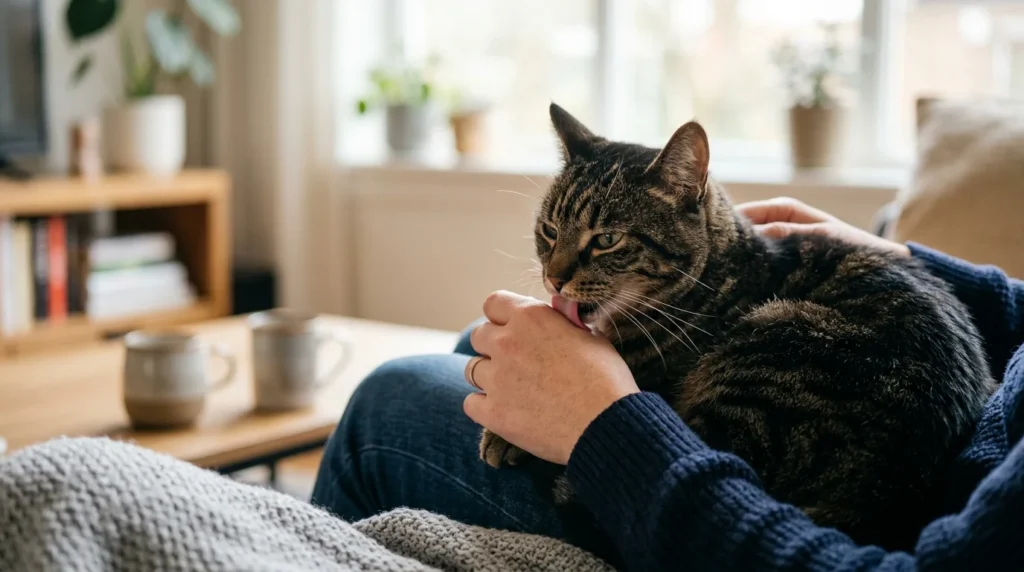
Cats may lick you as part of social grooming, bonding, attention-seeking, or simply because they like the taste or smell of something on your skin. Cats groom members of their social group, so licking a person can sometimes be part of that same social behavior. Context matters far more than the lick itself. Just like deciphering why cats purr or discovering why cats knead, understanding those sandpaper licks requires observing the full picture: posture, environment, timing, and tactile thresholds.
⚡ Quick Answer: Why Do Cats Lick You?
Licking is a normal part of feline social behavior, often described as allogrooming when directed at another animal or person. It usually signals affection, bonding, or a form of attention-seeking, though occasional or excessive licking can also point to anxiety or a compulsive behavior. Context — how often it happens and what else your cat is doing — is what separates normal affection from something worth watching.
At a Glance: Cat Licking Scenarios
| What You’re Noticing | Possible Reason | What to Check |
|---|---|---|
| Occasional licking during calm moments | Affection, social grooming (allogrooming) | Nothing — this is normal social bonding |
| Licking concentrated on hands or fingers | Tasting salt, lotion, or food residue | Wash hands if applying medicated lotions |
| Licking that abruptly shifts into biting | Sensory overstimulation | Watch tail twitches, ear angles, skin ripples |
| Licking you persistently to wake you up | Attention or breakfast solicitation | Establish structured feeding routines |
| Licking themselves bald in patches | Medical overgrooming / skin allergy / pain | Veterinary examination required |
Why Cats Lick People: The Social Dynamics of Allogrooming
In the animal behavior world, mutual grooming between members of the same species is called allogrooming. In colonies of feral cats and peaceful multi-cat households, feline companions groom one another around the head, neck, and ears — areas an individual cat cannot easily reach with their own tongue.
According to behavioral resources from the Cornell Feline Health Center, allogrooming serves two primary functions: maintaining coat hygiene and reinforcing social bonds within a trusted colony. When your domestic cat extends this behavior to your arm, hand, or face, they are applying the same communal social framework to you as a respected family member.

7 Reasons Behind the Sandpaper Kisses
Feline tongues are covered with hundreds of backwards-facing, keratinized spines called filiform papillae. These tiny curved barbs act like a natural comb to untangle fur, dislodge parasites, and distribute skin oils. When applied to human skin, those coarse bristles create that unmistakable “sandpaper” sensation. Here are the 7 primary reasons behind the behavior:
1. Social Grooming (Allogrooming)
Cats groom other cats they’re bonded with, and licking you is often an extension of that same trust-based behavior. In stable feline groups, social grooming reinforces harmony and mutual recognition.
- Signs: Calm, unhurried licking, often during quiet rest periods while sitting beside you on a couch or bed.
- What to do: Enjoy the companionship. This is a positive reflection of your cat’s comfort level in the relationship.
- When it’s not just this: Frantic, obsessive, or nonstop licking that cannot be redirected points to anxiety or medical distress.
2. Showing Affection and Connection
Related to grooming but broader — some cats lick as a general expression of closeness, similar to how they’d rub against your legs or butt heads (bunt) against your chin. It is a tactile gesture confirming peaceful, friendly intentions.
Licking isn’t the only way cats show closeness and attachment; some cats also prefer to sleep directly on their owners or sit directly against their favorite person.
3. Social Bonding and Familiarity
Cats use scent extensively in social interactions, but licking a person shouldn’t automatically be interpreted as territorial marking. Your cat may simply be engaging in a familiar social behavior that occurs within a trusted relationship. Cats have scent-producing glands throughout their bodies, and licking frequently occurs alongside other scent-related behaviors such as cheek rubbing.
4. Tasting Sweat, Lotion, or Food Residue
Sometimes licking has nothing to do with emotional bonding and everything to do with chemistry. Human skin produces natural salts in sweat, and cats are often attracted to the mineral taste. Similarly, moisturizing creams, lanolin, shea butter, or traces of meat or fish from preparing dinner can prompt curious tongue taps.
- Signs: Licking concentrated specifically on fingers, palms, or wrists right after you finish cooking, exercise, or step out of the shower.
- Important safety note: Always wash your hands before handling pets if you use medical ointments (especially topical hormone creams, minoxidil/Rogaine, or flurbiprofen NSAID gels), as small ingested quantities can be fatal to felines.

5. Seeking Attention
If licking reliably gets you to look up from your laptop, laugh, pet your cat, or even nudge them away, smart felines quickly learn that rough tongue contact commands instant human engagement. Just like why cats communicate through vocal behavior, repetitive licking can become an operative conditioned routine.
6. Kitten-Like Comfort Behavior
Some adult cats retain sucking, licking, or kneading behaviors associated with kittenhood. These behaviors are sometimes linked with early weaning, but the behavior alone doesn’t prove that a cat was separated from its mother too early. Individual cats retain juvenile self-soothing rituals for many unique developmental and neurological reasons.
7. Stress, Anxiety, or Repetitive Behavior
Repetitive licking can sometimes be a self-soothing displacement behavior associated with environmental stress or sensory overload. However, excessive grooming can also occur with allergies, parasites, skin disease, or joint pain, so persistent licking shouldn’t automatically be assumed to be purely psychological anxiety.
Why Does My Cat Lick Me and Purr?
When licking and purring happen together during a calm interaction, your cat is often showing relaxed social behavior. Some cats lick their owners while sitting on their lap, why cats knead rhythmically into fleece blankets, or settling down beside them for an evening snooze.
Look at the rest of the body language: relaxed muscles, soft eyes, naturally positioned ears, and a calm tail support the idea that your cat is comfortable. If licking and purring happen alongside tense muscles, flattened ears, hiding, or attempts to escape, don’t assume the purring means your cat is happy. Review our complete diagnostic breakdown on why cats purr to recognize how feline vibrations communicate stress as well as comfort.

Why Does My Cat Lick Me Then Bite Me?
A cat that licks you and then bites you isn’t necessarily changing from “loving” to “aggressive.” The interaction may simply have crossed the cat’s physical tolerance threshold, particularly if petting or close physical contact is involved.
According to clinical animal behaviorists at VCA Animal Hospitals, this phenomenon — known as petting-induced overstimulation — occurs when repetitive tactile sensations trigger sudden neurological arousal. The initial licking is genuine social engagement, but as nerve endings become overwhelmed, the cat delivers a quick nip or swat as a clear boundary marker saying, “That is enough for now.”
Learning to spot the subtle warning signs in cat body language prevents bites entirely. Watch for:
- Tail tip twitching, thumping, or swishing back and forth
- Skin rippling or twitching along the spine
- Ears rotating slightly backward or flattening into “airplane mode”
- Body muscles stiffening abruptly
- Sudden cessation of purring or head turning sharply toward your hand

Why Does My Cat Lick My Face, Hair, or While Sleeping?
Why Does My Cat Lick My Face?
Cats may lick a person’s face because of social grooming, familiarity, attention-seeking, or simply because facial skin carries distinctive scents and tastes. In feline colonies, mutual grooming is almost exclusively concentrated around the head and cheeks. Some cats are especially persistent around your nose or chin because those features are at eye level during quiet lap time. You do not need to allow face licking if you dislike it; gently turn your head and redirect your cat to a hand stroke instead.

Why Does My Cat Lick My Hair?
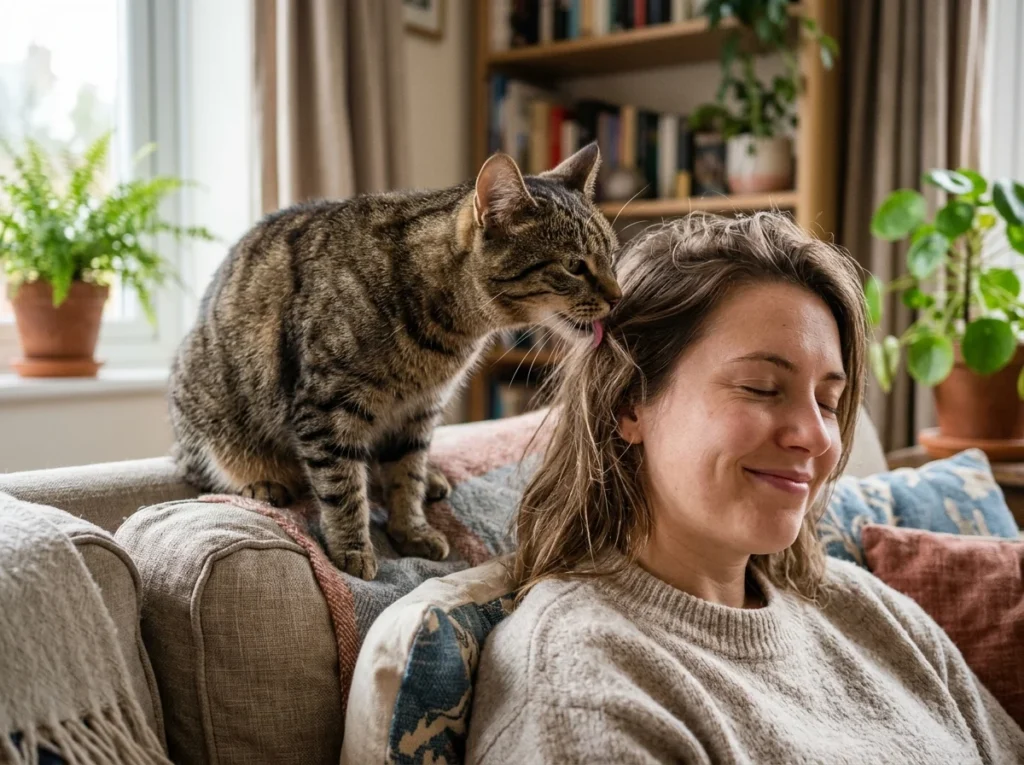
Human hair carries complex aromas from shampoo, conditioner, styling serums, and natural scalp oils. Some cats are strongly drawn to these scented fatty acids, while others simply find strands of hair reminiscent of feline fur. If your cat repeatedly pulls, chews, or swallows hair, redirect the behavior immediately — ingesting human hair can tangle with internal hairballs and form hazardous intestinal blockages.
Why Does My Cat Lick Me While I’m Sleeping?
Your cat may lick your eyelids, nose, or fingers in the middle of the night or early morning as an effective alarm clock. Because humans respond quickly to sandpaper licks on sleeping skin, cats repeat the trick when seeking attention or breakfast. If nighttime licking disrupts your sleep, avoid rewarding it with immediate food or play; establish a predictable bedtime routine and review our guide on why cats meow at night for night-settling strategies.
Should I Let My Cat Lick My Face? (Saliva & Hygiene)
You don’t have to let your cat lick your face. Cat saliva contains normal oral bacteria, most notably Pasteurella multocida, Bartonella henselae, and various streptococcal species. While licking intact, unbroken skin poses minimal risk to healthy adults, avoiding face and lip licking is a prudent hygiene boundary.
Important medical rule: Never allow a cat to lick an open scratch, paper cut, surgical wound, or eczema flare-up. Introducing oral feline bacteria into broken human skin significantly elevates the risk of severe bacterial cellulitis or cat-scratch disease. If your cat licks an area of skin, washing with mild soap and warm water is standard practice.
When Excessive Licking Is a Problem: Distinguishing Self vs. Owner
Occasional licking directed at you is generally normal and harmless. The far greater clinical concern is persistent licking directed at your cat’s own body, especially when it results in thinning coat, raw skin, or bald patches.
Cats normally spend roughly 30% to 50% of their waking hours grooming their fur. Healthy self-grooming keeps coats clean and regulates body temperature without damaging the epidermis:

However, excessive self-grooming (psychogenic alopecia or medical overgrooming) can have multiple underlying physical causes. Flea allergy dermatitis, food sensitivities, environmental atopy, parasitic mites, and localized joint pain (such as arthritis in hips) cause cats to lick raw spots repeatedly. If your cat is pulling out fur, review our clinical guide on cat overgrooming and bald spots and schedule a comprehensive veterinary checkup.

How to Gently Redirect a Licking Cat
If sandpaper kisses become uncomfortable, abrasive, or too persistent, follow these gentle handling strategies:
- Redirect with a soft brush: Offer a gentle grooming tool like a slicker or rubber curry brush. Most cats readily accept brush bristles as a superior substitute for grooming hands.
- Offer a kicker toy: If licking is escalating toward playful nibbling or overstimulation, toss a plush kicker toy so your cat can channel physical energy safely away from your skin.
- Wash off attractive scents: Rinse away sweet lotions, salty residues, or food fragrances that might be acting as an olfactory magnet.
- Never scold or strike: Punishment damages feline trust. Simply stand up calmly and walk into another room to end the interaction without drama.
Frequently Asked Questions
Why does my cat lick me and purr?
When licking and purring happen simultaneously in a relaxed posture, it usually reflects positive social bonding, calm companionship, and contentment. Your cat is treating you as a trusted member of their social unit.
Why does my cat lick me then bite me?
This is usually caused by tactile overstimulation rather than aggression. After several seconds of repetitive licking or petting, a cat’s nerve receptors become hypersensitive, prompting a quick stop-signal bite. Watch for tail twitches or skin ripples as early warning signs.
Why does my cat lick my face?
Cats groom other cats around the face and ears in natural allogrooming. Your face is also at eye level during lap snuggles, carries your unique scent, and offers subtle salt or skin care oils that attract curiosity.
Why does my cat lick my hair?
Hair absorbs distinctive scents from shampoos, conditioners, and natural scalp oils. Cats may lick hair as an extension of fur grooming, but you should prevent them from chewing or swallowing hair to avoid intestinal trichobezoars (hairballs).
Why does my cat lick me while I’m sleeping?
Licking while you sleep is usually a proactive attention-seeking strategy or mealtime reminder. Because owners awaken quickly to sandpaper licks, cats learn that licking works faster than quiet purrs.
Should I let my cat lick my face?
It is a personal hygiene choice. While low risk on completely healthy, intact skin, you should never allow a cat to lick near your lips, eyes, or any open scratches or skin irritations due to oral bacteria.
Is cat saliva dangerous to humans?
Cat saliva harbors bacteria such as Pasteurella multocida. On unbroken skin, simple hand washing with soap is entirely sufficient. However, if saliva contacts open wounds, clean immediately and consult a doctor if redness or swelling occurs.
Why does my cat lick itself so much?
Normal grooming occupies up to half of a cat’s day. But if licking creates hairless patches, redness, or scabs, it is medical overgrooming caused by allergies, external parasites, dermatitis, or localized joint discomfort that requires veterinary evaluation.
Final Takeaway
Licking is usually affection, social allogrooming, or simple curiosity about interesting tastes, and occasional sandpaper kisses are a healthy part of living with a cat. The primary exception is frequent, compulsive licking — particularly directed at the cat’s own body — which warrants veterinary evaluation. Continue exploring our cat behavior library to better understand feline habits:
- Why Does My Cat Purr? What Different Purrs Mean
- Why Does My Cat Knead Me? Causes & Behavioral Meaning
- Why Does My Cat Sleep on Me? 5 Reasons & What It Means
- Why Does My Cat Sit on My Chest? What It Means
- Cat Body Language Guide: What Your Cat Is Actually Telling You
- Cat Overgrooming and Bald Spots: Stress vs. Medical Causes
- Why Does My Cat Meow at Night? Causes & Solutions
🐾 Explore More Cat Behavior & Care Guides
Help your feline thrive with our hands-on tested guides and behavioral solutions: