By Emma Hartley | Reviewed by IndoorCatWell Editorial Team | Last updated August 2026
This article provides practical, veterinary-supported cat behavior guidance. If you buy through our links, we may earn an affiliate commission at no extra cost to you. Read our full Affiliate Disclosure.
Cats knead because the behavior begins in kittenhood and often continues into adulthood as a comfort or social behavior. When a cat kneads you, it may mean they feel relaxed and comfortable, while paw-pad scent marking and settling behavior can also play a role.
Kneading — the rhythmic pressing and alternating of front paws against a soft surface, affectionately called “making biscuits” — is one of the most endearing yet puzzling feline quirks. When a cat kneads you specifically, it often happens during relaxed, comfortable interactions and may be associated with social bonding. Cats also have scent glands in their paw pads, so kneading may leave scent on the surface they’re pressing against. Just like understanding why cats purr or why cats communicate through vocal behavior, interpreting kneading requires observing your cat’s posture, environment, and accompanying cues.
⚡ Quick Answer: Why Do Cats Knead?
Kittens knead their mother while nursing to stimulate milk flow, and many cats keep doing it as adults, usually in moments of comfort or before settling down to sleep. It can also serve as scent marking and a way of preparing a soft spot to lie on. Occasional kneading with claws out is normal; it only becomes a problem if it’s painful or paired with signs of stress.
At a Glance: Feline Kneading Scenarios
| What You’re Noticing | Possible Reason | What to Check |
|---|---|---|
| Kneading before settling down to sleep | Comfort, sleep preparation | Nothing — this is normal instinctive behavior |
| Kneading and purring together on lap | Contentment & social bonding | Nothing unusual — secure, relaxed cat |
| Kneading and biting the blanket | Nursing-instinct carryover / comfort | Ensure fabric fibers aren’t being swallowed |
| Kneading with claws out and painful | Normal motor reflex, needs buffer | Nail length; place a thick blanket on your lap |
| Sudden aggressive or frantic kneading | Possible stress or sensory agitation | Recent household changes or medical discomfort |
Why Do Cats Knead? The Developmental Origin
The behavior starts in early kittenhood. Kittens knead their mother’s mammary area while nursing, and the behavior is associated with nursing and milk flow. This tactile motion stimulates the release of oxytocin in the mother queen, promoting milk letdown.
According to developmental research referenced by the Cornell Feline Health Center, many cats retain the same rhythmic paw movement into adulthood, where it can appear during relaxed or comfortable situations. While the physical need for mother’s milk disappears after weaning, the neurological pattern remains deeply hardwired into the feline nervous system.

Reasons Your Cat Is “Making Biscuits”
When an adult domestic cat rhythmically presses into your thighs, a plush fleece throw, or their cat bed, they are expressing an instinctive behavior that serves several overlapping psychological and physical purposes:
1. Nursing Instinct Carryover and Comfort
This is the core foundation of adult feline kneading. For an adult cat, replicating this rhythmic motion evokes the profound emotional security experienced during early development.
- Signs: Appears most often during calm, intimate moments — when curled up beside you, settling on a favorite chair, or being softly stroked.
- What to do: Welcome the calm moment. It’s a clear indicator that your cat feels secure in their immediate environment.
- When it’s not just this: If kneading is paired with intense suckling or obsessive fabric chewing, ensure your cat is not ingesting loose threads.
2. Scent Marking and Familiarity
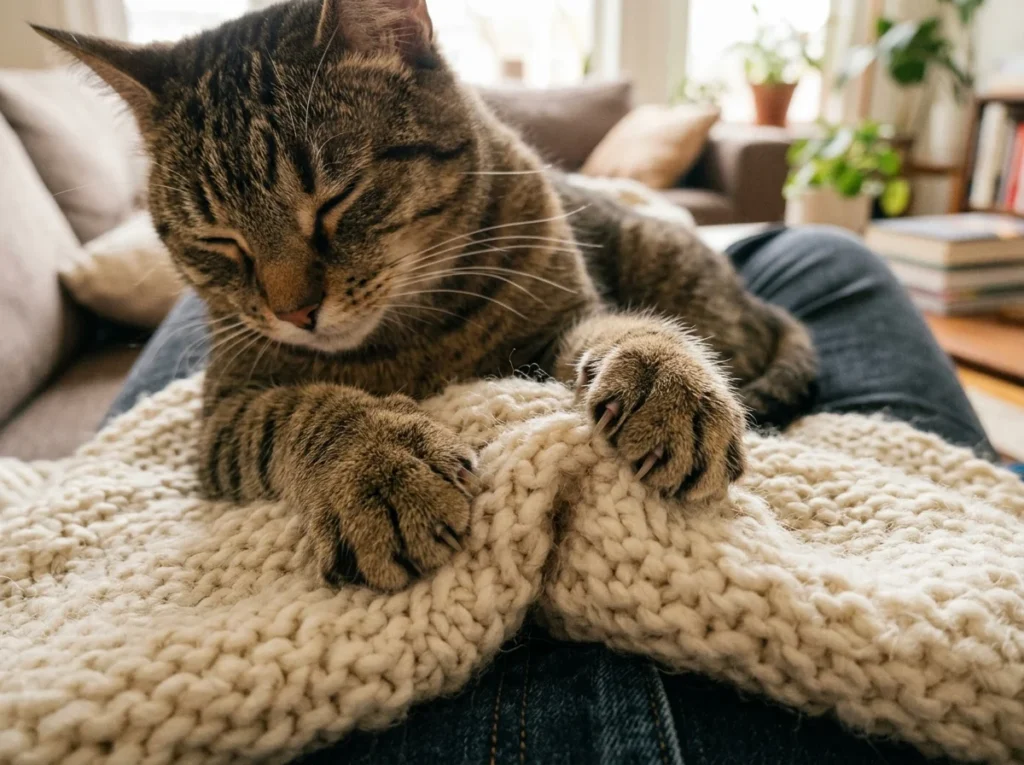
Cats have microscopic scent glands (interdigital glands) located between their paw pads. As noted in clinical feline behavior resources from VCA Animal Hospitals on cat behavior, kneading presses that scent into the surface they repeatedly step on.
When a cat kneads your lap, chest, or favorite sofa cushion, scent marking may be one subtle component of the behavior. By leaving their scent pheromones behind, they reinforce familiarity, claiming the resting area as safe, recognized home territory.

3. Preparing a Comfortable Bed
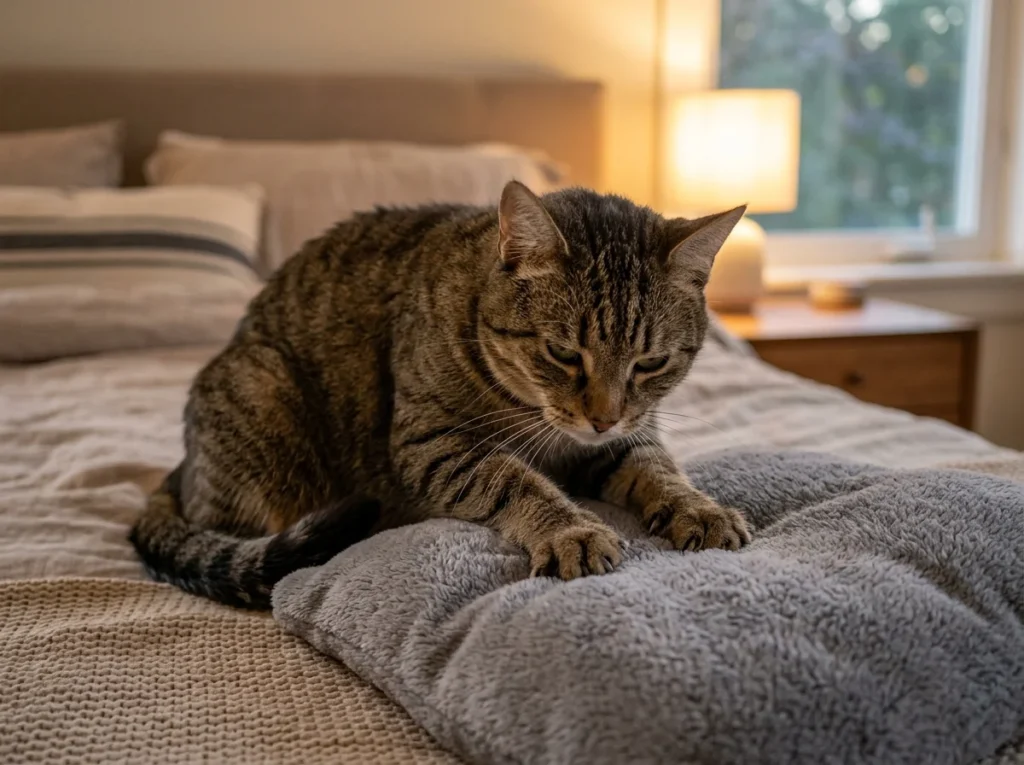
Some cats knead blankets, beds, or other soft surfaces immediately before settling down. While cat folklore often claims this stems from wild ancestors flattening tall savannah grass to create nests, the exact evolutionary origin isn’t settled fact. Rather, the rhythmic movement is part of a long-standing instinctive behavior associated with preparing and checking a comfortable resting place.
- Signs: Turning in small circles, kneading the center of a pillow or duvet for 30 to 60 seconds, and immediately curling into a ball.
- What to do: Provide washable, plush bedding or dedicated throws in draft-free sleeping nooks.
4. Stretching and Flexibility
Kneading isn’t purely psychological — it also feels physically beneficial. The alternating flexion and extension of the digital flexor tendons stretches the paws, forelegs, and shoulder blades. Cats frequently perform brief kneading sessions right after waking up from a nap, flexing their toes and claws as a feline warm-up.
Why Does My Cat Knead Me and Purr?
Kneading and purring often happen together because both behaviors commonly occur when a cat is relaxed and comfortable. A cat that climbs onto your lap, kneads rhythmically, purrs, and settles down is usually showing a relaxed social behavior.
Look at the whole picture, though. Relaxed muscles, soft eyes, forward-facing ears, and a calm tail support the idea that your cat is comfortable. If you want to understand the full acoustics of this combination, explore our detailed guide on why cats purr to recognize how purrs differ between contentment and stress.

Why Does My Cat Knead Only Me?
If your cat kneads only you and ignores other household members, that doesn’t necessarily mean they have an exclusive “kneading contract,” but it may reflect where they feel most comfortable. Your lap may be warmer, softer, more familiar, or more strongly associated with calm interaction than other people or surfaces.
If your cat consistently chooses you for kneading, take it as a positive sign of comfort — but don’t treat kneading alone as a scientific measurement of attachment. Felines choose interaction partners based on predictable handling, gentle voices, and positive past experiences.
Why Does My Cat Knead and Bite the Blanket?
Some cats knead while sucking, biting, or chewing a blanket. This combination can reflect retained kitten-like comfort behaviors, but it doesn’t automatically mean the cat was weaned too early. Some people associate persistent suckling or fabric chewing with early weaning, but the behavior isn’t proof that a cat was weaned prematurely; individual cats can retain these soothing reflexes for many reasons.
If your cat only gently mouths a blanket while kneading and otherwise behaves normally, it’s usually not a medical concern. However, swallowing pieces of fabric can cause dangerous gastrointestinal foreign-body blockages. Inspect blankets regularly and immediately remove throws that are shedding fibers or being chewed apart.

What Your Cat’s Kneading and Body Language Can Tell You
Kneading doesn’t happen in a vacuum. Paying close attention to accompanying signals in cat body language reveals how your feline companion actually feels:
| Kneading Paired With… | Likely Emotional Context |
|---|---|
| Purring, soft half-closed eyes | Deep contentment, security, and relaxation |
| Occasional drooling during purring | Very relaxed state; ensure no dental discomfort |
| Mouthing or sucking on fleece fabric | Nursing-reflex carryover; monitor fabric integrity |
| Tense body, flattened ears, dilated pupils | Possible overstimulation or stress coping mechanism |
| Slow rhythmic stepping before sleep | Sleep preparation routine; entirely normal |
Some cats drool when they’re extremely relaxed, including during kneading or purring. Occasional drooling during a clearly relaxed moment may be harmless, but new, excessive, or persistent drooling should be discussed with a veterinarian because dental disease and other medical problems can also cause it.
What to Do When Kneading Hurts (Claws Out)
Claws-out kneading on bare skin or thin jeans is one of the most common complaints from indoor cat owners. It is rarely intentional aggression — cats naturally extend and retract their claws as part of the flexor movement and simply don’t realize human skin lacks protective fur. Here is how to handle painful kneading constructively:
- Use a “biscuit blanket” buffer: Keep a folded, thick fleece blanket or towel next to your couch. When your cat approaches your lap, slide the blanket over your legs before the paws start pressing.
- Keep claws neatly trimmed: Regular nail trims take the sharp hook off claw tips without harming the quick. Follow safe techniques in our complete cat grooming guide.
- Gently redirect to a cushion: If the pressure is too intense, gently scoop your cat under their chest and place them onto an adjacent plush pillow.
- Never scold or punish: Shouting, pushing, or startling your cat will only create fear and break social trust. Kneading is an act of relaxation; gentle physical redirection is all that is needed.

Is Kneading a Sign That My Cat Loves Me?
Kneading can be a sign that your cat feels comfortable and secure around you, particularly when it happens alongside purring, relaxed body language, or settling close to you. But kneading isn’t a scientific “love test.”
Cats show attachment in many different ways, including seeking proximity, rubbing against you, head-bunting (bunting), slow blinking, and choosing to rest quietly in the same room. A cat that never kneads can be just as deeply bonded as one that makes biscuits every evening.
When Kneading May Be a Problem
Kneading itself is rarely a problem. The behavior deserves more clinical attention when it is accompanied by other physical or behavioral changes. Contact your veterinarian if you notice:
- Sudden, dramatic changes in kneading frequency or demeanor
- Persistent drooling outside of brief relaxed moments
- Difficulty eating, dropping kibble, or signs of mouth pain
- Excessive or compulsive fabric chewing and swallowing (pica)
- Unusual agitation, hissing, or reactivity when paws are touched
- Restlessness paired with pacing or crying
The kneading motion itself isn’t harmful; what matters is the broader behavioral and medical context surrounding it.
Frequently Asked Questions
Why does my cat knead me and purr?
Kneading and purring often happen together because both are common responses during moments of safety, physical comfort, and positive social interaction. It signals that your cat is content and relaxed in your presence.
Why does my cat knead only me?
If your cat only kneads you, it usually reflects comfort and predictability. Your lap may be warmer, softer, or associated with quiet, gentle petting. While it indicates familiarity, it shouldn’t be treated as a scientific measurement of attachment.
Why does my cat knead and bite the blanket?
Suckling or gently mouthing fabric while kneading is an extension of the neonatal nursing reflex. While harmless in moderation, make sure your cat isn’t chewing off or swallowing fabric threads, which can lead to intestinal blockages.
Why does my cat knead with its claws out?
Extending claws is part of the natural anatomical flexor movement of a cat’s paws. Because cats evolved with fur-covered companions, they don’t realize their claws poke sensitive human skin. Place a thick blanket over your lap to protect yourself.
Why does my cat knead before sleeping?
Kneading before settling down is a long-standing settling behavior. It allows cats to test and shape the softness of their resting spot while mentally preparing their body to relax and sleep.
Is kneading a sign that my cat loves me?
It indicates that your cat feels safe, comfortable, and receptive to positive contact around you. However, cats demonstrate bond and affection through many behaviors, including slow blinking, proximity, and bunting.
Why doesn’t my cat knead?
Not all cats knead, and this is completely normal. Feline behavioral patterns vary greatly between individuals. A cat that never kneads is not any less happy or bonded than one that kneads daily.
Final Takeaway
Kneading is a comfort behavior rooted in kittenhood that most cats carry into adulthood, signaling security, familiarity, and relaxation. The rare exception is claws-out kneading that stings, which is easily managed with a soft buffer blanket and routine nail care. Continue exploring our cat behavior library to understand your feline companion’s complete communication repertoire:
- Why Does My Cat Purr? What Different Purrs Mean
- Why Does My Cat Sleep on Me? 5 Reasons & What It Means
- Why Does My Cat Sit on My Chest? What It Means
- Cat Body Language Guide: What Your Cat Is Actually Telling You
- Why Does My Cat Meow So Much? 9 Reasons + What to Do
- Complete Cat Grooming Guide: Nails, Brushing & Care
- Why Does My Cat Meow at Night? Causes & Solutions
🐾 Explore More Cat Behavior & Care Guides
Help your feline thrive with our hands-on tested guides and behavioral solutions: