By Emma Hartley | Reviewed by IndoorCatWell Editorial Team | Last updated August 2026
There’s no single correct feeding schedule for an adult cat — it depends on weight, activity, whether your cat is spayed or neutered, and the calorie density of whatever food is in the bowl. What follows is a practical framework for building your own schedule, plus starting-point numbers you can adjust once you see how your cat actually responds.
Quick Answer: How Often Should an Adult Cat Eat?
Most adult cats do best on two meals a day, spaced roughly 12 hours apart (e.g., 7 AM and 7 PM). Cats prone to begging, vomiting on an empty stomach, or scarfing food too quickly often do better split into three or four smaller meals. There is no metabolic downside to smaller, frequent feedings — it’s about what keeps your cat satisfied and fits your daily routine.
Adult Cat Feeding Schedule at a Glance
| Cat Lifestyle | Meals / Day | Example Schedule |
|---|---|---|
| Typical indoor adult | 2 meals | 7:00 AM + 7:00 PM |
| Active or food-motivated cat | 3 meals | 7:00 AM + 1:00 PM + 7:00 PM |
| Prone to fast eating or vomiting | 3–4 small meals | Automatic feeder spaced every 6 hours |
| Overweight cat on weight loss | Vet-guided portions | Strictly measured scheduled meals (no free-feeding) |
Note: These are practical frameworks. For deeper foundational nutrient requirements, read our Complete Cat Nutrition Guide.
How Much Should a 1–7-Year-Old Cat Eat?
The honest answer is: it depends on the calorie density of your specific food, which varies more between brands than most people expect. A rough starting point for a healthy 10-pound indoor adult cat is 200–275 calories a day, but that range shifts once you check the actual kcal/cup or kcal/can on your food’s label rather than assuming. Consult the Cornell Feline Health Center Adult Cat Feeding Guidelines for clinical baseline details.
Cat Feeding Chart by Weight
These are starting estimates for a moderately active indoor adult cat, assuming a typical maintenance dry food around 350–400 kcal/cup. Adjust up for active cats, down for less active ones, and check our How Much to Feed an Indoor Cat Guide.
| Cat Weight | Approx. Daily Calories | Approx. Dry Food / Day |
|---|---|---|
| 5 lb (2.3 kg) | 130–170 kcal | 1/3 – 1/2 cup |
| 6 lb (2.7 kg) | 150–190 kcal | 3/8 – 1/2 cup |
| 7 lb (3.2 kg) | 170–210 kcal | 1/2 – 5/8 cup |
| 8 lb (3.6 kg) | 190–230 kcal | 1/2 – 2/3 cup |
| 9 lb (4.1 kg) | 210–250 kcal | 5/8 – 3/4 cup |
| 10 lb (4.5 kg) | 220–270 kcal | 5/8 – 3/4 cup |
| 11 lb (5.0 kg) | 240–290 kcal | 2/3 – 7/8 cup |
| 12 lb (5.4 kg) | 260–310 kcal | 3/4 – 7/8 cup |
How to Calculate Your Cat's Daily Calories
Veterinarians use the Resting Energy Requirement (RER) formula:
RER = 70 × (Body Weight in kg)^0.75
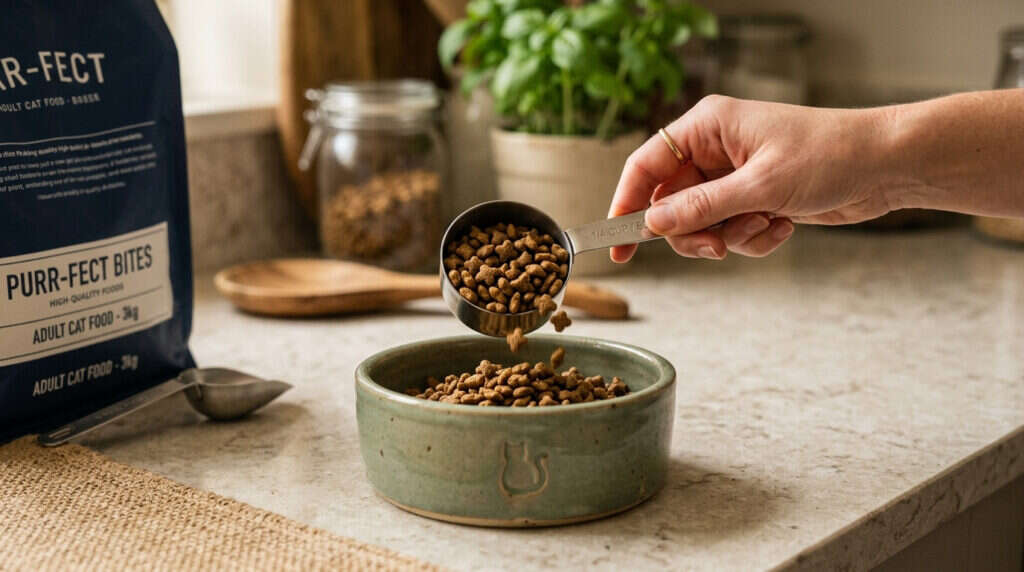
Multiply RER by an activity coefficient (1.2 for neutered indoor adult; 1.4 for active intact cat; 0.8 for weight loss). Divide total daily calories by the food’s kcal/can or kcal/cup to find exact portion size.
Feeding Wet + Dry Together
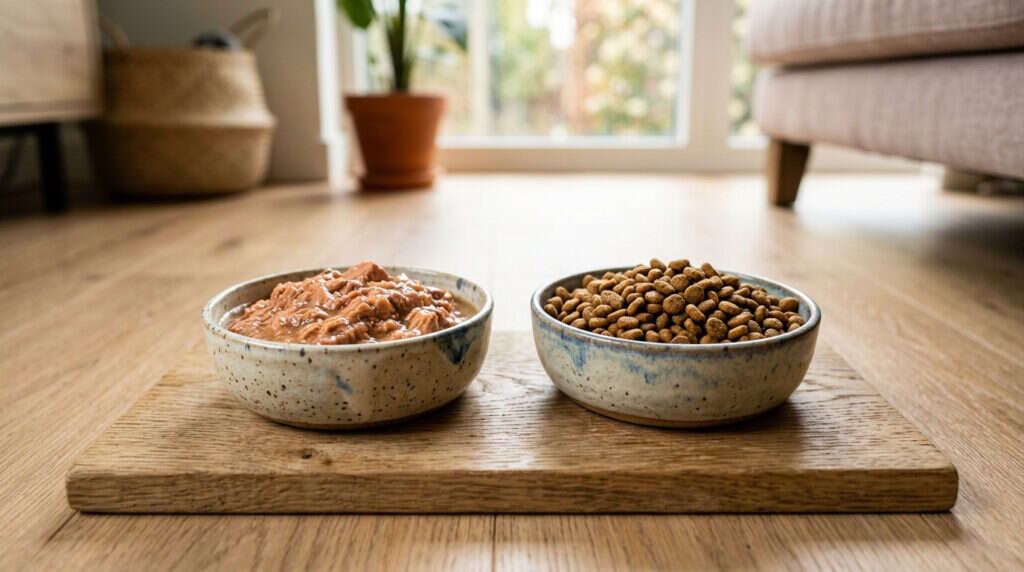
A mixed feeding approach is common and works well nutritionally, provided both foods are complete and balanced. Pick a total daily calorie target and split it: for example, one 3 oz can of wet food in the morning (~80 kcal) and a measured 1/3 cup of kibble (~140 kcal) split across the evening and an automatic feeder. Discover top foods in our guide to the Best Cat Food for Indoor Cats.
Free Feeding vs Scheduled Meals & Automatic Feeders
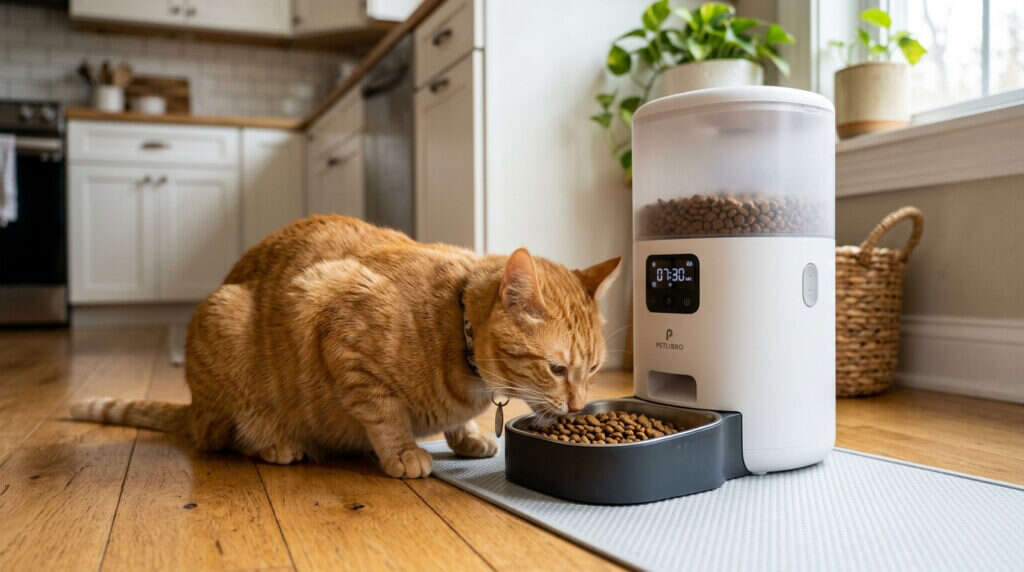
Free-feeding dry kibble all day removes portion control, leading to obesity. Scheduled meals make appetite changes immediately apparent. Automatic feeders are ideal for busy schedules or cats needing 3 to 4 smaller meals daily to prevent vomiting.
How to Know If You're Feeding Too Much or Too Little
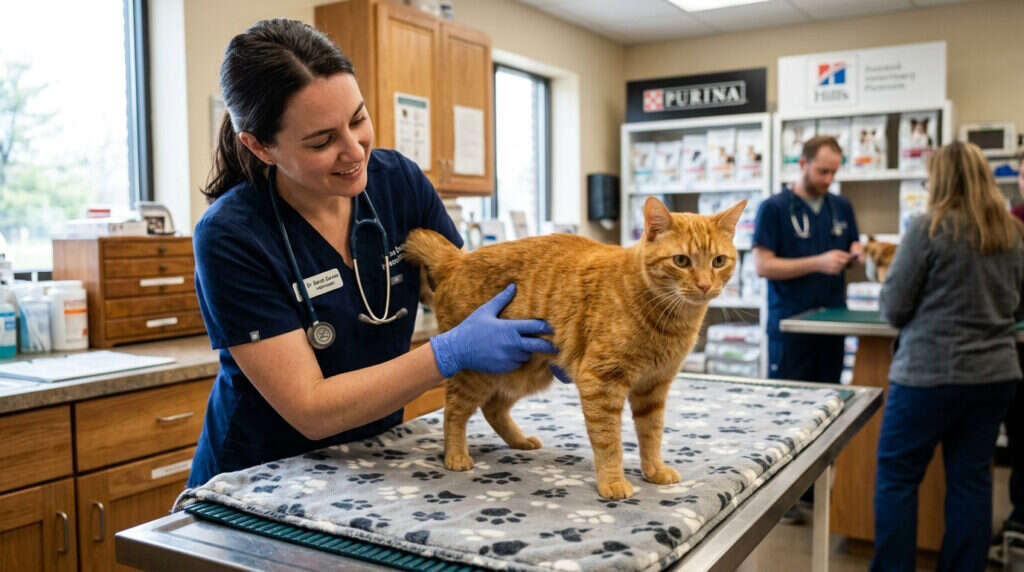
Evaluate body condition score (BCS) every few weeks: you should easily feel ribs under a thin fat layer with a distinct waistline when viewed from above. Adjust portions by 10% increments over 2 to 3 weeks. If managing aging cats past age 7, see our Senior Cat Nutrition Guide; for young cats, see our Kitten Nutrition Guide. Keep water intake optimal with our Cat Hydration Guide.
Adult Cat Feeding FAQ
How many times a day should I feed my adult cat?
Can cats eat three times a day?
Why is my cat always hungry?
Should I free-feed my indoor cat?
How much food does a 10-pound indoor cat need?
🐾 Explore Tested Automatic Feeders & Cat Nutrition Reviews
Browse our hands-on reviews of the best automatic portion-control feeders, microchip bowls, and premium cat foods tested with indoor cats.