By Emma Hartley | Last updated August 15, 2026 | Reviewed by IndoorCatWell Editorial Team
This article provides transparent, evidence-based nutrition advice. If you purchase through our links, we may earn an affiliate commission at no extra cost to you. Read our full Affiliate Disclosure.
⚡ Quick Answer: What Does “Complete and Balanced” Mean?
“Complete and balanced” is a strictly regulated claim in pet food. Defined by the Association of American Feed Control Officials (AAFCO) in the US and FEDIAF in Europe, it means the food supplies every single essential nutrient a cat requires in the exact biological ratios for a specified life stage without requiring supplements. A food qualifies either through laboratory nutrient profile formulation or rigorous animal feeding trials. Products lacking this statement are legally classified as intermittent or supplemental treats.
📌 Table of Contents
- Key Takeaways
- At a Glance: Regulatory Snapshot
- Where the Claim Comes From (AAFCO & FEDIAF)
- The Two Paths to “Complete and Balanced”
- What “Complete and Balanced” Does NOT Guarantee
- Life Stages: Growth vs. Adult Maintenance vs. All Life Stages
- Supplemental and Intermittent Feeding: The Warning Label
- Can Homemade & Raw Diets Be Complete and Balanced?
- 4-Step Checklist: How to Check a Label Yourself
- Common Mistakes Cat Owners Make
- When to Involve a Veterinarian
- Frequently Asked Questions
Key Takeaways
- It Is Life-Stage Specific: “Complete and balanced” applies to defined biological stages: Kitten (Growth & Reproduction), Adult Maintenance, or All Life Stages.
- Two Legitimate Qualification Methods: Brands qualify either through mathematical Nutrient Profile Formulation or multi-month Animal Feeding Trials.
- Feeding Trials Test Real-World Absorption: Feeding trials evaluate blood markers and weight stability in living cats, providing practical proof of digestibility.
- Absence Means Supplemental: Foods without an adequacy statement cannot sustain a cat long-term and must be treated strictly as treats or toppers.
- Homemade Food Requires Precision: Homemade diets are only complete and balanced if formulated by a board-certified veterinary nutritionist with specific vitamin and taurine supplements.
- “All Life Stages” Equals Kitten Nutrition: Foods labeled for All Life Stages meet the high caloric and mineral demands of growing kittens, meaning portions must be managed carefully for indoor adults.
At a Glance: Regulatory Snapshot
| Question | Short Answer |
|---|---|
| Who defines “complete and balanced”? | AAFCO in the United States; FEDIAF across the European Union. |
| Does it apply to cat treats & broths? | No — treats, broths, and meal toppers are labeled for “intermittent or supplemental feeding only.” |
| Are all complete & balanced foods equal? | No — the term confirms nutritional completeness, not ingredient quality, taste, or digestibility. |
| Can homemade food be complete? | Yes, but only if formulated using strict nutritional software and premix supplements by a veterinary nutritionist. |
| Does “All Life Stages” suit indoor adults? | Yes, but monitor portions closely because it is formulated to meet high kitten growth requirements. |
Where the Claim Comes From (AAFCO & FEDIAF)
In the pet food industry, words like “gourmet,” “premium,” and “holistic” are unregulated marketing buzzwords. In stark contrast, “complete and balanced” is a legally protected claim backed by strict state feed laws and regulatory standards.
In the United States, the Association of American Feed Control Officials (AAFCO) establishes the Cat Food Nutrient Profiles. These profiles specify the exact minimum (and maximum safe) quantities for more than 40 essential nutrients — including crude protein, fat, amino acids like taurine and arginine, fatty acids, vitamins, and trace minerals. In Europe, the FEDIAF Nutritional Guidelines serve an equivalent role.
Under FDA guidelines and state agricultural regulations, a manufacturer cannot print “complete and balanced” anywhere on packaging unless the product meets one of two rigorous verification paths.
The Two Paths to “Complete and Balanced”

1. Nutrient Profile Formulation (Laboratory Method)
Under this method, the pet food formulation team calculates the nutrient density of every ingredient using computer modeling and laboratory assays. The finished formula is verified to meet or exceed AAFCO nutrient profiles before packaging. On the label, it will read:
“[Product Name] is formulated to meet the nutritional levels established by the AAFCO Cat Food Nutrient Profiles for Adult Maintenance.”
Pros: Efficient, highly accurate mathematically, and allows for consistent adjustments across large batches.
Limitation: It proves nutrient presence on paper, but does not independently test biological bioavailability or digestive absorption in living cats.
2. Animal Feeding Trials (Real-World Biological Testing)
In an official AAFCO feeding trial, the finished food is fed as the sole source of nutrition to a colony of cats for a minimum of 26 weeks (6 months) under veterinary supervision. The cats undergo routine weight checks, complete blood counts, and serum chemistry testing to prove they absorb and thrive on the diet. The statement reads:
“Animal feeding tests using AAFCO procedures substantiate that [Product Name] provides complete and balanced nutrition for Growth and Reproduction / Adult Maintenance.”
Pros: Gold standard in nutritional proof because it tests actual digestion, palatability, and feline metabolic health.
Limitation: Costly and time-intensive; fewer brands conduct trials for every single recipe flavor.
What “Complete and Balanced” Does NOT Guarantee
While the AAFCO adequacy statement is essential, it is important to understand its boundaries:
- It Does Not Dictate Ingredient Quality: A budget dry food made with plant corn gluten and a high-end freeze-dried raw diet made with cage-free chicken can both earn “complete and balanced” status. To evaluate ingredient transparency, check our guide on How to Read a Cat Food Label.
- It Does Not Address Individual Sensitivities: If your cat has an allergy to beef or chicken, a complete and balanced food containing that protein will still trigger skin flare-ups or digestive upset. See our guide on Cat Food Allergy Symptoms.
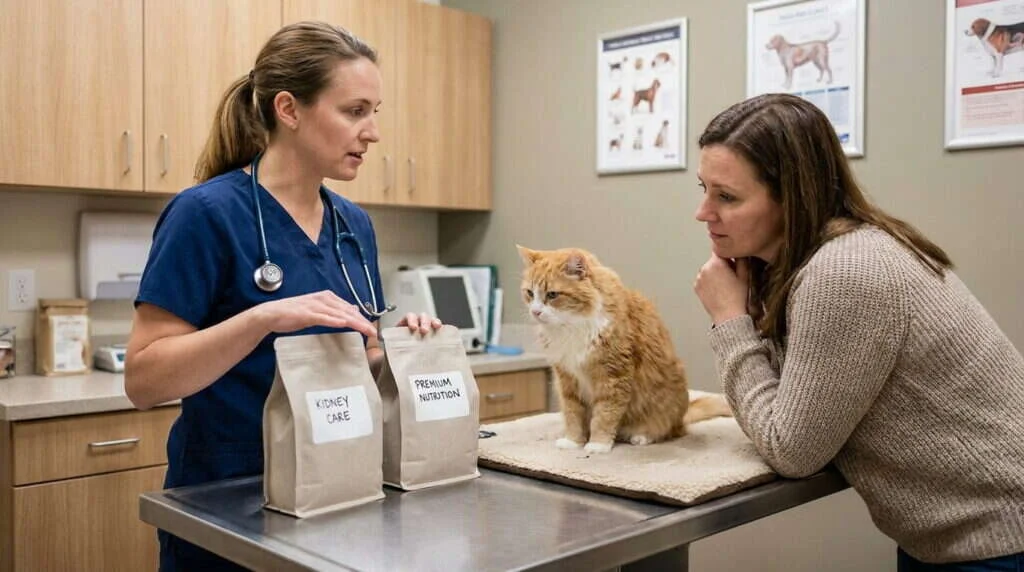
- It Does Not Replace Therapeutic Prescription Diets: Cats suffering from chronic ailments like Feline Kidney Disease require restricted phosphorus and specialized protein levels that fall outside standard maintenance profiles.
Life Stages: Growth vs. Adult Maintenance vs. All Life Stages

AAFCO establishes distinct profiles tailored to feline biological life stages:
| Life Stage | Nutrient Focus | Ideal For |
|---|---|---|
| Kitten / Growth & Reproduction | High calorie density, increased calcium, phosphorus, DHA, and 30%+ crude protein. | Kittens up to 12 months, pregnant or nursing queens. See Kitten Feeding Schedule. |
| Adult Maintenance | Moderate calories, controlled mineral levels, optimized for metabolic stability. | Adult indoor cats aged 1 to 7 years. |
| All Life Stages | Formulated to meet the highest threshold (Growth) so it covers both kittens and adults. | Multi-cat homes with kittens and adults, active cats. |
Supplemental and Intermittent Feeding: The Warning Label
Not all canned pet foods are complete meals. Many shredded chicken pouches, bone broths, and gourmet purees look identical to regular cat food but carry a tiny label on the back:
⚠️ Warning Label: “This product is intended for intermittent or supplemental feeding only.”
This means the product lacks critical daily vitamins, calcium-to-phosphorus balance, or taurine. Feeding supplemental foods as more than 10% of a cat’s daily calorie intake will lead to severe malnutrition, dilated cardiomyopathy (DCM), or bone fractures.
Can Homemade & Raw Diets Be Complete and Balanced?
Yes, but achieving complete nutrition at home requires exact scientific formulation. Raw muscle meat (like boneless chicken breast or beef steak) contains excessive phosphorus and almost zero calcium. Without added bone meal or calcium carbonate, along with measured amounts of taurine, iodine, vitamin E, and zinc, homemade food is critically deficient.
If you choose to prepare homemade cat food, work exclusively with recipes verified by a board-certified veterinary nutritionist (such as via the Cornell Feline Health Center or ACVN-certified software) rather than unverified online blog recipes.
4-Step Checklist: How to Check a Label Yourself
- Locate the Nutritional Adequacy Statement: Check the back or side panel near the guaranteed analysis.
- Confirm the Life Stage: Ensure the statement specifies Adult Maintenance or Growth depending on your cat’s age.
- Identify the Qualification Method: Check whether it states “formulated to meet” (Formulation) or “animal feeding tests” (Feeding Trial).
- Rule Out Supplemental Warnings: Ensure it does not say “for intermittent or supplemental feeding only.”
Common Mistakes Cat Owners Make
- Trusting Front-of-Bag Claims: Assuming words like “natural,” “grain-free,” or “veterinarian approved” guarantee nutritional completeness.
- Feeding Meal Toppers as Full Diets: Giving canned shredded meat pouches that lack essential vitamin and mineral premixes.
- Feeding “All Life Stages” Without Portion Control: Allowing an adult indoor cat to free-feed on growth-calorie formulas, resulting in rapid weight gain. Use our Indoor Cat Calorie Guide to calculate exact daily portions.
- Overlooking Hydration Needs: Feeding dry complete kibble without monitoring water intake. Read our Cat Water Fountain vs. Bowl Guide.
When to Involve a Veterinarian
If your indoor cat has diagnosed health conditions — such as diabetes, chronic renal failure, or urinary crystal formation — standard over-the-counter complete foods are not appropriate. Therapeutic clinical diets formulated under veterinary supervision are required.
Frequently Asked Questions
Is “complete and balanced” the same as “premium”?
No. “Premium” has zero legal or regulatory definition and is used freely in marketing. “Complete and balanced” is a strictly regulated claim requiring verified adherence to AAFCO or FEDIAF nutritional profiles.
Can a raw diet be complete and balanced?
Yes, provided it is formulated to meet AAFCO nutrient standards using appropriate ratios of muscle meat, organ meat, calcium sources, and supplemental taurine, vitamins, and minerals.
Does “all life stages” mean it is better than adult maintenance?
Not necessarily better, just richer. All life stages formulas are designed to meet the high nutrient demands of growing kittens, meaning they are higher in calories, calcium, and phosphorus than standard adult maintenance diets.
What if a cat food bag doesn’t mention AAFCO at all?
If a product lacks an AAFCO adequacy statement (or FEDIAF statement in Europe), it is not certified as a complete diet. It must be treated strictly as an occasional treat or meal topper.
Is feeding trial testing better than formulation testing?
Feeding trials provide real-world biological proof of palatability and absorption, making them the gold standard in nutritional research. However, formulation-backed foods designed by veterinary nutritionists are also completely safe and legitimate.
🐾 Explore More Evidence-Based Cat Nutrition Guides
Ready to find the ideal diet and feeding routine for your indoor cat? Check out our tested guides: