By Emma Hartley | Last updated August 15, 2026 | Editorial Review by IndoorCatWell Team
This article contains transparent editorial advice. If you purchase through our links, we may earn an affiliate commission at no extra cost to you. Read our full Affiliate Disclosure.
⚡ Quick Answer: How to Read a Cat Food Label
A cat food label has two sections that actually tell you what you are buying: the ingredient list (ordered strictly by weight before cooking) and the guaranteed analysis (which provides minimum protein and fat levels and maximum moisture and fiber). Look for an official AAFCO Nutritional Adequacy Statement confirming the recipe is complete and balanced for your cat’s specific life stage. Everything printed on the front of the bag — including buzzwords like “natural,” “holistic,” “premium,” and “gourmet” — is unregulated marketing.
📌 Table of Contents
- Key Takeaways & Summary
- At a Glance: Cat Food Label Anatomy
- The Ingredient List: What Order Actually Means
- Named vs. Generic Ingredients & By-Products
- Watch for Ingredient Splitting
- The Guaranteed Analysis: Minimums & Maximums
- Dry Matter Basis: The Wet vs. Dry Comparison Trick
- The AAFCO Statement: Confirming Nutritional Completeness
- Marketing Words That Mean Nothing Regulatory
- Feeding Guidelines: Starting Point vs. Real Portions
- Common Label-Reading Mistakes
- When to Loop In a Veterinarian
- Frequently Asked Questions
Key Takeaways
- Pre-Cooking Weight Dictates Order: The ingredient list ranks items by raw weight before processing, which makes moisture-heavy whole meats appear larger than dry protein meals.
- Guaranteed Analysis Isn’t Exact: It sets legal minimums and maximums, not exact nutrient values, and tells you nothing about protein digestibility or amino acid balance on its own.
- AAFCO Statement Is Non-Negotiable: The nutritional adequacy statement (established by the Association of American Feed Control Officials or European FEDIAF) is the only legal proof that a diet is complete and balanced.
- Marketing Terms Lack Legal Teeth: Words like “natural,” “premium,” “holistic,” and “gourmet” carry zero standardized legal nutrient thresholds.
- By-Products Are Nutrient-Dense: Clean, named animal organ meats (liver, kidneys, heart) provide vital taurine, vitamin A, and minerals that pure muscle meat lacks.
- Dry Matter Basis Is Essential for Comparisons: You cannot compare a canned wet food to dry kibble without stripping out water weight first.
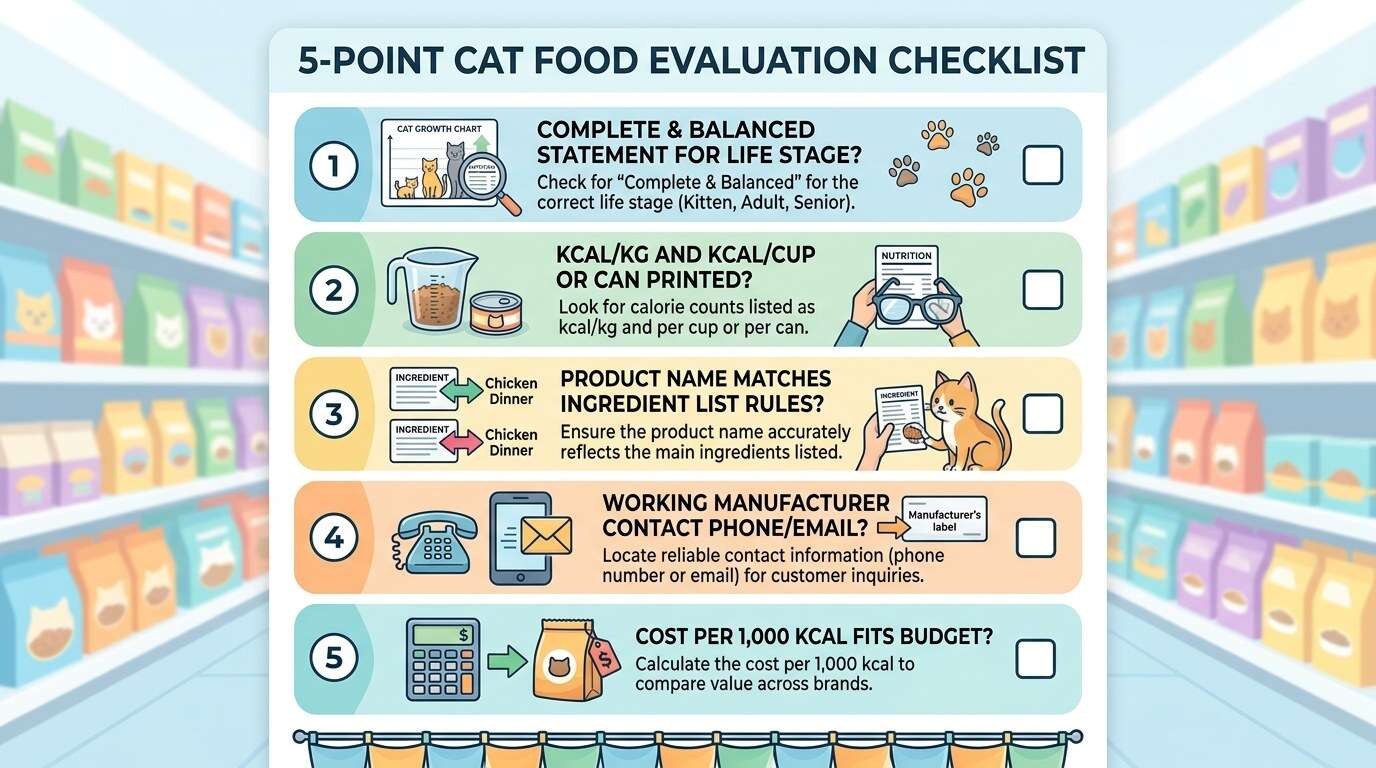
At a Glance: Cat Food Label Elements
| Label Element | What It Tells You | Where to Find It |
|---|---|---|
| Ingredient List | Every single ingredient inside the formula, sorted strictly by pre-cooking weight. | Side or back panel |
| Guaranteed Analysis | Guaranteed minimums for crude protein & fat; maximums for moisture & fiber. | Back or bottom panel |
| Nutritional Adequacy Statement | Whether the food meets AAFCO / FEDIAF standards for Growth, Adult Maintenance, or All Life Stages. | Usually below ingredient list |
| Life Stage Claim | Intended cat life stage (Kitten / Growth, Adult Maintenance, Senior, or All Life Stages). | Front bag header or back panel |
| Feeding Guidelines | Estimated starting daily cup/can portions based on average body weight. | Back panel feeding chart |
| Calorie Content (ME) | Metabolizable Energy expressed in kcal/kg and kcal/cup (or kcal/can). | Near guaranteed analysis |
The Ingredient List: What the Order Actually Means
According to FDA Center for Veterinary Medicine regulations, all pet food manufacturers must list ingredients in descending order by weight prior to cooking and extrusion. That single manufacturing rule explains the vast majority of consumer confusion.
Raw deboned chicken, salmon, or beef contains roughly 70% to 75% water weight. Because that heavy water is present when the batch is weighed on the factory floor, fresh meat almost always lands as the #1 ingredient. However, during high-heat extrusion into dry kibble, that water evaporates completely. After cooking, the actual concentrated meat contribution is significantly smaller than the first-position ranking suggests.
Conversely, dehydrated meat meals (such as Chicken Meal or Turkey Meal) have already undergone rendering and moisture removal before being added to the mix. A concentrated chicken meal listed as the #2 or #3 ingredient often provides substantially more actual animal protein and amino acids than whole fresh chicken listed at #1.
💡 Key Takeaway: Having fresh meat as the #1 ingredient is a solid baseline, but it isn’t the magic indicator of high protein. Always cross-check the guaranteed analysis and ensure secondary protein sources are high-quality, named meat meals rather than empty grain fillers.
Named vs. Generic Ingredients
Transparency in labeling begins with how specific the protein sources are. Always look for clearly identified animal species:
- High Transparency (Named Sources): Deboned Chicken, Turkey Meal, Atlantic Salmon, Beef Liver, Lamb Meal. You know exactly what animal species your cat is eating, making it easy to identify triggers if your cat develops a food allergy or intolerance.
- Low Transparency (Generic Sources): Meat Meal, Poultry By-Product, Animal Fat, Fish Meal. Generic terms allow manufacturers to swap between varying animal sources batch-to-batch depending on commodity prices, increasing the risk of digestive upset in sensitive cats.
By-Products Aren’t Automatically Low Quality
The term “by-product” is widely misunderstood in pet food marketing. In nature, wild felines consume entire prey animals — including liver, lungs, kidneys, spleen, and heart. In feline nutrition, these organ meats are classified as by-products, yet they are among the most nutrient-dense foods on earth, packed with vital taurine, iron, B-vitamins, and vitamin A that pure muscle meat lacks.
The red flag is not the presence of organ by-products; it is whether the source is named. “Chicken by-product meal” is clean, highly digestible organ nutrition. Unnamed “animal by-product meal” is what you should avoid.
Watch Out for Ingredient Splitting
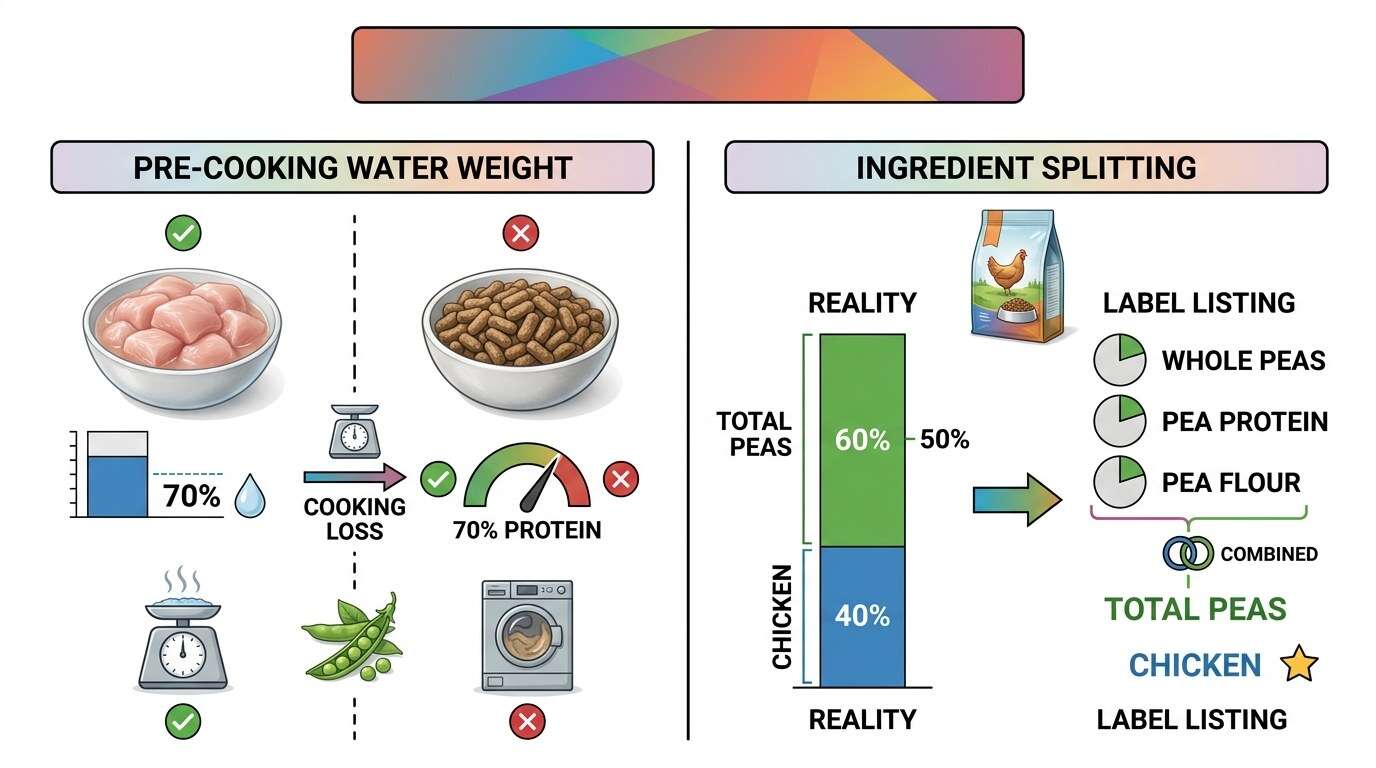
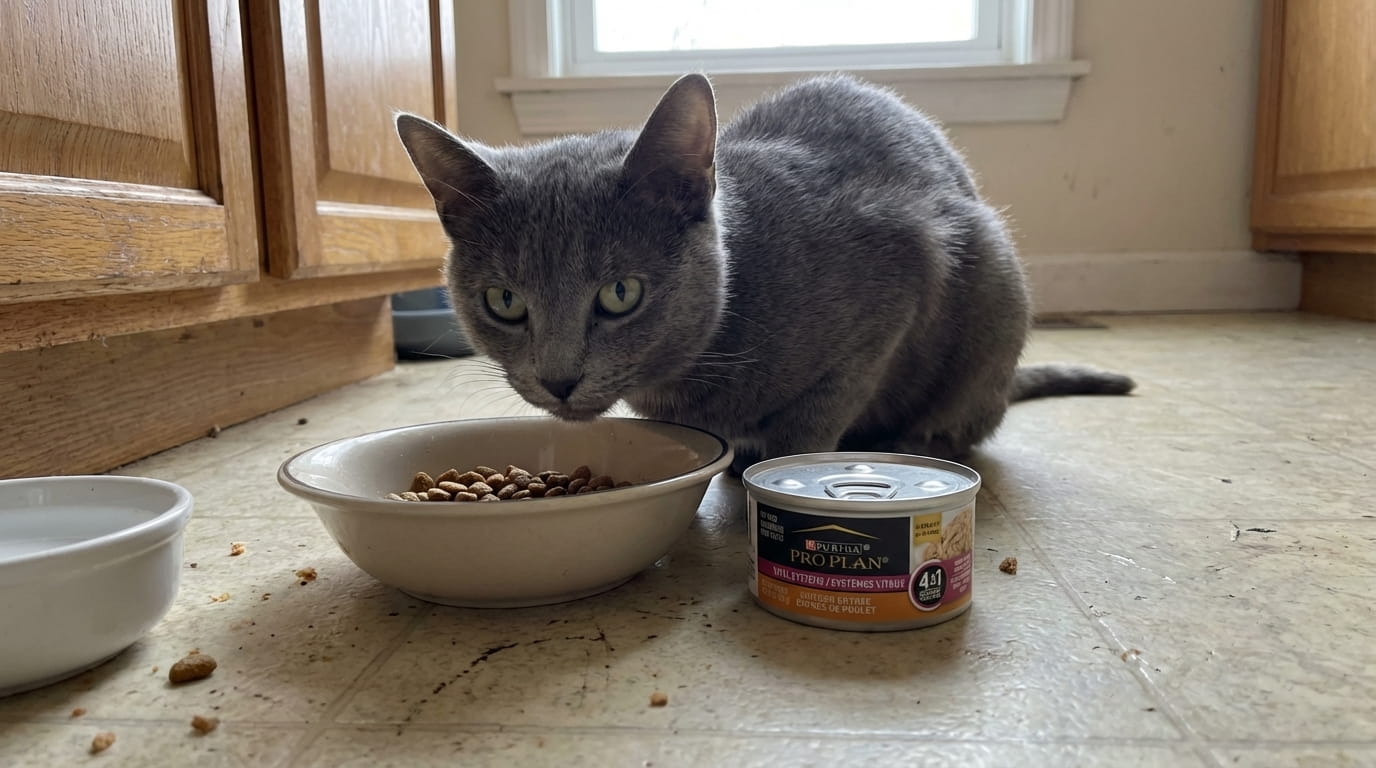
Ingredient splitting is a common, legal formulation technique where a single carbohydrate source is divided into multiple smaller fractions so that none of them weigh enough individually to surpass meat on the label.
For instance, a label might list: Chicken, Peas, Pea Flour, Pea Protein, Pea Starch. When listed individually, fresh chicken appears first. But if you combine all four pea fractions, the total pea content would easily outweigh the chicken. If you see multiple derivatives of corn, rice, or peas in the top 5 to 7 ingredients of a recipe, the food is heavily plant-based. For cats that thrive on lower-carb nutrition, check our guide on Grain-Free Cat Food: Myths vs. Facts.
The Guaranteed Analysis: Minimums, Maximums, and Why That Matters
The Guaranteed Analysis is a mandatory panel that lists the minimum and maximum percentages of key macronutrients:
- Crude Protein (Minimum %): The baseline protein level. “Crude” refers to the laboratory testing method measuring nitrogen content, not the culinary quality.
- Crude Fat (Minimum %): Essential fatty acids and calorie density required for energy and coat health.
- Crude Fiber (Maximum %): Indigestible plant matter aiding hairball control and bowel regularity.
- Moisture (Maximum %): Water content (typically ~10% in dry kibble and 75%–82% in wet canned food).
- Taurine (Minimum %): An essential amino acid for feline heart and retinal health (must be at least 0.10% in dry food and 0.05% in wet food).
Dry Matter Basis: How to Compare Wet and Dry Food Fairly

One of the biggest mistakes cat owners make is comparing the crude protein of canned food (e.g., 10%) directly to dry kibble (e.g., 34%) and assuming kibble has three times more protein. In reality, canned food is ~78% water. To compare foods fairly, you must calculate nutrient percentages on a Dry Matter (DM) Basis:
📐 3-Step Dry Matter Calculation Formula:
- Calculate Dry Matter %:
100% − Moisture % = Dry Matter % - Divide Nutrient by Dry Matter:
(Listed Nutrient % ÷ Dry Matter %) - Multiply by 100:
Result × 100 = Dry Matter %
Real-World Example: A can of wet food lists 10% Crude Protein and 78% Moisture.
1. Dry Matter = 100 − 78 = 22%
2. Dry Matter Protein = (10 ÷ 22) × 100 = 45.4% Protein!
That wet food actually delivers far more protein per ounce of nutrition than a 32% dry kibble! Learn more about moisture benefits in our Wet Food vs. Dry Food for Indoor Cats comparison.
The AAFCO Statement: The Part That Actually Confirms Completeness
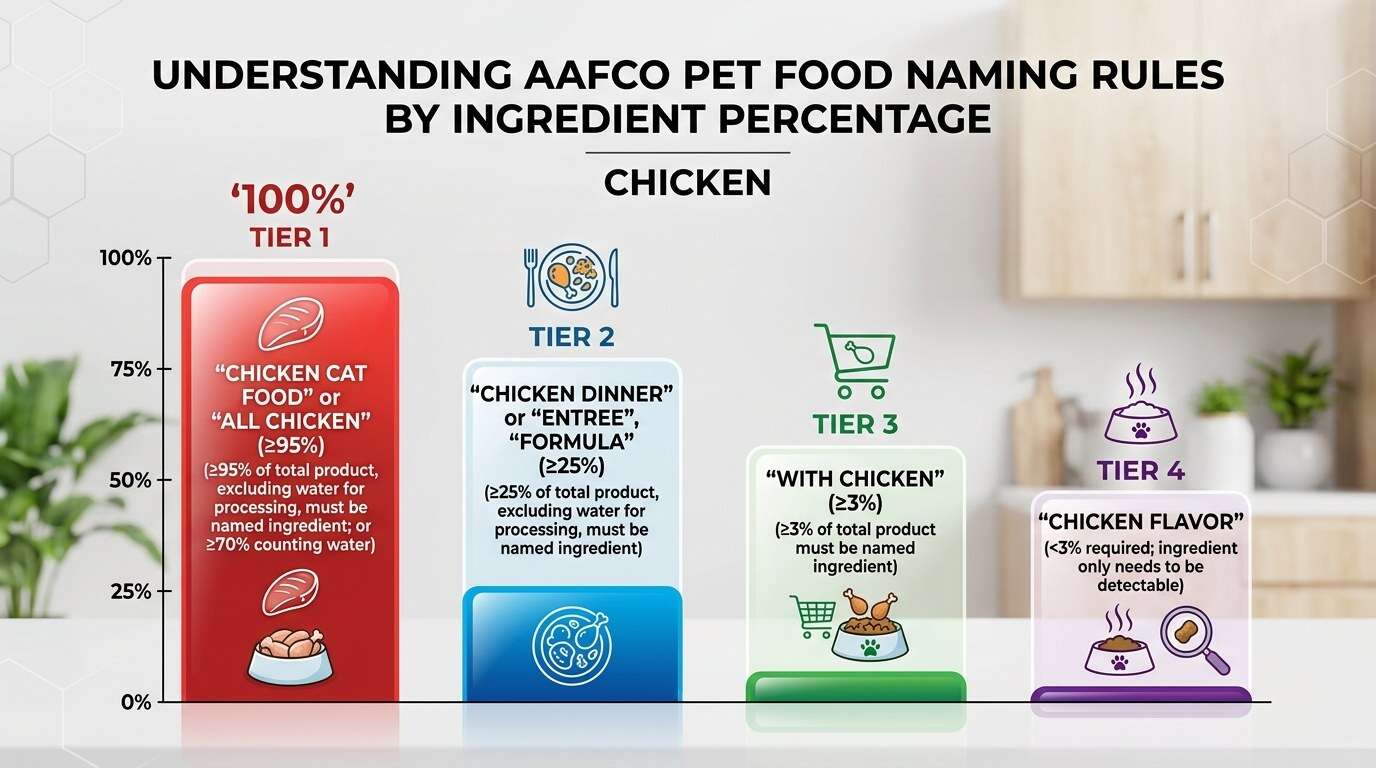
The Nutritional Adequacy Statement is the single most important regulatory sentence on any pet food package. Without it, you cannot verify whether a food is nutritionally safe to feed as your cat’s primary diet. Look for one of these standard legal formats:
- 1. Formulated to Meet Nutrient Profiles: “[Product] is formulated to meet the nutritional levels established by the AAFCO Cat Food Nutrient Profiles for Adult Maintenance / Growth.” This proves the recipe meets strict laboratory nutritional minimums on paper.
- 2. Animal Feeding Trials: “Animal feeding tests using AAFCO procedures substantiate that [Product] provides complete and balanced nutrition for all life stages.” This means the finished food was tested on living cats over a multi-month feeding trial to verify palatability and nutrient absorption.
- 3. Intermittent or Supplemental Feeding: If a label states “For intermittent or supplemental feeding only,” the food is not complete and balanced. This applies to treats, broths, and toppers — feeding these as a full diet will cause severe nutritional deficiencies.
Marketing Words That Mean Nothing Regulatory
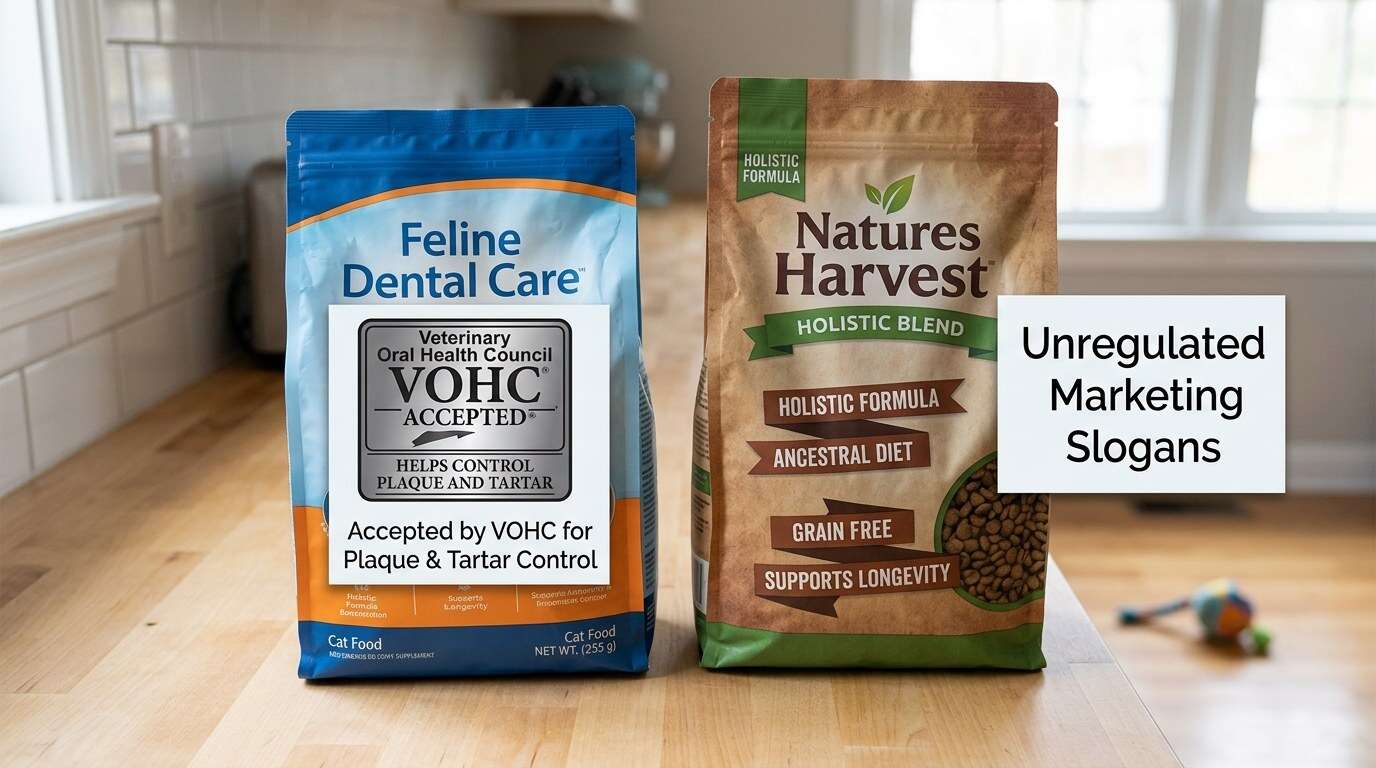
Pet food bags are designed by marketing teams to appeal to human grocery preferences. Here is what common buzzwords actually mean under pet food regulation:
| Marketing Claim | What It Legally Guarantees |
|---|---|
| “Natural” | Ingredients haven’t undergone chemical synthetic processing, but synthetic vitamins and amino acids are still routinely added. |
| “Premium” / “Super-Premium” | Zero legal definition. Any manufacturer can print “Premium” on any bag regardless of ingredient quality. |
| “Holistic” | Zero legal definition. Used purely for marketing perception. |
| “Human-Grade” | Ingredients and the processing facility meet USDA human-food standards. High quality, but does not guarantee the recipe is balanced for a feline metabolism. |
| “Grain-Free” | Free of wheat, corn, and soy, but frequently replaced with heavy starches like peas, potatoes, and tapioca. |
| “Veterinarian Recommended” | Vague claim requiring only a minimal survey sample size; does not mean your personal vet endorses it. |
Feeding Guidelines: Start There, Don’t Stop There
The feeding chart on the back of the bag provides a rough starting estimate calculated for an unneutered, moderately active adult cat. Because neutered indoor cats have significantly lower metabolic needs, feeding strictly according to the bag chart often leads to gradual weight gain.
Use the bag guidelines as an initial baseline for the first two weeks, then monitor your cat’s body condition score. For tailored calorie requirements based on your cat’s exact weight and activity level, use our comprehensive Indoor Cat Feeding & Calorie Guide.
Common Mistakes People Make Reading Labels
- Judging quality solely by the #1 ingredient: Fresh meat contains heavy water that pushes it to the top before cooking.
- Assuming “grain-free” means low carbohydrate: Many grain-free foods contain 30%+ carbohydrates from pea starch and lentils.
- Comparing wet and dry foods without Dry Matter conversion: Leads to false assumptions about protein density.
- Demonizing all by-products: High-grade organ meats (liver, heart, kidney) are essential for feline obligate carnivores.
- Ignoring the life stage designation: Feeding a “Growth/Kitten” diet to a sedentary adult cat can cause obesity, while feeding an “Adult Maintenance” diet to a growing kitten leads to developmental deficiencies. See our Kitten Feeding Schedule and Senior Cat Diet Guide for life-stage specifics.
When to Loop In a Veterinarian
Standard commercial food labels are designed for healthy indoor cats. If your cat suffers from chronic health conditions — such as feline kidney disease, urinary tract crystals, diabetes, or severe allergies — therapeutic prescription diets formulated under strict clinical oversight are necessary.
Frequently Asked Questions
Does the first ingredient really matter most?
Less than most pet owners think. Fresh meat listed first contains up to 75% water weight prior to cooking. While it confirms real animal inclusion, checking for named concentrated meat meals and verified dry-matter crude protein provides a much more accurate picture of actual nutrition.
Is “human-grade” a meaningful claim?
It has a legal definition regarding the sourcing and cleanliness of the manufacturing plant, but it does not automatically mean the food is biologically superior or balanced for an obligate carnivore. The AAFCO adequacy statement remains the key benchmark.
Why don’t the guaranteed analysis percentages add up to 100%?
Because the Guaranteed Analysis only lists mandatory minimums and maximums for four specific nutrients (protein, fat, fiber, moisture), plus optional items like ash, calcium, and taurine. It is not an exhaustive chemical breakdown of the total formula.
Is grain-free food healthier for indoor cats?
Not inherently. True grain allergies in cats are rare (beef, dairy, and fish are far more common allergens). Grain-free recipes often replace grains with high-glycemic starches like potatoes or peas, which can result in equal or higher carbohydrate levels.
What is the single most important thing to check on a cat food label?
The AAFCO (or FEDIAF) Nutritional Adequacy Statement. It is the only part of the package that legally verifies whether the food delivers complete, life-sustaining nutrition or is merely an incomplete treat.
🐾 Explore More Cat Nutrition & Product Guides
Looking to dive deeper into feeding routines, product reviews, and feline wellness? Explore our full collection of hands-on guides: