By Emma Hartley | Reviewed by IndoorCatWell Editorial Team | Last updated August 2026
This article provides practical, veterinary-supported cat health guidance. If you buy through our links, we may earn an affiliate commission at no extra cost to you. Read our full Affiliate Disclosure.
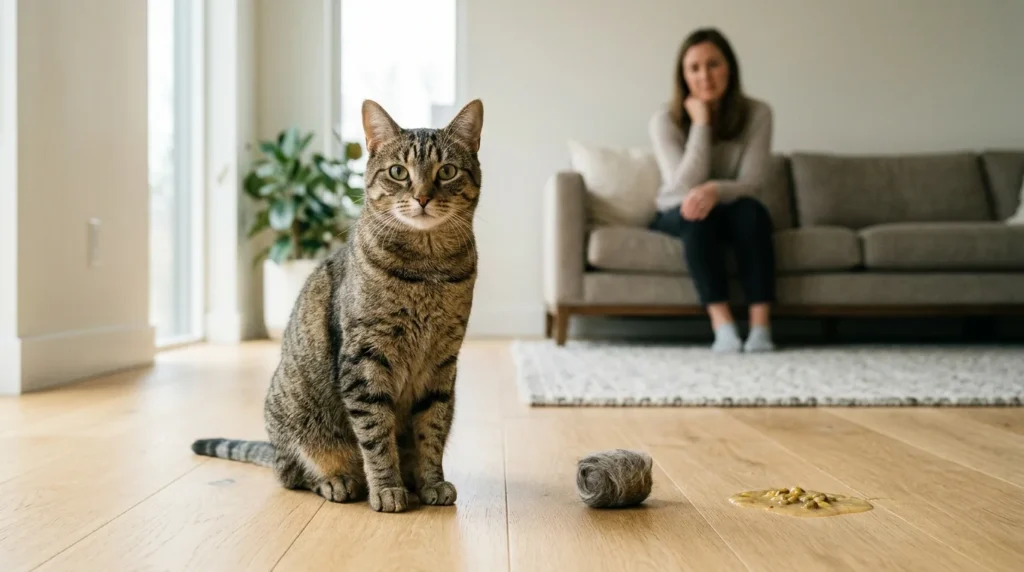
A hairball is a compact, cylindrical mass made mostly of swallowed fur that a cat expels from the digestive tract after grooming. True vomiting is the forceful, active ejection of stomach contents (food, liquid, foam, or bile) involving rhythmic abdominal heaving. While an occasional hairball is common, repeated vomiting, unproductive retching, or lethargy requires veterinary attention.
Cat vomiting and hairballs can look strikingly similar. Your cat may suddenly stop, crouch low to the carpet, extend their neck, and make alarming rhythmic hacking noises before expelling material — or producing nothing at all. But a hairball, true vomiting, esophageal regurgitation, and respiratory coughing are distinctly different events. Knowing how to distinguish them is essential to determine whether to simply monitor your cat or seek prompt veterinary care. Reading subtle shifts in cat body language provides vital clues during and after each episode.
⚡ Quick Summary: Hairball vs. Vomiting
An isolated, cylindrical clump of fur in a cat who immediately bounds away to play or eat is typically a benign hairball. In contrast, episodes involving fluid, digested food, repeated retching without output, or lethargy indicate true vomiting or respiratory coughing. Explore our complete guide on why your cat is throwing up for comprehensive medical triage.
Cat Vomiting vs Hairball: Quick Comparison
Clinical veterinary resources from the Cornell Feline Health Center and VCA Animal Hospitals emphasize evaluating the appearance of expelled material alongside the cat’s physical effort:
| What You Observe | Most Likely Event | Key Characteristics |
|---|---|---|
| Damp, tube-shaped mass made mostly of compacted fur | Hairball (Trichobezoar) | Occasional; cat quickly returns to normal activity |
| Food, fluid, foam, or bile with forceful abdominal contractions | True Vomiting | Active heaving; broad gastrointestinal or systemic causes |
| Undigested food comes up passively shortly after eating | Regurgitation | Effortless; esophageal motility or rapid eating issue |
| Crouching low, neck extended, raspy hacking, nothing produced | Coughing (Airway issue) | Often feline asthma or bronchitis; not a digestive problem |
| Repeated gagging or retching with nothing coming up | Unproductive Retching | Requires close monitoring; urgent vet visit if persistent |
What Does a Cat Hairball Look Like?
Despite the common name “hairball,” an expelled feline trichobezoar almost never looks like a round, spherical ball. When a cat grooms, tiny backward-facing keratin barbs (papillae) on their tongue catch loose and dead fur. Swallowed hair accumulates in the stomach lining and compacts into a tight mass. As the cat’s esophageal muscles squeeze the fur clump upward during expulsion, the narrow passage molds the material into an elongated, cylindrical, cigar-like shape.

A typical cat hairball exhibits distinct physical characteristics:
- Shape: Cylindrical, tubular, or sausage-shaped, typically 1 to 3 inches in length and about an inch wide.
- Composition: Composed almost entirely of dense, tightly packed, felted strands of fur.
- Moisture & Texture: Wet, damp, and coated with a thin layer of clear saliva, gastric mucus, or a small amount of yellow bile.
- Color: Closely reflects your cat’s coat color (e.g., charcoal grey, ginger, or dark brown), often slightly darker due to stomach acids.
- Food Content: Contains minimal to no recognizable food particles compared to ordinary vomit.
Immediately after producing a normal hairball, a cat typically stretches, shakes their head, and resumes normal activity, eating, and drinking without lingering distress. Learn more about baseline frequencies in our dedicated cat hairball frequency guide.
What Does Cat Vomit Look Like?
True vomiting is fundamentally different because it involves coordinated, active abdominal heaving that expels contents from the stomach and upper small intestine. In many cases, cats display visible warning signs of nausea minutes beforehand: excessive lip-licking, hard swallowing, profuse drooling, restless pacing, and low-pitched distressed vocalizations.

Depending on the underlying cause, feline vomit takes several forms:
1. Undigested Food
Intact, recognizable kibble or wet food chunks expelled within 15 to 30 minutes of eating. Often caused by eating too fast (“scarf and barf”), food intolerances, or acute dietary changes.
2. Partially Digested Food
Mushy, brown, pasty liquid containing broken-down food fragments, indicating that the meal stayed in the stomach for several hours before expulsion.
3. Clear Liquid or White Frothy Foam
Clear gastric juices or foamy aerated saliva brought up when the stomach is empty. Frequently seen with acid reflux, sudden nausea, or drinking excessive water while nauseated.
4. Yellow or Greenish Liquid (Bile)
Yellow fluid indicates bile reflux from the duodenum into the empty stomach. While common during prolonged fasting, recurring bile vomit can signal inflammatory bowel disease (IBD) or pancreatitis.
5. Hair Mixed With Vomit
A cat can vomit up fluid or food that happens to contain loose hair. The presence of some fur does not automatically make the episode a harmless hairball; the underlying trigger may still be gastric inflammation.
6. Blood in Vomit (Red or Coffee-Ground Material)
Bright red specks indicate fresh bleeding in the mouth, throat, or stomach. Dark, gritty brown granules resembling coffee grounds indicate partially digested blood from an upper gastrointestinal ulcer or severe mucosal injury — both require urgent veterinary intervention.
Clinical note: Vomit appearance and color provide valuable clues for your veterinary team, but color alone cannot definitively diagnose the underlying medical condition.
Hairball, Vomiting, Regurgitation, or Coughing?
Caregivers often use “throwing up” to describe four completely distinct biological events. Understanding where the reflex originates in your cat’s body is the key to accurate triage:

| Condition | Origin in Body | Physical Effort | Expelled Material |
|---|---|---|---|
| Hairball | Stomach | Active retching and gagging | Cylindrical mass of compacted fur |
| Vomiting | Stomach & upper intestine | Forceful abdominal contractions | Digested food, yellow bile, liquid, foam |
| Regurgitation | Esophagus | Passive; effortless slide upward | Undigested tubular food coated in saliva |
| Coughing | Lower airways & lungs | Crouched posture, extended neck | Nothing produced (or small frothy saliva) |
Regurgitation vs. True Vomiting
Regurgitation is a backward flow of esophageal contents before food ever reaches the acidic stomach environment. There are no preliminary nausea cues (no drooling or distress) and zero abdominal muscle pumping. The cat simply lowers its head, opens its mouth, and a tubular log of undigested kibble slides out. If your cat regurgitates frequently, explore our recommendations for sensitive stomach cat food options and consult your vet to rule out megaesophagus or strictures.
Why Is My Cat Gagging but Nothing Comes Up?
Watching your cat repeatedly gag, retch, or heave without producing anything is deeply alarming. While pet owners often assume a hairball is simply “stuck,” repeated unproductive retching is a potential clinical warning sign that should never be ignored or treated with random over-the-counter pastes.
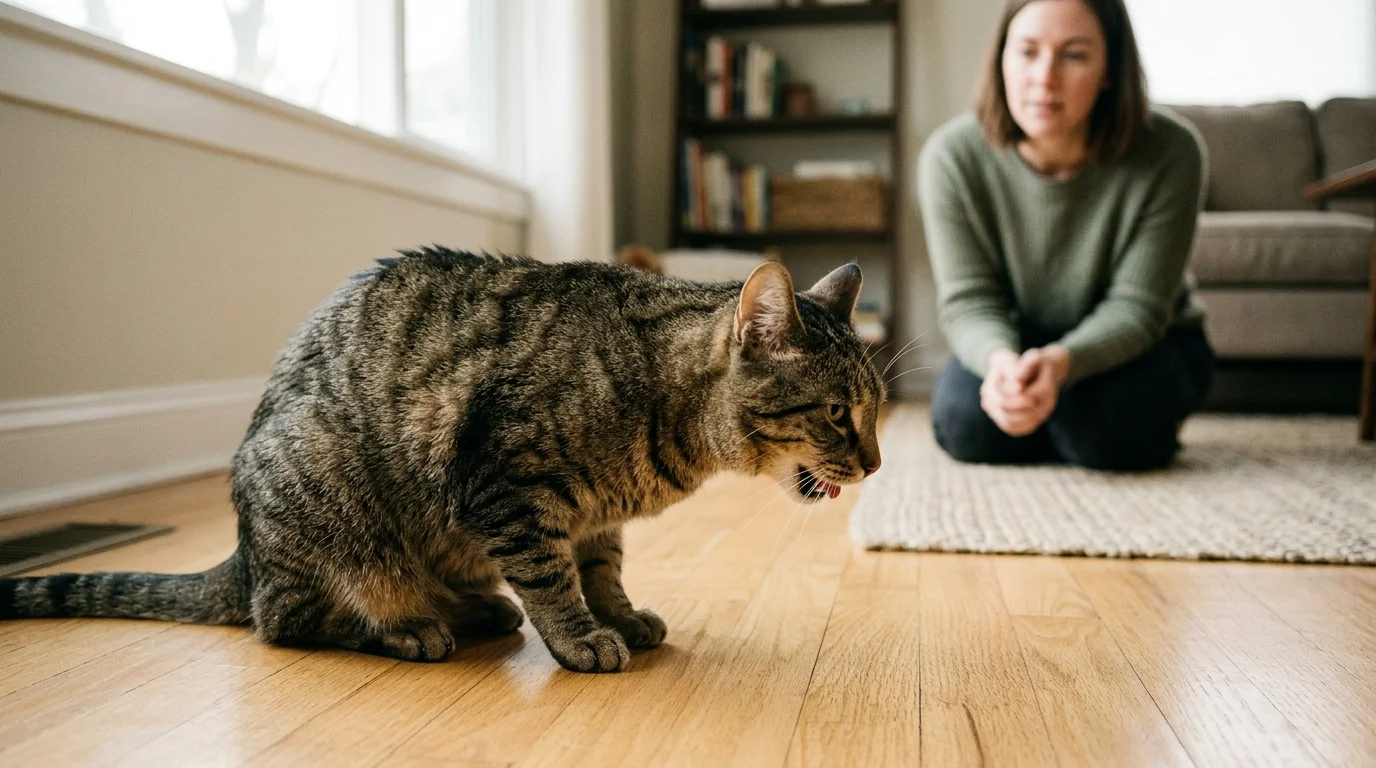
Several medical issues cause unproductive gagging and retching in cats:
- Gastrointestinal Foreign Body Obstruction: A swallowed linear object (thread, hair elastic, ribbon) or large hair mass lodged in the stomach outflow tract or intestines. The stomach contracts to expel the blockage, but nothing can pass.
- Severe Gastric Nausea & Dry Heaving: Pancreatitis, acute gastritis, or kidney disease triggers powerful central nausea signals in the brainstem even when the feline stomach is completely empty.
- Pharyngeal or Esophageal Foreign Body: A blade of tough grass, hairball clump, or bone fragment caught in the back of the throat or esophagus triggers relentless gag reflexes.
- Feline Asthma & Bronchial Spasms: Severe airway inflammation causes hacking and coughing that ends in a dry retch or gag, often mistaken for an unproductive hairball attempt.
Contact a veterinarian immediately if unproductive retching repeats multiple times over a few hours, is accompanied by lethargy, appetite loss, abdominal pain, open-mouth breathing, or if your cat may have accessed sewing string, yarn, or holiday tinsel.
Why Does My Cat Keep Trying to Cough Up a Hairball?
One of the most frequent diagnostic confusions in feline health is mistaking a coughing cat for a cat trying to pass a hairball. Clinical resources from VCA Animal Hospitals on Coughing in Cats highlight that felines with respiratory conditions — especially feline asthma, bronchitis, or heartworm — adopt a characteristic posture that mimics hairball retching.

During a coughing fit, a cat will crouch flat against the floor with their elbows pointed outward, extend their neck straight forward, and emit a series of rapid, raspy, dry wheezes or hacks. The episode frequently concludes with a hard swallow. Because the cat is crouched and hacking, owners naturally assume a hairball is stuck. If your cat has recurring episodes where they hack low to the floor and produce zero fur or fluid, capture a smartphone video and schedule a veterinary evaluation to test for feline asthma.
How Often Should a Cat Have Hairballs?
There is no single universal frequency that defines “normal” for every individual feline. Hairball production depends heavily on coat length, grooming habits, seasonal shedding cycles, and gastrointestinal motility:
- Cornell Feline Health Center notes that an otherwise healthy cat may occasionally produce a hairball every week or two without lasting health implications, particularly in long-haired breeds (such as Persians, Maine Coons, or Ragdolls).
- VCA Animal Hospitals recommends consulting a veterinarian if hairballs occur more frequently than once a month, noting that chronic trichobezoars often indicate underlying skin allergies, excessive overgrooming, or reduced gut motility.
Rather than adhering to an arbitrary calendar cutoff, evaluate your cat’s individual baseline pattern. If a short-haired cat who previously passed one hairball a year suddenly begins bringing up hairballs twice a week, that change in pattern warrants medical investigation.
Can Hairballs Cause an Intestinal Blockage?
Yes. While the vast majority of swallowed fur passes smoothly through the intestines and exits in the litter box, an exceptionally large or compacted trichobezoar can become physically stuck in the pylorus (stomach exit) or small intestine. According to veterinary references in the Merck Veterinary Manual, an obstructing trichobezoar constitutes a serious medical emergency that often requires surgical extraction or endoscopic retrieval.
Clinical signs of a dangerous hairball or foreign-body blockage include:
- Persistent, repeated vomiting after any food or water intake
- Frequent unproductive retching and gagging
- Complete loss of appetite lasting over 24 hours; see why cats stop eating
- Extreme lethargy, weakness, and hiding in dark closets (see why cats hide when sick)
- Abdominal tenderness, hunching, or crying when touched; review our diagnostic guide on how to tell if your cat is in pain
- Inability to pass normal stool or straining in the litter box
How to Reduce Hairballs Safely
Preventing hairballs requires capturing loose fur before it enters your cat’s digestive tract, combined with supporting healthy gastrointestinal motility:

- Brush Your Cat Consistently: Daily brushing for long-haired cats and 2 to 3 sessions per week for short-haired cats mechanically removes dead undercoat fur. Master gentle deshedding techniques in our complete cat grooming guide.
- Address Excessive Grooming: If your cat obsessively licks specific areas until bare patches appear, investigate environmental stress or skin allergies; see our guide to cat overgrooming and bald spots and check indoor cat parasite prevention.
- Support Optimal Hydration: Proper fluid intake keeps hair moving smoothly through the bowel. Review healthy water baselines in our cat hydration guide.
- Consult on Hairball Diets: Specialized hairball management diets contain increased insoluble dietary fiber blends that gently sweep hair through the gastrointestinal tract; explore nutritional principles in our complete cat nutrition guide.
- Use Veterinary-Approved Pastes with Caution: Never administer mineral oil or human laxatives, which can be aspirated into feline lungs. Consult your vet before using commercial petroleum-based hairball gels.
When Should I Take My Cat to the Vet?
Use this structured clinical triage system to evaluate your cat’s urgency level:
| Triage Level | Symptoms Observed | Recommended Action |
|---|---|---|
| 🟢 Monitor Closely | Single hairball produced; cat immediately returns to normal eating, drinking, and energetic play. | Continue regular brushing and normal feeding routines. |
| 🟡 Schedule Vet Visit | Hairballs increasing in frequency; weekly vomiting; dry hacking fits; mild appetite decrease; excessive licking. | Schedule non-emergency veterinary exam to check gut motility and skin health. |
| 🔴 Urgent Emergency Care | Repeated unproductive retching; blood in vomit; inability to retain water; food refusal >24h; breathing distress; suspected string ingestion. | Seek immediate veterinary or emergency clinic care without waiting. |

Frequently Asked Questions
How can I tell if my cat is vomiting or having a hairball?
Inspect the expelled material and evaluate your cat’s behavior afterward. A hairball consists of a damp, cylindrical mass of tightly felted fur, and the cat usually recovers immediately. True vomiting expels digested food, liquid, foam, or yellow bile through forceful abdominal heaving and often signals an underlying dietary or medical issue.
What does a cat hairball look like?
Despite the name, expelled hairballs are cylindrical, tubular, or cigar-shaped rather than round. They are composed of dense, compacted fur coated in clear mucus or slight bile, matching the color of your cat’s coat, and typically measure 1 to 3 inches in length.
Why does my cat gag but nothing comes up?
Repeated unproductive retching can occur when a large hairball or foreign object is lodged in the gastrointestinal tract, or when severe nausea triggers the vomiting center on an empty stomach. It can also stem from feline asthma and respiratory irritation. Persistent unproductive gagging requires prompt veterinary evaluation.
Can cats cough like they’re trying to cough up a hairball?
Yes. Feline coughing closely mimics hairball retching. A coughing cat crouches low, extends their neck straight forward, and emits raspy wheezes or hacks that end in a dry swallow without expelling fur. This is a classic presentation of feline asthma or bronchitis, not a stomach hairball.
How often should cats have hairballs?
Occasional hairballs occurring once every few weeks can be normal in long-haired cats during seasonal shedding. However, if hairballs occur weekly, increase in frequency, or appear in short-haired cats, consult your veterinarian to evaluate grooming stress, skin irritation, or gastrointestinal motility.
Can a hairball cause an intestinal blockage?
Yes. While uncommon, an unusually dense trichobezoar can lodge in the stomach exit (pylorus) or small intestine, creating a life-threatening gastrointestinal obstruction that requires immediate medical or surgical intervention.
Should I give my cat hairball medicine or laxatives?
Do not give human laxatives, mineral oil, or hairball medications without veterinary approval. Mineral oil carries a severe risk of fatal aspiration pneumonia in cats. Daily brushing, moisture-rich diets, and vet-approved lubricants are the safest preventive measures.
When should I worry about my cat’s hairballs?
Seek veterinary attention if hairballs become frequent, if your cat gags repeatedly without producing anything, refuses food for more than 24 hours, shows lethargy, vomits blood, or displays signs of physical pain.
Final Takeaway
Distinguishing feline gastrointestinal and respiratory events comes down to four fundamental rules: Hairballs are cylindrical masses of fur; Vomiting involves active abdominal heaving with food or fluids; Regurgitation is effortless passive expulsion; and Coughing is a low-crouch respiratory hack. An occasional hairball in a healthy cat is manageable with regular brushing, but recurring vomiting or unproductive gagging warrants prompt veterinary care. Explore our comprehensive feline wellness guides to keep your companion thriving:
- Why Is My Cat Throwing Up? Causes, Colors & When to See a Vet
- Why Is My Cat Not Eating? Causes & When to See a Vet
- How Long Can a Cat Go Without Eating? 24, 48 & 72 Hours
- Cat Hairballs: How Often Is Normal, and When to Worry
- How to Tell If Your Cat Is in Pain: Subtle Signs Owners Miss
- Cat Hydration Guide: How Much Water Does a Cat Need?
- Complete Cat Grooming Guide: Brushing, Nails, Ears & Bathing
- Cat Overgrooming and Bald Spots: Stress vs. Medical Causes
- Food Allergies vs. Food Intolerance in Cats: How to Tell the Difference
- Best Cat Food for Sensitive Stomachs: Digestive Care Guide
- Why Is My Cat Hiding? Normal vs. Concerning Reasons
🐾 Explore More Cat Health & Care Guides
Support your indoor cat’s long-term health with our veterinarian-supported resources:
Veterinary note: This article provides general educational information and is not a substitute for professional veterinary diagnosis. If your cat is experiencing repeated vomiting, unproductive retching, lethargy, or breathing distress, contact a licensed veterinarian immediately.

