By Emma Hartley | Reviewed by IndoorCatWell Editorial Team | Last updated August 2026
This article provides practical, veterinary-supported cat behavior guidance. If you buy through our links, we may earn an affiliate commission at no extra cost to you. Read our full Affiliate Disclosure.
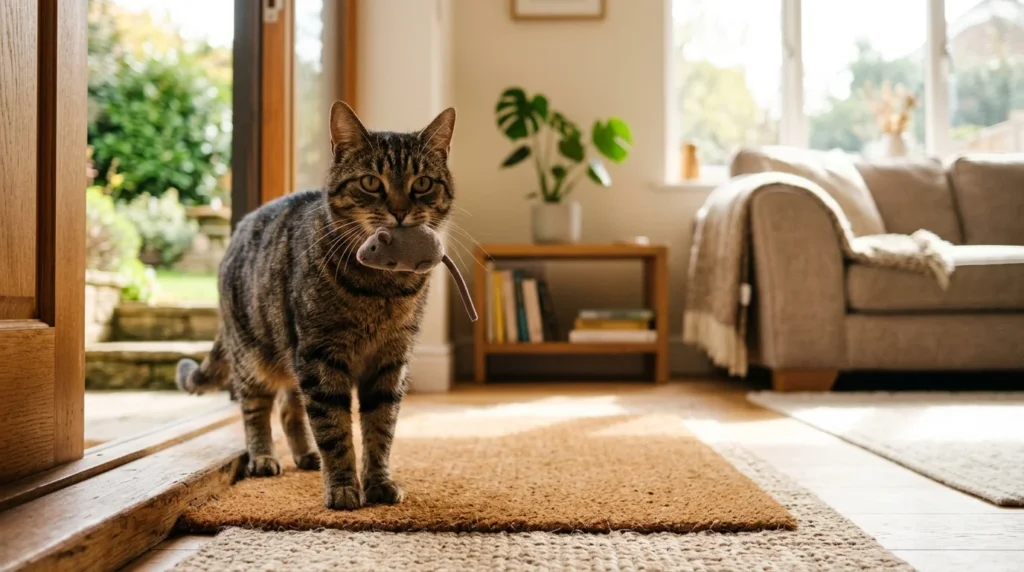
Cats bring dead animals home primarily because of their natural hunting behavior. Your home is a safe and familiar base, and carrying prey there can be part of the natural predatory sequence. The popular idea that cats bring prey to “teach” their owners how to hunt is a plausible theory, but there isn’t enough scientific evidence to treat it as an established fact.
Finding a deceased mouse on your kitchen rug or a songbird placed neatly at your back doorstep is one of the most jarring surprises a feline caregiver can encounter. While humans instinctively view the gesture through a lens of human gifting or morbid confusion, feline predatory drive operates on entirely different biological rules. Much like interpreting why cats purr or discovering why cats knead, understanding why prey ends up at your feet requires observing the entire predatory chain, safe territory caching, and natural instinct.
⚡ Quick Answer: Why Do Cats Bring Dead Animals Home?
Cats are instinctive predators, and bringing caught prey back to a secure home base — which includes you — is consistent with normal denning and caching behavior, regardless of how well-fed they are. While maternal teaching instincts and social excitement may explain why some cats share their catch, it is rarely an intentional “gift.” Keeping cats indoors, using escape-proof enclosures, and providing vigorous interactive play are the most reliable ways to reduce the behavior.
At a Glance: Cat Prey Retrieval Scenarios
| What You Notice | Possible Reason | What to Check |
|---|---|---|
| Brings dead mice or birds regularly | Natural hunting drive and safe caching | Outdoor access and local prey density |
| Vocalizes loudly while carrying prey | Excitement, maternal announcement, or display | Normal acoustic arousal; observe body posture |
| Brings toys instead of real prey | Predatory instinct redirected toward toys | Healthy behavioral outlet for indoor cats |
| Prey looks diseased or mangled | Parasite or rodenticide ingestion risk | Dispose with gloves; monitor cat for signs of toxicity |
| Never brings prey despite roaming outside | Eats prey on-site or lacks strong hunting drive | Normal individual variation among cats |
Understanding Feline Predatory Biology
Domestic felines (Felis catus) evolved as obligate solitary carnivores. In the wild, their ancestral survival depended on executing multiple successful predatory sequences every day — detecting movement, stalking, pouncing, capturing, and delivering the lethal nape bite.
According to veterinary behavioral research published by the Cornell Feline Health Center and clinical studies supported by International Cat Care, a cat’s hunting drive is functionally decoupled from feelings of hunger. Even a cat that has just finished a bowl of premium wet food will reflexively crouch, stalk, and strike if a small creature darts across their peripheral vision. Satiety does not turn off the motor pathways that control hunting.

4 Possible Reasons Behind the “Gifts”
When a cat drops a dead rodent or bird inside your home, feline behaviorists point to four primary interacting motivations:
1. Hunting Instinct
The most straightforward explanation is that predatory motor patterns run on autonomous biological programming. Outdoor and indoor-outdoor cats retain sharp hunting reflexes regardless of how comfortable or well-nourished their domestic life is. Cats do not hunt out of spite, boredom, or cruelty — catching prey is an innate evolutionary behavior.
- Signs: Prey is caught and brought home regularly whenever outdoor access coincides with rodent or avian activity.
- What to do: Recognize that this is natural biology, not bad behavior. Never scold or physically correct your cat for hunting.
- When it’s not just this: If hunting escalates into intense predation on backyard wildlife, management through environmental barriers is necessary.

2. Carrying Prey to a Safe Base
In natural habitats, small wild felids rarely consume captured prey out in open, vulnerable terrain where larger predators (such as coyotes, foxes, or raptors) or rival felines could challenge them. Instead, they retrieve their catch and transport it back to their central safe core — a den, burrow, or sheltered thicket.
For your domestic cat, your house represents that secure core territory. Depositing the prey near the entryway, living room rug, or bedroom doorway is simply the cat returning to their safe base where resources can be examined or eaten without external threat.

3. The Maternal Teaching Theory
In the wild, queen cats teach their weaning kittens how to eat and hunt through a structured developmental progression: first bringing dead prey back to the nest, then bringing stunned or injured prey for kittens to finish off, and finally guiding kittens on live stalks. Some animal writers theorize that spayed female or neutered male domestic cats view their human family members as clumsy, hunting-deficient companions who need provisioning.
While this maternal teaching model is an intriguing and plausible theory, scientific research has not established that domestic cats deliberately view adult humans as surrogate kittens in need of hunting lessons. It is more accurate to view prey-sharing as an expression of maternal instinct or habitual den-caching rather than a calculated pedagogical lesson.
4. Social Display or Excitement
Many caregivers note that their cat delivers prey while emitting loud, muffled, rhythmic vocalizations from behind clamped jaws. Cats may vocalize while carrying prey out of heightened arousal or social announcement. If your feline is generally vocal across different contexts, explore our comprehensive analysis of why cats meow to distinguish between communication types.
This vocalization often reflects intense autonomic excitement. The cat has just completed a thrilling adrenaline-fueled chase and carries the prize to where their social group resides, eager to share the exciting moment.
Is My Cat Actually “Giving Me a Gift”?
It is tempting to project human altruism onto our feline friends. The narrative that a cat brings a dead mouse because they “love you and want to present you with a gift” is heartwarming, but it anthropomorphizes complex predatory behavior. We do not have scientific proof confirming that cats possess the cognitive concept of altruistic gift-giving.
A more grounded perspective is that cats share communal space with humans they trust. Dropping prey near you confirms that you are part of their secure social environment — not a competitor who will steal their food or a predator they need to flee from. While it might not be a literal “present,” it remains a profound demonstration of safety and domestic trust. Notice how this aligns with other affiliative social gestures, such as why cats lick you or why cats sleep on you.
Dead Mice vs. Dead Birds: Is There a Difference?
Caregivers frequently wonder why some cats specialize almost exclusively in rodents while others target songbirds:
Why Does My Cat Bring Me Dead Mice?
Mice and small voles are ground-dwelling, crepuscular rodents that trigger feline acoustic reflexes with high-frequency rustling in grasses or baseboards. Rodents are a cat’s natural primary dietary target. Because rodents freeze and scurry rather than take flight vertically, they are easier to ambush and transport intact without losing feathers or structural integrity.
Why Does My Cat Bring Me Dead Birds?
Hunting birds requires rapid vertical leaps and lightning-fast aerial paw swats. Cats that successfully catch birds often do so around ground feeders, low shrubs, or fledglings learning to fly in springtime. Because feathers detach easily in the mouth, cats often carry deceased birds with an elevated head posture, dropping them quickly onto flat home surfaces.
Why Does My Indoor Cat Bring Me Toys Instead?
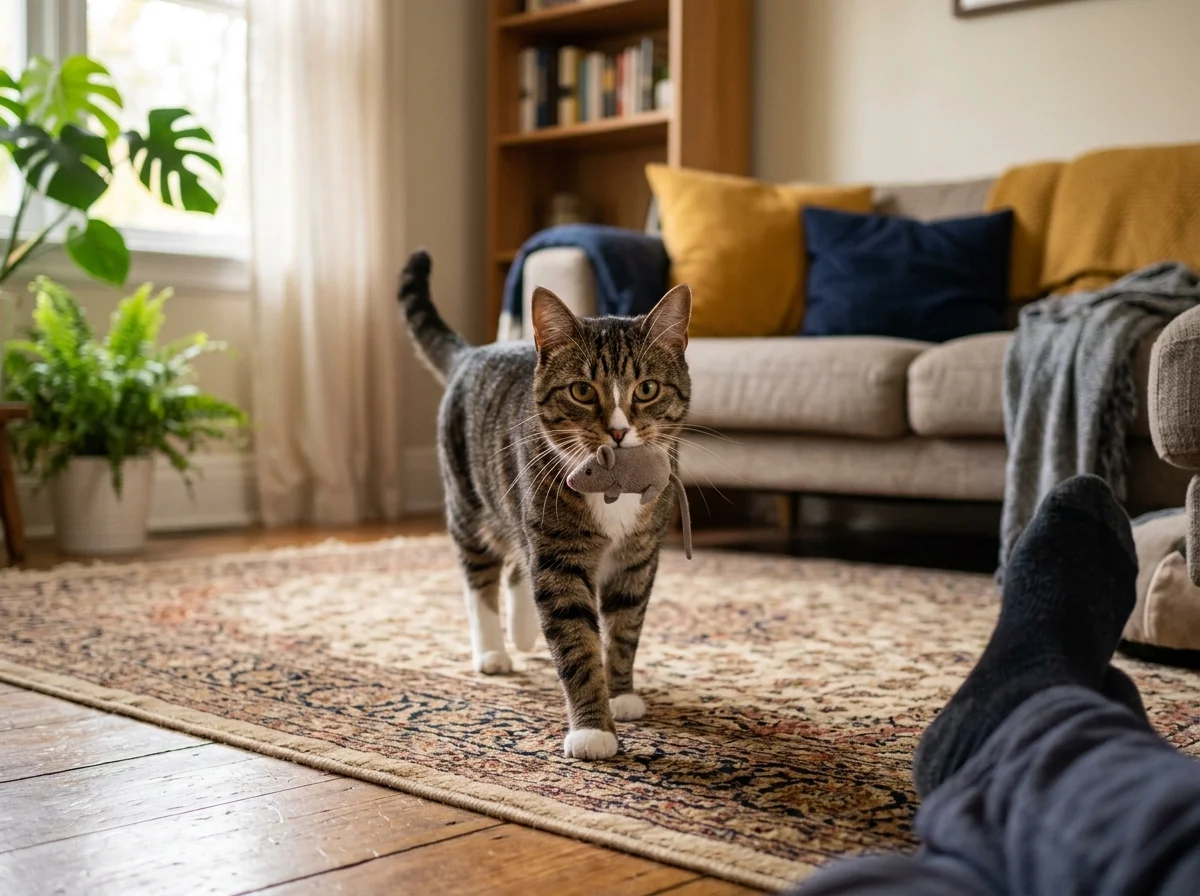
Indoor cats who never set foot outside still possess identical predatory neural circuitry. Deprived of wild rodents and insects, an indoor cat redirects the entire predatory sequence — stalk, chase, capture, and carry — onto small household substitutes: plush catnip mice, foam balls, crinkle toys, or even socks.
When your indoor feline proudly trots down the hallway carrying a plush toy in their mouth and drops it on your bed or lap, they are completing that same innate hunting loop. This is an exceptionally positive behavior; it proves your cat has found a harmless, non-destructive outlet for their evolutionary drive. Learning to read subtle cues in cat body language reveals whether your cat is presenting a finished catch or inviting you to launch a game of fetch.
What Should I Do When My Cat Brings Me a Dead Animal?
Discovering a deceased animal on your carpet demands a measured, hygienic response. Avoid dramatic reactions that undermine trust or spread contamination:
- Stay calm and avoid screaming: Screaming, flailing your arms, or throwing objects terrifies your cat without communicating why you are upset. A frightened cat may bolt and hide the prey in an inaccessible location, like behind the refrigerator.
- Do not scold or punish: Punishing an instinctive behavior is ineffective and damaging to your human-animal bond. A cat cannot connect scolding with the act of hunting that occurred 20 minutes earlier outdoors. Review how punishment backfires in our guide on why cats bite.
- Calmly separate your cat from the prey: Gently distract your cat with a high-value treat or toss an enticing toy in the opposite direction. Close the door to the room while you clean.
- Dispose of the carcass safely: Put on disposable rubber or latex gloves. Use an inverted plastic bag or paper towels to lift the animal, double-bag it tightly, and dispose of it in an outdoor garbage bin.
- Disinfect the floor: Thoroughly sanitize the surrounding flooring with an enzymatic pet-safe disinfectant to neutralize bacteria and bodily fluids. Wash your hands thoroughly with warm water and soap.

Health Risks From Dead Prey: Pathogens and Parasites
Wild prey animals carry an array of biological hazards that can threaten both feline and human household health. Understanding these risks highlights why mitigating outdoor hunting is important:
1. Toxoplasmosis
According to public health resources from the CDC on toxoplasmosis, domestic and wild cats are the sole definitive hosts for Toxoplasma gondii. Cats contract the microscopic parasite by consuming tissue cysts present in infected wild rodents and birds. While infected adult cats rarely show symptoms, they shed millions of infective oocysts in their feces, posing severe health risks to pregnant women and immunocompromised individuals.
2. Secondary Rodenticide Poisoning
One of the gravest threats to hunting cats is secondary poisoning. Property owners and municipal exterminators widely deploy anticoagulant or neurotoxic rodenticides. A poisoned mouse becomes lethargic and disoriented, making it extraordinarily easy prey for a hunting cat. If the cat consumes the poisoned rodent, the toxicant transfers internally.
If you suspect your cat has ingested a poisoned rodent or displays pale gums, lethargy, or bruising, seek immediate veterinary care or contact the ASPCA Animal Poison Control Center immediately.
3. Intestinal Worms and External Parasites
Wild rodents frequently harbor tapeworm larvae (Taenia taeniaeformis) and roundworm cysts, while wild birds carry fleas, ticks, and mites. Cats that regularly capture wildlife require strict, consistent cat parasite prevention protocols to prevent household infestations and intestinal parasite loads.
How to Reduce Hunting Without Punishing Your Cat
Eliminating the predatory drive completely is biologically impossible, but caregivers can dramatically reduce hunting success and protect native wildlife through proactive management:
1. Provide Predatory Wand-Toy Play
Clinical trials conducted by animal welfare organizations demonstrate that dedicating just 10 to 15 minutes twice daily to interactive predatory play — such as feather wands or lure toys — reduces wild prey catches by up to 25%. Moving toys unpredictably lets cats expend pent-up predatory energy safely. Discover proven daily play structures in our guide on how to mentally stimulate an indoor cat.

2. Build a Predictable Routine and Feeding Plan
Research confirms that cats fed meat-rich, premium protein diets capture fewer wild prey animals than cats fed low-protein grain diets. Pairing high-protein nutrition with a structured indoor cat routine keeps energy levels balanced and satisfied.
3. Transition to Safe Outdoor Enclosures (Catios)
Transitioning free-roaming cats to indoor living with access to an escape-proof patio enclosure (catio) or cat-fenced garden is the single most effective way to eliminate wildlife predation. Felines enjoy fresh air, sunshine, and sensory enrichment without endangering songbirds or contracting parasites.

4. Use Quick-Release Bell or Colorful Bird-Safe Collars
If outdoor access cannot be restricted, fitting your cat with a breakaway safety collar equipped with a bell or a bright fabric collar (like the Birdsbesafe ruff) can reduce bird capture rates significantly. Birds possess exceptional color vision and spot bright patterns in time to escape.
Frequently Asked Questions
Why does my cat bring me dead mice?
Mice are a natural primary prey target for domestic felines. When a cat catches a mouse outdoors, they instinctively transport it back to their core home territory where they feel secure from rival predators. Dropping it near you indicates they view your living space as a safe base.
Why does my cat bring me dead birds?
Birds trigger high-intensity stalk and ambush reflexes, particularly near low bushes or bird feeders. Bringing a bird home follows the same caching instinct as mice, bringing the catch back to shelter where feathers and prey can be examined safely.
Does my cat think I’m a bad hunter?
While maternal cats teach kittens how to hunt by provisioning prey, scientific evidence does not confirm that domestic cats view human owners as incompetent hunters. It is more accurate to view prey-sharing as an extension of normal den-caching and predatory arousal rather than a deliberate hunting lesson.
Why does my indoor cat bring me toys instead?
Indoor cats express identical predatory motor circuits by stalking, catching, and retrieving toy mice or socks. Dropping a toy at your feet is a safe, healthy redirection of their hunting drive and often serves as an invitation for interactive play.
Should I punish my cat for bringing me dead animals?
No. Hunting is an instinctual evolutionary behavior, not spiteful misbehavior. Punishing or yelling confuses and frightens your cat without altering their hunting drive. The solution is managing outdoor access and redirecting play to wand toys.
Does my cat expect me to eat what they bring me?
There is no scientific proof that cats expect humans to eat their catch. Carrying prey back to a secure home base is rooted in caching and maternal behavioral patterns rather than a literal culinary offering for their human caregivers.
Final Takeaway
A cat bringing dead prey into your home is following deeply hardwired predatory programming and safe-base denning behavior. Rather than attempting to decode unprovable human-like intent, focus on practical hygiene, safe handling, and providing rich interactive indoor play to redirect their instincts. Continue exploring our feline communication and behavioral care guides to foster a harmonious household:
- Why Does My Cat Meow So Much? 9 Reasons + What to Do
- Indoor Cat Routine: Real Schedules for Home-Alone Cats
- How to Mentally Stimulate Indoor Cats: Proven Daily Routines
- Cat Body Language Guide: What Your Cat Is Actually Telling You
- Parasite Prevention for Indoor Cats: What Is Necessary
- Why Does My Cat Purr? What Different Purrs Mean
- Why Does My Cat Knead Me? Causes & Behavioral Meaning
- Why Does My Cat Lick Me? 7 Reasons Cats Lick Their Owners
- Why Does My Cat Bite Me? Types of Cat Bites Explained
- Why Does My Cat Sleep on Me? 5 Reasons & What It Means
- Why Does My Cat Sit on My Chest? What It Means
- Why Is My Cat Hiding? Normal vs. Concerning Reasons
🐾 Explore More Cat Behavior & Care Guides
Help your feline thrive with our hands-on tested guides and behavioral solutions: